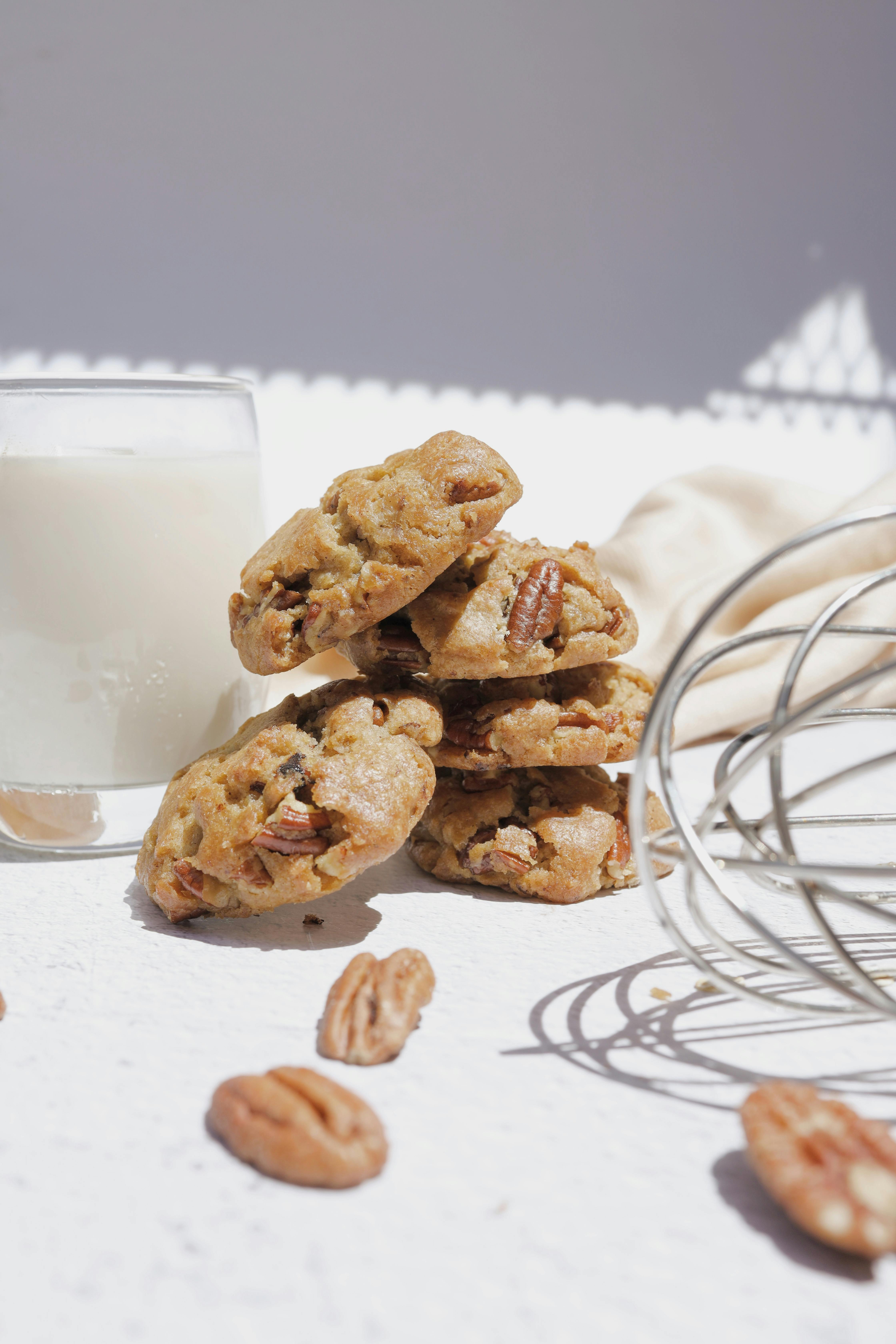
Photo: Meraki Photos / Pexels
American
Pecan Praline
The diets react (see scores below)
Common Ingredients
- pecans
- sugar
- butter
- water
- vanilla extract
- salt
Specific recipes may vary.
Incompatible with 11 of 11 diets
Diet Ratings
Pecan praline is fundamentally incompatible with ketogenic eating due to its primary ingredient being sugar, which is the main structural and flavor component of the candy. A standard serving (1-2 pieces, ~30g) contains roughly 20-25g of net carbs almost entirely from refined sugar, which alone can exceed or exhaust an entire day's keto carb budget. While pecans themselves are keto-friendly (high fat, low net carbs), the sugar coating transforms them into a high-glycemic confection that would immediately disrupt ketosis. The butter and pecans are keto-appropriate, but they are minor players in a sugar-dominant dish.
Pecan Praline as listed contains butter, which is a dairy product derived from cow's milk and is unambiguously non-vegan. This single ingredient disqualifies the dish from vegan compliance regardless of all other ingredients. Pecans, sugar, water, vanilla extract, and salt are all plant-based, so a vegan version of pecan praline is achievable by substituting butter with a plant-based alternative such as vegan margarine or coconut oil.
Pecan Praline contains multiple non-paleo ingredients that disqualify it clearly. Refined sugar is a primary ingredient and is explicitly excluded from the paleo diet as a processed, modern food with no hunter-gatherer equivalent. Butter is a dairy product, excluded under strict paleo guidelines. Salt (added) is also discouraged. While pecans and vanilla extract are paleo-approved, the overall dish is a heavily processed, sugar-laden confection that fundamentally contradicts paleo principles. The combination of refined sugar, dairy butter, and added salt makes this an unambiguous avoid.
Pecan Praline is a candy confection that fundamentally contradicts Mediterranean diet principles. While pecans are a healthy nut that would otherwise be encouraged, the dominant ingredients here are sugar and butter — significant added sugar and saturated fat — which transform the nuts into a high-sugar, processed sweet. Added sugars and butter-based confections are precisely the category of foods the Mediterranean diet minimizes. This is an American candy treat with no place as a regular food in the Mediterranean dietary pattern.
Pecan Praline is entirely incompatible with the carnivore diet. The dish is dominated by plant-derived and processed ingredients: pecans (a nut — explicitly excluded), sugar (processed plant-derived sweetener), vanilla extract (plant-derived), and water. The only marginally carnivore-adjacent ingredient is butter, but it is a minor component in a dessert that is fundamentally a plant-based confection. There is no animal protein, no ruminant meat, no fish, no eggs — nothing that forms the foundation of carnivore eating. Sugar alone is an automatic disqualifier, as is the nut base. This scores a 1 because virtually the entire dish violates carnivore principles at the most basic level.
Pecan Praline contains multiple excluded ingredients. Sugar is explicitly banned on Whole30 as an added sugar. Regular butter (not ghee or clarified butter) is also excluded under the dairy rule. These are not edge cases — both are clearly and unambiguously prohibited by the official Whole30 program. The pecans, vanilla extract, salt, and water would be fine on their own, but the sugar and butter disqualify this dish entirely.
Pecan praline contains ingredients that are individually low-FODMAP (sugar, butter, water, vanilla extract, salt), but pecans are the key variable. Monash University rates pecans as low-FODMAP at a serving of 10 pecan halves (approximately 20g), but high-FODMAP at larger servings due to excess fructose accumulation. A standard pecan praline serving typically contains a generous amount of pecans, and the candy-style preparation encourages eating multiple pieces, which can easily push total pecan intake above the safe threshold. Sugar (sucrose) itself is not a FODMAP concern at normal amounts. Butter is low-FODMAP. Vanilla extract in small culinary amounts is safe. The dish as a whole is borderline — one small praline piece may be manageable, but typical snacking portions risk exceeding the pecan serving limit.
Monash University considers pecans low-FODMAP at 10 pecan halves, but many clinical FODMAP practitioners apply caution because praline candy encourages multiple servings and the per-piece pecan count varies widely by recipe, making it difficult to control intake during the strict elimination phase.
Pecan praline is a candy confection that is fundamentally incompatible with DASH diet principles. The dominant ingredients are sugar and butter, making it extremely high in added sugar and saturated fat — both of which DASH explicitly limits. While pecans themselves are a DASH-approved food (nuts are encouraged in moderation, about 4-5 servings per week), they are encased here in a sugar-and-butter matrix that transforms them into a sweet confection. DASH guidelines specifically call for limiting sweets and added sugars, and butter is a source of saturated fat that DASH discourages. A single praline can contain 15-20g of added sugar and significant saturated fat per serving, far exceeding DASH-appropriate amounts for a snack. The salt adds minimal nutritional benefit in this context. This falls squarely in the 'sweets' category that DASH limits to fewer than 5 servings per week of small portions, and even then, lower-sugar options are preferred.
Pecan praline is dominated by sugar as its primary carbohydrate source — pure sucrose, which is extremely high-glycemic and nutritionally empty. While pecans themselves are an excellent Zone food (rich in monounsaturated fat and favorable in the fat block system), in praline they are subordinate to a sugar-and-butter candy matrix. The dish has no protein, making it impossible to construct a Zone-balanced block ratio. The carbohydrate load is almost entirely from refined sugar, which Dr. Sears consistently identifies as one of the worst foods for hormonal balance and eicosanoid dysregulation. The butter adds saturated fat without the benefit of monounsaturated fat predominance. There is no fiber to offset the glycemic hit. Even in small portions, pecan praline delivers a sharp insulin spike with no protein or fiber buffer, directly opposing the Zone's core objective of controlling insulin. This is one of the rare foods that is genuinely very difficult to incorporate into any Zone-balanced meal or snack.
Pecan praline is a candy confection where the anti-inflammatory benefits of pecans are heavily outweighed by large amounts of added sugar and butter. Pecans themselves are a genuinely beneficial nut — rich in monounsaturated fats, polyphenols, manganese, and vitamin E, with research linking them to reduced LDL oxidation and lower inflammatory markers. However, in a praline, pecans are bound in a caramelized sugar shell made primarily of refined sugar and butter. Added sugar is one of the most well-established pro-inflammatory dietary components, directly elevating CRP, IL-6, and triglycerides, and feeding AGE (advanced glycation end-product) formation — particularly relevant here since the sugar is cooked to high temperatures (caramelization). Butter contributes saturated fat, which in excess is associated with increased inflammatory signaling. The vanilla and salt are nutritionally negligible at these quantities. As an occasional indulgence the damage is limited, but as a snack this dish is structurally a sugar-and-saturated-fat delivery vehicle with a thin veneer of nut nutrition. There is no meaningful anti-inflammatory case to be made for it.
Pecan praline is a candy confection that is nearly the opposite of what GLP-1 patients need. It is dominated by sugar and butter, delivering high amounts of refined sugar and saturated fat with negligible protein and minimal fiber. The caloric density is extremely high while nutritional value per calorie is extremely low — a critical problem for patients eating significantly reduced volumes of food. The high sugar content risks blood sugar spikes, and the high fat content (butter plus pecans) worsens GLP-1 side effects including nausea, bloating, and reflux. While pecans do contain some unsaturated fat and trace minerals, the overall food matrix of this candy negates any benefit. As a snack category item, it fails on virtually every GLP-1 dietary priority: no meaningful protein, low fiber, high sugar, high saturated fat, poor digestibility, and empty calories.
*See how scores were generated at our methodology page.
Nutritional profile
Six traits that cut across every diet.
Fiber & Plants
How much whole-plant food and fiber it delivers.
Healthy Fats
The quality of its fats (unsaturated, omega-3).
Whole / Unprocessed
How close it is to its natural, unprocessed form.
Gut Gentle
How easy it is on digestion (low FODMAP, few irritants).
Low Glycemic
How little it spikes your blood sugar.
Protein Density
How much protein it packs per calorie.
Controversy Index
Higher controversy = more disagreement between diets.