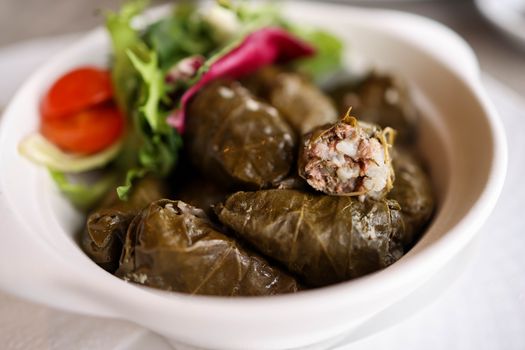
Photo: Valeria Boltneva / Pexels
The diets react (see scores below)
Common Ingredients
- grape leaves
- ground beef
- rice
- parsley
- dill
- mint
- split peas
- onion
Specific recipes may vary.
Incompatible with 6 of 11 diets
Diet Ratings
Dolmeh is fundamentally incompatible with a ketogenic diet. The dish contains rice as a primary ingredient, which is a high-carb grain that alone can exceed an entire day's keto carb budget in a single serving. Split peas add additional significant net carbs (roughly 15-20g per half cup). Even grape leaves themselves contain some carbs. Combined, a typical serving of dolmeh could easily deliver 40-60g+ of net carbs, making ketosis impossible to maintain. The ground beef is keto-friendly, and herbs like parsley, dill, and mint are fine, but the foundational starchy ingredients (rice, split peas) disqualify this dish entirely.
Dolmeh contains ground beef as the primary protein, which is a direct animal product. This immediately disqualifies the dish from vegan compliance. While the remaining ingredients — grape leaves, rice, parsley, dill, mint, split peas, and onion — are all fully plant-based, the inclusion of beef makes the dish incompatible with a vegan diet. A vegan version of dolmeh is achievable by substituting the beef with additional legumes, mushrooms, or plant-based ground meat, but as presented this dish must be avoided.
Dolmeh contains two clear paleo violations: rice (a grain) and split peas (a legume). Both are explicitly excluded from the paleo diet by all major authorities including Loren Cordain, Mark Sisson, and Robb Wolf. Rice is a grain high in anti-nutrients and not available in the form consumed today to Paleolithic hunter-gatherers, while split peas are legumes containing lectins and phytates. The remaining ingredients — ground beef, grape leaves, parsley, dill, mint, and onion — are fully paleo-compliant, but the presence of two core 'avoid' ingredients disqualifies the dish as a whole.
Dolmeh is a dish with both Mediterranean-friendly and less ideal elements. The grape leaves, fresh herbs (parsley, dill, mint), split peas, and onion are excellent plant-based components strongly aligned with Mediterranean principles. However, ground beef as the primary protein is a red meat that the Mediterranean diet recommends limiting to only a few times per month. White rice is a refined grain, less preferred than whole grains in modern Mediterranean guidelines. The combination results in a dish that has a solid plant-forward foundation but is held back by the red meat component. If consumed occasionally and in moderate portions, it fits within the broader Mediterranean pattern, but it is not a staple dish due to the beef.
Some Mediterranean diet interpretations, particularly those drawing from traditional Middle Eastern and Eastern Mediterranean cuisines, acknowledge that stuffed grape leaf dishes are culturally embedded in the region and often made with lamb or beef mixed with abundant herbs and legumes, making the overall dish more plant-forward than its protein label suggests. Traditional Greek dolmades and similar dishes across the Levant and Persia are seen by some practitioners as acceptable within the diet's spirit when beef is used sparingly as a flavoring rather than a dominant component.
Dolmeh is almost entirely incompatible with the carnivore diet. While it contains ground beef as the primary protein, the beef is heavily mixed with and wrapped in numerous plant-based ingredients: grape leaves, rice, parsley, dill, mint, split peas, and onion. Every one of these is explicitly excluded on a carnivore diet. Grape leaves are plant matter, rice is a grain, parsley/dill/mint are herbs, split peas are legumes, and onion is a vegetable. The ground beef itself cannot be separated from these ingredients in the dish as prepared. This dish is essentially a plant-forward recipe that uses meat as a minor component within a predominantly plant-based preparation.
Dolmeh contains two excluded ingredients: rice (a grain, explicitly excluded on Whole30) and split peas (a legume, explicitly excluded on Whole30). These are core structural ingredients of the dish, not optional additions, making the dish incompatible with the Whole30 program regardless of the other compliant ingredients (grape leaves, ground beef, parsley, dill, mint, onion are all fine).
Dolmeh contains multiple high-FODMAP ingredients that make it unsuitable during the elimination phase. Onion is one of the highest-FODMAP foods due to fructans and is problematic even in small amounts. Split peas are high in GOS (galacto-oligosaccharides) and are not safe during elimination. Together, these two ingredients alone would disqualify the dish. Grape leaves themselves have limited Monash testing but are generally considered low-FODMAP in typical serving amounts. Ground beef, rice, parsley, dill, and mint are all low-FODMAP and safe. However, the combination of onion and split peas makes this dish clearly high-FODMAP at any realistic serving size.
Dolmeh (Persian stuffed grape leaves) contains a mixed nutritional profile from a DASH perspective. The dish includes several DASH-friendly components: fresh herbs (parsley, dill, mint) rich in potassium and micronutrients, split peas providing fiber and plant-based protein, rice as a grain, and onion as a vegetable. Grape leaves themselves are low in calories and sodium when fresh or properly rinsed. However, the primary protein is ground beef, which is a red meat DASH guidelines recommend limiting due to saturated fat content. The DASH diet does not exclude lean ground beef entirely but recommends limiting red meat to no more than a few servings per week and choosing lean cuts (≤93% lean). The overall dish can be moderate in sodium depending on preparation — jarred/brined grape leaves can be high in sodium, while fresh or well-rinsed leaves reduce this concern significantly. The combination of plant-forward ingredients with a moderate portion of lean ground beef makes this a 'caution' dish — acceptable occasionally and improvable by substituting ground turkey or chicken, using fresh/rinsed grape leaves, and opting for brown rice.
NIH DASH guidelines clearly limit red meat and recommend lean poultry or fish as preferred proteins, placing ground beef in a restricted category. However, updated clinical interpretations note that lean ground beef (≥90% lean) in modest portions within an otherwise plant-rich meal pattern may be compatible with DASH goals — especially when the overall dish is rich in fiber, herbs, and legumes as in this recipe.
Dolmeh is a mixed dish with both Zone-favorable and Zone-unfavorable components. The grape leaves themselves are favorable — they are low-calorie, low-glycemic wrappers rich in polyphenols. The fresh herbs (parsley, dill, mint) and onion are excellent Zone carbohydrate choices, low-glycemic and anti-inflammatory. Split peas are a moderate-glycemic legume that provide both protein and carbohydrate blocks, acceptable in Zone but requiring careful accounting. However, the two primary problematic ingredients are rice (a high-glycemic, unfavorable carb in Zone methodology) and ground beef (which, depending on fat content, may carry more saturated fat than Zone's lean protein preference). The combination of rice and split peas creates a significant carbohydrate load that is difficult to balance to the 40/30/30 ratio within a standard serving. Traditional dolmeh portions are relatively small, which does help. If the recipe uses minimal rice and lean ground beef (90%+ lean), the dish becomes more manageable, but as typically prepared, the carbohydrate density skews high and the protein-to-carb ratio is off. Portioning 2-3 dolmeh alongside a green salad and lean protein supplement could bring a meal closer to Zone compliance.
Some Zone practitioners would be more lenient here, noting that Dr. Sears' later work emphasizes polyphenol-rich, anti-inflammatory foods — and dolmeh's herb-heavy, grape-leaf-wrapped profile with split peas aligns with that philosophy. The dish has no processed ingredients, uses whole foods throughout, and the rice quantity per individual piece is small. A stricter Zone reading would focus on the unfavorable carb rating of white rice and the potential saturated fat in ground beef, keeping this firmly in caution territory.
Persian Dolmeh presents a genuinely mixed anti-inflammatory profile. On the positive side, the dish contains several strongly anti-inflammatory components: fresh herbs (parsley, dill, mint) are rich in polyphenols, flavonoids, and antioxidants; grape leaves themselves contain quercetin and resveratrol-related polyphenols and are used in traditional medicine for their anti-inflammatory properties; split peas are a legume providing fiber and plant protein that support a healthy gut microbiome and reduce inflammatory markers; and onion contributes quercetin. The use of rice provides a whole-food carbohydrate base, though white rice is relatively neutral. The primary concern is ground beef as the main protein. Red meat is a 'limit' food in anti-inflammatory frameworks due to its saturated fat content and arachidonic acid, which is a precursor to pro-inflammatory eicosanoids. However, the beef is diluted significantly by the rice, legumes, and herbs, and the overall saturated fat load per serving is moderate. If leaner ground beef is used, the concern is further reduced. This dish is better than a straight beef dish and worse than one using fish or poultry — it lands squarely in the 'caution/moderate' category. Preparing with leaner beef or substituting lamb (traditional) for turkey or lentils would shift the profile closer to approval.
Some anti-inflammatory practitioners, particularly those following Dr. Weil's Mediterranean-influenced framework, might view this dish more favorably given the herb density, legumes, and grape leaves, rating it as acceptable or even mildly beneficial overall — especially if the beef portion is small relative to the filling. Conversely, stricter anti-inflammatory or autoimmune protocol (AIP) advocates would flag both red meat and white rice as inflammatory drivers and recommend avoiding the dish or substantially reformulating it.
Dolmeh (Persian stuffed grape leaves) is a mixed-profile dish for GLP-1 patients. On the positive side, it contains meaningful protein from ground beef, fiber from split peas, herbs, and grape leaves, and the overall portion size per piece is naturally small — fitting GLP-1 small-meal patterns well. The fresh herbs (parsley, dill, mint) add micronutrients with negligible calories. Split peas contribute both protein and soluble fiber, which supports digestion and blood sugar stability. However, ground beef introduces saturated fat that can worsen GLP-1 GI side effects (nausea, bloating, reflux), and white rice is a refined carbohydrate with low fiber and protein density per calorie, diluting the nutritional profile. The dish is not fried and not heavily spiced, which works in its favor for digestibility. Overall, this is an acceptable occasional choice — especially if made with leaner ground beef (93%+ lean) and modest rice portions — but it is not an optimized GLP-1 meal due to saturated fat content and the rice-heavy filling reducing protein-per-calorie density.
Some GLP-1-focused dietitians may rate this more favorably given its whole-food ingredients, natural small serving size, and fiber contribution from split peas and grape leaves — particularly compared to other cultural beef dishes. Others caution that even moderate saturated fat from ground beef can disproportionately trigger nausea and slowed-emptying discomfort in GLP-1 patients, making lean protein substitutions (ground turkey, lentils) worth recommending.
*See how scores were generated at our methodology page.
Nutritional profile
Six traits that cut across every diet.
Fiber & Plants
How much whole-plant food and fiber it delivers.
Healthy Fats
The quality of its fats (unsaturated, omega-3).
Whole / Unprocessed
How close it is to its natural, unprocessed form.
Gut Gentle
How easy it is on digestion (low FODMAP, few irritants).
Low Glycemic
How little it spikes your blood sugar.
Protein Density
How much protein it packs per calorie.
Controversy Index
Higher controversy = more disagreement between diets.
Diet-Specific Tips
 Mediterranean — 5/10
View tips
- Ground beef is a red meat, recommended only a few times per month in Mediterranean diet
- Grape leaves are a traditional Mediterranean ingredient and nutrient-rich wrapper
- Split peas and fresh herbs (parsley, dill, mint) add strong plant-based nutritional value
- White rice is a refined grain, less preferred over whole grains in modern guidelines
- Dish has Persian roots with parallels to Eastern Mediterranean stuffed grape leaf traditions
- Overall plant-to-meat ratio is reasonable, mitigating some concerns about the beef
 DASH — 5/10
View tips
- Ground beef is a red meat limited by DASH guidelines due to saturated fat
- Split peas add significant fiber, plant protein, and potassium — all DASH-positive
- Fresh herbs (parsley, dill, mint) contribute potassium, magnesium, and micronutrients
- Jarred/brined grape leaves can be high in sodium — rinsing or using fresh leaves is critical
- Rice is acceptable as a grain; brown rice would improve whole-grain content
- Overall dish is plant-forward, which partially offsets the red meat concern
- Substituting ground turkey or chicken would elevate this to an 'approve' rating
 Zone — 5/10
View tips
- Grape leaves are a Zone-favorable, low-glycemic, polyphenol-rich wrapper
- Rice is an unfavorable high-glycemic carbohydrate in Zone methodology
- Split peas contribute moderate-glycemic carbs plus some protein — require dual accounting
- Fresh herbs (parsley, dill, mint) are excellent Zone carb choices
- Ground beef fat content is variable; leaner versions (90%+) align better with Zone lean protein rules
- Traditional portion sizes are small, which helps manage carbohydrate load
- No trans fats or processed ingredients — anti-inflammatory profile is solid
- Rice + split peas together create carbohydrate stacking that challenges 40/30/30 balance
 Anti-Inflammatory — 5/10
View tips
- Ground beef (red meat) is a 'limit' food due to saturated fat and arachidonic acid content
- Grape leaves contain quercetin and polyphenols with anti-inflammatory properties
- Parsley, dill, and mint are rich in flavonoids and antioxidants — strongly anti-inflammatory
- Split peas (legume) contribute fiber, plant protein, and gut-supportive prebiotic content
- Onion provides quercetin, a well-studied anti-inflammatory flavonoid
- White rice is neutral — neither strongly pro- nor anti-inflammatory
- Beef is diluted by plant-based ingredients, moderating the overall inflammatory load
- Overall dish is Mediterranean-adjacent in character — moderate profile
 GLP-1 Friendly — 5/10
View tips
- Ground beef adds saturated fat — a known GLP-1 GI side effect trigger
- Split peas provide meaningful fiber and supplemental plant protein
- White rice is a refined carbohydrate that reduces nutrient density per calorie
- Naturally small per-piece portion fits GLP-1 small-meal eating pattern
- No frying, minimal spice — digestibility is reasonable
- Fresh herbs add micronutrient value with negligible caloric cost
- Protein per serving is moderate but not high — depends heavily on beef-to-rice ratio