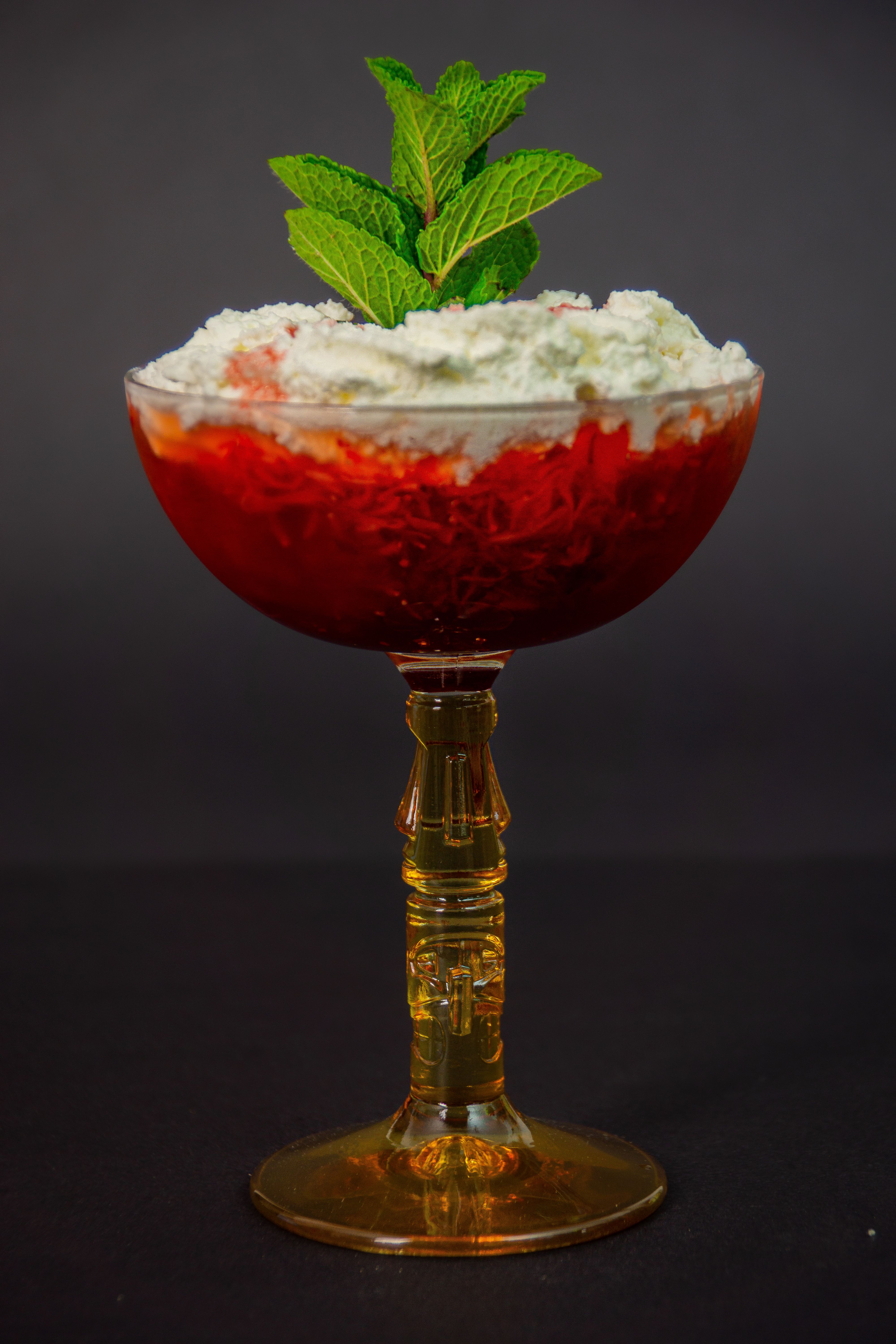
Photo: omer havivi / Pexels
The diets react (see scores below)
Common Ingredients
- rice vermicelli
- sugar
- rose water
- lime juice
- water
- cornstarch
Specific recipes may vary.
Incompatible with 8 of 11 diets
Diet Ratings
Faloodeh is a Persian frozen dessert that is fundamentally incompatible with ketogenic eating. It is built on rice vermicelli (high-carb refined grain), a sugar syrup, and cornstarch as a thickener — three major keto-disqualifying ingredients stacked together. A single serving would deliver an enormous net carb load (likely 40–70g+), completely blowing the daily 20–50g keto budget in one snack. Rose water and lime juice are the only keto-neutral components. There is no meaningful fat content and no protein to partially offset the carb impact. No portion adjustment can make this dish keto-compatible; its entire structure relies on carbohydrate-dense ingredients.
Faloodeh is a traditional Persian frozen dessert made entirely from plant-based ingredients. Rice vermicelli, sugar, rose water, lime juice, water, and cornstarch are all derived from plants or are non-animal in origin. There are no animal products, animal-derived ingredients, or contested components in this formulation. It is a relatively minimally processed dish using whole or near-whole food ingredients, which earns it a high score within the approve range.
Faloodeh is a Persian frozen dessert that contains multiple non-paleo ingredients. Rice vermicelli is a grain-based product (rice is a grain excluded from the paleo diet). Refined sugar is explicitly excluded as a processed, refined sweetener. Cornstarch is derived from corn, another excluded grain. While rose water and lime juice are paleo-compatible, and water is neutral, the foundational ingredients of this dish — rice noodles, refined sugar, and cornstarch — are all clear paleo violations. There is no meaningful way to make a traditional Faloodeh paleo-compliant without fundamentally reconstructing the dish.
Faloodeh is a Persian frozen dessert made primarily from refined rice vermicelli, added sugar, and starch — all of which directly contradict Mediterranean diet principles. The dish is essentially a sweetened, refined-carbohydrate dessert with no meaningful fiber, healthy fats, or micronutrients. Added sugar is one of the foods most strongly discouraged in Mediterranean eating patterns, and refined starch-based noodles offer none of the benefits of whole grains. Rose water and lime juice are innocuous but contribute nothing nutritionally significant. There is no olive oil, no plant-forward whole-food base, no legumes, and no redeeming Mediterranean-aligned component.
Faloodeh is a Persian frozen dessert made entirely from plant-derived and processed ingredients. Rice vermicelli (grain), sugar (processed sweetener), rose water (plant extract), lime juice (fruit), and cornstarch (grain derivative) are all explicitly excluded on a carnivore diet. There is no animal-derived ingredient whatsoever in this dish. It represents the antithesis of carnivore eating: a high-carbohydrate, sugar-laden, plant-based dessert with zero nutritional value from an animal-product standpoint.
Faloodeh contains multiple excluded ingredients that make it clearly non-compliant with Whole30. Rice vermicelli is a grain-based noodle (rice = excluded grain), sugar is explicitly excluded as an added sugar, and cornstarch is specifically called out as an excluded ingredient in the Whole30 rules. Any one of these three ingredients alone would disqualify the dish; together they make it unambiguously off-limits.
Faloodeh is a Persian frozen dessert made from thin rice vermicelli noodles set in a sugar syrup flavored with rose water and lime juice. Examining each ingredient: rice vermicelli is a gluten-free grain product that is low-FODMAP per Monash University testing; sugar (sucrose) is low-FODMAP at normal amounts; rose water is low-FODMAP as it contains no significant FODMAPs; lime juice is low-FODMAP at standard servings (up to 1 tablespoon, and moderate use in a dessert is unlikely to exceed this); water is FODMAP-free; and cornstarch is low-FODMAP. None of the ingredients are known high-FODMAP triggers. The main concern is the total sugar load — sucrose itself is not a FODMAP, but very large quantities could theoretically contribute to osmotic symptoms in sensitive individuals, though this is not a FODMAP-specific issue. Overall, Faloodeh is a genuinely low-FODMAP dessert with no significant FODMAP-containing ingredients at standard serving sizes.
Some clinical FODMAP practitioners may flag rose water as a caution ingredient due to limited formal Monash University testing data, though there is no known FODMAP content in distilled floral waters. Lime juice at larger quantities (beyond a tablespoon or two) can become borderline due to fructose content, so a very generously lime-flavored portion warrants awareness.
Faloodeh is a Persian frozen dessert made primarily of rice vermicelli, sugar syrup, and rose water. While it is low in sodium, saturated fat, and cholesterol — which aligns with some DASH principles — it is essentially a high-added-sugar dessert with negligible nutritional value. DASH guidelines explicitly limit sweets and added sugars (no more than 5 servings per week of sweets, and even those should be low-fat). The primary ingredients here are refined starch (rice vermicelli) and sugar, contributing empty calories with no meaningful potassium, calcium, magnesium, fiber, or protein — the nutrients DASH emphasizes. The lime juice provides a negligible amount of vitamin C but does not redeem the dish nutritionally. It can be consumed occasionally in strict portion control, as it does not carry the sodium or saturated fat penalties of other 'avoid' foods, but it is not a DASH-friendly food and should be treated as a rare treat.
Faloodeh is a Persian frozen dessert made almost entirely of high-glycemic, nutritionally empty carbohydrates: rice vermicelli (refined starch), sugar, and cornstarch. It provides essentially no protein, no meaningful fat, and no fiber. From a Zone perspective, this dish is a macronutrient disaster — it delivers a massive carbohydrate spike with zero balancing protein or fat blocks. Sugar and refined starch are among the most 'unfavorable' carbohydrate sources in Zone terminology, driving rapid insulin release and eicosanoid imbalance, which is precisely what the Zone Diet is designed to prevent. There is no realistic way to portion this dish into a Zone-compliant meal without essentially eliminating the dish itself, as its entire character is built around ingredients Zone explicitly discourages. The lime juice and rose water contribute negligible nutritional value. Unlike most foods that can fit with careful portioning, Faloodeh's composition — pure sugar plus refined starch with no redeeming macronutrient balance — places it firmly in the 'avoid' category alongside candy and soda.
Faloodeh is a Persian frozen dessert composed almost entirely of refined carbohydrates and added sugar. The base is rice vermicelli (refined starch) suspended in a sugar syrup thickened with cornstarch, flavored with rose water and lime juice. While rose water and lime juice offer trace polyphenols and vitamin C, they appear in negligible amounts relative to the overall composition. The dish provides no meaningful anti-inflammatory components — no fiber, no omega-3s, no antioxidant-rich ingredients, no healthy fats. Sugar is the dominant macronutrient calorie source. High added sugar intake is directly linked to elevated inflammatory markers including CRP and IL-6, promotes oxidative stress, and is consistently flagged as pro-inflammatory across all major anti-inflammatory dietary frameworks. Refined starches (white rice vermicelli, cornstarch) have a high glycemic load, causing rapid blood glucose spikes that further drive inflammatory pathways. Rose water contains minor phenolic compounds, but at culinary quantities used here, this provides no meaningful anti-inflammatory offset. As an occasional cultural indulgence, it is less harmful than heavily processed desserts, but its nutritional profile is fundamentally pro-inflammatory.
Faloodeh is a Persian frozen dessert made primarily of sugar, rice vermicelli, and rose water — offering virtually no protein, negligible fiber, and a high sugar load. For GLP-1 patients, this is a near-ideal example of empty calories: it provides rapid-digesting refined carbohydrates and added sugar with minimal nutritional return per calorie. The reduced appetite that GLP-1 medications create makes every calorie count critically, and faloodeh offers almost no protein (zero), no meaningful fiber, and no micronutrient density. The high sugar content works directly against blood sugar stabilization, which is a core goal for most GLP-1 patients (many of whom have type 2 diabetes or prediabetes). While the dish is low in fat and relatively light in texture — which would normally be positives for digestibility — those attributes do not redeem its nutritional profile. The lime juice and rose water contribute negligible benefits. Small occasional portions might not be catastrophic, but there is no meaningful argument for including this in a GLP-1-friendly eating pattern.
*See how scores were generated at our methodology page.
Nutritional profile
Six traits that cut across every diet.
Fiber & Plants
How much whole-plant food and fiber it delivers.
Healthy Fats
The quality of its fats (unsaturated, omega-3).
Whole / Unprocessed
How close it is to its natural, unprocessed form.
Gut Gentle
How easy it is on digestion (low FODMAP, few irritants).
Low Glycemic
How little it spikes your blood sugar.
Protein Density
How much protein it packs per calorie.
Controversy Index
Higher controversy = more disagreement between diets.
Diet-Specific Tips
 Vegan — 9/10
View tips
- Rice vermicelli is plant-based (made from rice starch)
- Sugar is vegan as listed (no bone char qualification needed at ingredient level)
- Rose water and lime juice are fully plant-derived
- Cornstarch is a plant-based thickener
- No animal products, dairy, eggs, gelatin, or honey present
- Simple, traditional preparation with minimal processing
 Low-FODMAP — 8/10
View tips
- Rice vermicelli is a low-FODMAP gluten-free grain noodle
- Sugar (sucrose) is not a FODMAP and is safe at normal dessert quantities
- Rose water contains no known FODMAPs but has limited formal Monash testing
- Lime juice is low-FODMAP at standard culinary amounts (up to ~1 tbsp per serving)
- Cornstarch is low-FODMAP
- No high-FODMAP ingredients such as wheat, dairy, onion, garlic, or stone fruit present
 DASH — 4/10
View tips
- High added sugar content from sugar syrup — DASH limits sweets
- Refined starch (rice vermicelli, cornstarch) with no fiber
- No meaningful potassium, calcium, magnesium, or protein
- Very low sodium — a positive attribute
- No saturated fat or cholesterol — a positive attribute
- Essentially an empty-calorie dessert not emphasized by DASH
- Occasional small portions may be acceptable within DASH's 5 sweets/week allowance