Photo: Valeria Boltneva / Pexels
The diets react (see scores below)
Common Ingredients
- ground beef
- potatoes
- onion
- eggs
- breadcrumbs
- turmeric
- garlic
- oil
Specific recipes may vary.
Incompatible with 8 of 11 diets
Diet Ratings
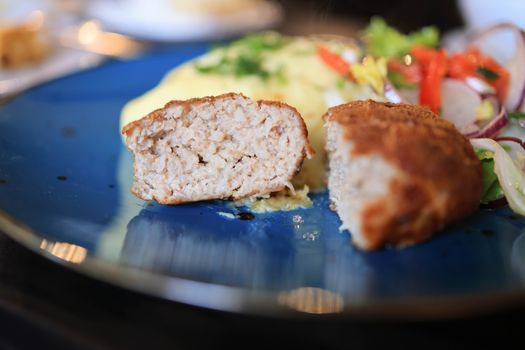
Kotlet is a Persian meat patty that contains two major keto-incompatible ingredients: potatoes and breadcrumbs. Potatoes are a high-starch vegetable with roughly 15-17g net carbs per 100g, and breadcrumbs add additional grain-based carbohydrates. Together, these ingredients make a standard kotlet serving easily exceed the entire daily net carb limit for ketosis. While ground beef and eggs are excellent keto foods, and turmeric, garlic, and onion are used in small amounts, the structural carb load from potatoes and breadcrumbs cannot be offset. This dish is fundamentally incompatible with a ketogenic diet in its traditional form.
Kotlet is a Persian meat patty containing ground beef and eggs — both are animal products strictly excluded from a vegan diet. Ground beef is mammalian flesh, and eggs are an animal-derived ingredient. There is no ambiguity here; this dish is fundamentally non-vegan in its core composition.
Kotlet contains two clear paleo violations: breadcrumbs (made from wheat, a grain explicitly excluded from the paleo diet) and an unspecified oil that is most likely a seed oil (canola, vegetable, or sunflower) commonly used in Persian cooking. These are non-negotiable exclusions with strong paleo consensus. Potatoes are debated but even setting that aside, the breadcrumbs alone disqualify the dish. The remaining ingredients — ground beef, eggs, onion, turmeric, garlic — are all paleo-approved, meaning the dish has a solid paleo-friendly core that could be adapted, but as traditionally prepared it cannot be considered paleo.
Kotlet is a Persian pan-fried patty whose primary protein is ground beef — a red meat that Mediterranean guidelines restrict to a few times per month. The dish combines ground beef with refined breadcrumbs (a processed grain), eggs, and potatoes, then fries the patties in oil (likely not extra virgin olive oil in traditional preparation). The combination of red meat as the central ingredient, refined breadcrumbs, and frying pushes this firmly into 'avoid' territory under Mediterranean diet principles. Turmeric, garlic, and onion are positive elements, but they are minor in the overall dietary impact of the dish.
Some Mediterranean diet practitioners applying a flexible, cross-cultural lens might classify Kotlet as an occasional 'caution' food if prepared with olive oil and eaten infrequently (once or twice a month), noting that eggs and potatoes are individually tolerated in moderation and the portion size of a snack kotlet is relatively small. This interpretation aligns with guidelines that permit red meat a few times per month rather than banning it outright.
Kotlet is fundamentally incompatible with the carnivore diet. While it contains carnivore-approved ingredients (ground beef and eggs), the dish is dominated by multiple plant-based and processed components: potatoes (starchy vegetable), breadcrumbs (grain-based binder), onion (plant), turmeric (plant spice), garlic (plant), and plant-based cooking oil. The breadcrumbs alone are a direct grain product, and potatoes are a high-carbohydrate plant food — both are unambiguously excluded. This is essentially a meat-and-vegetable patty with grain coating, not an animal-products dish.
Kotlet contains breadcrumbs, which are made from wheat — a grain explicitly excluded on the Whole30 program. All other ingredients (ground beef, potatoes, onion, eggs, turmeric, garlic, oil) are individually Whole30-compliant, but the breadcrumbs alone disqualify the dish. Additionally, even if breadcrumbs were swapped out, a pan-fried patty made with potato and egg as a binder could be considered a grain-free workaround, but breadcrumbs as listed make this a clear avoid.
Kotlet contains two high-FODMAP ingredients that make it unsuitable during the elimination phase: onion (high in fructans at any meaningful amount) and garlic (high in fructans even in very small quantities). Standard breadcrumbs are also typically wheat-based, adding fructans from a third source. Ground beef, potatoes, eggs, turmeric, and oil are all low-FODMAP, but the presence of onion and garlic — both of which are among the highest-FODMAP foods per Monash University — means this dish cannot be considered safe during elimination without significant reformulation.
Kotlet is a Persian pan-fried patty made primarily from ground beef, potatoes, eggs, and breadcrumbs. From a DASH perspective, several factors create concern. Ground beef is a red meat that DASH guidelines explicitly limit due to saturated fat content; lean ground beef (90%+ lean) is far more acceptable than regular (80/20) which is commonly used. The dish is fried in oil, adding fat and calories beyond what DASH emphasizes. Breadcrumbs add refined carbohydrates with potential sodium. On the positive side, the dish contains no added sodium inherently (though salt is typically added in preparation), includes onion and garlic which are DASH-friendly aromatics, potatoes provide potassium, and eggs offer lean protein. The core issue is the red meat base and frying method — DASH explicitly advises limiting red meat to 1-2 servings per week and favors baking/grilling over frying. As a snack portion (smaller serving), occasional consumption fits within DASH's allowance for limited red meat. Modifications like using lean ground turkey or chicken, baking instead of frying, and using whole-wheat breadcrumbs with minimal added salt would significantly improve its DASH compatibility.
NIH DASH guidelines explicitly limit red meat and fried foods, placing this dish firmly in the caution-to-avoid range for regular consumption. However, updated clinical interpretations note that if lean ground beef (≥93% lean) is used and the patties are oven-baked rather than pan-fried, Kotlet can fit within the DASH red meat allowance of 1-2 servings per week, with some DASH dietitians permitting it occasionally without modification given the relatively small portion typical of a snack serving.
Kotlet is a Persian pan-fried patty made primarily from ground beef and potatoes, which creates several Zone Diet challenges. The potato is a high-glycemic, unfavorable carbohydrate in Zone terminology — Dr. Sears explicitly lists potatoes as a food to minimize or avoid due to their high glycemic load. Breadcrumbs add more high-GI starch. Ground beef (not lean) contributes saturated fat, making it a less favorable protein source compared to skinless chicken or fish. The frying oil (likely vegetable/seed oil in traditional preparation) may add omega-6-heavy fat rather than preferred monounsaturated fats. On the positive side, eggs are a decent Zone protein source, onion and garlic are favorable low-GI ingredients, and turmeric has anti-inflammatory polyphenol properties Sears would appreciate. The core problem is that the carbohydrate block is dominated by potatoes and breadcrumbs — both unfavorable — rather than low-GI vegetables. To make Kotlet more Zone-compatible, one would need to substitute cauliflower or zucchini for the potato, use lean ground turkey or chicken, bake rather than fry, and use olive oil. As traditionally prepared, it strains Zone ratios and uses unfavorable carb sources, placing it firmly in caution territory. It's not categorically excluded but requires substantial modification to fit Zone blocks properly.
Some Zone practitioners argue that if Kotlet is portioned small (one small patty as a snack), the potato content is limited enough to fit within 1-2 carb blocks, making it an acceptable occasional choice. Additionally, Sears' later writings (The Mediterranean Zone) are somewhat more permissive about whole-food carbohydrates in general, and a small portion of potato in a mixed dish might be tolerated if the overall meal is balanced with adequate lean protein and monounsaturated fat on the side.
Kotlet is a Persian pan-fried patty combining ground beef, potatoes, onion, eggs, breadcrumbs, turmeric, and garlic. The profile is genuinely mixed from an anti-inflammatory standpoint. On the positive side, turmeric and garlic are well-established anti-inflammatory spices with curcumin and allicin respectively, and onions provide quercetin. Eggs contribute choline and selenium. However, ground beef is a red meat high in saturated fat and arachidonic acid, both associated with pro-inflammatory pathways — anti-inflammatory guidelines consistently place red meat in the 'limit' category. Refined breadcrumbs represent a processed, refined carbohydrate. The frying oil is unspecified; if a seed oil like sunflower or corn oil is used (common in Persian cooking), the dish gains additional omega-6 load; extra virgin olive oil would be a meaningfully better choice. Potatoes are neutral to mildly beneficial. Overall, the dish is not deeply inflammatory but the red meat base and frying method prevent a favorable rating. Occasional consumption is acceptable, but the dish as typically prepared sits firmly in the caution zone.
Some anti-inflammatory practitioners, particularly those following Mediterranean-adjacent frameworks, would view Kotlet more charitably if made with lean ground beef and fried in olive oil, arguing that the turmeric, garlic, and onion provide meaningful anti-inflammatory offset and that whole-food red meat in moderation is less harmful than processed alternatives. Conversely, stricter anti-inflammatory protocols (e.g., Dr. Weil's guidance on limiting red meat to 1–2 servings per week) would push this toward the lower end of caution or even avoid if consumed regularly, especially given the refined breadcrumbs and frying.
Kotlet is a Persian pan-fried patty made from ground beef, potato, egg, onion, and breadcrumbs — shallow-fried in oil. The combination of high-fat red meat, starchy potato filler, refined breadcrumbs, and frying oil creates a high-fat, low-fiber-per-calorie profile that is poorly suited for GLP-1 patients. Ground beef (especially standard 80/20) contributes significant saturated fat, which worsens nausea, bloating, and reflux — the most common GLP-1 side effects. Frying adds further fat load. Potatoes and breadcrumbs dilute protein density per calorie and contribute refined starch with minimal fiber. Eggs contribute some protein and nutrients, but they are a minor component. Overall, this dish fails on three key GLP-1 criteria simultaneously: it is high in saturated fat, fried, and low in protein density relative to its caloric load. It also has low fiber and poor digestibility for a slowed-gastric-emptying context.
Some GLP-1-aware dietitians might argue that a modified kotlet — using extra-lean ground beef (93/7 or leaner) or substituting ground turkey/chicken, baking instead of frying, reducing the potato volume, and using whole wheat breadcrumbs — could be upgraded to a cautionary-acceptable dish. The disagreement centers on whether the traditional preparation is being rated versus a modified home-cooking version, and individual tolerance for red meat among GLP-1 patients varies meaningfully.
*See how scores were generated at our methodology page.
Nutritional profile
Six traits that cut across every diet.
Fiber & Plants
How much whole-plant food and fiber it delivers.
Healthy Fats
The quality of its fats (unsaturated, omega-3).
Whole / Unprocessed
How close it is to its natural, unprocessed form.
Gut Gentle
How easy it is on digestion (low FODMAP, few irritants).
Low Glycemic
How little it spikes your blood sugar.
Protein Density
How much protein it packs per calorie.
Controversy Index
Higher controversy = more disagreement between diets.
Diet-Specific Tips
 DASH — 4/10
View tips
- Ground beef is a red meat — DASH limits to ≤1-2 servings/week
- Pan-frying adds excess fat, inconsistent with DASH cooking method recommendations
- Breadcrumbs are refined grain with potential added sodium
- Potatoes provide potassium, a key DASH nutrient
- Onion and garlic are DASH-compatible aromatics
- Eggs add protein; cholesterol concern is medium-confidence given evolving guidelines
- No inherently high-sodium ingredients, but salt is typically added in preparation
- Lean ground beef substitute or baking method would raise score to 6-7
 Zone — 4/10
View tips
- Potatoes are an explicitly unfavorable high-glycemic carbohydrate in Zone methodology
- Breadcrumbs add additional high-GI starch to the carb block
- Ground beef is higher in saturated fat than Zone-preferred lean proteins like chicken or fish
- Frying oil may introduce omega-6 seed oils rather than preferred monounsaturated fats
- Eggs contribute quality protein and are Zone-favorable
- Turmeric provides anti-inflammatory polyphenols aligned with Sears' later anti-inflammatory focus
- Onion and garlic are low-GI and Zone-compatible
- Portion control is essential — one small patty limits unfavorable carb and fat load
- Substituting cauliflower for potato and baking instead of frying would significantly improve Zone compatibility
 Anti-Inflammatory — 4/10
View tips
- Ground beef is a red meat high in saturated fat and arachidonic acid — anti-inflammatory guidelines recommend limiting red meat
- Turmeric (curcumin) and garlic (allicin) are strong anti-inflammatory spices and partially offset the red meat concern
- Onion provides quercetin, a beneficial anti-inflammatory flavonoid
- Refined breadcrumbs are a processed carbohydrate with no anti-inflammatory benefit
- Frying oil type is critical — seed oils (sunflower, corn) add omega-6 burden; extra virgin olive oil would be significantly better
- Potatoes are nutritionally neutral in this context
- Eggs are a moderate-category ingredient with mixed but not strongly pro-inflammatory profile
- Pan-frying method increases fat absorption and oxidation potential compared to baking