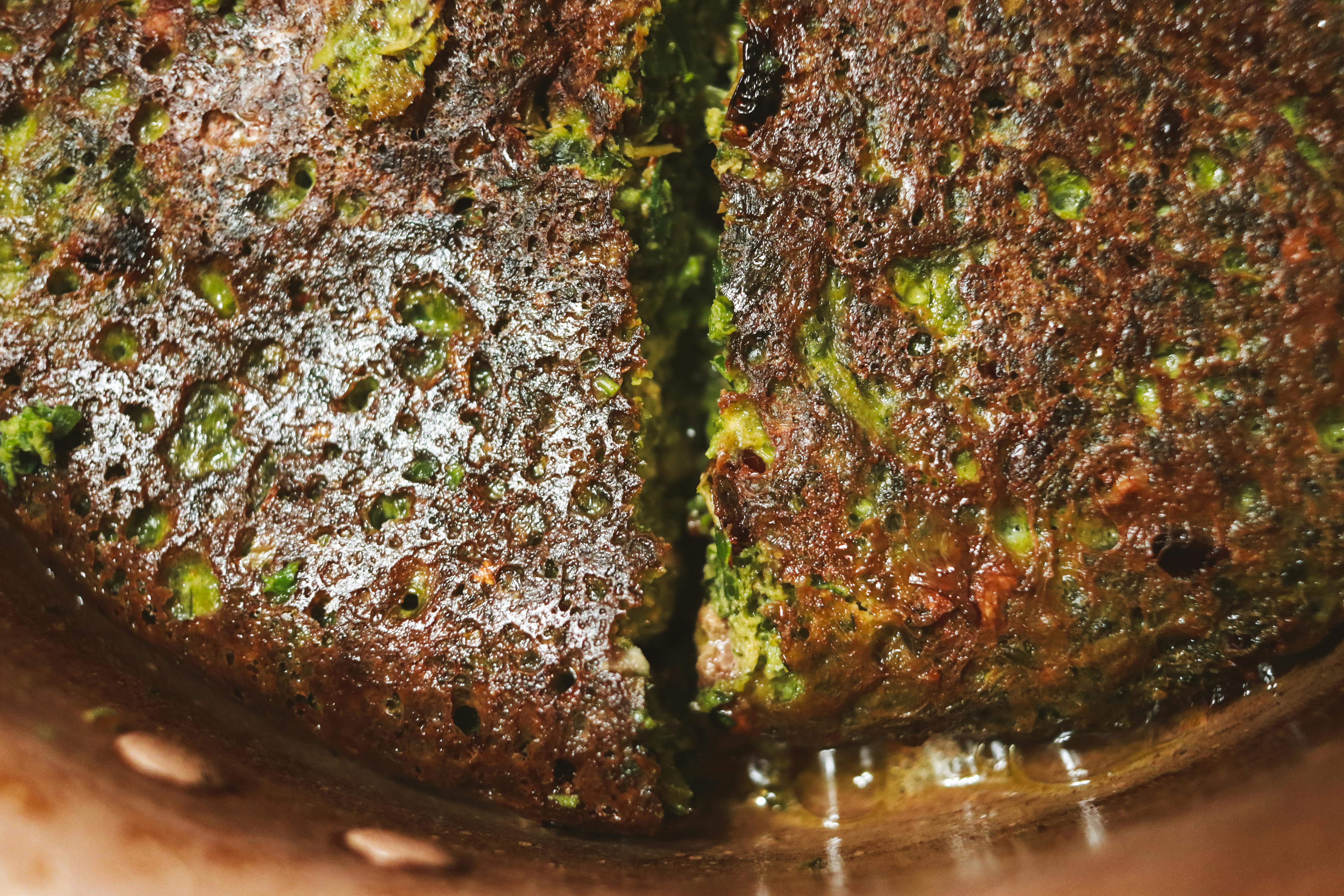
Photo: Golboo Maghooli / Pexels
Persian
Kuku Sabzi
The diets react (see scores below)
Common Ingredients
- eggs
- parsley
- cilantro
- dill
- chives
- walnuts
- barberries
- flour
Specific recipes may vary.
Incompatible with 4 of 11 diets
Diet Ratings
Kuku Sabzi is a Persian herb frittata that is mostly keto-friendly but contains two problematic ingredients: barberries and flour. Eggs are an ideal keto food, and the large quantities of fresh herbs (parsley, cilantro, dill, chives) contribute minimal net carbs with good fiber. Walnuts are acceptable in moderate portions. However, barberries are tart dried berries with notable sugar content (roughly 10-15g net carbs per 1/4 cup), and flour — even in the small binding quantity traditional recipes use — adds refined grain carbs. Traditional recipes typically use only 1-2 tablespoons of flour, keeping the flour contribution relatively low per serving, but combined with barberries the dish enters caution territory. With substitutions (omitting flour, using a keto binder like almond flour, and minimizing or omitting barberries), this dish would be strongly keto-approved.
Some lazy keto or flexible keto practitioners would approve this dish outright, arguing that the flour and barberries are used in such small quantities across multiple servings that the per-serving net carb impact remains under 5-7g and fits comfortably within a daily budget. Strict keto advocates counter that any wheat flour and sweetened dried fruit are categorically excluded regardless of quantity.
Kuku Sabzi is a Persian herb frittata whose defining characteristic is eggs as the primary binding protein. Eggs are an animal product (unfertilized poultry ova) and are explicitly excluded under vegan dietary rules. All other ingredients — parsley, cilantro, dill, chives, walnuts, barberries, and flour — are fully plant-based, but the dish cannot be made without eggs and remain Kuku Sabzi in any meaningful sense. There is no debate within the vegan community about eggs being non-vegan.
Kuku Sabzi is a Persian herb frittata that is largely paleo-compatible — eggs, fresh herbs (parsley, cilantro, dill, chives), walnuts, and barberries are all whole, unprocessed paleo-approved foods. However, the inclusion of flour (wheat flour, as is traditional in this dish) is a clear disqualifier. Grains are one of the most firmly excluded food groups in the paleo framework, and flour represents a processed grain product. The dish cannot be approved in its traditional form. A paleo adaptation using almond flour or coconut flour in place of wheat flour would shift the verdict to approve or caution.
Kuku Sabzi is a Persian herb frittata dominated by fresh green herbs (parsley, cilantro, dill, chives), walnuts, and eggs. The dish is overwhelmingly plant-forward with its massive proportion of herbs and walnuts, which aligns beautifully with Mediterranean principles. Eggs are a permitted moderate food in the Mediterranean diet. Walnuts are an approved nut. Barberries add a small amount of tart fruit. The only minor concern is a small amount of flour (refined grain), though the quantity is minimal and used as a binder. The primary caveat is that eggs are categorized as 'moderate' rather than daily staples in strict Mediterranean guidelines, preventing a full 'approve' rating despite the dish being largely plant-based.
Some Mediterranean diet practitioners, particularly those drawing on Middle Eastern and Eastern Mediterranean traditions, would argue this dish skews toward 'approve' given the extraordinary herb density and walnuts make it functionally plant-dominant, with eggs serving more as a binder than a primary protein — similar to a vegetable-rich Spanish tortilla. Modern clinical interpretations (e.g., PREDIMED-based guidelines) place eggs at moderate frequency, supporting the 'caution' rating.
Kuku Sabzi is a Persian herb frittata that is fundamentally incompatible with the carnivore diet. While eggs are the primary protein and are generally accepted by most carnivore practitioners, they are completely overwhelmed by the dish's other ingredients. The bulk of the dish consists of plant foods: large quantities of parsley, cilantro, dill, and chives (herbs excluded on carnivore), walnuts (nuts are strictly excluded), barberries (fruit, strictly excluded), and flour (grain-based binder, strictly excluded). The ratio of plant to animal ingredients makes this dish essentially a plant-based dish that happens to contain eggs. No carnivore variant of this dish is possible without a complete reconstruction.
Kuku Sabzi is a Persian herb frittata that is otherwise largely Whole30-compliant, but the inclusion of flour (a grain product) is a disqualifying ingredient. Flour is explicitly excluded on the Whole30 program as it falls under the grains category. All other ingredients — eggs, parsley, cilantro, dill, chives, walnuts, and barberries — are fully compliant. The dish could theoretically be made compliant by simply omitting the flour, as it is used only as a minor binder in this recipe.
Kuku Sabzi is a Persian herb frittata with several components to assess. Eggs are low-FODMAP and safe. Fresh herbs (parsley, cilantro, dill) are low-FODMAP in typical culinary quantities. Chives are a notable point: Monash rates chives as low-FODMAP and they are commonly recommended as an onion substitute, but they are used in large amounts in Kuku Sabzi — the dish is herb-dominant, so chive quantity could approach a threshold concern. Walnuts are low-FODMAP at a standard serving (30g/10 walnut halves per Monash), though large quantities tip into high-FODMAP territory due to GOS. Barberries (zereshk) are not well-studied by Monash but are used in small amounts as a tart garnish; dried fruits can concentrate polyols/fructose, making this a mild uncertainty. The primary concern is flour: if wheat flour is used (traditional in some recipes as a binder), even a small amount per serving introduces fructans and warrants caution. A gluten-free flour substitute (rice flour) would resolve this. The cumulative herb volume and wheat flour make this a 'caution' rather than a clear approve or avoid.
Some clinical FODMAP practitioners would flag the large volume of fresh herbs per serving — while individual herbs are low-FODMAP, the combined load in a herb-heavy frittata like Kuku Sabzi has not been formally tested. Additionally, if traditional wheat flour is used as a binder, Monash data clearly classifies wheat as high-FODMAP due to fructans, and many practitioners advise avoiding it entirely during elimination regardless of the small quantity used.
Kuku Sabzi is a Persian herb frittata dominated by nutrient-dense greens (parsley, cilantro, dill, chives) and eggs, with walnuts adding healthy unsaturated fats and barberries providing antioxidants. The herb base is strongly DASH-aligned — rich in potassium, magnesium, and fiber. Walnuts are explicitly endorsed in DASH guidelines as a beneficial nut. Barberries are low-sugar and DASH-compatible. The main complexity is eggs: DASH historically limited dietary cholesterol, and Kuku Sabzi is egg-heavy (typically 5-6 eggs per dish). Under older DASH interpretations, this egg load would be a concern. Flour is a minor binder and not problematic. Sodium depends heavily on preparation — if salt is added modestly, the dish can remain low-sodium. Overall, this is a nutrient-rich dish that sits in 'caution' territory primarily due to egg volume and evolving cholesterol guidance, not because of inherently problematic ingredients.
Traditional NIH DASH guidelines emphasized limiting dietary cholesterol, which would flag the high egg content in Kuku Sabzi as a concern. However, updated clinical interpretation following the 2020-2025 Dietary Guidelines — which removed the 300mg/day cholesterol cap — leads many DASH-oriented clinicians to view eggs in moderation as acceptable, which would push this dish closer to an 'approve' rating given its otherwise excellent nutrient profile.
Kuku Sabzi is a Persian herb frittata that aligns reasonably well with Zone principles. The protein base is eggs, which are a complete Zone-compatible protein source, though whole eggs carry saturated fat from the yolks (egg whites are rated more favorably than whole eggs in Zone). The dominant ingredients by volume are fresh herbs — parsley, cilantro, dill, and chives — which are low-glycemic, polyphenol-rich vegetables that Zone strongly favors. Walnuts provide monounsaturated and polyunsaturated fat (including omega-3 ALA), fitting the Zone's healthy fat emphasis, though they are a denser fat source and need portion control to avoid excess calories. Barberries are a notable Zone-positive ingredient: they are tart, low-sugar berries rich in berberine, a polyphenol Sears has discussed favorably in his anti-inflammatory writing. The flour is a minor concern — even small amounts of refined flour push the glycemic load slightly upward — but in a dish where it functions only as a binder in small quantity, the impact is modest. The overall macro profile of this dish skews protein- and fat-forward with low-glycemic carbohydrate from herbs and barberries, which maps well onto Zone ratios. The main caution is that whole eggs and walnuts together can push saturated and total fat higher than ideal; portioning is important to stay within Zone fat blocks per meal.
Strict Zone practitioners following Sears' earlier 'Enter the Zone' guidance would note that whole eggs are an 'unfavorable' protein compared to egg whites or lean meats due to saturated fat content. The small amount of flour, even as a binder, represents a refined carbohydrate that Zone labels unfavorable. A conservative Zone follower might recommend substituting egg whites for a portion of the whole eggs and omitting or replacing the flour with a low-glycemic alternative. However, Sears' later anti-inflammatory work is less restrictive about whole eggs given their favorable phospholipid and choline profile, which is why confidence is medium rather than high.
Kuku Sabzi is a Persian herb frittata dominated by fresh green herbs — parsley, cilantro, dill, and chives — which collectively provide a rich array of polyphenols, flavonoids, chlorophyll, and antioxidants (including quercetin, apigenin, and luteolin) with well-documented anti-inflammatory properties. Walnuts contribute ALA omega-3 fatty acids and ellagic acid, making them one of the most emphasized nuts in anti-inflammatory protocols. Barberries are rich in berberine, an alkaloid with significant anti-inflammatory and antioxidant activity studied for its ability to reduce NF-κB signaling and lower CRP. The small amount of flour used as a binder is nutritionally minor. Eggs represent the one ingredient with genuine debate — they provide choline and selenium (anti-inflammatory) but also arachidonic acid (potentially pro-inflammatory in excess). However, in the context of this herb-heavy dish, the egg base is unlikely to dominate the inflammatory profile. Assuming the dish is cooked in extra virgin olive oil (traditional and typical), this adds oleocanthal, a natural COX inhibitor. The overall profile strongly skews anti-inflammatory, though the egg content prevents a 9–10 score.
Eggs carry contested status in anti-inflammatory nutrition: some protocols (including certain AIP and functional medicine approaches) flag arachidonic acid in egg yolks as a driver of the inflammatory cascade, while Dr. Weil's pyramid includes eggs in moderation and mainstream research generally finds them neutral or beneficial for most people. The dish's verdict hinges partly on eggs being acceptable, which is a moderately confident but not universally agreed-upon position.
Kuku Sabzi is a Persian herb frittata made primarily from eggs and a large volume of fresh herbs (parsley, cilantro, dill, chives), with walnuts, barberries, and a small amount of flour as a binder. It has genuine strengths for GLP-1 patients: eggs provide complete protein (roughly 12-18g per serving depending on portion size), the dominant herb base contributes meaningful fiber, micronutrients, and antioxidants, and the dish is relatively easy to digest compared to heavy meat-based mains. Barberries add a tart flavor with minimal sugar impact at typical quantities. The walnuts are the primary concern — they add healthy unsaturated and omega-3 fats (walnuts are a good omega-3 source), but also add significant fat and calories per serving, which can slow digestion further on top of GLP-1-induced delayed gastric emptying and potentially worsen nausea in sensitive patients. The dish is traditionally pan-fried or oven-baked; oven-baked versions are significantly more GLP-1-friendly than pan-fried versions cooked in substantial oil. Protein per serving is moderate but not high — patients relying on this as a primary protein source may fall short of the 20-30g per meal target without supplementing with additional protein. Overall a nutrient-dense, whole-food dish that earns cautious approval, with preparation method and walnut quantity being the key variables.
Some GLP-1-focused dietitians would rate this higher, viewing the egg-and-herb combination as an excellent nutrient-dense small-portion meal with beneficial fats from walnuts; others would flag the moderate fat content from walnuts and cooking oil as a potential GI trigger in patients with active nausea or reflux, and note the protein yield may be insufficient as a standalone main without augmentation.
*See how scores were generated at our methodology page.
Nutritional profile
Six traits that cut across every diet.
Fiber & Plants
How much whole-plant food and fiber it delivers.
Healthy Fats
The quality of its fats (unsaturated, omega-3).
Whole / Unprocessed
How close it is to its natural, unprocessed form.
Gut Gentle
How easy it is on digestion (low FODMAP, few irritants).
Low Glycemic
How little it spikes your blood sugar.
Protein Density
How much protein it packs per calorie.
Controversy Index
Higher controversy = more disagreement between diets.
Diet-Specific Tips
 Keto — 5/10
View tips
- Eggs are a cornerstone keto food — high fat and protein, zero carbs
- Fresh herbs in large quantities contribute fiber and very low net carbs
- Barberries are dried, sugar-containing berries that add meaningful net carbs
- Wheat flour, even in small binding amounts, introduces grains — a keto red flag
- Walnuts are keto-compatible but should be portion-controlled
- Dish can be made keto-compliant with simple substitutions (almond flour, omit barberries)
- Per-serving carb load is moderate but depends heavily on recipe proportions
 Mediterranean — 6/10
View tips
- Dominant fresh herb content (parsley, cilantro, dill, chives) strongly aligns with plant-forward Mediterranean principles
- Walnuts are a Mediterranean-approved nut source adding healthy fats
- Eggs are permitted in moderation (a few servings per week) but are not a daily staple
- Small amount of flour is a minor refined grain concern but negligible in quantity
- Barberries are a whole fruit ingredient with no dietary concerns
- No red meat, processed ingredients, or added sugars
- Overall dish is nutrient-dense and minimally processed
 Low-FODMAP — 5/10
View tips
- Eggs are low-FODMAP and safe — core protein source
- Parsley, cilantro, and dill are low-FODMAP in culinary amounts
- Chives are low-FODMAP per Monash and an onion substitute, but large herb volumes in this dish add cumulative uncertainty
- Walnuts are low-FODMAP at ≤30g (10 halves); larger portions introduce GOS concerns
- Barberries (dried) are not well-tested by Monash; dried fruits can contain concentrated fructose/polyols even in small amounts
- Wheat flour (if used) contains fructans and is high-FODMAP — substituting rice or gluten-free flour improves compatibility significantly
- Dish can be made more reliably low-FODMAP with gluten-free flour and careful portion control on walnuts
 DASH — 6/10
View tips
- High volume of DASH-ideal herbs (parsley, cilantro, dill, chives) — rich in potassium, magnesium, and fiber
- Eggs are primary protein — cholesterol content debated under DASH; older guidelines flag, newer guidance is more permissive
- Walnuts explicitly endorsed in DASH guidelines as a healthy nut source
- Barberries are low-sugar, antioxidant-rich, and DASH-compatible
- No high-sodium, high-saturated-fat, or heavily processed ingredients
- Sodium level depends on preparation — modest salting keeps this DASH-friendly
- Flour used as minor binder — negligible nutritional impact
 Zone — 7/10
View tips
- Eggs provide complete Zone protein but whole eggs carry saturated fat from yolks — egg whites would be more favorable
- Abundant fresh herbs (parsley, cilantro, dill, chives) are low-glycemic, polyphenol-rich carbohydrates strongly favored in Zone
- Walnuts supply healthy fats including omega-3 ALA, consistent with Zone anti-inflammatory fat emphasis
- Barberries are low-sugar, polyphenol-rich berries — a Zone-positive carbohydrate source
- Small amount of flour is a refined carbohydrate (unfavorable) but negligible in quantity as a binder
- Dish is naturally low in high-glycemic carbs and avoids seed oils, processed ingredients, and trans fats
- Portion control of walnuts and eggs needed to balance fat blocks correctly per Zone meal
 Anti-Inflammatory — 8/10
View tips
- Very high herb content (parsley, cilantro, dill, chives) — exceptional polyphenol and flavonoid density
- Walnuts provide ALA omega-3 fatty acids and ellagic acid
- Barberries rich in berberine — studied for anti-inflammatory and NF-κB inhibiting effects
- Eggs: moderate anti-inflammatory profile with some debate around arachidonic acid
- Small amount of flour — minimal inflammatory impact at binder quantities
- Traditional preparation in olive oil would add oleocanthal (COX-inhibiting)
 GLP-1 Friendly — 6/10
View tips
- Moderate protein from eggs (~12-18g per serving) — adequate but not high; may need protein augmentation to hit per-meal targets
- High herb volume contributes fiber, micronutrients, and antioxidants — a genuine GLP-1 dietary positive
- Walnuts add healthy omega-3 fats but also increase total fat and calorie density, potentially worsening nausea in sensitive patients
- Preparation method is critical: oven-baked versions are preferred over pan-fried to minimize added fat
- Barberries contribute minimal sugar at typical serving quantities and add micronutrient value
- Small-portion friendly — works well as a GLP-1 small meal
- Easy to digest relative to meat-heavy mains, but walnut fat content adds some digestive load