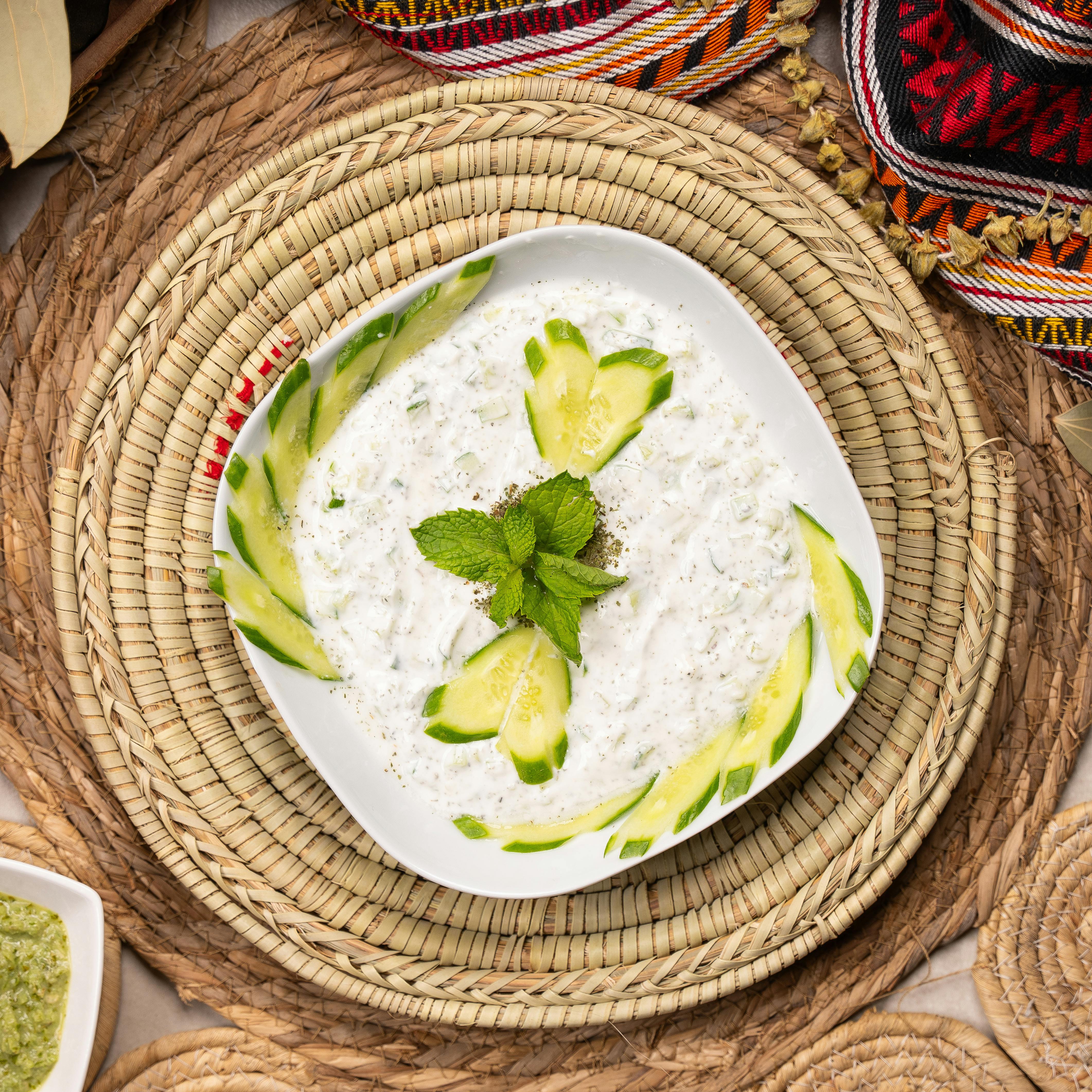
Photo: Ali Dashti / Pexels
Persian
Mast o Khiar
The diets react (see scores below)
Common Ingredients
- yogurt
- cucumber
- dried mint
- walnuts
- raisins
- garlic
- salt
Specific recipes may vary.
Incompatible with 5 of 11 diets
Diet Ratings
Mast o Khiar is a Persian yogurt-cucumber dip that is largely keto-friendly in its base form, but the traditional inclusion of raisins is the primary concern. Raisins are extremely high in sugar and net carbs (roughly 65g net carbs per 100g), making even a small amount problematic. Plain full-fat yogurt carries moderate carbs (~4-6g per 100g), and cucumber, dried mint, walnuts, and garlic are all low-carb or negligible. The walnuts are a keto-positive addition (healthy fats). If raisins are omitted or used in a trace garnish amount, this dish shifts toward 'approve' territory. As traditionally prepared with a meaningful amount of raisins, it warrants caution due to the cumulative carb load from yogurt sugars plus raisin sugars.
Some lazy keto or flexible keto practitioners may approve a small serving of this dish by arguing that the raisins used are minimal (just a garnish) and that the overall portion keeps net carbs within a daily budget. Strict keto adherents, however, would insist raisins must be entirely eliminated and only full-fat Greek yogurt used to minimize milk sugars.
Mast o Khiar contains yogurt as its primary base ingredient. Yogurt is a dairy product made from animal milk, which is explicitly excluded under all vegan frameworks. The remaining ingredients — cucumber, dried mint, walnuts, raisins, garlic, and salt — are all fully plant-based, but the yogurt alone disqualifies this dish. A vegan version could be made using plant-based yogurt (coconut, soy, almond, or cashew-based), which would transform it into a fully compliant dish.
Mast o Khiar is fundamentally a yogurt-based dish, and yogurt is dairy — one of the clearest exclusions in the paleo framework across virtually all paleo authorities. While several other ingredients are paleo-friendly (cucumber, dried mint, walnuts, garlic), and raisins are in a gray area due to concentrated natural sugar, the yogurt base alone disqualifies this dish. Salt is also explicitly excluded under strict paleo rules. The dish cannot be meaningfully adapted without replacing its defining ingredient.
Mast o Khiar is a Persian yogurt-cucumber dish that aligns reasonably well with Mediterranean diet principles. Cucumber, garlic, walnuts, and raisins are all plant-based ingredients strongly encouraged in the Mediterranean diet. Dried mint adds flavor without nutritional concern. However, the primary base is yogurt, a dairy product, which falls into the 'moderate' category — acceptable but not a daily staple. Walnuts are a Mediterranean-approved nut and add healthy fats. Raisins contribute natural sugars but in small amounts typical of this dish are not problematic. Overall, this is a wholesome, minimally processed dish with no red meat, refined grains, or added sugars, but the dairy-dominant base keeps it in the caution/moderate tier rather than a full approve.
Some Mediterranean diet practitioners, particularly those drawing on Eastern Mediterranean and Levantine traditions where fermented dairy (yogurt, labneh) is a dietary cornerstone, would rate this dish more favorably — arguing that yogurt consumed in moderate portions is a traditional and beneficial component, potentially pushing this toward an approve rating.
Mast o Khiar is fundamentally incompatible with the carnivore diet. While yogurt is an animal-derived dairy product, the dish is dominated by plant-based ingredients: cucumber (vegetable), dried mint (herb/plant), walnuts (nuts), raisins (fruit/sugar), and garlic (vegetable). Multiple carnivore exclusion categories are violated simultaneously — vegetables, herbs, nuts, and fruit-derived sugar (raisins) are all strictly prohibited. Even setting aside the dairy debate around yogurt, the overwhelming plant content makes this an unambiguous avoid. There is no meaningful carnivore adaptation possible here without reconstructing the dish entirely.
Mast o Khiar is a Persian yogurt-and-cucumber dip. The primary ingredient — yogurt — is dairy and is explicitly excluded on the Whole30. Dairy (including milk, cheese, sour cream, and yogurt) is one of the core eliminated categories for the full 30 days. The only dairy exception granted by the program is ghee and clarified butter. All other ingredients (cucumber, dried mint, walnuts, raisins, garlic, salt) are individually Whole30-compatible, but the dish cannot be made in its traditional form without the excluded yogurt base.
Mast o Khiar contains multiple high-FODMAP ingredients that make it unsuitable during the elimination phase. Yogurt is high in lactose and must be avoided unless lactose-free. Garlic is one of the highest-FODMAP foods per Monash University, containing significant fructans even in small amounts. Raisins are high-FODMAP due to excess fructose and fructans — a standard serving (1 tablespoon / ~13g) already exceeds safe thresholds. Walnuts are low-FODMAP at small servings (10 halves / ~30g), so they are less of a concern if used sparingly. Cucumber and dried mint are low-FODMAP. However, the combination of yogurt, garlic, and raisins — all core ingredients in this dish — makes it very difficult to bring into a low-FODMAP range without fundamentally altering the recipe.
Mast o Khiar is a Persian yogurt-cucumber dip with mostly DASH-friendly ingredients. Cucumber is an excellent low-sodium vegetable, walnuts provide heart-healthy unsaturated fats and magnesium, raisins contribute potassium and natural sweetness, garlic and dried mint add flavor with no sodium penalty. The primary concern is the yogurt: DASH guidelines specify low-fat or fat-free dairy, and this dish is traditionally made with full-fat yogurt (Greek-style or Middle Eastern strained yogurt). If full-fat yogurt is used, saturated fat content rises. Added salt is another variable — home preparation can keep sodium modest, but restaurant versions may be saltier. With low-fat yogurt and minimal added salt, this dish could easily score 7-8 and be approved; as traditionally prepared with full-fat yogurt and moderate salt, a caution rating is appropriate.
NIH DASH guidelines clearly specify low-fat or fat-free dairy to limit saturated fat intake. However, updated clinical interpretations note that recent meta-analyses (including those informing the 2020-2025 Dietary Guidelines) found full-fat dairy does not significantly worsen cardiovascular outcomes, leading some DASH-oriented clinicians to permit full-fat yogurt in moderation — which would push this dish toward an 'approve' rating.
Mast o Khiar is a Persian yogurt-cucumber dish that has several Zone-friendly elements but also a notable problem ingredient. Yogurt provides protein and some fat, cucumber is an excellent low-glycemic vegetable, garlic and dried mint are polyphenol-rich and anti-inflammatory, and walnuts offer monounsaturated and omega-3 fats. However, raisins are explicitly flagged as 'unfavorable' carbohydrates in Zone methodology due to their high sugar concentration and glycemic load — Dr. Sears lists raisins alongside bananas as high-sugar fruits to avoid. The raisins elevate this dish's glycemic profile meaningfully. Additionally, regular yogurt (as opposed to plain Greek yogurt) has a moderate glycemic index and contributes carbohydrates. As a side dish with no primary protein, it doesn't stand alone as a Zone meal but can serve as a carb-fat block contributor. The raisins should ideally be omitted or minimized to bring this closer to a Zone-favorable food. With careful portioning (small serving, raisins reduced), it can fit into a Zone meal, but it requires attention.
Some Zone practitioners would rate this more favorably by simply omitting or dramatically reducing the raisins, arguing the base dish — yogurt, cucumber, walnuts, garlic — is quite Zone-friendly. Dr. Sears' later anti-inflammatory writing emphasizes polyphenols heavily, and garlic, mint, walnuts, and cucumber all deliver well on that front. A raisin-free version could score 7.
Mast o Khiar is a Persian yogurt-cucumber dish with a largely favorable anti-inflammatory profile. Cucumber provides hydration, quercetin, and mild antioxidants. Walnuts are a standout anti-inflammatory ingredient — one of the best plant sources of ALA omega-3 fatty acids, also providing polyphenols and vitamin E. Garlic contains allicin and organosulfur compounds with well-documented anti-inflammatory effects. Dried mint contributes rosmarinic acid and other polyphenols with antioxidant properties. Raisins add natural sugars but also resveratrol and antioxidants; in the modest amounts typically used in this dish, this is unlikely to be problematic. Yogurt is the most nuanced ingredient: low-fat dairy is classified as 'moderate' in the anti-inflammatory framework. Full-fat yogurt is more of a 'use with caution' due to saturated fat content, but yogurt's probiotic content (live cultures) has documented anti-inflammatory effects on gut microbiome and may reduce systemic inflammatory markers. Taken together, the dish is predominantly anti-inflammatory with no clearly pro-inflammatory ingredients, though the dairy component creates slight uncertainty.
Dr. Weil's framework and mainstream anti-inflammatory guidance classify low-fat dairy as acceptable and probiotics in yogurt as beneficial, supporting an approve rating. However, stricter anti-inflammatory and autoimmune protocols (AIP) exclude all dairy — including yogurt — due to casein and potential gut irritation in sensitive individuals, which would push this dish into caution territory for those populations.
Mast o Khiar is a Persian yogurt-cucumber dip that has several GLP-1-friendly qualities but also a few considerations that keep it in caution territory. The yogurt base provides moderate protein and probiotics, and cucumber contributes high water content and easy digestibility — both beneficial for GLP-1 patients. Dried mint is stomach-soothing. However, walnuts add meaningful fat per serving (mostly unsaturated, which is preferred, but still calorie-dense in a context where every calorie must count), and raisins introduce added natural sugar with minimal fiber benefit in the small quantities typically used. Garlic is generally well-tolerated but can worsen reflux or bloating in some GLP-1 patients due to slowed gastric emptying. The dish has no primary protein source, so it should be treated as a side or condiment rather than a protein anchor. Portion size matters: a 2-3 tablespoon serving is quite reasonable; a larger portion amplifies fat and sugar from walnuts and raisins. If prepared with plain low-fat or non-fat Greek yogurt, the protein density improves meaningfully.
Some GLP-1-focused dietitians would rate this more favorably if made with Greek yogurt, citing its probiotic content, digestibility, and hydration support from cucumber — viewing the walnuts as a beneficial source of omega-3 unsaturated fats in small amounts. Others would flag the raisins and walnut fat content as unnecessary caloric additions when appetite is already suppressed, and recommend omitting or reducing both.
*See how scores were generated at our methodology page.
Nutritional profile
Six traits that cut across every diet.
Fiber & Plants
How much whole-plant food and fiber it delivers.
Healthy Fats
The quality of its fats (unsaturated, omega-3).
Whole / Unprocessed
How close it is to its natural, unprocessed form.
Gut Gentle
How easy it is on digestion (low FODMAP, few irritants).
Low Glycemic
How little it spikes your blood sugar.
Protein Density
How much protein it packs per calorie.
Controversy Index
Higher controversy = more disagreement between diets.
Diet-Specific Tips
 Keto — 4/10
View tips
- Raisins are very high in sugar (~65g net carbs/100g) and are incompatible with keto even in small amounts
- Yogurt contains natural milk sugars (~4-6g net carbs/100g); full-fat versions preferred but still moderate
- Cucumber is low-carb and keto-safe
- Walnuts provide healthy fats and are keto-approved
- Garlic and dried mint contribute negligible carbs at typical serving quantities
- Dish can be made keto-compatible by omitting raisins and using full-fat Greek yogurt
 Mediterranean — 6/10
View tips
- Yogurt is the primary ingredient — dairy is acceptable in moderation but not a core Mediterranean staple
- Cucumber, garlic, and walnuts are plant-based Mediterranean-friendly ingredients
- Raisins add natural sugars in small, traditional amounts — not a concern at typical serving sizes
- No red meat, refined grains, or processed ingredients
- Minimally processed, whole-food preparation aligns with Mediterranean principles
- Walnuts provide heart-healthy polyunsaturated fats consistent with Mediterranean guidelines
 DASH — 6/10
View tips
- Full-fat yogurt raises saturated fat concern per standard DASH dairy guidelines
- Cucumber is an ideal DASH vegetable — low sodium, hydrating, nutrient-rich
- Walnuts provide DASH-recommended unsaturated fats, magnesium, and protein
- Raisins add potassium and natural sugar — acceptable in small portions
- Added salt should be minimized; low-sodium preparation improves DASH compatibility
- No red meat, processed ingredients, or high-sodium additives
- Substituting low-fat or non-fat yogurt would make this dish highly DASH-compatible
 Zone — 5/10
View tips
- Raisins are explicitly 'unfavorable' in Zone due to high sugar concentration and glycemic load
- Yogurt contributes both protein and carbohydrate blocks — portioning matters
- Cucumber is an excellent low-glycemic Zone vegetable
- Walnuts provide favorable fats including omega-3s, supporting Zone's anti-inflammatory focus
- Garlic and dried mint are polyphenol-rich, aligning with Sears' anti-inflammatory emphasis
- No primary protein means this cannot serve as a standalone Zone meal — must be paired with lean protein
- Small serving size can mitigate raisin-related glycemic concerns
 Anti-Inflammatory — 7/10
View tips
- Walnuts provide ALA omega-3 fatty acids and polyphenols — strong anti-inflammatory contribution
- Garlic contains allicin and organosulfur compounds with demonstrated anti-inflammatory effects
- Dried mint contributes rosmarinic acid and polyphenols
- Yogurt's probiotic cultures may reduce inflammatory markers via gut microbiome support
- Full-fat yogurt contains saturated fat, classified as 'moderate/limit' in anti-inflammatory frameworks
- Raisins add small amounts of resveratrol and antioxidants but also natural sugars
- Cucumber provides quercetin and hydration with negligible inflammatory potential
 GLP-1 Friendly — 5/10
View tips
- Yogurt provides moderate protein and probiotics — protein content improves significantly if Greek yogurt is used
- Cucumber adds high water content and supports hydration, which is a GLP-1 priority
- Walnuts add unsaturated and omega-3 fats but are calorie-dense — portion-sensitive
- Raisins contribute natural sugar with limited fiber benefit in typical serving amounts
- No primary protein source — must be paired with a protein-rich main dish
- Garlic may worsen bloating or reflux in patients sensitive to GLP-1 gastric slowing
- Small serving size (2-3 tbsp as a side) keeps fat and sugar impact manageable