Photo: Sahar Fallah / Pexels
The diets react (see scores below)
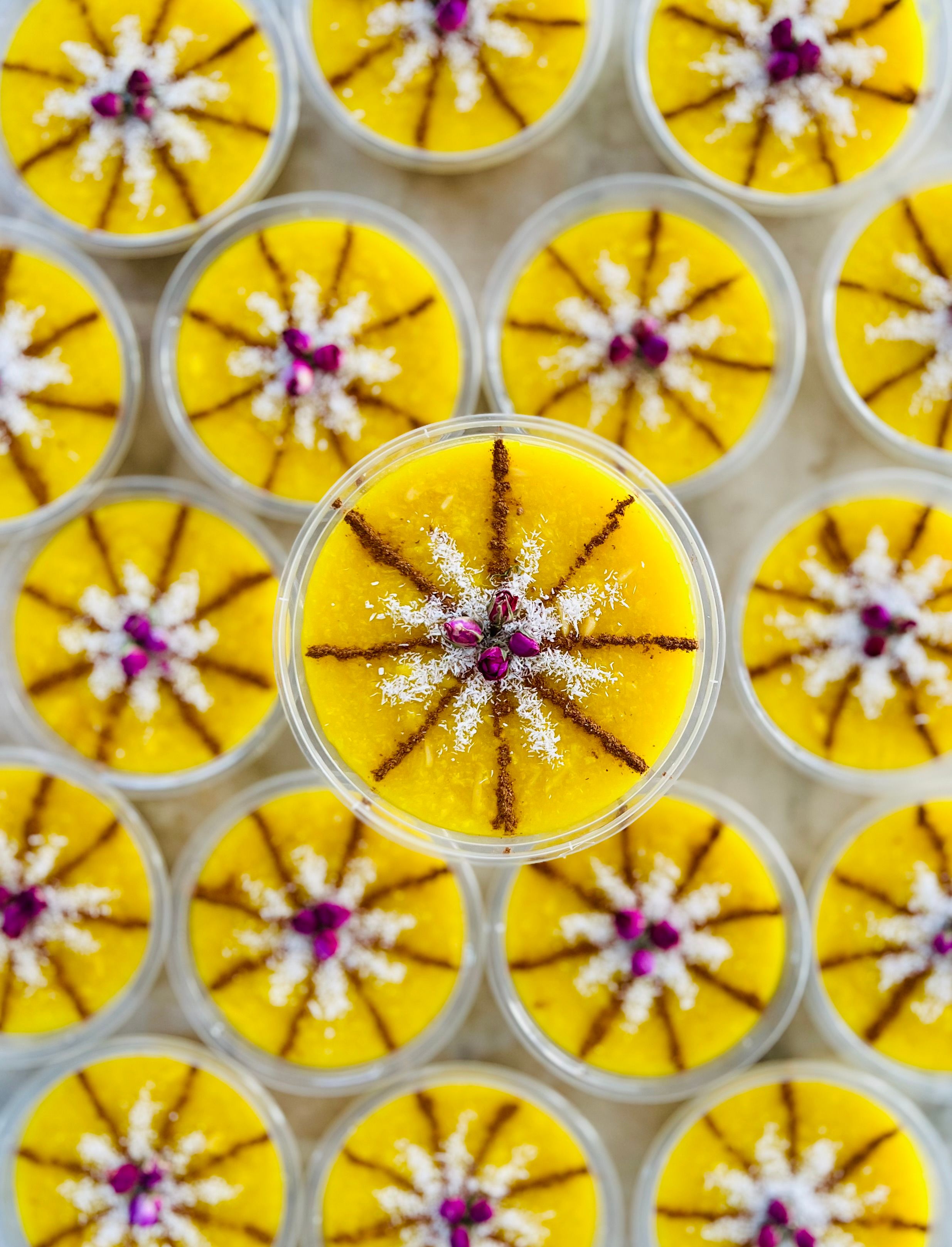
Common Ingredients
- rice
- sugar
- saffron
- rose water
- cardamom
- almonds
- pistachios
- cinnamon
Specific recipes may vary.
Incompatible with 8 of 11 diets
Diet Ratings
Sholeh Zard is a Persian saffron rice pudding whose two primary ingredients — white rice and sugar — are fundamentally incompatible with ketogenic eating. White rice is a high-glycemic grain delivering roughly 45g of net carbs per half-cup cooked serving, and added sugar compounds the problem further. Together these two ingredients alone can exceed an entire day's keto carb budget in a single small portion. The aromatic additions (saffron, rose water, cardamom, cinnamon) are keto-neutral in culinary quantities, and the almonds and pistachios provide some fat and protein, but they cannot redeem a dish that is structurally built around starch and sugar. This dessert/snack would immediately disrupt ketosis.
Sholeh Zard is a traditional Persian saffron rice pudding made entirely from plant-based ingredients. Rice, sugar, saffron, rose water, cardamom, almonds, pistachios, and cinnamon are all fully vegan. Unlike some rice puddings that use dairy milk or butter, this version is naturally dairy-free and egg-free. All ingredients are whole or minimally processed plant foods, earning it a high approval score. No animal-derived ingredients or ethically contested components are present.
Sholeh Zard is a Persian saffron rice pudding whose two core ingredients — rice and refined sugar — are firmly excluded by the paleo diet. Rice is a grain and universally rejected in paleo frameworks regardless of school (Cordain, Sisson, Wolf). Refined sugar is a processed, non-ancestral food equally rejected across all paleo interpretations. The remaining ingredients (saffron, rose water, cardamom, cinnamon, almonds, pistachios) are all paleo-approved aromatics, spices, and nuts, but they are minor garnishes that cannot redeem a dish built on a grain-and-sugar base. This dish is fundamentally incompatible with the paleo diet.
Sholeh Zard is a Persian saffron rice pudding whose primary ingredients are white rice and significant added sugar, both of which contradict core Mediterranean diet principles. White rice is a refined grain offering little fiber, and the high sugar content places this firmly in the 'avoid' category for added sugars. While the dish does contain beneficial components — almonds and pistachios provide healthy fats and protein, and saffron, rose water, cardamom, and cinnamon are health-positive spices — these are present in small, garnish-level quantities that do not offset the dominant refined carbohydrate and sugar load. As an occasional cultural treat it might be tolerated, but as a snack it is poorly aligned with Mediterranean dietary patterns.
Some Mediterranean diet interpreters note that traditional Middle Eastern and Eastern Mediterranean cuisines do include rice-based desserts consumed in small portions during festivals or special occasions, and that the nut and spice content adds modest nutritional value. In this framing, a very small serving eaten rarely could be viewed as a 'caution' rather than a strict 'avoid,' similar to how traditional sweets like baklava are treated in Greek dietary culture.
Sholeh Zard is a Persian saffron rice pudding made entirely from plant-based ingredients. Every single component — rice, sugar, saffron, rose water, cardamom, almonds, pistachios, and cinnamon — is explicitly excluded from the carnivore diet. Rice is a grain, sugar is a processed plant-derived sweetener, and the remaining ingredients are plant-based spices, nuts, and flavorings. There is no animal product whatsoever in this dish. This is about as far from carnivore-compatible as a food can get.
Sholeh Zard is a Persian saffron rice pudding that contains two explicitly excluded ingredients: rice (a grain, banned on Whole30) and sugar (added sugar, banned on Whole30). Either of these alone would disqualify the dish. Additionally, even if these ingredients were substituted, the dish would likely fall under the 'no recreating junk food/desserts' rule, as it is a sweet pudding-style dessert. The remaining ingredients — saffron, rose water, cardamom, almonds, pistachios, and cinnamon — are all Whole30-compliant, but they cannot salvage a dish built on two foundational excluded ingredients.
Sholeh Zard is a Persian saffron rice pudding whose FODMAP status depends heavily on portion size and specific ingredient quantities. White rice is low-FODMAP and forms the base. Saffron, rose water, and cinnamon are low-FODMAP in culinary amounts. Cardamom is low-FODMAP at small amounts (1/4 tsp per serving). Sugar (sucrose) is low-FODMAP in moderate amounts. The key concerns are almonds and pistachios: almonds are low-FODMAP at 10 almonds (12g) but high in GOS above that; pistachios are high-FODMAP even at small servings (15g triggers excess fructans and GOS). In a standard serving of Sholeh Zard, pistachios are typically used as a garnish alongside almonds, and the combined nut load may push into moderate-to-high FODMAP territory. Sugar in large amounts can also contribute excess fructose if quantities are very high, though this is less likely at typical dessert servings. The dish is a dessert/snack typically served in moderate portions, making it potentially manageable if nut garnishes are minimal, but the presence of pistachios is a meaningful concern during strict elimination.
Monash University rates pistachios as high-FODMAP even at a standard serving (28g contains significant fructans and GOS), and many FODMAP practitioners would advise avoiding this dish entirely during elimination due to pistachio content. However, if pistachios are used only as a light decorative garnish (very small amount), clinical practitioners may consider a small portion of Sholeh Zard cautiously acceptable — the practical risk depends entirely on the recipe's nut quantities.
Sholeh Zard is a Persian saffron rice pudding whose primary ingredients are white rice and sugar, making it a high-sugar, high-glycemic dessert/snack. DASH guidelines explicitly limit added sugars and sweets, and white rice lacks the fiber of whole grains recommended by DASH. The dish is served in substantial portions as a sweet pudding, with sugar as a dominant ingredient alongside refined white rice. While it contains some positive elements — almonds and pistachios provide healthy fats, magnesium, and protein; saffron, cardamom, cinnamon, and rose water are low-calorie aromatics — these are present in small garnish quantities insufficient to offset the high added sugar content. The overall macronutrient profile is dominated by refined carbohydrates and added sugar, which DASH explicitly discourages. Sodium is low, which is a positive, but the heavy sugar load places this firmly in the 'avoid' category for DASH adherence.
Sholeh Zard is a Persian saffron rice pudding whose primary ingredients are white rice and sugar — two of the most explicitly 'unfavorable' carbohydrates in Zone Diet methodology. White rice is a high-glycemic, refined starch that Dr. Sears consistently flags as a food that drives insulin spikes, and sugar is the archetypical Zone-avoid ingredient. Together they constitute the overwhelming caloric base of this dish, making the macronutrient ratio wildly skewed toward carbohydrates with virtually no protein and only modest fat from the almonds and pistachios. The dish has no lean protein component whatsoever. While saffron, rose water, cardamom, and cinnamon are Zone-friendly polyphenol-rich spices, and almonds/pistachios provide monounsaturated fat, these favorable elements are minor garnishes that cannot rescue the macro profile. As a snack, a Zone-compliant option should still maintain a rough 40/30/30 ratio — Sholeh Zard is likely 80%+ carbohydrates by calorie, predominantly high-glycemic. There is essentially no realistic portioning strategy that brings this dish into Zone balance without reducing it to a few spoonfuls, at which point it ceases to function as a meaningful snack.
Sholeh Zard is a Persian saffron rice pudding with a genuinely mixed anti-inflammatory profile. On the positive side, it contains several powerful anti-inflammatory ingredients: saffron is one of the most potent anti-inflammatory spices known, with crocin and safranal shown to reduce inflammatory markers; cardamom and cinnamon both carry meaningful anti-inflammatory and antioxidant properties; rose water contains polyphenols; and almonds and pistachios provide healthy monounsaturated fats, vitamin E, and polyphenols that support an anti-inflammatory state. However, the dish is built on a foundation of white rice (refined carbohydrate with negligible fiber) and substantial added sugar — both of which are flagged as pro-inflammatory in anti-inflammatory dietary frameworks due to their capacity to spike blood glucose, promote glycation, and elevate inflammatory markers like CRP. Sugar is specifically listed as something to limit or avoid, and white rice, while not as problematic as other refined carbs, offers little anti-inflammatory benefit. The net result is a dish where genuinely beneficial spices and nuts are embedded in a high-sugar, refined-carb base, making it a treat acceptable on occasion rather than a regular anti-inflammatory food. It is best consumed in small portions infrequently.
Sholeh Zard is a Persian saffron rice pudding whose nutritional profile is nearly the opposite of what GLP-1 patients need. Sugar is a primary ingredient, making this a high-glycemic, high-sugar dish with empty calories. The base is white rice, a refined carbohydrate with minimal fiber. There is no meaningful protein source — nuts provide a small amount but in the quantities typical of a garnish, this is negligible. The combination of refined starch and sugar causes rapid blood sugar spikes, directly counterproductive to the metabolic goals of GLP-1 therapy. With reduced appetite on GLP-1 medications, spending limited caloric 'budget' on a nutrient-poor, sugar-heavy dessert displaces the protein and fiber intake that is critical for muscle preservation and GI health. The small nut garnish (almonds, pistachios) adds some healthy fat and minimal protein but is insufficient to offset the overall profile.
*See how scores were generated at our methodology page.
Nutritional profile
Six traits that cut across every diet.
Fiber & Plants
How much whole-plant food and fiber it delivers.
Healthy Fats
The quality of its fats (unsaturated, omega-3).
Whole / Unprocessed
How close it is to its natural, unprocessed form.
Gut Gentle
How easy it is on digestion (low FODMAP, few irritants).
Low Glycemic
How little it spikes your blood sugar.
Protein Density
How much protein it packs per calorie.
Controversy Index
Higher controversy = more disagreement between diets.
Diet-Specific Tips
 Vegan — 8/10
View tips
- All ingredients are plant-based with no animal products
- No dairy or eggs, unlike many other rice pudding traditions
- Whole food ingredients: nuts, spices, rice — minimally processed
- Saffron, rose water, and cardamom are plant-derived
- Sugar used is standard (not bone-char filtered, which is not assessed at the dish level)
- No ethically contested ingredients within mainstream vegan discourse
 Low-FODMAP — 5/10
View tips
- White rice is low-FODMAP — safe base ingredient
- Pistachios are high-FODMAP even at standard servings (fructans and GOS) — primary concern
- Almonds are low-FODMAP at ≤10 almonds (12g) but high-FODMAP above that threshold
- Saffron, rose water, and cinnamon are low-FODMAP in culinary doses
- Cardamom is low-FODMAP at small amounts (≤1/4 tsp per serve)
- Sugar is low-FODMAP in moderate amounts but large quantities risk excess fructose
- Portion size and quantity of nut garnishes are the deciding factor for FODMAP safety
 Anti-Inflammatory — 4/10
View tips
- Saffron: highly potent anti-inflammatory spice (crocin, safranal — reduces CRP and oxidative stress)
- Cinnamon and cardamom: meaningful anti-inflammatory and antioxidant contributions
- Almonds and pistachios: healthy monounsaturated fats, vitamin E, polyphenols — anti-inflammatory
- Rose water: minor polyphenol contribution
- Added sugar: primary concern — pro-inflammatory, spikes blood glucose, elevates CRP
- White rice: refined carbohydrate with low fiber; modest glycemic burden
- Overall: anti-inflammatory ingredients undermined by high sugar and refined carb base