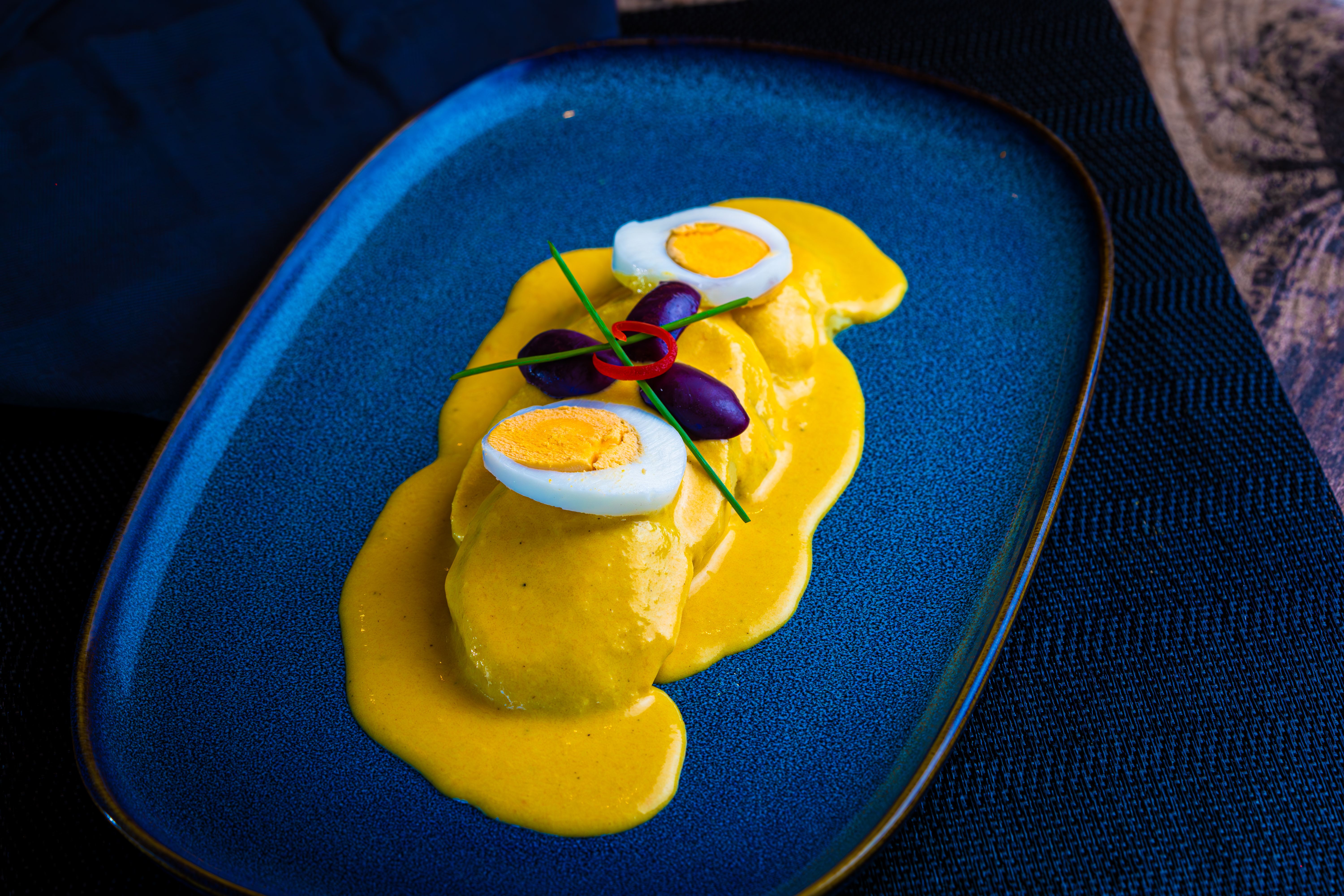
Photo: Nano Erdozain / Pexels
Peruvian
Papa a la Huancaina
The diets react (see scores below)
Common Ingredients
- potatoes
- aji amarillo
- queso fresco
- evaporated milk
- crackers
- garlic
- olives
- eggs
Specific recipes may vary.
Incompatible with 6 of 11 diets
Diet Ratings
Papa a la Huancaina is fundamentally incompatible with a ketogenic diet. The dish is built around potatoes, which are a high-starch vegetable containing roughly 15-17g net carbs per 100g — a single standard serving would likely exceed the entire daily keto carb budget. Crackers (saltines or similar) are added as a binder and garnish, contributing additional grain-based carbohydrates. Evaporated milk also adds meaningful lactose-derived carbs. While some ingredients are keto-friendly (queso fresco, eggs, olives, garlic, aji amarillo in small amounts), the foundational ingredients — potatoes and crackers — make this dish unavoidably high in net carbs and entirely incompatible with maintaining ketosis.
Papa a la Huancaina contains multiple animal-derived ingredients that disqualify it from a vegan diet. Queso fresco is a fresh dairy cheese, evaporated milk is a concentrated dairy product, and eggs are used both in the sauce and as a garnish. These are unambiguous animal products with no debate within the vegan community. While the base ingredients — potatoes, aji amarillo peppers, garlic, and olives — are fully plant-based, the dish as traditionally prepared is fundamentally non-vegan. A vegan adaptation would require replacing the cheese and milk with plant-based alternatives (e.g., cashew cream, vegan cheese) and omitting the eggs.
Papa a la Huancaina contains multiple non-paleo ingredients that disqualify it clearly. Queso fresco is a fresh dairy cheese, evaporated milk is processed dairy, and crackers are a grain-based processed food — all three are firmly excluded under paleo rules. The dish's defining sauce is built entirely around these forbidden ingredients. Potatoes are debated in paleo circles, but the dairy and grain components alone are sufficient to place this dish in the 'avoid' category. Aji amarillo, garlic, olives, and eggs are paleo-compatible, but they are minor supporting ingredients that cannot offset the core violations.
Papa a la Huancaina contains several Mediterranean-compatible ingredients — potatoes are an acceptable whole food, olives are a Mediterranean staple, eggs and queso fresco are moderate-consumption dairy/egg items that fit within the diet's guidelines. However, the sauce relies heavily on evaporated milk (a processed dairy product) and crackers (a refined grain binder), which are not aligned with Mediterranean principles of whole, minimally processed foods. The dish lacks olive oil as a fat source, instead deriving most of its fat from cheese and evaporated milk. Overall, it is an acceptable occasional side dish given its vegetable and egg content, but the processed components and dairy-heavy sauce keep it in the caution zone.
Some Mediterranean diet interpreters would view this dish more favorably, noting that potatoes, eggs, olives, and fresh cheese are all individually acceptable ingredients, and that dairy-based sauces appear in traditional Mediterranean cooking (e.g., Greek tzatziki, Italian fonduta). A more lenient reading might score it higher if the crackers are replaced with whole grain alternatives and the evaporated milk is substituted with a lighter dairy option.
Papa a la Huancaina is almost entirely plant-based and completely incompatible with the carnivore diet. The dish is built on potatoes (starchy plant tuber), aji amarillo peppers (plant), crackers (grain-based), garlic (plant), and olives (plant). While it does contain queso fresco (dairy), evaporated milk (dairy), and eggs — which are at least animal-derived — these are minor components in a sauce accompanying a fundamentally plant-based dish. The overwhelming majority of ingredients violate carnivore principles. This dish would need to be entirely reconstructed to be carnivore-compatible; there is no meaningful adaptation possible while retaining its identity.
Papa a la Huancaina contains multiple Whole30-excluded ingredients. Queso fresco is a dairy cheese, which is explicitly excluded on Whole30 (only ghee and clarified butter are permitted dairy exceptions). Evaporated milk is also a dairy product and excluded. Crackers are a grain-based product and fall under both the grains exclusion and the explicit 'no crackers' rule under the junk food/baked goods prohibition. These three ingredients alone make this dish non-compliant, regardless of the otherwise acceptable components (potatoes, aji amarillo, garlic, olives, eggs).
Papa a la Huancaina contains multiple high-FODMAP ingredients that make it unsuitable during the elimination phase. Garlic is one of the highest-FODMAP foods tested by Monash University (high fructans even at tiny amounts). Queso fresco is a soft, fresh cheese with significant lactose content — unlike aged hard cheeses, it retains most of its lactose and is high-FODMAP at typical serving sizes. Evaporated milk is a lactose-heavy ingredient that compounds the dairy problem. Crackers are typically wheat-based, adding fructans to the mix. Olives are generally low-FODMAP in small servings, potatoes are low-FODMAP, eggs are low-FODMAP, and aji amarillo pepper (fresh chili) is low-FODMAP. However, the combination of garlic, queso fresco, and evaporated milk creates an unavoidable high-FODMAP dish. Even if crackers were substituted with a gluten-free alternative, the garlic alone would disqualify it, and the lactose load from both the queso fresco and evaporated milk together is substantial. This dish cannot be made low-FODMAP without fundamentally altering its core sauce ingredients.
Papa a la Huancaina sits in a gray zone for the DASH diet. The base — boiled potatoes — is a DASH-friendly vegetable rich in potassium. Aji amarillo pepper adds beneficial nutrients with minimal sodium. However, the sauce is built on queso fresco (a moderate-sodium cheese), evaporated milk (whole-milk versions add saturated fat), and saltine-style crackers (processed, sodium-containing binder), pulling the dish away from DASH ideals. Hard-boiled eggs are acceptable in moderate DASH interpretations. Black olives add healthy monounsaturated fat but also contribute sodium. The overall dish is not heavily processed, but the combined sodium from queso fresco, crackers, and olives, plus saturated fat from full-fat dairy components, make it a 'moderation' food rather than a DASH staple. Portion size matters significantly — a small serving alongside a vegetable-rich meal is more compatible than a large portion.
Traditional NIH DASH guidelines would flag the sodium from queso fresco, crackers, and olives and the saturated fat from full-fat evaporated milk as concerns requiring strict portion control. An updated clinical interpretation might note that queso fresco is lower in sodium than many aged cheeses, that eggs are now viewed more permissively post-2020 Dietary Guidelines, and that the potassium-rich potato base partially offsets sodium concerns — making a modest serving reasonably compatible with a flexible DASH pattern.
Papa a la Huancaina is dominated by high-glycemic, unfavorable Zone carbohydrates. Potatoes are explicitly listed by Dr. Sears as an unfavorable carb to avoid due to their high glycemic index, and crackers add additional refined starch. The dish is primarily carbohydrate-dense with very little lean protein — queso fresco and eggs provide some protein but the quantities are modest relative to the carb load. The fat profile is mixed: olives provide favorable monounsaturated fat, but evaporated milk and queso fresco bring saturated fat, and the overall fat contribution is modest. Achieving a 40/30/30 Zone block balance with this dish is extremely difficult because the carb block count from potatoes alone would far outweigh the protein and fat blocks available. As a side dish, it adds an unfavorable carb burden to any meal without contributing meaningful lean protein. To salvage Zone compatibility, one would need to dramatically reduce portion size (just a small taste), supplement with substantial lean protein, and add monounsaturated fat — at which point the dish is no longer the meal centerpiece.
Papa a la Huancaina has a mixed anti-inflammatory profile. On the positive side, aji amarillo (yellow chili pepper) is rich in capsaicin and carotenoids with meaningful anti-inflammatory properties. Potatoes, while moderate on the glycemic index, contain polyphenols and vitamin C. Garlic is a well-established anti-inflammatory ingredient, and olives contribute beneficial monounsaturated fats and polyphenols. Eggs provide choline and selenium. However, the dish is anchored by a rich cream sauce made from queso fresco and evaporated milk, adding saturated fat and sodium at levels that fall into the 'moderate' or 'limit' category under anti-inflammatory guidelines. The crackers (typically refined wheat) introduce refined carbohydrates with minimal nutritional benefit. The overall dish is not strongly pro-inflammatory — it lacks trans fats, added sugars, or seed oils — but the saturated dairy fat load and refined crackers prevent a clear approval. Portion size matters significantly here: a small serving as a side is more defensible than a large portion. Nightshade-sensitive individuals following AIP protocols should also note that both potatoes and aji amarillo are nightshades.
Mainstream anti-inflammatory nutrition (including Dr. Weil's framework) would view the chili pepper, garlic, and olives favorably and consider this dish acceptable in moderation given its whole-food base. However, Autoimmune Protocol (AIP) advocates would flag both nightshade ingredients (potatoes and aji amarillo) as potentially pro-inflammatory for sensitive individuals, and stricter anti-inflammatory practitioners might caution against the full-fat dairy content of queso fresco and evaporated milk, which some research associates with elevated inflammatory markers at higher intake levels.
Papa a la Huancaina is a Peruvian side dish of boiled potatoes covered in a creamy sauce made from aji amarillo, queso fresco, evaporated milk, and crackers, garnished with olives and hard-boiled eggs. While the dish contains some useful nutrients — eggs provide protein, and aji amarillo offers antioxidants — it falls short of GLP-1 dietary priorities in several ways. Protein content is modest for the calorie load; queso fresco and eggs contribute some protein but not enough to qualify this as a high-protein dish, especially as a side. The sauce is calorie-dense and moderately high in fat from the cheese and evaporated milk, which can worsen GLP-1 side effects like nausea and reflux. Potatoes are a refined starchy carbohydrate with low fiber density, and crackers add further refined carbs with minimal nutritional value. The aji amarillo is a mild-to-moderate chili that most patients tolerate, but individuals sensitive to spice may experience GI irritation. Olives add unsaturated fat, which is the preferred fat type, but also add calories and sodium. Portion size matters significantly here — a small serving as an accent to a high-protein main could be acceptable, but this dish cannot stand alone as a nutritionally adequate meal for GLP-1 patients.
Some GLP-1-focused dietitians may view this dish more favorably when consumed in a small portion alongside a lean protein main, noting that the eggs and queso fresco do contribute meaningful protein and that the dish is not fried or heavily processed. Others flag the high-starch, moderate-fat sauce combination as particularly likely to worsen delayed gastric emptying symptoms and would recommend avoiding it, especially in early weeks of GLP-1 therapy when GI side effects are most pronounced.
*See how scores were generated at our methodology page.
Nutritional profile
Six traits that cut across every diet.
Fiber & Plants
How much whole-plant food and fiber it delivers.
Healthy Fats
The quality of its fats (unsaturated, omega-3).
Whole / Unprocessed
How close it is to its natural, unprocessed form.
Gut Gentle
How easy it is on digestion (low FODMAP, few irritants).
Low Glycemic
How little it spikes your blood sugar.
Protein Density
How much protein it packs per calorie.
Controversy Index
Higher controversy = more disagreement between diets.
Diet-Specific Tips
 Mediterranean — 5/10
View tips
- Potatoes are a whole food and acceptable carbohydrate source
- Olives are a Mediterranean staple and add healthy fats
- Eggs and queso fresco are moderate-consumption foods within the diet
- Evaporated milk is a processed dairy product, not ideal
- Crackers are a refined grain binder inconsistent with whole grain principles
- No olive oil used as primary fat — dish is dairy-fat dominant
- No red meat or added sugars, which is a positive factor
 DASH — 4/10
View tips
- Potatoes provide DASH-valued potassium and fiber
- Queso fresco adds moderate sodium — lower than aged cheeses but still a concern at scale
- Saltine-style crackers contribute processed sodium and refined carbohydrates
- Evaporated milk (whole) adds saturated fat inconsistent with DASH low-fat dairy emphasis
- Olives provide monounsaturated fat but increase overall sodium load
- Eggs are acceptable in moderate DASH interpretations per updated dietary guidelines
- Aji amarillo pepper is a nutrient-dense, DASH-compatible ingredient
- Dish lacks the fiber density and low-sodium profile of core DASH foods
 Zone — 5/10
View tips
- Potatoes are explicitly categorized as an 'unfavorable' high-glycemic carbohydrate in Dr. Sears' Zone framework and should be avoided
- Crackers add additional refined, high-glycemic carbohydrate load
- Very low lean protein content — queso fresco is a moderate-fat cheese, not an ideal Zone protein block
- Olives provide favorable monounsaturated fat, a modest positive
- Eggs contribute some protein and are Zone-acceptable, but are minor components here
- Overall macro ratio is heavily carbohydrate-skewed, making 40/30/30 balance nearly impossible at any reasonable portion
- As a side dish, it worsens the carb-to-protein ratio of the overall meal rather than improving it
 Anti-Inflammatory — 5/10
View tips
- Aji amarillo provides capsaicin and carotenoids with anti-inflammatory activity
- Garlic and olives are anti-inflammatory positives
- Queso fresco and evaporated milk contribute saturated fat (moderate concern)
- Refined crackers add processed carbohydrates with little nutritional value
- Potatoes and aji amarillo are nightshades — relevant for autoimmune-sensitive individuals
- Eggs are a neutral-to-modest contributor with mixed anti-inflammatory evidence
- No trans fats, seed oils, or added sugars — a meaningful positive
- Dish is acceptable in moderate portions as an occasional side
 GLP-1 Friendly — 4/10
View tips
- Low protein density relative to calorie content — not a meaningful protein source as a side dish
- Starchy potato base with low fiber — poor blood sugar and satiety profile
- Creamy cheese-and-evaporated-milk sauce is moderately high in fat, risking nausea and reflux
- Crackers add refined carbohydrates and empty calories
- Eggs contribute some protein and nutrients but are a minor component
- Aji amarillo is mild enough for most patients but may irritate sensitive GI tracts
- Olives provide healthy unsaturated fats but add calories and sodium
- Portion-sensitive: small amounts alongside a high-protein main are more acceptable than a full serving