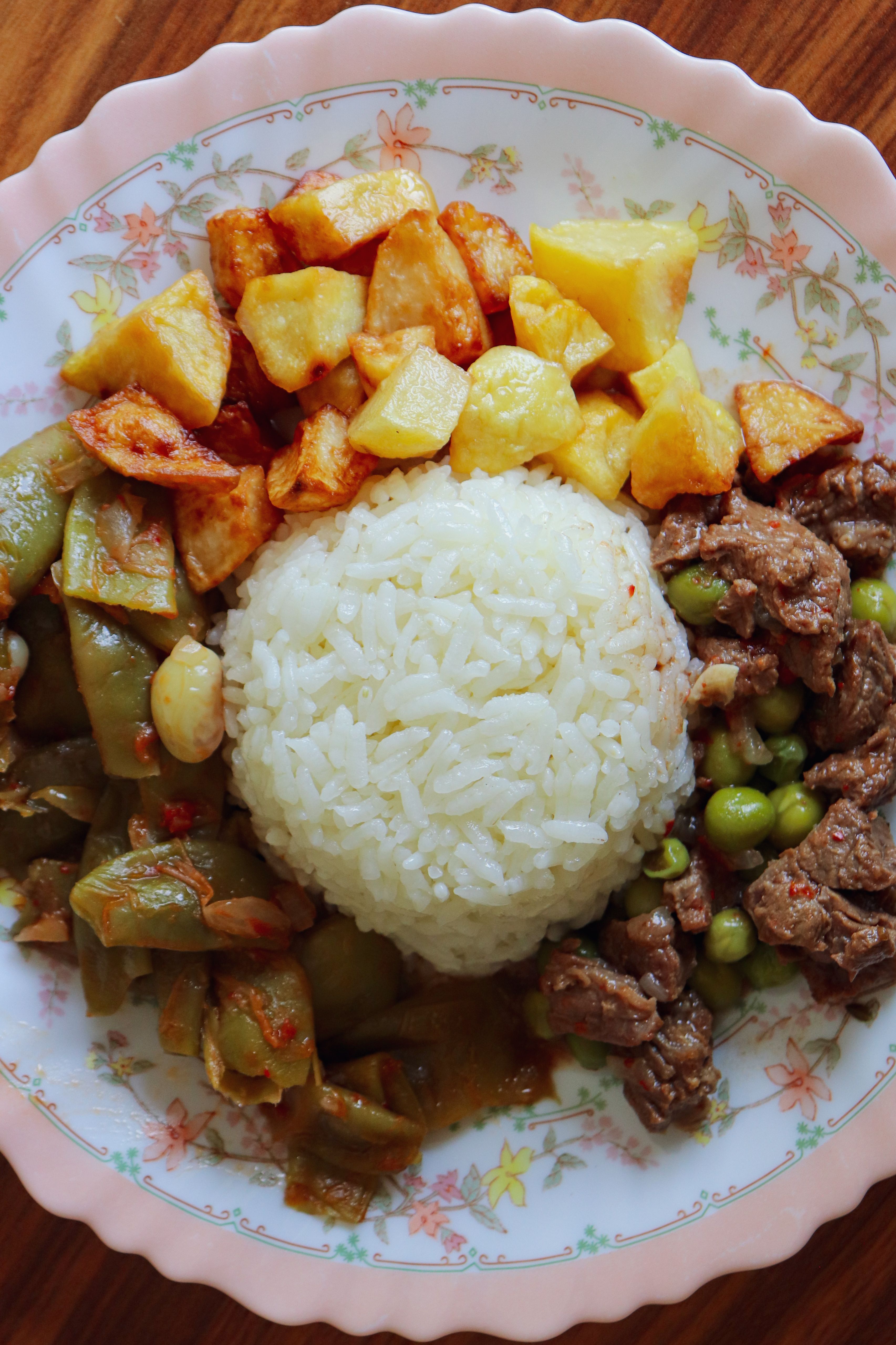
Photo: Gizem Gökce / Pexels
Peruvian
Seco de Cordero
The diets react (see scores below)
Common Ingredients
- lamb
- cilantro
- aji amarillo
- onion
- garlic
- chicha de jora
- carrot
- peas
Specific recipes may vary.
Incompatible with 7 of 11 diets
Diet Ratings
Seco de Cordero, while built on a keto-friendly protein base (lamb), contains multiple high-carb ingredients that make it incompatible with ketosis in its traditional form. Peas are a starchy legume with approximately 12-14g net carbs per 100g serving. Chicha de jora (fermented corn beer) is a corn-derived fermented beverage with significant carbohydrate content. Carrots add additional net carbs (~7g/100g). Combined with onion and aji amarillo (which also contribute moderate carbs), a standard serving of this dish would likely exceed 25-35g net carbs on its own — potentially consuming an entire day's keto carb budget. The dish as traditionally prepared is fundamentally incompatible with ketogenic macros.
Seco de Cordero is a traditional Peruvian lamb stew. Lamb is a red meat — a direct animal product — making this dish entirely incompatible with a vegan diet. There is no ambiguity here: the primary protein is the carcass of a young sheep. The remaining ingredients (cilantro, aji amarillo, onion, garlic, chicha de jora, carrot, peas) are all plant-based, but the presence of lamb is an absolute disqualifier under any definition of veganism.
Seco de Cordero contains two clear paleo violations: peas (a legume, excluded from the paleo diet) and chicha de jora (a fermented corn beer, making it a grain-based alcohol). The lamb, cilantro, aji amarillo, onion, garlic, and carrot are all paleo-approved whole foods, but the inclusion of peas and chicha de jora disqualifies the dish. Chicha de jora is both a grain product (corn) and an alcoholic beverage derived from it — a double violation. While fermented foods are sometimes debated in paleo circles, grain-fermented alcohols are not. Peas are consistently excluded by all major paleo authorities as a legume. The dish as traditionally prepared cannot be considered paleo-compliant without substituting these two ingredients.
Seco de Cordero is a Peruvian lamb stew where lamb is the primary and dominant protein. Lamb is red meat, which the Mediterranean diet restricts to only a few times per month. While the dish does contain several Mediterranean-friendly ingredients — onion, garlic, carrot, peas, and cilantro are all plant-based and encouraged — the central component is a significant portion of red meat, which contradicts core Mediterranean principles. The chicha de jora (fermented corn beer) used as a braising liquid is a non-traditional, region-specific ingredient with no Mediterranean parallel, though it is a modest quantity. The vegetable components are positive, but they cannot offset the fundamental issue of lamb as the primary protein in what is essentially a meat-centered dish. This is not an occasional-use preparation where red meat is a minor accent; it is the star of the dish.
Seco de Cordero is a traditional Peruvian lamb stew that, while centered on lamb (an excellent carnivore protein), is heavily laden with plant-based ingredients that disqualify it entirely from the carnivore diet. Cilantro and aji amarillo are plant-based herbs/peppers that define the dish's flavor base. Onion and garlic are vegetables. Chicha de jora is a fermented corn beer — a grain-derived alcoholic beverage. Carrots are root vegetables. Peas are legumes. The lamb itself is carnivore-approved, but the dish as prepared is essentially a plant-dominant stew with lamb added, making it incompatible with carnivore principles.
Seco de Cordero contains two disqualifying ingredients under Whole30 rules. First, chicha de jora is a fermented corn beer — it is both alcohol AND a grain (corn), both of which are explicitly excluded on Whole30. Second, peas are legumes and are excluded on Whole30 (unlike the explicitly excepted green beans, sugar snap peas, and snow peas). The remaining ingredients — lamb, cilantro, aji amarillo, onion, garlic, and carrot — are all fully compliant. However, the presence of chicha de jora and peas makes this dish non-compliant as traditionally prepared.
Seco de Cordero contains multiple high-FODMAP ingredients that make it unsuitable during the elimination phase. Onion and garlic are among the highest-FODMAP foods in the Monash system, both rich in fructans — they are essentially impossible to make safe in a cooked dish because FODMAPs leach into the cooking liquid and permeate the entire stew. Peas are high in GOS (galacto-oligosaccharides) and are rated high-FODMAP at typical serving sizes (safe only at very small amounts, around 1/4 cup or less, which is unrealistic in a stew). Chicha de jora (fermented corn beer) has limited Monash testing but fermented grain beverages can contain fructans and other FODMAPs depending on fermentation completeness. The lamb itself is low-FODMAP, and cilantro, aji amarillo, and carrot are generally low-FODMAP at standard servings. However, the combination of onion, garlic, and peas as core structural ingredients of this dish means it cannot be made low-FODMAP without fundamentally altering the recipe. This dish should be avoided during the elimination phase.
Seco de Cordero presents a mixed DASH profile. On the positive side, it features DASH-friendly vegetables (onion, garlic, carrot, peas), cilantro, and aji amarillo — all contributing fiber, potassium, and beneficial micronutrients. However, the primary protein — lamb — is a red meat with notable saturated fat content, which DASH guidelines explicitly limit. Traditional preparation often involves a significant amount of lamb fat, and the dish may be braised with added salt. Chicha de jora (fermented corn beer) adds minimal nutritional concern but contributes some carbohydrates. The vegetable base partially offsets concerns, but lamb's saturated fat content and its classification as red meat place this dish in the 'caution' zone. Preparation method matters greatly: trimming visible fat and limiting added sodium could improve the DASH score meaningfully.
NIH DASH guidelines categorize red meat as a food to limit due to saturated fat and cardiovascular risk. However, some updated clinical interpretations note that lamb, when trimmed of visible fat, can have a saturated fat content comparable to lean cuts of beef, and some DASH-oriented dietitians allow modest portions of lean red meat (2-3 oz, 1-2x/week) within an otherwise adherent DASH eating pattern, especially when the dish is vegetable-rich as in this case.
Seco de Cordero is a flavorful Peruvian stew that presents a mixed Zone profile. The primary protein — lamb — is moderately fatty compared to Zone-preferred lean proteins like chicken breast or fish. Lamb contains higher saturated fat, which Dr. Sears traditionally discouraged, though it does provide quality complete protein. The vegetable base (onion, garlic, carrot, cilantro, aji amarillo) is largely Zone-friendly and anti-inflammatory, contributing low-glycemic carbohydrates and polyphenols. Peas add moderate carbohydrate load but are a reasonable Zone carb source with fiber. The chicha de jora (fermented corn beer used in braising) introduces some concern — corn-derived and mildly glycemic, though the quantity used in cooking is relatively small and much alcohol/sugar cooks off. The dish lacks a clearly identified Zone-friendly fat source (no olive oil or avocado noted), and the fat profile depends on how much lamb fat is rendered into the stew. Portioning is the key challenge: a typical restaurant serving likely delivers too much protein and fat relative to Zone block targets, and the carbohydrate balance from peas and carrots alone may be insufficient to hit the 40% carb target without adding a vegetable side. With careful portioning — leaner lamb cuts, controlled serving size, and pairing with additional low-GI vegetables — this dish can be adapted into a reasonable Zone meal.
Some Zone practitioners, particularly those following Sears' later anti-inflammatory writings (Toxic Fat, The Mediterranean Zone), may rate lamb more favorably, noting that grass-fed lamb provides omega-3 fatty acids and conjugated linoleic acid (CLA), which align with anti-inflammatory Zone goals. In that context, the lamb's fat profile becomes less of a concern and the dish's rich polyphenol content from cilantro, aji amarillo, garlic, and onion elevates its Zone compatibility. Under this view, Seco de Cordero with a trimmed cut could score closer to 6-7.
Seco de Cordero is a traditional Peruvian braised lamb stew with a genuinely mixed anti-inflammatory profile. On the positive side, the dish features a rich array of anti-inflammatory ingredients: cilantro provides quercetin and antioxidants; ají amarillo is a chili pepper containing capsaicin, a well-documented anti-inflammatory compound; garlic and onion supply allicin, quercetin, and organosulfur compounds; carrots contribute beta-carotene; and peas add fiber and plant-based protein. These collectively represent meaningful anti-inflammatory benefit. The primary concern is lamb itself — a red meat that falls under the 'limit' category in anti-inflammatory frameworks due to its saturated fat content and potential to raise arachidonic acid levels and pro-inflammatory markers (CRP, IL-6) when consumed regularly. Chicha de jora (fermented corn beer used as a braising liquid) is minimally inflammatory in the small amounts typically used in cooking, and the fermentation process may even confer modest probiotic benefit, though this is modest. The dish's overall profile depends heavily on preparation: the fat content of the cut of lamb used (shoulder vs. leg), trimming of visible fat, and portion size all matter significantly. As an occasional dish with lean lamb cuts, the abundant anti-inflammatory aromatics and vegetables partially offset the red meat concern, placing this solidly in 'caution' territory.
Some anti-inflammatory practitioners, particularly those following stricter protocols like the AIP or Dr. Weil's more conservative red meat guidance (limit to once or twice monthly), would push this toward 'avoid' given that lamb is higher in saturated fat than most red meats. Conversely, researchers noting lamb's CLA (conjugated linoleic acid) content and the dish's strong polyphenol load from ají amarillo, garlic, and cilantro might argue this is a reasonable moderate choice, particularly with lean cuts.
Seco de Cordero is a traditional Peruvian braised lamb stew that presents a mixed nutritional profile for GLP-1 patients. Lamb is a meaningful protein source, but it is a fatty red meat — even lean cuts carry moderate-to-high saturated fat, and braised lamb shoulder or leg (the typical cut used in seco) retains significant intramuscular fat after slow cooking. The braising liquid, chicha de jora (fermented corn beer), adds minimal nutrition and introduces a small amount of alcohol, which is flagged as a concern for GLP-1 patients due to empty calories, though the quantity remaining after cooking is likely low. On the positive side, the dish includes genuinely beneficial ingredients: cilantro (antioxidants), aji amarillo (mild-to-moderate heat — a caution for reflux-prone patients), onion, garlic, carrot (fiber, beta-carotene), and peas (fiber and plant protein). The vegetable content adds fiber and nutrient density. However, the fat load from lamb, the moderate spice level from aji amarillo, and the slower gastric emptying already caused by GLP-1 medications combine to create real risk of nausea, bloating, or reflux. A small portion with lean lamb trimmed of visible fat, served with the vegetables and legumes prioritized, could be tolerable. As typically prepared in a restaurant setting, the fat content is likely too high for comfortable digestion on GLP-1 therapy.
Some GLP-1-focused dietitians accept red meat including lamb in moderate portions, arguing that the protein density justifies inclusion and that individual fat tolerance varies widely among patients — particularly those further along in their medication titration. Others flag fatty red meats categorically as a GLP-1 risk due to slowed gastric emptying compounding the digestive burden of saturated fat, making nausea and reflux significantly more likely regardless of portion size.
*See how scores were generated at our methodology page.
Nutritional profile
Six traits that cut across every diet.
Fiber & Plants
How much whole-plant food and fiber it delivers.
Healthy Fats
The quality of its fats (unsaturated, omega-3).
Whole / Unprocessed
How close it is to its natural, unprocessed form.
Gut Gentle
How easy it is on digestion (low FODMAP, few irritants).
Low Glycemic
How little it spikes your blood sugar.
Protein Density
How much protein it packs per calorie.
Controversy Index
Higher controversy = more disagreement between diets.
Diet-Specific Tips
 DASH — 4/10
View tips
- Lamb is a red meat high in saturated fat — explicitly limited by DASH guidelines
- Vegetable-rich base (carrot, peas, onion, garlic) contributes potassium, fiber, and micronutrients aligned with DASH
- Chicha de jora adds minimal nutritional concern but is not a DASH-emphasized ingredient
- Traditional preparation may involve high sodium through added salt and seasoning pastes
- Fat trimming and portion control (2-3 oz lamb) would improve DASH compatibility
- No high-sodium processed ingredients listed, but sodium depends heavily on preparation
 Zone — 5/10
View tips
- Lamb is a higher-saturated-fat protein — unfavorable in classic Zone, more acceptable in later anti-inflammatory Zone framework
- Cilantro, garlic, onion, and aji amarillo provide polyphenols and anti-inflammatory compounds, aligning with Zone principles
- Peas and carrots are moderate-glycemic Zone carb sources — acceptable but require portioning
- Chicha de jora (fermented corn beer) introduces a mildly glycemic, corn-derived ingredient, though cooking reduces its impact
- No explicit monounsaturated fat source (olive oil/avocado) noted — fat profile is lamb-dependent
- Typical restaurant portion likely exceeds Zone protein and fat block targets — careful portioning required
- Dish lacks the 40/30/30 balance on its own and benefits from pairing with additional low-GI vegetables
 Anti-Inflammatory — 5/10
View tips
- Lamb (red meat) is a primary concern — anti-inflammatory frameworks recommend limiting red meat due to saturated fat and potential to elevate pro-inflammatory markers
- Ají amarillo provides capsaicin, a well-researched anti-inflammatory compound
- Cilantro, garlic, and onion contribute quercetin, allicin, and organosulfur compounds with anti-inflammatory properties
- Carrots add beta-carotene (antioxidant carotenoid); peas add fiber and plant protein
- Chicha de jora (fermented corn beer) is a minor concern — small cooking amounts are likely neutral; fermentation may add modest benefit
- Overall verdict highly sensitive to lamb cut, fat trimming, and portion size
 GLP-1 Friendly — 4/10
View tips
- Lamb is a high-saturated-fat protein source — not ideal for GLP-1 patients prone to nausea and slowed gastric emptying
- Aji amarillo adds moderate spice that may worsen reflux or nausea in sensitive patients
- Chicha de jora introduces trace alcohol; residual content after braising is low but not zero
- Peas and carrots contribute beneficial fiber and micronutrients
- Cilantro, onion, and garlic are GLP-1-neutral and nutritionally supportive
- Braised preparation (vs. fried) is a relative positive — not greasy, easier to digest than fried lamb
- Portion size is critical — a small serving prioritizing vegetables and lean meat is more tolerable than a full restaurant portion
- Overall fat load of the dish as traditionally prepared is the primary concern