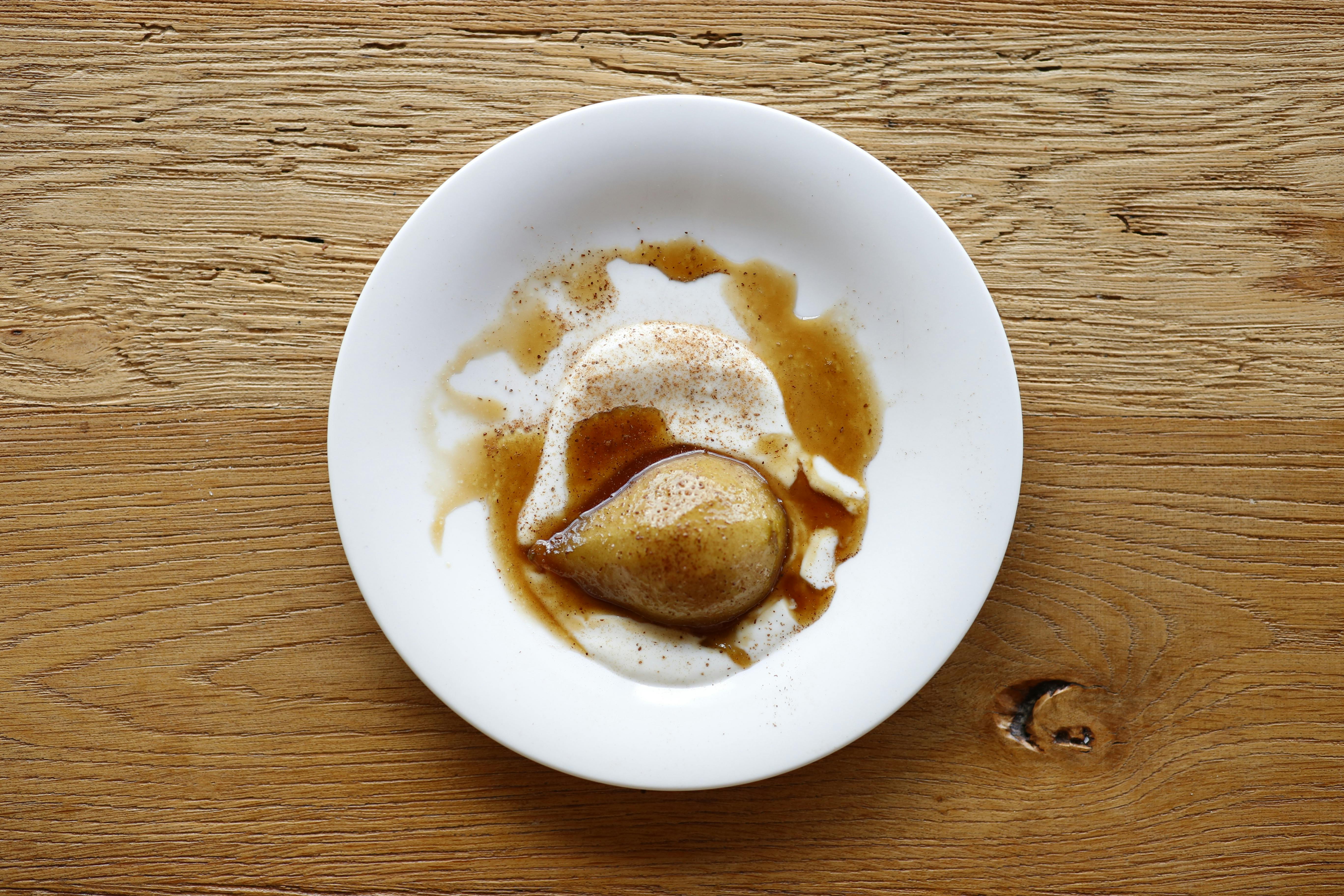
Photo: Johanka Hubikova / Pexels
French
Poached Pears
The diets react (see scores below)
Common Ingredients
- pears
- red wine
- sugar
- cinnamon
- cloves
- vanilla
- lemon
- water
Specific recipes may vary.
Incompatible with 6 of 11 diets
Diet Ratings
Poached Pears is fundamentally incompatible with a ketogenic diet. Pears are a high-sugar fruit with approximately 21-25g of net carbs per medium pear, and the recipe adds explicit sugar to the poaching liquid along with red wine, which contributes additional carbohydrates. Together, a single serving would deliver far more net carbs than the entire daily keto allowance (20-50g). There is no portion size that makes this dish keto-friendly — even a small portion of poached pear absorbs the sugar-wine syrup during cooking, concentrating the carbohydrate load further. The dish also contains zero fat and negligible protein, making it nutritionally misaligned with keto macronutrient targets on every dimension.
All listed ingredients are plant-based: pears, red wine, sugar, cinnamon, cloves, vanilla, lemon, and water contain no animal products. However, two ingredients carry notable vegan caveats. First, red wine is historically filtered using isinglass (fish bladder), gelatin, or egg whites as fining agents, making many commercial wines non-vegan; though an increasing number of wines are now produced with vegan-friendly fining agents or are unfiltered. Second, refined white sugar in some markets (particularly the US) is processed through bone char to achieve its white color, which many ethical vegans consider non-vegan. The dish itself is a relatively whole-food preparation with no heavy processing, so if vegan-certified wine and unrefined or certified vegan sugar are used, this would score much higher. As commonly prepared in restaurants or homes without ingredient vetting, caution is warranted.
Some vegan advocates argue that trace processing aids like isinglass or bone char do not remain in the final product and therefore do not constitute animal ingredients, making the dish fully vegan as served. Whole-food plant-based advocates, by contrast, may also flag the sugar content as nutritionally poor regardless of its vegan status.
Poached Pears contains two clear non-paleo ingredients: refined sugar and alcohol (red wine). Refined sugar is explicitly excluded from the paleo diet as a processed, modern food with no place in a hunter-gatherer diet. Red wine, while sometimes debated in broader health contexts, is an alcoholic processed beverage derived from fermentation and is generally avoided in strict paleo. The remaining ingredients — pears, cinnamon, cloves, vanilla, lemon, and water — are all paleo-approved whole foods. However, the refined sugar alone is sufficient to disqualify this dish. The combination of two problematic ingredients (sugar + alcohol) firmly places this in the 'avoid' category.
Poached pears are built on a whole fruit base, which is strongly encouraged in the Mediterranean diet. The spices (cinnamon, cloves, vanilla) and lemon are entirely compatible, and red wine is a traditional Mediterranean ingredient used in cooking. However, the added sugar is a concern — Mediterranean diet principles discourage added sugars and sweet desserts in regular consumption, reserving them for occasional indulgences. The dish is not highly processed and contains no refined grains or unhealthy fats, but the sugar content and dessert/snack framing prevent a full approval. As an occasional treat it is far preferable to pastries or confections, but it should not be a daily staple.
Traditional Mediterranean culinary practice commonly features fruit-based desserts sweetened modestly with honey or sugar, and poached fruit in wine is a recognized regional preparation in Southern France and Italy; some Mediterranean diet practitioners would approve this as a wholesome, fruit-forward choice with minimal added sugar relative to typical Western desserts.
Poached Pears is entirely plant-based with zero animal-derived ingredients. Every component — pears, red wine, sugar, cinnamon, cloves, vanilla, lemon, and water — is either plant-derived or a plant-based additive. This dish violates every tier of the carnivore diet, including the most lenient interpretations. There is no animal product present whatsoever, and the sugar, fruit, spices, and wine represent exactly the categories the carnivore diet explicitly excludes.
Poached Pears as described contain two clearly excluded ingredients: red wine (alcohol is explicitly prohibited on Whole30) and sugar (added sugar in any form is excluded). While pears, cinnamon, cloves, vanilla, lemon, and water are all Whole30-compliant, the presence of both alcohol and added sugar makes this dish non-compliant. There is no workaround or exception that would allow red wine or granulated sugar in this preparation.
Poached pears are problematic for multiple FODMAP reasons. Pears are one of the highest-FODMAP fruits tested by Monash University, containing significant levels of fructose and sorbitol (polyols) — they are rated red/high-FODMAP at any typical serving size. A standard poached pear serving would be at minimum half to a whole pear, far exceeding any safe threshold. Red wine adds further concern: while small amounts (150ml) of wine are considered low-FODMAP, the wine used in poaching concentrates as it reduces and the dish is typically served with the wine-based syrup, potentially increasing FODMAP load. Sugar itself is low-FODMAP (sucrose). Cinnamon, cloves, vanilla (extract or bean), and lemon (juice and zest in small amounts) are generally low-FODMAP. However, the pear component alone makes this dish unsuitable for the elimination phase regardless of other ingredients.
Monash University clearly rates pears as high-FODMAP due to sorbitol and excess fructose, but some FODMAP practitioners note that cooking and leaching FODMAPs into poaching liquid (which could theoretically be discarded) might reduce the pear's FODMAP content slightly — however, this has not been validated by Monash testing and clinical practice does not support recommending poached pears during elimination phase.
Poached pears are built around a DASH-friendly core ingredient — pears are an excellent source of fiber, potassium, and vitamin C with no sodium. However, the preparation introduces two meaningful concerns. First, added sugar is a DASH-limited ingredient; the quantity used in poaching syrup can be substantial, pushing this dish toward the 'sweets' category that DASH restricts to 5 or fewer servings per week. Second, red wine adds alcohol and additional sugars, neither of which are emphasized in DASH. The spices (cinnamon, cloves, vanilla) and lemon are harmless or even beneficial. Sodium is negligible. If prepared with minimal sugar and consumed in a small portion, the dish leans toward acceptable — the pear itself is a model DASH food. But as traditionally prepared in French cuisine with a generous red wine sugar syrup, the added sugar load warrants caution rather than approval.
NIH DASH guidelines categorically limit sweets and added sugars, which would keep this dish in the 'caution' zone due to its poaching syrup. However, some DASH-oriented dietitians argue that when fruit is the primary ingredient and sugar is used only as a flavor vehicle in a small portion, the overall glycemic and caloric impact remains modest — particularly compared to pastries or candy — and the dish could be considered an acceptable DASH dessert or snack if sugar is minimized.
Poached Pears present a mixed Zone picture. Pears themselves are a moderately favorable Zone fruit — relatively low glycemic index compared to bananas or raisins, with decent fiber content. However, this dish is problematic for several reasons: (1) Added sugar significantly raises the glycemic load of the dish, moving it from a reasonable fruit serving to a high-sugar dessert preparation. (2) As a snack category in Zone terms, it lacks protein and fat entirely — a critical structural failure, since every Zone meal and snack must approximate the 40/30/30 ratio. Without protein or fat, this is essentially a pure carbohydrate (and high-glycemic carbohydrate at that) snack. (3) The red wine and sugar poaching liquid is typically absorbed by the pear, further concentrating sugars. To fit Zone protocol as a snack, a small portion of poached pear (perhaps half a pear, with minimal syrup) would need to be paired with a lean protein (e.g., a few almonds and low-fat cottage cheese) and a monounsaturated fat source. As served in the traditional French preparation, the dish as a standalone snack does not meet Zone criteria.
Some Zone practitioners argue that fruit-based dishes like poached pears can fit as the carbohydrate component of a Zone snack block if portion-controlled carefully (one pear = approximately 2-3 carb blocks in net carbs depending on size and syrup absorption). Dr. Sears does not categorically ban fruit-based dishes; rather, he emphasizes pairing them with protein and fat. A minimally sweetened version with significantly reduced sugar could be elevated to a reasonable Zone carb source when properly paired.
Poached Pears present a genuinely mixed anti-inflammatory profile. On the positive side, pears are a good source of dietary fiber, vitamin C, and polyphenols (including flavonoids and quercetin), which have antioxidant and anti-inflammatory properties. The spices — cinnamon, cloves, and vanilla — are all notable anti-inflammatory ingredients; cloves in particular rank among the highest antioxidant spices by ORAC value, and cinnamon has well-documented anti-inflammatory effects. Lemon adds vitamin C and beneficial flavonoids. Red wine, used in moderate culinary quantities (much of the alcohol cooks off), contributes resveratrol and polyphenols, and is included in Dr. Weil's Anti-Inflammatory Pyramid in moderation. However, the dish's significant weak point is the added sugar, which is a direct pro-inflammatory ingredient — refined sugar promotes glycation, increases CRP, and is explicitly limited under anti-inflammatory principles. The amount of sugar used in a classic poaching syrup is typically substantial (½ to 1 cup per 4 pears). As a dessert-style snack, total sugar load is the primary concern. The fruit and spice base push this toward the positive side, but the sugar prevents an approval. Consumed occasionally and in moderate portions, this is acceptable within an anti-inflammatory lifestyle.
Some anti-inflammatory practitioners (particularly those following stricter protocols like AIP or whole-food frameworks) would rate this closer to 'avoid' due to the significant added sugar content, arguing that even fruit-based desserts with refined sugar meaningfully spike blood glucose and promote inflammatory cascades. Conversely, more permissive interpretations of the anti-inflammatory diet — such as Dr. Weil's approach — would note that the polyphenol-rich fruit, spices, and red wine in a moderate occasional serving could place this in a higher caution or even borderline approve range, especially if sugar is minimized.
Poached pears in red wine is a poor fit for GLP-1 patients across multiple criteria. The dish contains alcohol (red wine), which is explicitly flagged as an avoid due to empty calories, and dehydration risk. Added sugar further compounds the problem, contributing empty calories and a significant glycemic spike with no protein or meaningful fiber to buffer it. While pears themselves offer modest fiber and water content, these benefits are overwhelmed by the alcohol and sugar content of the preparation. The dish provides essentially zero protein, making it nutritionally hollow for GLP-1 patients who must maximize protein in every small meal or snack. As a snack category item, it competes directly with high-protein, high-fiber alternatives and loses badly on nearly every scoring dimension.
*See how scores were generated at our methodology page.
Nutritional profile
Six traits that cut across every diet.
Fiber & Plants
How much whole-plant food and fiber it delivers.
Healthy Fats
The quality of its fats (unsaturated, omega-3).
Whole / Unprocessed
How close it is to its natural, unprocessed form.
Gut Gentle
How easy it is on digestion (low FODMAP, few irritants).
Low Glycemic
How little it spikes your blood sugar.
Protein Density
How much protein it packs per calorie.
Controversy Index
Higher controversy = more disagreement between diets.
Diet-Specific Tips
 Vegan — 6/10
View tips
- All core ingredients are plant-derived
- Red wine is frequently fined with isinglass, gelatin, or egg whites — many commercial wines are not vegan
- Refined sugar may be processed through bone char in some regions
- Vegan-certified wine and unrefined/raw sugar alternatives would make this fully vegan-compliant
- Dish is otherwise a minimally processed, whole-food preparation
- No meat, dairy, eggs, or explicitly animal-derived ingredients listed
 Mediterranean — 5/10
View tips
- Whole fruit (pears) as the primary ingredient — strongly positive
- Added sugar contradicts Mediterranean diet's minimal added-sugar principle
- Red wine is a traditional Mediterranean cooking ingredient
- No refined grains, unhealthy fats, or processed components
- Spices and lemon are fully compatible
- Best consumed occasionally rather than as a regular snack
 DASH — 5/10
View tips
- Pears are a DASH-approved fruit: high in fiber, potassium, and vitamin C with no sodium
- Added sugar in poaching syrup is a DASH-limited ingredient (max 5 servings sweets/week)
- Red wine contributes alcohol and additional sugar, not emphasized in DASH
- Spices and lemon are DASH-neutral or beneficial
- Negligible sodium — a positive factor
- Portion size and sugar quantity are critical — a lightly sweetened version scores higher
- No saturated fat, no processed ingredients, no high-sodium components
 Zone — 4/10
View tips
- No protein or fat — fails Zone 40/30/30 balance as a standalone snack
- Added sugar significantly increases glycemic load beyond what pear alone would contribute
- Pears themselves are a moderately favorable Zone fruit with reasonable fiber
- Red wine poaching liquid absorbs into the fruit, adding additional sugar and glycemic impact
- Spices (cinnamon, cloves, vanilla) are Zone-neutral and polyphenol-rich — a minor positive
- Would require pairing with lean protein and monounsaturated fat to approach Zone compliance
- Traditional French preparation is dessert-oriented, not designed for Zone macronutrient balance
 Anti-Inflammatory — 5/10
View tips
- Pears provide fiber, quercetin, and polyphenols with anti-inflammatory properties
- Cinnamon and cloves are potent anti-inflammatory spices with high antioxidant values
- Added sugar is a significant pro-inflammatory concern and the primary limiting factor
- Red wine contributes resveratrol and polyphenols; alcohol largely cooks off in poaching
- Lemon adds vitamin C and flavonoids
- No omega-3s, no significant protein, limited nutritional density beyond fruit and spice benefits
- Overall profile is acceptable occasionally but not ideal for regular anti-inflammatory snacking