The diets react (see scores below)
Common Ingredients
- beets
- onion
- carrots
- garlic
- bay leaf
- vinegar
- marjoram
- stock
Specific recipes may vary.
Incompatible with 3 of 11 diets
Diet Ratings
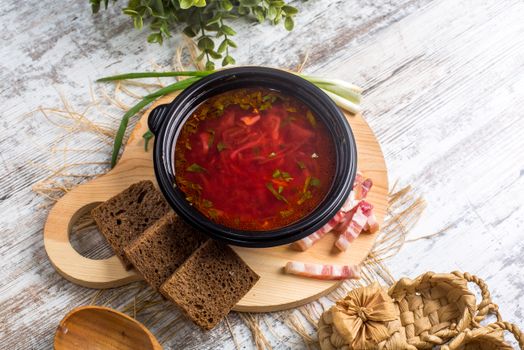
Barszcz (Polish beet soup) is primarily made from beets, which are high in net carbs and natural sugars. A typical serving (1 cup/240ml) contains approximately 10-13g net carbs, almost entirely from beets. With carrots adding additional carbs and no fat content to speak of, this soup is poorly suited to keto. The broth-like nature means you consume the carbs without much fiber offset. Even a small bowl can consume a significant portion of the daily 20g net carb limit, and the beet base makes portion control difficult while still achieving the dish's intended flavor profile.
Lazy keto or high-carb-limit keto practitioners (targeting 50g net carbs/day) might argue that a small cup as a starter, made with a heavily diluted beet broth rather than a thick reduction, could fit within daily limits if the rest of the day's meals are strictly zero-carb. Some also note that consuming it as a small flavoring broth rather than a full bowl reduces carb load substantially.
The listed ingredients (beets, onion, carrots, garlic, bay leaf, vinegar, marjoram) are all fully plant-based. However, the ingredient 'stock' is ambiguous and critical: traditional Polish barszcz is most commonly made with meat or bone broth, making the standard restaurant or home version non-vegan. As listed here with a generic 'stock', the dish could be vegan if vegetable stock is used, but this cannot be assumed. The dish is rated 'caution' because the default preparation in Polish cuisine typically involves animal-based stock, and the ingredient as listed does not confirm a plant-based version. If vegetable stock is confirmed, this would be a whole-food, nutrient-dense approve/9.
Some plant-based advocates would rate this as 'approve' based on the listed ingredients taken at face value, arguing that stock should default to vegetable stock when no animal product is explicitly named. Strict ethical vegans would counter that 'stock' in Polish culinary tradition almost universally implies meat or bone broth and must be explicitly confirmed as plant-based.
Barszcz (Polish beet soup) is composed almost entirely of paleo-friendly whole foods: beets, onion, carrots, and garlic are unprocessed vegetables; bay leaf and marjoram are natural herbs; and a meat-based or vegetable stock is paleo-compatible. The key question mark is the vinegar — most vinegars (apple cider vinegar in particular) are generally accepted in the paleo community, though the type used matters. White distilled vinegar is more processed and less favored, while apple cider or red wine vinegar are widely tolerated. Assuming a natural vinegar and a clean stock with no additives or added salt, this dish aligns well with paleo principles. There is no grain, legume, dairy, refined sugar, or seed oil present.
Strict paleo purists following Loren Cordain's original framework may flag vinegar (depending on type) and commercial stocks that often contain added salt, preservatives, or natural flavors — ingredients that technically fall outside a clean paleo protocol. Ensuring homemade or fully additive-free stock is critical to full compliance.
Barszcz is a beet-based soup composed almost entirely of vegetables — beets, onion, carrots, and garlic — with aromatic herbs and a light stock base. Every ingredient aligns closely with Mediterranean diet principles emphasizing whole, plant-based foods. Beets are nutrient-dense root vegetables rich in fiber, folate, and antioxidants. The aromatics (onion, garlic, carrots) are staples of Mediterranean-style cooking. Vinegar adds acidity without sugar or unhealthy fat. The only minor consideration is the stock, which could be animal-based, but even so it is used sparingly as a flavor base. There are no processed ingredients, added sugars, refined grains, or unhealthy fats present. While Polish in origin rather than Mediterranean, the dish is entirely compatible with Mediterranean dietary principles by composition.
Barszcz is a traditional Polish beet soup made entirely from plant-based ingredients. Every single component — beets, onion, carrots, garlic, bay leaf, vinegar, and marjoram — is plant-derived and explicitly excluded from the carnivore diet. Even the stock is unspecified, but given the dish has no primary protein listed and is a classic vegetable-based soup, it is unlikely to be a pure animal-based stock. There is no animal product present in this dish. This is a complete violation of every tier of the carnivore diet, including the most lenient interpretations.
Barszcz (Polish beet soup) is made from entirely Whole30-compliant ingredients. Beets, onion, carrots, garlic, bay leaf, marjoram, and vinegar are all permitted. Most vinegars are explicitly allowed on Whole30 (except malt vinegar). The stock should be checked to ensure it contains no added sugar, MSG (now allowed), or non-compliant additives, but homemade or compliant store-bought stock is widely available. This is a whole-food, vegetable-based soup that aligns perfectly with the spirit and rules of the program.
Barszcz contains multiple high-FODMAP ingredients that make it unsuitable during the elimination phase. Garlic is one of the highest-FODMAP foods (fructans) and is a core flavoring. Onion is similarly high in fructans and is used as a primary aromatic. Both are cooked in a water-based stock, meaning their fructans leach directly into the broth — making the entire soup high-FODMAP even if the solids are strained out. Beets are high-FODMAP at standard serving sizes (Monash rates beets as high-FODMAP at 2 slices/75g due to excess fructose and GOS), and soup portions typically exceed safe thresholds. The stock may also contain onion or garlic. The combination of garlic, onion, and beets in a water-based broth creates a high-FODMAP dish with no easy modification path short of substituting most of the key ingredients.
Barszcz (Polish beet soup) is built on a foundation of DASH-friendly vegetables — beets, carrots, onion, and garlic — that are rich in potassium, folate, fiber, and nitrates. These ingredients align well with DASH principles. However, the key variable is the stock used as the base. Commercial or restaurant stock can be very high in sodium (500–900mg per cup), which is the primary concern for DASH compliance. If made with homemade low-sodium stock, this soup would score much higher (8–9) and be a strong DASH approve. As commonly prepared in Polish cuisine, commercial stock is typical, pushing sodium into cautionary territory. The small amount of vinegar adds negligible concern. No saturated fat, no added sugar, no processed meats — the vegetable profile is excellent.
NIH DASH guidelines do not specifically address beet soup, but emphasize vegetable-rich, low-sodium soups as ideal. Updated clinical interpretation among DASH-oriented dietitians would likely approve this dish when prepared with low-sodium or homemade stock, noting that the beet-forward vegetable base is exceptionally well-aligned with DASH nutrient targets (potassium, magnesium, fiber).
Barszcz (Polish beet soup) is a vegetable-based soup with no protein or fat components, making it incomplete as a Zone meal on its own. The primary ingredient — beets — has a moderate-to-high glycemic index (GI ~64), which places them in Zone's 'unfavorable' carbohydrate category, though the glycemic load in a typical serving is moderate due to high water content and fiber. The other vegetables (onion, carrots, garlic) are generally Zone-favorable. The vinegar is actually Zone-positive, as it helps blunt glycemic response. As a soup, barszcz is very low in calories overall, so the absolute glycemic impact per serving is manageable. However, without protein or fat, it cannot stand alone as a Zone-balanced meal — it needs to be paired with lean protein and a monounsaturated fat source to hit the 40/30/30 ratio. As a starter or component within a larger Zone meal, it can work with careful portioning of beets.
Some Zone practitioners treat beets as simply requiring small block portions rather than avoidance — Sears' later writings emphasize polyphenol-rich foods, and beets are high in polyphenols and nitrates with anti-inflammatory properties, which aligns with his post-Enter-the-Zone anti-inflammatory framework. This could push barszcz toward a more favorable view when consumed in reasonable quantities as part of a complete Zone meal.
Barszcz (Polish beet soup) is a strongly anti-inflammatory dish with an excellent ingredient profile. Beets are rich in betalains (betanin, vulgaxanthin), powerful antioxidant and anti-inflammatory pigments that have been shown to reduce CRP and NF-κB signaling. They also provide nitrates that support vascular health. Carrots contribute beta-carotene and other carotenoids. Onion and garlic are both well-established anti-inflammatory foods high in quercetin, allicin, and organosulfur compounds. Marjoram is an anti-inflammatory herb with rosmarinic acid content. Bay leaf contains compounds with demonstrated anti-inflammatory and antioxidant properties. The vinegar adds acidity without harm, and a vegetable or bone stock provides minerals. There are no pro-inflammatory ingredients present — no refined carbohydrates, no seed oils, no sugar, no processed additives, no excessive saturated fat. This is a traditional, whole-food, plant-based soup with a broad array of polyphenols and antioxidants, making it highly compatible with anti-inflammatory dietary principles.
Barszcz is a traditional Polish beet soup that is low in calories, low in fat, and easy to digest — all positives for GLP-1 patients. Beets provide some fiber and beneficial micronutrients (folate, manganese, potassium), and the vegetable-based broth supports hydration. However, the dish has no meaningful protein source, which is the top dietary priority for GLP-1 patients. On its own, it contributes almost nothing toward the 100-120g daily protein target and would be a poor use of limited stomach capacity if it displaces protein-rich foods. The vinegar content is a mild concern for patients experiencing reflux or nausea, though in typical recipe quantities it is unlikely to cause significant issues. Barszcz is acceptable as a light starter or hydration-supportive side, but should always be paired with a protein-rich component (e.g., hard-boiled egg, lean meat uszka dumplings with careful portion control, or cottage cheese on the side) rather than consumed as a standalone meal.
*See how scores were generated at our methodology page.
Nutritional profile
Six traits that cut across every diet.
Fiber & Plants
How much whole-plant food and fiber it delivers.
Healthy Fats
The quality of its fats (unsaturated, omega-3).
Whole / Unprocessed
How close it is to its natural, unprocessed form.
Gut Gentle
How easy it is on digestion (low FODMAP, few irritants).
Low Glycemic
How little it spikes your blood sugar.
Protein Density
How much protein it packs per calorie.
Controversy Index
Higher controversy = more disagreement between diets.
Diet-Specific Tips
 Vegan — 6/10
View tips
- Stock is ambiguous — traditional Polish barszcz uses meat/bone broth, making it non-vegan by default
- All other listed ingredients are fully plant-based whole foods
- Vegan version is easily achievable with vegetable stock substitution
- Beets provide excellent nutrition: folate, fiber, and antioxidants
- No processed or ethically contested ingredients beyond the stock uncertainty
 Paleo — 8/10
View tips
- Beets, carrots, onion, and garlic are whole, unprocessed paleo vegetables
- Bay leaf and marjoram are natural, paleo-approved herbs
- Vinegar type matters — apple cider or red wine vinegar is preferred over distilled white vinegar
- Stock quality is critical — homemade or additive-free stock required for full paleo compliance
- No grains, legumes, dairy, refined sugar, or seed oils present
- Naturally low-sugar, nutrient-dense dish with no processed ingredients
 Mediterranean — 9/10
View tips
- Beets are a nutrient-dense whole vegetable rich in fiber and antioxidants
- All primary ingredients are whole, unprocessed plant foods
- No added sugars, refined grains, or unhealthy fats
- Garlic and onion are core Mediterranean aromatics
- Stock base may be animal-derived but used in minimal quantities
- Vinegar is a Mediterranean-compatible acidulant
 Whole30 — 6/10
View tips
- Beets and all other vegetables are fully Whole30-compliant
- Vinegar is explicitly allowed (except malt vinegar — standard white, apple cider, or wine vinegar applies here)
- Marjoram and bay leaf are permitted herbs/spices
- Stock should be verified as compliant (no added sugar or non-compliant additives)
- No excluded ingredients present
- Whole, unprocessed food preparation consistent with Whole30 spirit
 DASH — 6/10
View tips
- Excellent vegetable base: beets, carrots, onion, garlic — all DASH-recommended
- High in potassium, folate, fiber, and nitrates from beets
- Sodium highly dependent on stock choice — commercial stock can add 500–900mg per serving
- No saturated fat, cholesterol, added sugar, or processed ingredients
- Low-sodium or homemade stock version would qualify as a strong DASH approve
- Vinegar adds flavor without sodium penalty — a DASH-friendly technique
 Zone — 5/10
View tips
- Beets are a moderate-to-high glycemic index carbohydrate, classified as 'unfavorable' in Zone terminology
- Glycemic load per serving is moderate due to high water content in soup form
- Vinegar in the recipe is Zone-positive as it blunts glycemic response
- No protein or fat present — cannot form a balanced Zone meal alone
- Must be paired with lean protein (~25g) and monounsaturated fat (~10-15g) to achieve 40/30/30 ratio
- Carrots, onion, and garlic are generally Zone-favorable vegetables
- Beets contain polyphenols and nitrates consistent with Sears' later anti-inflammatory emphasis
 Anti-Inflammatory — 8/10
View tips
- Beets high in betalains — potent anti-inflammatory and antioxidant pigments
- Garlic and onion provide quercetin, allicin, and organosulfur anti-inflammatory compounds
- Carrots contribute beta-carotene and carotenoids
- Marjoram and bay leaf add anti-inflammatory phytochemicals
- No pro-inflammatory ingredients — no refined carbs, seed oils, sugar, or additives
- Entirely whole-food, plant-based preparation
 GLP-1 Friendly — 5/10
View tips
- No significant protein — critical gap for GLP-1 patients needing 100-120g daily
- Low fat — supports GLP-1 tolerability and reduces nausea/reflux risk
- Moderate fiber from beets and vegetables — supports digestion and constipation prevention
- High water content — beneficial given reduced thirst sensation on GLP-1 medications
- Low calorie density — hydration-supportive but must not displace protein-rich foods at meals
- Vinegar content — mild reflux/nausea concern for sensitive GLP-1 patients, generally tolerable
- Nutrient-dense for its calorie load but incomplete as a standalone meal or main course