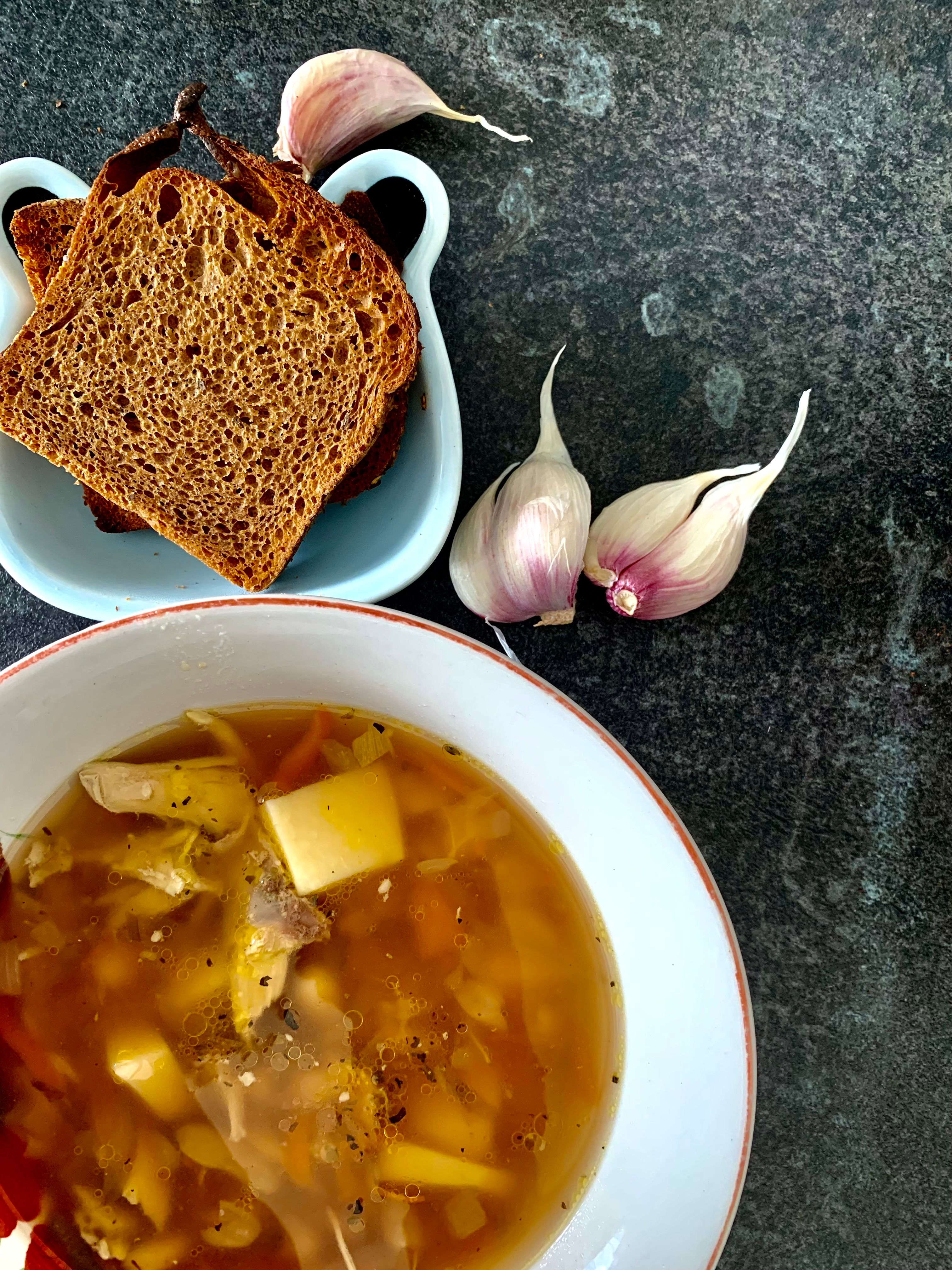
Photo: Helen Brudna / Pexels
The diets react (see scores below)
Common Ingredients
- beef tripe
- carrots
- onion
- celery root
- marjoram
- paprika
- ginger
- stock
Specific recipes may vary.
Incompatible with 4 of 11 diets
Diet Ratings
Flaki is a traditional Polish tripe soup that is broadly keto-compatible in its protein and fat profile, but requires attention to carb-contributing ingredients. Beef tripe is a low-fat, moderate-protein offal that is keto-friendly and nutritionally dense. The main carb concerns come from carrots (roughly 6-7g net carbs per 100g) and celery root (roughly 7-9g net carbs per 100g), both of which are used in meaningful quantities in a traditional recipe. Stock may also contain hidden carbs depending on preparation. Spices like marjoram, paprika, and ginger are fine in typical cooking quantities. A standard serving of Flaki could push net carbs to 10-15g depending on vegetable proportions, which is manageable within a daily keto budget but not negligible. Portion control and reducing the carrot and celery root quantities would make this more solidly keto-friendly.
Some strict keto practitioners would flag carrots and celery root as too starchy for regular inclusion, arguing that even moderate amounts accumulate quickly when combined with other daily carb sources, and would recommend substituting with lower-carb vegetables like zucchini or celery stalks.
Flaki is a traditional Polish tripe soup made from beef tripe (the stomach lining of cattle) as its primary ingredient, along with beef stock. Both beef tripe and beef stock are direct animal products — organ meat and animal-derived liquid respectively. There is absolutely no ambiguity here: this dish is fundamentally incompatible with a vegan diet. The vegetables and spices (carrots, onion, celery root, marjoram, paprika, ginger) are plant-based, but the core protein and broth are entirely animal-derived.
Flaki is a traditional Polish tripe soup built on ingredients that align well with paleo principles. Beef tripe is organ meat — a nutrient-dense food highly regarded in ancestral eating and enthusiastically endorsed by paleo authorities like Chris Kresser and the Weston A. Price Foundation. Carrots, onion, and celery root are all paleo-approved vegetables. Marjoram, paprika, and ginger are natural herbs and spices with no paleo objection. The main uncertainty lies in the stock: homemade bone broth is fully paleo-approved, but commercial stock often contains added salt, preservatives, or flavor additives that would push this toward caution. Assuming a clean, homemade or additive-free stock, this dish is a strong paleo option. Confidence is medium rather than high because commercial stock is the norm in practice, and some paleo practitioners are skeptical of heavily processed tripe (pre-bleached, pre-cleaned industrial tripe vs. fresh from a butcher).
Some stricter paleo adherents raise concerns about industrially processed tripe, which is often bleached and treated before sale, arguing this processing conflicts with paleo's whole-food philosophy. Additionally, if prepared with commercial stock containing added salt or yeast extract, the dish would warrant a caution rating under strict interpretations.
Flaki is a traditional Polish tripe soup built around beef offal, which falls squarely in the red meat/organ meat category that the Mediterranean diet limits to a few times per month. While the vegetable base (carrots, onion, celery root) and spices (marjoram, paprika, ginger) are Mediterranean-friendly, the primary protein is beef tripe — an organ meat with relatively high saturated fat content and no place as a regular feature in Mediterranean eating. The dish is also deeply rooted in Central European culinary tradition, not Mediterranean, and would typically be made with animal-based stock rather than olive oil as the fat foundation. The overall dietary pattern it represents — heavy reliance on red/organ meat — contradicts Mediterranean principles.
Some Mediterranean diet interpreters note that offal is actually consumed in traditional Southern Italian and Greek cuisines (e.g., Greek kokoretsi, Italian lampredotto), and organ meats are whole, minimally processed foods. A moderate, occasional serving could be viewed as more acceptable than highly processed red meat products under a traditional Mediterranean lens.
Flaki is a traditional Polish tripe soup that, while centered on beef tripe (an excellent organ meat highly valued on carnivore), is disqualified by its numerous plant-based ingredients. Carrots, onion, and celery root are vegetables, and marjoram, paprika, and ginger are plant-derived spices — all excluded on a strict carnivore diet. The stock may also contain plant-based aromatics. Beef tripe itself would score a 9-10 on carnivore, but the dish as prepared cannot be approved due to its heavy reliance on plant foods.
Flaki is a traditional Polish tripe soup whose listed ingredients—beef tripe, carrots, onion, celery root, marjoram, paprika, ginger, and stock—are all Whole30-compliant whole foods. Beef tripe is an animal protein explicitly permitted by the program. The vegetables and spices are straightforwardly allowed. The one variable is 'stock': homemade or compliant store-bought stock (no added sugar, gluten, soy, or off-limits additives) is fine, but many commercial stocks contain sugar, yeast extract, or other excluded ingredients and would require careful label-reading.
Confidence is medium rather than high because organ meats and offal, while technically compliant, sit in a space where some Whole30 practitioners debate whether heavily processed or pre-packaged tripe (which can be bleached or treated) fully honors the program's whole-food spirit. Official Whole30 guidelines do not restrict organ meats, but Melissa Urban's emphasis on food quality encourages sourcing minimally processed animal products.
Flaki contains two significant high-FODMAP ingredients that make it problematic during the elimination phase. Onion is one of the highest-FODMAP foods tested by Monash University, containing significant fructans even in small amounts — it is a core ingredient in this dish and cannot easily be removed. Celery root (celeriac) is also high-FODMAP at standard serving sizes due to fructans and mannitol content. Beef tripe itself is a plain protein and is low-FODMAP. Carrots are low-FODMAP at standard servings (75g). Marjoram, paprika, and ginger are low-FODMAP spices in typical culinary quantities. However, the stock is a wildcard — commercial stocks often contain onion and/or garlic, adding further FODMAP load. The combination of onion and celery root as structural ingredients means this dish cannot be considered safe during the elimination phase without significant recipe modification.
Monash University clearly rates onion as high-FODMAP at any serving size, making its presence unambiguous. However, some clinical FODMAP practitioners note that if onion is used only to flavor the stock and then removed before serving, FODMAP transfer into broth is relatively low (FODMAPs are water-soluble and do transfer into cooking liquid — so this remains debated). The dish as traditionally prepared with onion cooked in is not elimination-safe.
Flaki (Polish tripe soup) presents a mixed DASH profile. The vegetable base (carrots, onion, celery root) and spices (marjoram, paprika, ginger) are DASH-friendly, providing potassium, fiber, and anti-inflammatory compounds. However, beef tripe is an organ meat — higher in cholesterol than lean muscle meats and not emphasized in DASH guidelines, which favor lean poultry, fish, and plant proteins. The stock is the critical variable: traditional Polish stock is often high in sodium, potentially pushing a single serving well above DASH thresholds (500-900mg+ per bowl). Beef tripe itself is relatively low in saturated fat compared to fatty cuts of red meat, which is a partial positive, but it is not a lean protein DASH would prioritize. The dish is not explicitly processed or laden with saturated fat or added sugar, so it avoids the 'avoid' category, but the likely sodium load from stock and the use of organ meat keep it in 'caution' territory. Using low-sodium stock and limiting portion size would improve its DASH compatibility significantly.
NIH DASH guidelines do not specifically address organ meats like tripe, focusing instead on limiting red meat broadly and favoring lean proteins. Some DASH-oriented clinicians note that tripe is actually quite low in saturated fat (unlike fatty beef cuts) and may be acceptable in moderation, particularly if the dish is prepared with low-sodium stock — this more permissive interpretation would rate home-prepared, low-sodium flaki closer to a 5-6.
Flaki (Polish tripe soup) presents a mixed Zone Diet profile. Beef tripe is a lean, high-protein organ meat with a decent amino acid profile and relatively low fat content compared to other beef cuts — it functions reasonably well as a Zone protein source, though it is not a 'favorable' lean protein like skinless chicken or fish. The vegetable base (carrots, onion, celery root) contributes low-glycemic carbohydrates that align well with Zone principles, and the anti-inflammatory spices (marjoram, ginger, paprika) are positively viewed under Sears' polyphenol emphasis. The main concerns are: (1) beef tripe contains some saturated fat, which early Zone writings cautioned against; (2) the stock may add sodium and hidden ingredients depending on preparation; (3) the dish lacks a good monounsaturated fat source, leaving the 30% fat block unfulfilled unless supplemented. As a soup, it is also lower in caloric density, making it harder to hit Zone block targets in a single serving. With careful portioning and the addition of a monounsaturated fat source (e.g., a drizzle of olive oil or a few almonds on the side), this dish can be incorporated into a Zone meal plan.
Some Zone practitioners following Sears' earlier, stricter Enter the Zone guidelines would flag beef tripe more strongly due to its saturated fat content and classify it as an 'unfavorable' protein, preferring fish or poultry. Sears' later anti-inflammatory writings (The OmegaRx Zone) softened the stance on saturated fat somewhat, focusing more on the omega-6/omega-3 ratio — tripe is not particularly high in omega-6s, which modestly rehabilitates it in later Zone frameworks.
Flaki presents a genuinely mixed anti-inflammatory profile. On the positive side, the dish contains several meaningful anti-inflammatory ingredients: marjoram and ginger are well-regarded anti-inflammatory spices, paprika contributes carotenoids and antioxidants, and the aromatic vegetables (carrots, onion, celery root) provide fiber, flavonoids, and polyphenols. The broth-based preparation is a plus — soups tend to retain nutrients well. However, the primary protein, beef tripe, is organ meat from a red meat source. While tripe is relatively low in fat compared to many red meat cuts, it is high in cholesterol and contains arachidonic acid, a precursor to pro-inflammatory eicosanoids. The anti-inflammatory framework generally limits red meat and does not specifically endorse organ meats. Tripe does offer some nutritional merits — it's rich in protein, zinc, selenium, and B vitamins — and its fat content is moderate, which somewhat mitigates concerns compared to fatty red meat. The spice profile (marjoram, ginger, paprika) partially offsets the pro-inflammatory potential of the tripe. Overall, this is an acceptable occasional dish but not one aligned with the core emphasis of the anti-inflammatory diet.
Some traditional and ancestral nutrition advocates (e.g., those aligned with nose-to-tail eating or the Weston A. Price Foundation) argue that organ meats like tripe are nutrient-dense superfoods with beneficial compounds like collagen precursors and glycine, which some research suggests may have anti-inflammatory properties. However, mainstream anti-inflammatory frameworks (Dr. Weil's pyramid, IF Rating system) do not emphasize organ meats and continue to categorize red meat generally as a food to limit.
Flaki is a traditional Polish tripe soup that presents a mixed nutritional profile for GLP-1 patients. Beef tripe is a lean organ meat — notably lower in fat than most beef cuts — and provides a reasonable amount of protein (~17-20g per serving), making it better than many red meat options. The broth-based format is a significant advantage: soups are generally easy to digest, hydrating, portion-friendly, and sit lighter in a slowed stomach than solid heavy meals. The vegetables (carrot, celery root, onion) add fiber, micronutrients, and water content. Marjoram, paprika, and ginger are generally well-tolerated and ginger may even help with GLP-1-related nausea. The main concerns are: (1) tripe is still a red meat product and carries some saturated fat, though less than fatty beef cuts; (2) the spice profile, particularly paprika and ginger in larger quantities, may irritate some GLP-1 patients experiencing nausea or reflux, though at typical culinary doses this risk is mild; (3) protein per serving may fall short of the 15-30g per meal target depending on tripe quantity, and protein density per calorie is moderate rather than high. Overall, a traditional homemade bowl is acceptable and preferable to fried or fatty meat dishes, but it is not a protein powerhouse and spice tolerance is individual.
Some GLP-1-focused dietitians avoid recommending any red or organ meat due to saturated fat concerns and a preference for clearly lean proteins like chicken or fish; others consider tripe acceptable precisely because its fat content is lower than typical beef and the broth format aids tolerability. Individual sensitivity to spices — particularly on injection days when nausea peaks — means the same bowl may be well-tolerated by one patient and problematic for another.
*See how scores were generated at our methodology page.
Nutritional profile
Six traits that cut across every diet.
Fiber & Plants
How much whole-plant food and fiber it delivers.
Healthy Fats
The quality of its fats (unsaturated, omega-3).
Whole / Unprocessed
How close it is to its natural, unprocessed form.
Gut Gentle
How easy it is on digestion (low FODMAP, few irritants).
Low Glycemic
How little it spikes your blood sugar.
Protein Density
How much protein it packs per calorie.
Controversy Index
Higher controversy = more disagreement between diets.
Diet-Specific Tips
 Keto — 5/10
View tips
- Beef tripe is a keto-friendly offal protein with low net carbs
- Carrots contribute meaningful net carbs (~6-7g/100g) and are a point of concern
- Celery root adds additional net carbs (~7-9g/100g)
- Spices and herbs are negligible in carb contribution
- Stock quality and carb content varies; homemade preferred
- Standard serving likely 10-15g net carbs — manageable with portion control
- Tripe provides collagen and nutrients valued in whole-food keto approaches
 Paleo — 6/10
View tips
- Beef tripe is a nutrient-dense organ meat — strongly paleo-aligned
- Carrots, onion, and celery root are fully paleo-approved vegetables
- Marjoram, paprika, and ginger are natural herbs/spices with no paleo concerns
- Stock quality is critical — homemade bone broth is ideal; commercial stock may contain additives or salt
- Industrial tripe processing (bleaching) is a minor concern for strict paleo adherents
- No grains, legumes, dairy, or seed oils present
 Whole30 — 8/10
View tips
- Beef tripe is an organ meat and fully Whole30-compliant animal protein
- All vegetables (carrots, onion, celery root) are approved
- Marjoram, paprika, and ginger are compliant herbs and spices
- Stock must be verified compliant—no added sugar, soy, or gluten-containing ingredients
- Pre-packaged tripe may be treated with bleach or additives; sourcing quality matters
- No grains, dairy, legumes, or sweeteners in the listed ingredients
 DASH — 4/10
View tips
- Beef tripe is an organ meat with elevated cholesterol, not emphasized in DASH lean protein recommendations
- Traditional stock likely contributes high sodium load, potentially exceeding DASH limits per serving
- Vegetable base (carrots, onion, celery root) provides DASH-friendly potassium and fiber
- Tripe is relatively low in saturated fat compared to other beef products, a partial DASH positive
- Spices (marjoram, paprika, ginger) are sodium-free flavor enhancers consistent with DASH sodium-reduction strategies
- Low-sodium stock substitution would meaningfully improve DASH compatibility
 Zone — 5/10
View tips
- Beef tripe is a lean organ meat with acceptable protein content but contains saturated fat, making it a borderline Zone protein source
- Vegetable ingredients (carrots, onion, celery root) are low-glycemic and Zone-favorable carbohydrates
- Anti-inflammatory spices (ginger, marjoram, paprika) align with Sears' polyphenol emphasis
- Dish lacks a monounsaturated fat source — supplementation needed to balance the 30% fat block
- Soup format has lower caloric density, making it difficult to hit Zone block targets without larger portions or side additions
- Stock quality and sodium content are preparation-dependent variables
 Anti-Inflammatory — 4/10
View tips
- Beef tripe is an organ meat from a red meat source — limited in anti-inflammatory frameworks due to arachidonic acid and cholesterol content
- Ginger is a well-established anti-inflammatory spice (inhibits NF-κB and COX enzymes)
- Marjoram contributes antioxidant polyphenols and has demonstrated anti-inflammatory activity
- Paprika provides carotenoids (capsanthin, beta-carotene) with antioxidant properties
- Carrots and onion add fiber, quercetin, and beta-carotene
- Broth-based preparation is preferable to fried or cream-based alternatives
- No refined carbohydrates, added sugars, or trans fats present
- Tripe is relatively low in saturated fat compared to other red meats, which moderates concern
- Collagen/glycine content of tripe may have modest anti-inflammatory benefits — an area of emerging research
 GLP-1 Friendly — 5/10
View tips
- Tripe is lean compared to most beef cuts — lower saturated fat than fatty red meat
- Broth-based soup format supports hydration and easy gastric emptying
- Moderate protein per serving (~17-20g), may need supplementing to hit meal targets
- Vegetables contribute fiber and micronutrients
- Spices (paprika, ginger) generally mild but may worsen nausea or reflux in sensitive patients
- Organ meat — some GLP-1 clinicians advise caution with all red/organ meat categories
- No fried components, no added sugar, no carbonation — no major red flags