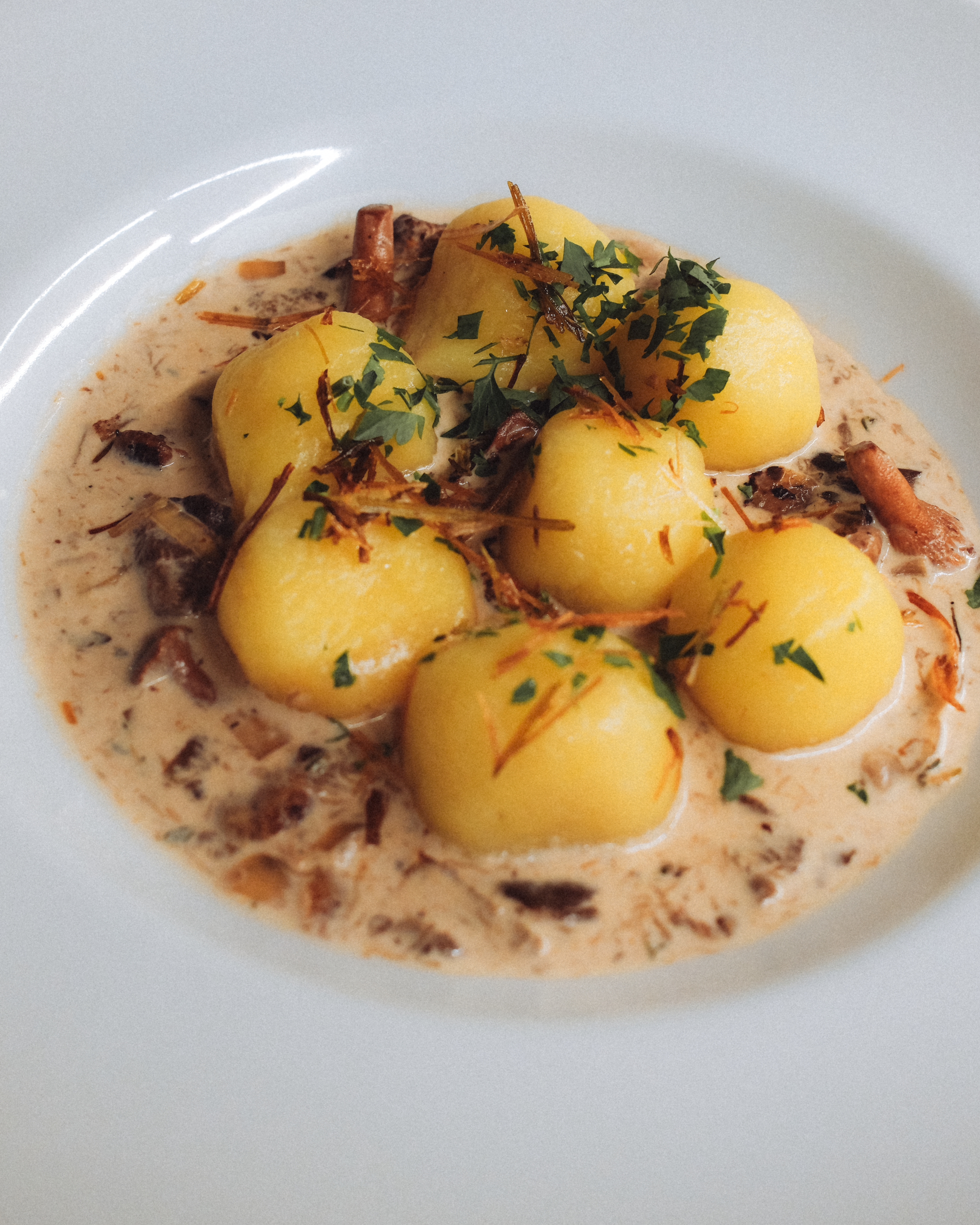
Photo: Anh Nguyen / Pexels
The diets react (see scores below)
Common Ingredients
- potatoes
- flour
- eggs
- salt
- butter
Specific recipes may vary.
Incompatible with 8 of 11 diets
Diet Ratings
Kopytka are Polish potato dumplings made primarily from potatoes and wheat flour — both of which are strictly incompatible with a ketogenic diet. Potatoes are high-starch vegetables with very high net carbs (roughly 15-17g net carbs per 100g cooked), and wheat flour compounds the problem further with additional starch and gluten-based carbohydrates. A standard serving of kopytka (150-200g) would easily contain 40-60g of net carbs on its own, far exceeding the entire daily keto allowance. The eggs and butter are keto-friendly, but they are minor components that cannot offset the dominant carbohydrate load from potatoes and flour. This dish is fundamentally a carbohydrate-dense comfort food with no viable keto modification without completely changing its identity.
Kopytka are Polish potato dumplings that contain eggs and butter — both animal-derived ingredients — making them incompatible with a vegan diet. Eggs are a direct animal product, and butter is a dairy derivative. While the base of potatoes and flour is fully plant-based, the two binding and finishing ingredients disqualify this dish entirely. Vegan adaptations exist (replacing eggs with flaxseed meal or aquafaba, and butter with plant-based margarine or olive oil), but the traditional recipe as listed is not vegan.
Kopytka are Polish potato dumplings that are fundamentally incompatible with the paleo diet. While potatoes are debated in paleo circles, the dish's primary structure depends on wheat flour, which is a grain and a clear paleo exclusion with high consensus. Salt is also added, which is excluded under paleo rules. Butter is a dairy product, excluded by strict paleo guidelines. Even setting aside the flour, this dish cannot exist in its traditional form without non-paleo ingredients — it is not a borderline case. The combination of a grain (flour), dairy (butter), added salt, and a debated ingredient (white potato) makes this a firm avoid.
Kopytka are Polish potato dumplings made primarily from refined white flour and starchy potatoes, finished with butter as the fat — a combination that conflicts with core Mediterranean diet principles on multiple levels. Refined flour is a processed grain discouraged in favor of whole grains; potatoes offer limited nutritional density compared to Mediterranean vegetables and legumes; and butter as the primary fat directly contradicts the Mediterranean emphasis on extra virgin olive oil. The dish is carbohydrate-heavy with minimal fiber, vitamins, or healthy fats in its traditional form.
Some Mediterranean diet interpreters allow moderate potato consumption, as potatoes appear occasionally in southern European cuisines (e.g., Greek and Italian side dishes), and eggs are an accepted moderate ingredient. A small portion alongside vegetables and olive oil could theoretically fit a flexible interpretation, but the butter and refined flour remain problematic.
Kopytka are Polish potato dumplings made primarily from potatoes and flour — two plant-derived, starchy foods that are completely incompatible with the carnivore diet. Potatoes are a plant tuber and flour is a grain product, both explicitly excluded. While eggs and butter are animal-derived, they are minor components and do not redeem this dish. The overwhelming majority of ingredients are plant-based carbohydrates with no meaningful animal protein source.
Kopytka are Polish potato dumplings made primarily with flour, which is a grain and explicitly excluded on the Whole30. Additionally, butter (regular dairy butter) is excluded — only ghee and clarified butter are permitted. Even setting aside the spirit-of-the-program concern about recreating a dumpling/pasta-like dish, the inclusion of flour alone makes this a clear avoid. The dish also structurally falls under the 'no recreating pasta or noodles' rule (kopytka are functionally potato-flour dumplings analogous to gnocchi), reinforcing the exclusion.
Kopytka is a Polish potato dumpling dish made primarily with wheat flour, which is the critical FODMAP problem. While potatoes, eggs, salt, and butter are all low-FODMAP ingredients, regular wheat flour is high in fructans and is one of the most significant FODMAP sources to avoid during the elimination phase. A standard serving of kopytka contains enough wheat flour to make the dish high-FODMAP. The dish cannot be meaningfully separated from its wheat flour component — it is structurally essential. This is analogous to gnocchi with wheat flour: the potato content does not offset the fructan load from wheat. To make kopytka low-FODMAP, the wheat flour would need to be replaced with a gluten-free alternative such as rice flour or a GF blend, which is a non-trivial substitution that changes the dish.
Kopytka are Polish potato dumplings made from potatoes, flour, eggs, salt, and butter. While potatoes themselves are a DASH-friendly vegetable rich in potassium, the dish is refined-carbohydrate-heavy (white flour), contains added butter (saturated fat), and salt. It lacks the fiber of whole grains, the calcium of low-fat dairy, and meaningful amounts of DASH-priority micronutrients in its final form. Butter adds saturated fat, which DASH explicitly limits. The dish is not inherently high in sodium if salt is used sparingly, but as commonly prepared it is a starchy, butter-finished side with limited nutritional density relative to DASH priorities. It is not a core DASH food but is not categorically prohibited — consumed in a small portion alongside vegetables and lean protein, it can fit within a DASH meal pattern.
NIH DASH guidelines emphasize whole grains and vegetables over refined starchy dishes with added saturated fat like butter-tossed dumplings. However, some DASH-oriented nutritionists note that potatoes are an excellent source of potassium and that kopytka prepared with minimal butter and moderate salt can serve as an occasional starchy side within DASH portion limits, especially if paired with a vegetable-rich main.
Kopytka are Polish potato dumplings made almost entirely from high-glycemic carbohydrates — potatoes and white flour — with butter added for fat. This combination is deeply problematic for Zone Diet compliance. Potatoes are explicitly listed by Dr. Sears as an 'unfavorable' high-glycemic carbohydrate to avoid, and white flour compounds this with a second high-GI starch. Together they create a dish that is roughly 80-90% carbohydrate calories with virtually no protein (egg provides minimal protein in typical ratios used), and the fat comes from saturated butter rather than preferred monounsaturated sources. There is no practical way to portion kopytka into a Zone-balanced meal without reducing the serving to such a small amount that it provides negligible nutritional value — and even then, the macro ratio would be skewed almost entirely toward carbohydrates. As a side dish with no protein component, it offers no Zone blocks of value and would spike blood glucose rapidly, driving the insulin response that the Zone Diet is specifically designed to prevent. This dish sits at the opposite end of Zone principles from virtually every direction simultaneously: wrong carb type, wrong fat type, minimal lean protein.
Kopytka are Polish potato dumplings made from boiled potatoes, white flour, eggs, salt, and butter. From an anti-inflammatory standpoint, this dish is largely neutral to mildly problematic. Potatoes themselves have some antioxidant content (vitamin C, potassium, resistant starch when cooled) but have a high glycemic index, which can promote low-grade inflammation when consumed in large quantities. White refined flour provides simple carbohydrates with minimal fiber or micronutrients, representing the 'refined carbohydrates' category that anti-inflammatory guidelines recommend limiting. Eggs are a moderate-category food — acceptable in the anti-inflammatory framework, contributing some choline and selenium. Butter is a saturated fat that anti-inflammatory guidelines recommend limiting, though it is present in modest amounts as a finishing fat. The dish contains no meaningful anti-inflammatory ingredients — no omega-3 sources, no colorful vegetables, no herbs or spices with anti-inflammatory properties, no legumes, no whole grains. It is a starchy, refined-carbohydrate-dominant side dish with saturated fat. It is not overtly pro-inflammatory (no trans fats, no processed additives, no seed oils, no sugar), but it offers little anti-inflammatory benefit. Occasional consumption is acceptable; it should not be a dietary staple on an anti-inflammatory plan. It could be improved by using whole wheat flour, olive oil instead of butter, and serving alongside antioxidant-rich accompaniments.
Kopytka are Polish potato dumplings made from mashed potatoes, flour, eggs, and salt, typically finished with melted butter. As a side dish, they are essentially a refined-carbohydrate, starch-heavy food with minimal protein and minimal fiber. The butter adds saturated fat. While the eggs contribute a small amount of protein, the overall macronutrient profile is dominated by simple starch with little nutritional density per calorie — exactly what GLP-1 patients need to avoid when appetite is suppressed and every bite must count. Gastric emptying is already slowed on GLP-1 medications, and a dense starchy dumpling with butter can sit heavily and worsen bloating or reflux. The dish is not fried and is not extremely high in fat, which keeps it out of the avoid tier, but it offers very poor protein density, negligible fiber, and empty starch calories. A small portion alongside a high-protein main could be tolerated occasionally, but it contributes little to the nutritional priorities of a GLP-1 patient.
*See how scores were generated at our methodology page.
Nutritional profile
Six traits that cut across every diet.
Fiber & Plants
How much whole-plant food and fiber it delivers.
Healthy Fats
The quality of its fats (unsaturated, omega-3).
Whole / Unprocessed
How close it is to its natural, unprocessed form.
Gut Gentle
How easy it is on digestion (low FODMAP, few irritants).
Low Glycemic
How little it spikes your blood sugar.
Protein Density
How much protein it packs per calorie.
Controversy Index
Higher controversy = more disagreement between diets.
Diet-Specific Tips
 DASH — 4/10
View tips
- Potatoes provide DASH-valued potassium but refined white flour reduces whole-grain benefit
- Butter adds saturated fat, which DASH explicitly limits
- Salt content depends on preparation but adds to daily sodium load
- No significant fiber, calcium, or magnesium contribution relative to DASH priorities
- Not a processed or heavily salted food — moderate sodium if prepared carefully
- Small portions alongside vegetables and lean protein can fit within DASH framework
 Anti-Inflammatory — 4/10
View tips
- White refined flour is a refined carbohydrate with minimal fiber — a category to limit on anti-inflammatory diets
- Potatoes have a high glycemic index, which may promote inflammation when consumed regularly or in large portions
- Butter contributes saturated fat, which anti-inflammatory guidelines recommend limiting
- No meaningful anti-inflammatory ingredients present (no omega-3s, antioxidants, polyphenols, or beneficial herbs/spices)
- Eggs are an acceptable moderate-category food contributing some beneficial micronutrients
- No trans fats, processed additives, or high-fructose corn syrup — not actively pro-inflammatory
- Whole food preparation from scratch is a relative positive compared to processed alternatives
 GLP-1 Friendly — 4/10
View tips
- Very low protein — no meaningful protein source; eggs contribute minimally at typical dumpling ratios
- Negligible dietary fiber — refined flour and potato starch with no fiber benefit
- High refined carbohydrate load — rapidly digestible starch with poor satiety value per calorie
- Butter adds saturated fat, which can worsen nausea and reflux on GLP-1 medications
- Dense starchy texture may feel heavy given slowed gastric emptying
- Not fried and not extremely high fat, which prevents an avoid rating
- Portion-sensitive: a very small side portion alongside a high-protein main is more defensible than a full serving