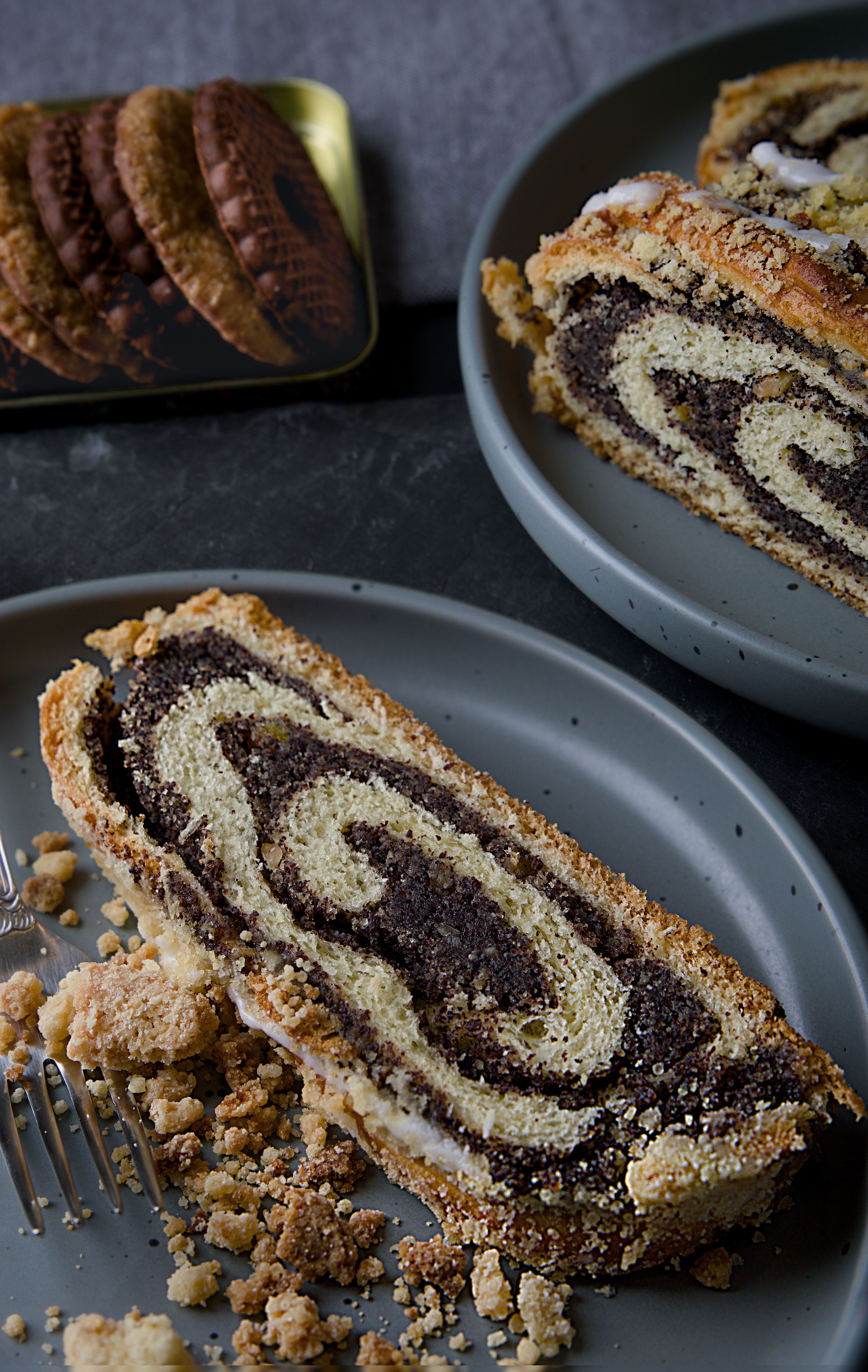
Photo: Sylwester Ficek / Pexels
The diets react (see scores below)
Common Ingredients
- flour
- yeast
- poppy seeds
- sugar
- butter
- eggs
- honey
- raisins
Specific recipes may vary.
Incompatible with 9 of 11 diets
Diet Ratings
Makowiec is a traditional Polish poppy seed roll that is fundamentally incompatible with a ketogenic diet. The base is a wheat flour and yeast leavened dough — a pure grain product delivering massive net carbs per slice. The filling compounds the problem with added sugar, honey, and raisins, all of which are high-glycemic, keto-prohibited ingredients. A single slice of Makowiec can easily contain 40-60g of net carbs, which alone would exceed or nearly exhaust the entire daily keto carb budget. There is no practical portion size that makes this food keto-compatible.
Makowiec is a traditional Polish poppy seed roll that contains multiple animal-derived ingredients, making it clearly non-vegan in its standard form. Butter and eggs are unambiguous animal products excluded by all vegan standards. Honey is also listed, which the vast majority of vegan organizations (including the Vegan Society and PETA) exclude as an animal product derived from bees. The base ingredients — flour, yeast, poppy seeds, sugar, and raisins — are all plant-based, meaning a vegan version of Makowiec is theoretically achievable by substituting plant-based butter, flax or chia eggs, and maple syrup or agave for honey. However, the traditional recipe as listed here is not vegan-compatible. The score is 2 rather than 1 because the dish has strong vegan-adaptable potential and the non-vegan ingredients are all substitutable.
A small minority of plant-based eaters who permit honey would still consider this non-vegan due to butter and eggs, so honey does not alter the verdict here. However, some plant-based health advocates might note that honey is the least ethically contested of the three animal ingredients, since bees are invertebrates and some argue their exploitation is categorically different from vertebrate animal use.
Makowiec is a traditional Polish poppy seed roll that is fundamentally incompatible with the paleo diet. The primary structure of this dish is wheat flour, a grain that is categorically excluded from all paleo frameworks. Yeast-leavened bread made from wheat represents exactly the type of Neolithic agricultural food that the paleo diet seeks to eliminate. Additionally, refined sugar and butter (dairy) are both non-paleo ingredients. While eggs, honey, raisins, and poppy seeds are individually paleo-compatible, they cannot redeem a dish whose foundation is wheat-based bread. There is no version of Makowiec that could be considered paleo without fundamentally deconstructing and reinventing the dish.
Makowiec is a traditional Polish poppy seed roll that fundamentally conflicts with Mediterranean diet principles. It is built on refined white flour (not whole grain), significant added sugars (sugar + honey used as sweetener in a pastry context), and butter as the primary fat instead of olive oil. While poppy seeds, eggs, and raisins have some nutritional value, the overall profile is that of a sweet, refined-grain pastry with high saturated fat from butter and high sugar load. This is precisely the category of food the Mediterranean diet minimizes — processed baked goods with added sugars and refined grains. Its non-Mediterranean origin compounds the misalignment.
Makowiec is a traditional Polish poppy seed roll that is fundamentally incompatible with the carnivore diet. The dish is almost entirely plant-based: flour (grain), yeast, poppy seeds (seeds), sugar, honey, and raisins (fruit) are all excluded plant or plant-derived ingredients. While butter and eggs are animal-derived and carnivore-compatible, they represent a minor fraction of this dish and cannot redeem it. The dominant components — wheat flour forming the dough base, poppy seeds as the primary filling, sugar, and raisins — are all explicitly prohibited on any tier of the carnivore diet. This is a baked good with virtually no animal-product foundation.
Makowiec is a traditional Polish poppy seed roll — a sweet, yeasted bread. It contains multiple excluded ingredients: flour (grain), sugar (added sugar), butter (dairy), and honey (added sugar). Beyond the individual excluded ingredients, this dish is a classic baked good (sweet bread/roll), which is explicitly prohibited under Whole30's rule against recreating baked goods even with compliant ingredients. There is no compliant version of this dish possible within Whole30 guidelines.
Makowiec is a traditional Polish poppy seed roll that contains multiple high-FODMAP ingredients. The primary concern is wheat flour, which is high in fructans and is a major FODMAP trigger. Honey is high in excess fructose and is explicitly avoid-listed by Monash University. Raisins are high in fructose and fructans at normal serving sizes (safe only at ~1 tablespoon, which is far less than what would be present in a typical slice). Poppy seeds themselves are low-FODMAP at standard servings (~2 tablespoons), and butter and eggs are low-FODMAP. However, the combination of wheat flour, honey, and raisins makes this dish high-FODMAP regardless of portion size. There is no realistic serving of Makowiec that would be safe during the elimination phase.
Makowiec is a traditional Polish poppy seed roll that presents a mixed nutritional profile from a DASH perspective. On the positive side, poppy seeds are rich in calcium, magnesium, and healthy fats — nutrients DASH actively promotes — and raisins and honey contribute potassium and natural sugars without added sodium. However, the dish is made with refined white flour (not a whole grain), a notable amount of butter (saturated fat), and significant added sugar from both sugar and honey. The combination of refined carbohydrates and saturated fat puts it outside the DASH ideal, even though it is not high in sodium. Butter directly conflicts with DASH guidance to limit saturated fat, and the refined flour misses the whole-grain recommendation. As a small, occasional snack portion it is borderline acceptable, but it is not a food DASH emphasizes or encourages regularly.
NIH DASH guidelines emphasize limiting saturated fat and refined grains, which would place Makowiec firmly in the caution or avoid territory. However, some updated DASH-aligned clinical dietitians note that poppy seeds provide exceptional calcium and magnesium density, and that moderate butter consumption in the context of an otherwise DASH-compliant diet may be acceptable — particularly given recent meta-analyses questioning the independent cardiovascular risk of saturated fat from dairy sources.
Makowiec is a traditional Polish poppy seed roll that is essentially a sweet yeast bread — one of the most Zone-unfavorable food categories. The base is white flour (high-glycemic refined carbohydrate), sweetened with sugar and honey, enriched with butter (saturated fat), and studded with raisins (a high-glycemic fruit Dr. Sears specifically flags as unfavorable). While poppy seeds do contribute some fat and modest protein, and eggs provide lean protein, these favorable elements are overwhelmed by the dominant high-glycemic carbohydrate load and saturated fat profile. The macro ratio is wildly skewed: very high carbohydrate (primarily high-GI), moderate fat (primarily saturated from butter), and minimal lean protein — essentially the inverse of a Zone meal. There is no practical way to incorporate a meaningful portion of Makowiec into a Zone block structure without dramatically spiking insulin. As a snack, it provides no Zone-compatible carbohydrate-to-protein anchoring whatsoever. This falls squarely in the 'avoid' category alongside white bread, pastries, and other refined-flour sweets.
Makowiec is a traditional Polish poppy seed roll made with refined white flour, butter, sugar, eggs, honey, and raisins. While it contains some genuinely beneficial ingredients — poppy seeds provide omega-3 fatty acids (linolenic acid), calcium, and magnesium; honey offers trace polyphenols; eggs contribute choline and selenium; raisins provide some antioxidants — the overall profile is dominated by pro-inflammatory concerns. Refined white flour is a refined carbohydrate with a high glycemic index that can spike blood sugar and promote low-grade inflammation. The added sugar and honey together contribute significant glycemic load. Butter is a source of saturated fat, which anti-inflammatory guidelines recommend limiting. As a sweet baked good, Makowiec is essentially a refined-carbohydrate-and-saturated-fat dessert bread with modest nutritional redeeming qualities. The poppy seeds are genuinely noteworthy — they contain oleic and linoleic acids and are used in substantial quantity in this dish — but not enough to offset the refined flour, sugar, and butter foundation. Occasional consumption as a treat is acceptable within an anti-inflammatory lifestyle, but regular consumption is inconsistent with anti-inflammatory principles.
Makowiec is a traditional Polish poppy seed roll made primarily from refined white flour, butter, sugar, and honey — a combination that delivers high refined carbohydrates, added sugars, and saturated fat with virtually no meaningful protein and minimal fiber despite the poppy seeds. For GLP-1 patients, this food fails on nearly every priority criterion: it offers empty calories in a context where every bite must count nutritionally, contains significant butter (saturated fat) that can worsen nausea and bloating, is high in sugar which undermines blood sugar stability, and is built on refined flour which digests rapidly without sustaining fullness. The raisins and honey add further sugar load. While poppy seeds do contain some minerals and a modest amount of fiber, the quantity used per serving is insufficient to move the needle nutritionally. The dense, sweet, buttery nature of this pastry is precisely the food category GLP-1 patients are advised to minimize. A small occasional taste might be tolerable socially, but it has no functional place as a regular snack for someone on a GLP-1 medication.
*See how scores were generated at our methodology page.
Nutritional profile
Six traits that cut across every diet.
Fiber & Plants
How much whole-plant food and fiber it delivers.
Healthy Fats
The quality of its fats (unsaturated, omega-3).
Whole / Unprocessed
How close it is to its natural, unprocessed form.
Gut Gentle
How easy it is on digestion (low FODMAP, few irritants).
Low Glycemic
How little it spikes your blood sugar.
Protein Density
How much protein it packs per calorie.
Controversy Index
Higher controversy = more disagreement between diets.
Diet-Specific Tips
 DASH — 4/10
View tips
- Poppy seeds are high in calcium and magnesium, aligning with DASH micronutrient goals
- Butter contributes saturated fat, which DASH limits
- Refined white flour rather than whole grain reduces fiber content and DASH alignment
- Added sugar from both granulated sugar and honey increases caloric density without DASH benefit
- Raisins and honey provide potassium but also concentrated natural sugars
- Low sodium content is a positive attribute
- Small portion size as a snack mitigates but does not eliminate DASH concerns
 Anti-Inflammatory — 4/10
View tips
- Refined white flour — high glycemic index, pro-inflammatory refined carbohydrate
- Added sugar plus honey — significant glycemic load, promotes insulin response
- Butter — saturated fat, limit per anti-inflammatory guidelines
- Poppy seeds — notable source of omega-3 fatty acids, calcium, and magnesium; a genuine positive
- Eggs — neutral to mildly beneficial (choline, selenium)
- Raisins — concentrated natural sugars but some antioxidant value
- Overall profile: treats-category baked good, acceptable occasionally but not a dietary staple