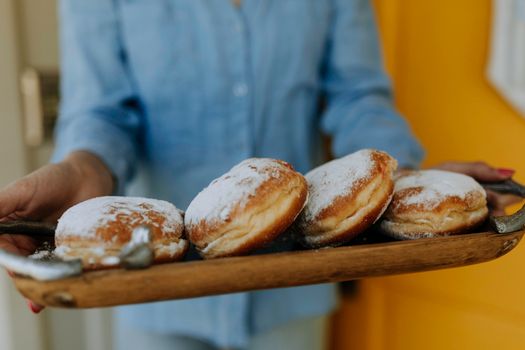
Photo: RDNE Stock project / Pexels
The diets react (see scores below)
Common Ingredients
- flour
- yeast
- eggs
- butter
- sugar
- milk
- rose jam
- powdered sugar
Specific recipes may vary.
Incompatible with 11 of 11 diets
Diet Ratings
Paczki are Polish deep-fried doughnuts that are fundamentally incompatible with a ketogenic diet. Every primary ingredient is a keto disqualifier: wheat flour and yeast dough form a high-carb grain base, sugar is added both to the dough and as a powdered sugar topping, rose jam is a concentrated sugar source, and milk adds further carbohydrates. A single paczek typically contains 50-70g of net carbs — exceeding the entire daily keto carb budget in one item. There is absolutely no version of a traditional paczek that is keto-compatible.
Pączki are traditional Polish doughnuts that contain multiple animal-derived ingredients: eggs, butter, and milk are all clear animal products that disqualify this dish from being vegan. There is no ambiguity here — these are core, structural ingredients in the recipe, not trace contaminants. A vegan version of pączki could theoretically be made by substituting plant-based milk, vegan butter, and egg replacers, but the traditional recipe as listed is not vegan-compatible.
Paczki are Polish deep-fried doughnuts that are fundamentally incompatible with the paleo diet. The primary ingredient is wheat flour, a grain explicitly excluded from paleo. Beyond that, the recipe includes milk and butter (dairy), refined sugar and powdered sugar (refined sugar), and yeast-leavened dough — all of which are non-paleo. The rose jam filling typically contains added sugar as well. While eggs are the one paleo-approved ingredient, they play a minor structural role in a dish that is otherwise entirely built on excluded food categories. There is no meaningful paleo adaptation possible without completely reconstructing the dish.
Paczki are Polish deep-fried doughnuts that fundamentally contradict Mediterranean diet principles across multiple dimensions. They are made from refined white flour (not whole grain), contain significant added sugars both in the dough and as a powdered sugar topping, use butter as the primary fat rather than olive oil, and are filled with rose jam (high in sugar). The dish is a highly processed, refined-grain pastry with high sugar and saturated fat content — precisely the type of food the Mediterranean diet advises minimizing. There are no redeeming Mediterranean-aligned ingredients, and the overall nutritional profile is the opposite of what the diet promotes.
Paczki are traditional Polish filled doughnuts that are fundamentally incompatible with the carnivore diet. The dish is almost entirely plant-derived: flour (grain), yeast (fungus), sugar, rose jam (plant-based fruit preserve), and powdered sugar are all strictly excluded. While eggs, butter, and milk are animal-derived ingredients, they are minor components in what is essentially a grain-based, sugar-laden pastry. No amount of animal-product content can redeem a dish whose primary structure is wheat flour and whose flavor profile is driven by sugar and fruit jam. This is a processed, high-carbohydrate confection with zero place on any tier of the carnivore diet.
Paczki are Polish filled doughnuts that contain multiple excluded ingredients: flour (grain), sugar (added sugar), butter (dairy — not ghee/clarified butter), milk (dairy), and powdered sugar (added sugar). Even setting aside the individual excluded ingredients, paczki are a classic fried pastry/doughnut — exactly the type of baked good/junk food recreation that Whole30 explicitly prohibits regardless of ingredient compliance. This dish fails on nearly every front of the Whole30 program.
Paczki (Polish doughnuts) are high-FODMAP due to multiple problematic ingredients. Wheat flour is the primary ingredient and a major source of fructans, which are restricted during the FODMAP elimination phase. Milk contributes lactose, and while eggs and butter are low-FODMAP, they do not offset the other issues. Sugar itself is low-FODMAP (sucrose), and powdered sugar is similarly fine in small amounts. Rose jam is typically made from rose petals and sugar — while rose hips can have polyols, traditional Polish rose petal jam (różany) is generally not a significant FODMAP concern at jam-sized servings. However, the wheat flour alone is sufficient to make paczki high-FODMAP at any standard serving size. A single paczek contains a substantial amount of wheat flour, delivering a significant fructan load that exceeds safe elimination-phase thresholds. There is no practical way to consume a standard paczek within low-FODMAP limits.
Paczki are Polish deep-fried doughnuts made with refined white flour, butter, eggs, sugar, sweet jam filling, and powdered sugar glaze. They are essentially indistinguishable from other fried pastries or doughnuts in nutritional profile — high in refined carbohydrates, added sugars, saturated fat (from butter and frying oil), and calories, with virtually no fiber, potassium, magnesium, or calcium. DASH diet explicitly limits sweets, added sugars, and saturated fats. Refined grain products like white flour doughnuts are the opposite of the whole grains DASH promotes. A single paczek can contain 300–400+ calories, 15–20g fat (significant saturated fat), and 30–40g of sugar — far exceeding DASH's recommendation of ≤5 servings of sweets per week in small portions. This food offers none of the nutrients DASH seeks to maximize (potassium, calcium, magnesium, fiber) and concentrates exactly what DASH seeks to minimize.
Paczki are Polish filled doughnuts — deep-fried pastries made from refined white flour, butter, sugar, eggs, and milk, then filled with rose jam and topped with powdered sugar. From a Zone perspective, this food is deeply problematic on nearly every macronutrient dimension. The carbohydrate load is extremely high-glycemic: white flour provides rapidly digested starch, the jam and powdered sugar add pure sugar, and there is essentially zero fiber to slow absorption. This is precisely the category of refined, high-glycemic carbohydrate that Dr. Sears identifies as the primary driver of insulin overproduction. The fat profile is dominated by saturated fat from butter and likely trans or omega-6-heavy fats from frying, the opposite of the monounsaturated fats the Zone prioritizes. There is no meaningful lean protein source. The macronutrient ratio is wildly skewed — likely 60-70% calories from carbohydrates, heavy saturated fat, and negligible protein — making it essentially impossible to incorporate into a Zone meal without radical restructuring. Even in small portions, a single paczki would consume most or all of a meal's carbohydrate blocks in low-quality, high-glycemic form with no offsetting nutritional benefit. This is one of the clearer 'avoid' verdicts in Zone methodology.
Pączki are traditional Polish deep-fried doughnuts with a strongly pro-inflammatory nutritional profile. The ingredient list combines refined white flour (high glycemic, low fiber), added sugars (both in the dough and as powdered sugar topping), butter (saturated fat), and the dish is deep-fried — a combination that hits nearly every 'limit' or 'avoid' category in anti-inflammatory nutrition. Refined carbohydrates rapidly spike blood glucose and insulin, promoting inflammatory cytokine release. The added sugar load (dough sugar + rose jam + powdered sugar glaze) is substantial. Butter contributes saturated fat. Deep frying — though not explicitly listed in the ingredients — is the defining preparation method for pączki and introduces oxidized fats and potentially acrylamide. There are virtually no redeeming anti-inflammatory components: no omega-3s, no meaningful antioxidants, no fiber, no polyphenols. The rose jam could theoretically contribute trace polyphenols but in quantities far too small to offset the inflammatory burden of the dish. This is essentially the anti-inflammatory diet's archetypal 'avoid' food: a combination of refined carbs, added sugar, saturated fat, and fried preparation.
Paczki are traditional Polish filled doughnuts — deep-fried, enriched dough made with refined flour, butter, eggs, sugar, and milk, then filled with rose jam and dusted with powdered sugar. A single paczek typically contains 350-450 calories, 15-25g of fat (much of it saturated from frying and butter), 50-60g of refined carbohydrates, minimal fiber, and very little protein. This profile is deeply problematic for GLP-1 patients on every key dimension: the high fat content from deep frying and butter directly worsens nausea, bloating, and reflux — the most common GLP-1 side effects. The refined flour and sugar spike blood sugar rapidly with no fiber to slow absorption. The calorie density is extremely high relative to nutritional value, making every calorie largely empty. The fried, greasy texture is among the hardest categories for slowed gastric emptying to handle comfortably. There is no meaningful protein contribution, no fiber, and no micronutrient density to justify the caloric load. This is one of the clearest avoid cases in the GLP-1 dietary framework.
*See how scores were generated at our methodology page.
Nutritional profile
Six traits that cut across every diet.
Fiber & Plants
How much whole-plant food and fiber it delivers.
Healthy Fats
The quality of its fats (unsaturated, omega-3).
Whole / Unprocessed
How close it is to its natural, unprocessed form.
Gut Gentle
How easy it is on digestion (low FODMAP, few irritants).
Low Glycemic
How little it spikes your blood sugar.
Protein Density
How much protein it packs per calorie.
Controversy Index
Higher controversy = more disagreement between diets.