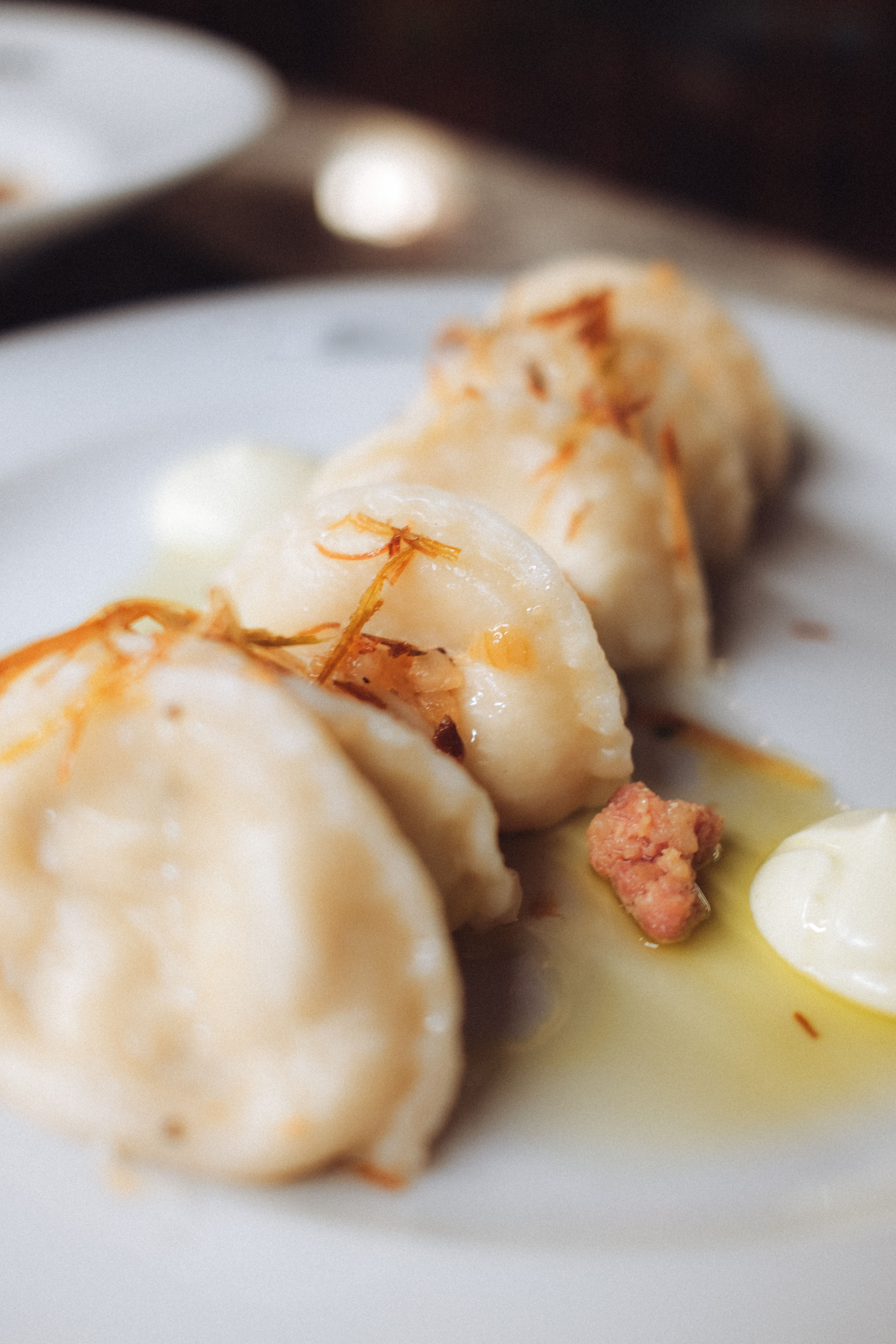
Photo: Anh Nguyen / Pexels
Polish
Pierogi Ruskie
The diets react (see scores below)
Common Ingredients
- flour
- eggs
- potatoes
- farmer cheese
- onion
- butter
- salt
- pepper
Specific recipes may vary.
Incompatible with 7 of 11 diets
Diet Ratings
Pierogi Ruskie are fundamentally incompatible with a ketogenic diet. The dough is made from wheat flour, which is a grain and a primary keto offender — a single serving of 4-5 pierogi can contain 40-60g of net carbs from the dough alone. The filling compounds the problem with starchy potatoes, another high-carb ingredient. Together, flour and potatoes would blow the entire daily net carb budget (20-50g) in a single serving. The butter, eggs, and farmer cheese are keto-friendly components, but they are entirely overwhelmed by the carb load of the dough and potato filling. There is no meaningful portion adjustment that could make this dish keto-compatible — even 1-2 pierogi would deliver a substantial carb hit from the dough.
Pierogi Ruskie contains multiple animal-derived ingredients that disqualify it from a vegan diet. Eggs are used in the dough, farmer cheese (twaróg) is a dairy product, and butter is used for cooking and finishing. These are unambiguously animal products — eggs from poultry, and both farmer cheese and butter derived from cow's milk. There is no meaningful debate within the vegan community about any of these ingredients. A vegan version of pierogi could be made by substituting plant-based milk or aquafaba in the dough instead of eggs, using tofu or cashew-based cheese for the filling, and replacing butter with vegan margarine or oil — but the traditional recipe as listed is not vegan.
Pierogi Ruskie is fundamentally incompatible with the Paleo diet. The dish's core structure depends on wheat flour dough, which is a grain and one of the most clearly excluded foods in all paleo frameworks. The primary filling combines farmer cheese (dairy) with potatoes — dairy is excluded across all mainstream paleo authorities, and while potatoes occupy a gray area, they are secondary to the more critical violations. Butter is also a dairy product excluded under strict paleo. Salt is listed as an added ingredient, also excluded. With multiple foundational paleo violations — grains, dairy, added salt — this dish cannot be reconciled with any mainstream interpretation of the Paleo diet.
Pierogi Ruskie is a traditional Polish dumpling dish that sits poorly within Mediterranean diet principles. The dough is made from refined white flour, a refined grain that the Mediterranean diet discourages. Butter is used as the primary fat rather than olive oil, which contradicts the foundational Mediterranean principle of olive oil as the central fat source. The filling of potatoes and farmer cheese, while not inherently harmful, is starchy and calorie-dense with no olive oil, legumes, or vegetables emphasized. Eggs contribute some nutritional value, and onion is a positive element, but the overall profile — refined grain wrapper, butter-cooked, starchy filling — does not align with Mediterranean dietary patterns. This is a Central/Eastern European comfort food with little overlap with Mediterranean staples.
Some Mediterranean diet interpreters note that dairy (farmer cheese) and eggs are acceptable in moderation, and that a small portion of pierogi alongside a large vegetable-forward meal could be accommodated occasionally. Traditional Mediterranean cuisines do include some pasta and dumplings (e.g., Italian tortellini), and if pierogi were prepared with olive oil instead of butter, the score would improve marginally.
Pierogi Ruskie is fundamentally incompatible with the carnivore diet. The dish is dominated by plant-based ingredients: flour (grain-based dough wrapper), potatoes (starchy tuber), and onion (vegetable). While it does contain eggs, butter, and farmer cheese (animal-derived), these are minor components in a dish that is structurally built around plant foods. No amount of animal-derived ingredients can redeem a dish whose foundation is wheat flour and potato filling. This is a classic Eastern European comfort food that sits at the opposite end of the carnivore spectrum.
Pierogi Ruskie contains multiple excluded ingredients that make it incompatible with Whole30. Flour (wheat grain) is explicitly excluded as a grain product. Farmer cheese and butter are dairy products, both excluded (butter is not the same as ghee/clarified butter). Beyond individual ingredients, pierogi are a form of filled pasta/dumpling — they fall squarely into the 'pasta or noodles' and 'recreating junk food/comfort food' prohibition. Even if one attempted to substitute ingredients, the dish itself is a dough-wrapped dumpling that violates the spirit of Rule 4.
Pierogi Ruskie contains multiple high-FODMAP ingredients that make it unsuitable during the elimination phase. Wheat flour (the primary dough ingredient) is high in fructans — one of the most problematic FODMAPs — and is a clear avoid at any reasonable serving. Onion is among the highest-FODMAP foods tested by Monash University, also due to fructans, and is a core component of the traditional filling. Farmer cheese (twaróg) is a fresh, soft cheese with significant lactose content, similar to ricotta or quark, which Monash rates as high-FODMAP above very small amounts. Potatoes themselves are low-FODMAP, as are eggs, butter, salt, and pepper. However, the combination of wheat dough, onion filling, and lactose-containing cheese means this dish has three independent high-FODMAP triggers at standard serving sizes. Even a small portion of 2–3 pierogi would include enough wheat flour and onion to exceed safe FODMAP thresholds. This dish cannot be made low-FODMAP without fundamentally altering the recipe (e.g., gluten-free flour, omitting onion, using a low-lactose cheese alternative).
Pierogi Ruskie contains several ingredients that partially align with DASH principles but with notable concerns. The dough (flour, eggs) provides refined carbohydrates rather than the whole grains DASH emphasizes. The filling of potatoes and farmer cheese offers potassium and some calcium, which are DASH-friendly nutrients. However, butter is a saturated fat source that DASH limits, and the dish is typically salted throughout preparation (dough, filling, and boiling water), raising sodium concerns. Farmer cheese is a fresh, relatively lower-fat cheese compared to aged varieties, which is a mild positive, but it is not a low-fat dairy product in the DASH sense. The dish is not inherently high in sodium the way processed foods are, but butter and full-fat cheese push it toward caution. Portion control matters greatly — a modest serving as part of a balanced meal is more acceptable than a large portion. The overall dish lacks the fiber richness and nutrient density DASH prioritizes, and relies on refined flour and saturated fat rather than whole grains and lean protein.
NIH DASH guidelines emphasize low-fat dairy and whole grains, which this dish largely lacks. However, some DASH-oriented nutritionists note that homemade pierogi using farmer cheese — a lower-sodium fresh cheese — and modest butter represent a far better choice than processed convenience foods, and could be incorporated occasionally within DASH calorie and saturated fat budgets, especially if prepared with reduced butter or a plant-based oil substitute.
Pierogi Ruskie is a starch-dominant dish that poses significant challenges for Zone compliance. The dough (refined white flour) and filling (potatoes) are both high-glycemic carbohydrates — two of the Zone's most explicitly 'unfavorable' carb sources. Together they create a carbohydrate load that is both high-glycemic and difficult to balance with adequate lean protein. The protein source is farmer's cheese, which is moderate in quality but also contributes fat and relatively little protein per serving compared to Zone-preferred lean proteins. Butter adds saturated fat rather than the preferred monounsaturated fat. A typical serving of 4-6 pierogi provides roughly 40-60g of high-GI carbohydrates, minimal lean protein (perhaps 8-12g from farmer's cheese), and saturated fat from butter — making the actual macronutrient ratio far from 40/30/30 and skewed heavily toward unfavorable carbohydrates. While portion control could theoretically reduce harm, the dish's structural composition (dough + potato filling) makes it nearly impossible to achieve Zone ratios without fundamentally altering the dish. It scores a 3 rather than 1-2 because it is real food with some nutritional value (protein from cheese, eggs in dough) and is not nutritionally empty like candy.
Pierogi Ruskie is a traditional Polish comfort food with a largely neutral-to-mixed inflammatory profile. The dough (refined white flour) is a refined carbohydrate with a high glycemic index, which can promote inflammatory signaling when consumed regularly. Butter is a saturated fat that anti-inflammatory guidelines recommend limiting. Farmer cheese (twaróg) is a low-fat fresh cheese — more acceptable than aged high-fat cheeses, but still a full-fat dairy product depending on preparation. Potatoes are whole foods with potassium and vitamin C, and onion provides quercetin, a meaningful anti-inflammatory flavonoid. Eggs contribute some beneficial nutrients (choline, selenium) but also arachidonic acid. The dish is entirely absent of omega-3 sources, colorful antioxidant-rich vegetables, herbs/spices with anti-inflammatory potency (beyond onion and black pepper), or other emphasized foods. It's essentially a starchy, butter-finished dumpling — calorie-dense and low in anti-inflammatory density. Occasional consumption is not a concern, but it offers little positive anti-inflammatory value and several mildly pro-inflammatory elements. Score of 4 reflects a food that is neither notably harmful in moderation nor beneficial from an anti-inflammatory standpoint.
Pierogi Ruskie are a refined-flour dough stuffed with a potato and farmer cheese filling, typically finished with sautéed onion and butter. The dish lands firmly in the caution tier for GLP-1 patients. Protein content is modest — farmer cheese contributes some, but a standard serving (4-6 pierogi, ~250-300g) delivers roughly 10-14g of protein, well below the 15-30g per-meal target. The dough is made from refined white flour, offering negligible fiber and representing empty starch calories at a time when every bite must count nutritionally. Fat content is moderate-to-high depending on the amount of butter used for finishing, and butter is a saturated fat source that is less preferred on GLP-1 protocols. On the positive side, the dish is soft-textured and easy to digest — an important consideration given slowed gastric emptying — and it is not fried in its traditional boiled form. Potatoes provide potassium and some micronutrient value. The dish is portion-sensitive: a small serving (2-3 pierogi) with a side of cottage cheese or Greek yogurt could partially compensate for the protein gap, but as a standalone main it does not meet GLP-1 nutritional priorities. The butter finish should be minimized or substituted with a light drizzle of olive oil and herbs.
Some GLP-1-focused dietitians may rate traditional comfort foods like pierogi more favorably when portion-controlled, noting that the psychological sustainability of including familiar cultural foods supports long-term adherence — a factor that rigid elimination approaches can undermine. Others hold that refined-flour, low-protein staples should be consistently deprioritized regardless of tolerability, as they displace higher-value protein and fiber options within an already reduced calorie budget.
*See how scores were generated at our methodology page.
Nutritional profile
Six traits that cut across every diet.
Fiber & Plants
How much whole-plant food and fiber it delivers.
Healthy Fats
The quality of its fats (unsaturated, omega-3).
Whole / Unprocessed
How close it is to its natural, unprocessed form.
Gut Gentle
How easy it is on digestion (low FODMAP, few irritants).
Low Glycemic
How little it spikes your blood sugar.
Protein Density
How much protein it packs per calorie.
Controversy Index
Higher controversy = more disagreement between diets.
Diet-Specific Tips
 DASH — 4/10
View tips
- Refined white flour dough instead of DASH-preferred whole grains
- Butter adds saturated fat, which DASH limits
- Farmer cheese is lower-sodium than aged cheeses but is not low-fat dairy
- Potatoes contribute DASH-beneficial potassium
- Salt added throughout preparation increases sodium load
- No lean protein emphasis — cheese is the primary protein source
- Homemade preparation avoids the high sodium of processed/restaurant versions
- Portion size critical — a small serving is more DASH-compatible
 Zone — 5/10
View tips
- Refined white flour dough is a high-glycemic, unfavorable Zone carbohydrate
- Potato filling is explicitly listed as an unfavorable, high-glycemic carb in Sears' Zone methodology
- Double high-GI carb sources (flour + potato) make Zone balancing structurally very difficult
- Farmer's cheese provides some protein but is insufficient and fatty compared to Zone-preferred lean proteins
- Butter adds saturated fat rather than preferred monounsaturated fat (olive oil, avocado, almonds)
- Typical serving creates a macro ratio heavily skewed toward carbohydrates, far from 40/30/30
- Onion is a Zone-favorable vegetable but too minor in quantity to meaningfully offset the unfavorable carbs
 Anti-Inflammatory — 4/10
View tips
- Refined white flour dough is a high-glycemic refined carbohydrate — mildly pro-inflammatory
- Butter finishing adds saturated fat, which anti-inflammatory guidelines recommend limiting
- Farmer cheese is relatively low-fat compared to aged cheeses, reducing dairy concern somewhat
- Onion provides quercetin, a clinically relevant anti-inflammatory flavonoid
- Potatoes contribute potassium and vitamin C but are a high-GI starch
- No omega-3 sources, no anti-inflammatory herbs or spices of significance beyond pepper
- Dish lacks colorful antioxidant-rich vegetables or any emphasized anti-inflammatory foods
- Eggs contribute mixed signals: choline and selenium (positive) vs. arachidonic acid (mildly negative)
- Acceptable occasionally; problematic as a dietary staple from an anti-inflammatory perspective
 GLP-1 Friendly — 4/10
View tips
- Low protein density: ~10-14g per standard serving, below the 15-30g per-meal GLP-1 target
- Refined white flour dough: minimal fiber, low nutrient density per calorie
- Butter finishing adds saturated fat, less preferred on GLP-1 protocols
- Soft, boiled texture is easy to digest — positive for GI tolerability
- Portion-sensitive: small servings reduce but do not eliminate the nutritional shortfall
- Protein gap can be partially offset by pairing with a high-protein side (cottage cheese, Greek yogurt)
- No fried component in traditional preparation — avoids worst-case GLP-1 GI trigger
- Potatoes provide modest micronutrient value (potassium) but limited fiber in this form