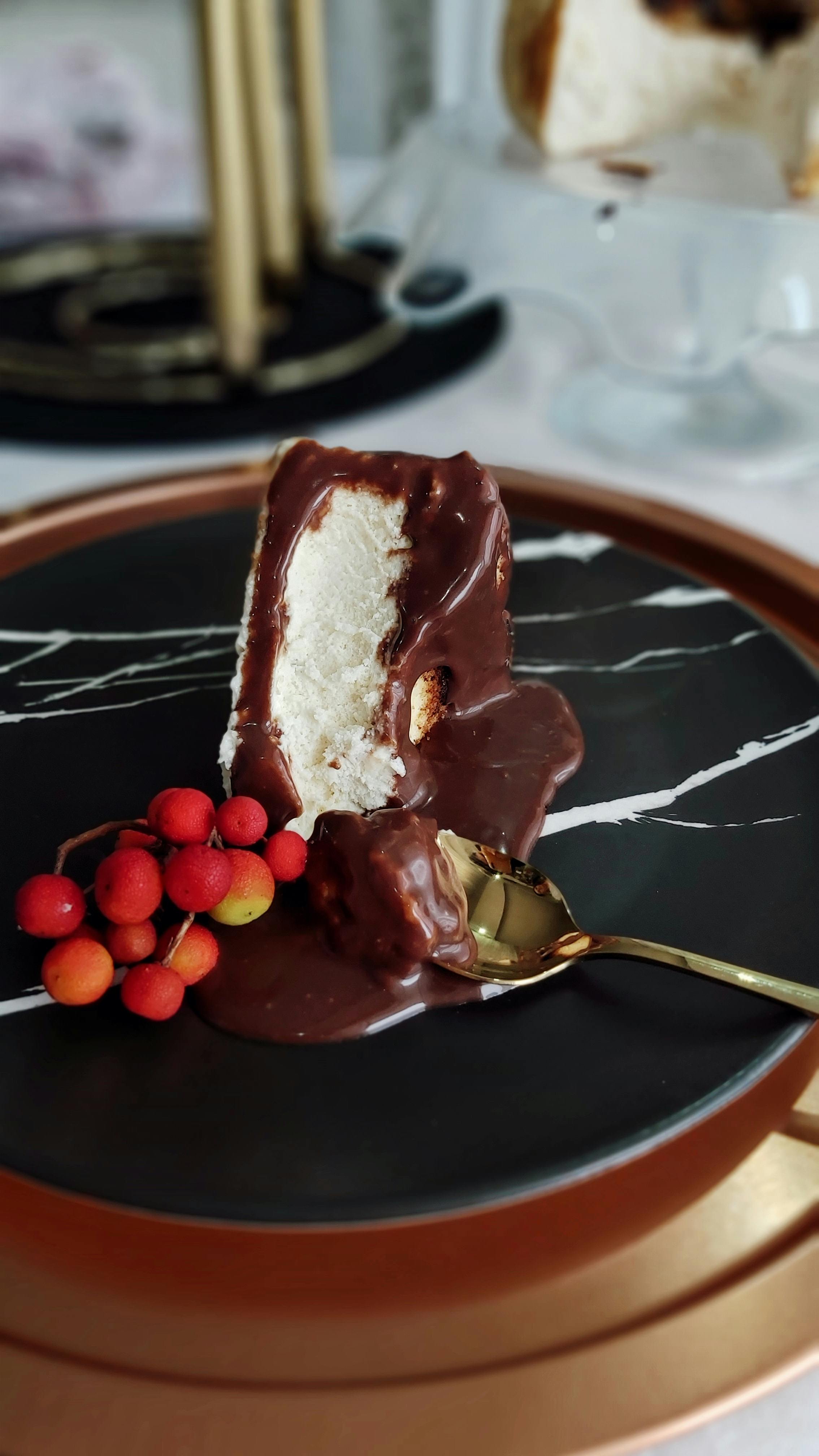
The diets react (see scores below)
Common Ingredients
- twarog cheese
- eggs
- sugar
- butter
- flour
- vanilla
- raisins
- lemon zest
Specific recipes may vary.
Incompatible with 8 of 11 diets
Diet Ratings
Sernik is a traditional Polish cheesecake that is fundamentally incompatible with ketogenic eating. Despite twarog cheese being a relatively low-carb base ingredient, the recipe includes multiple high-carb, keto-prohibited ingredients: sugar (a direct disqualifier), flour (a grain-based ingredient), and raisins (dried fruit extremely high in sugar and net carbs). A standard serving would deliver far more than the entire daily keto carb allowance in one sitting. There is no realistic portion size that would make this dish compatible with ketosis. The dish would need to be completely reformulated — replacing sugar with keto sweeteners, flour with almond or coconut flour, and eliminating raisins entirely — to be considered keto-friendly.
Sernik is a Polish cheesecake built entirely around animal-derived ingredients. Twaróg (quark/farmer's cheese) is a dairy product, eggs are an animal product, and butter is animal-derived dairy fat. Three of the core structural ingredients are directly excluded under vegan rules. The remaining ingredients — sugar, flour, vanilla, raisins, and lemon zest — are plant-based, but they are minor components that cannot redeem the dish. There is no meaningful vegan debate here: this is unambiguously non-vegan. A vegan version could theoretically be made using tofu or cashew-based cheese, flax eggs, and plant-based butter, but the traditional dish as described is not compatible with a vegan diet.
Sernik is a Polish cheesecake that contains multiple non-paleo ingredients. Twaróg (fresh curd cheese) is a dairy product excluded under paleo guidelines. Sugar is refined and excluded. Flour (wheat) is a grain and strictly forbidden. Butter is dairy. While eggs, vanilla, raisins, and lemon zest are paleo-compatible, the core structural ingredients — cheese, flour, and sugar — are all paleo violations. This dish cannot be considered paleo in any interpretation.
Sernik is a Polish cheesecake that combines several ingredients problematic for the Mediterranean diet. It features added sugar as a primary ingredient, butter as the fat source (rather than olive oil), and refined white flour. While twarog (fresh curd cheese) and eggs are acceptable in moderation within Mediterranean eating, the overall profile of this dessert — a high-sugar, butter-based baked good with refined flour — places it firmly in the 'avoid' category. It is a processed, sweet confection with high saturated fat and added sugar content, contradicting core Mediterranean principles.
Some Mediterranean diet interpretations allow for occasional traditional desserts made with dairy and eggs, viewing them as culturally acceptable treats rather than dietary staples. Twarog cheese itself is a minimally processed fresh cheese somewhat analogous to ricotta or cottage cheese, which do appear in Mediterranean cuisines, and a small occasional portion could be argued as consistent with the diet's allowance for dairy in moderation.
Sernik is a Polish cheesecake that is fundamentally incompatible with the carnivore diet. While it contains some animal-derived ingredients (twarog cheese, eggs, butter), the dish is dominated by multiple plant-based and processed components: flour (grain), sugar (processed), raisins (fruit), lemon zest (citrus fruit), and vanilla (plant extract). The presence of flour alone disqualifies it entirely as a grain-based product. Sugar adds further metabolic concerns. Raisins and lemon zest are plant foods explicitly excluded from any carnivore framework. This is a classic dessert/baked good — exactly the category carnivore eliminates. Even the most lenient 'animal-based' carnivore practitioners would not include this dish.
Sernik is a Polish cheesecake. It contains multiple excluded ingredients: twarog cheese (dairy — not ghee or clarified butter), sugar (added sugar), butter (regular butter, not ghee), and flour (a grain product). Even if those individual ingredients were swapped out, the dish itself is a cheesecake — a baked good explicitly prohibited under Whole30's Rule 4, which forbids recreating baked goods even with compliant ingredients.
Sernik (Polish cheesecake) contains multiple high-FODMAP ingredients that make it unsuitable during the elimination phase. Twaróg (Polish quark/farmer's cheese) is a fresh, soft cheese with significant lactose content — similar to ricotta or cottage cheese, which Monash classifies as high-FODMAP at normal serving sizes (lactose-heavy). Raisins are high-FODMAP due to excess fructose and fructans even at small quantities (Monash sets the threshold at about 1 tablespoon/13g, but raisins are typically used in larger amounts in sernik). Wheat flour contributes fructans. Sugar itself is low-FODMAP, as are eggs, butter, vanilla, and lemon zest. However, the combination of high-lactose twaróg, raisins, and wheat flour makes a standard serving of sernik clearly high-FODMAP. Even a small slice would likely exceed safe FODMAP thresholds across multiple FODMAP categories simultaneously (lactose, fructans, excess fructose).
Some FODMAP practitioners note that twaróg varies considerably in lactose content depending on how thoroughly the whey is drained — a very well-drained, dry twaróg might have lower lactose than typical quark. Additionally, Monash University has not specifically tested twaróg, so its exact FODMAP load per serving remains extrapolated from similar fresh cheeses rather than directly measured.
Sernik is a Polish cheesecake made primarily from twaróg (quark/farmer's cheese), eggs, sugar, butter, flour, vanilla, raisins, and lemon zest. While twaróg can be a relatively lean fresh cheese (especially in its low-fat form, providing protein and calcium), the dish as a whole is a dessert/sweet snack with notable amounts of added sugar and butter, contributing saturated fat and excess calories. DASH discourages sweets and added sugars, and limits saturated fat. The butter adds saturated fat directly contrary to DASH principles, and the sugar load classifies this as a 'sweets' item, which DASH limits to 5 or fewer servings per week. On the positive side, twaróg (low-fat variety) aligns with DASH's low-fat dairy emphasis, raisins add potassium and fiber, and lemon zest is benign. Sodium is relatively low, which is favorable. However, the overall dessert profile — sugar, butter, refined flour — places this firmly in the 'caution' category, acceptable only in small portions and infrequently, consistent with DASH's allowance for occasional sweets.
Some DASH-aligned clinicians note that twaróg-based sernik, especially when made with low-fat twaróg and reduced sugar, provides meaningful protein and calcium consistent with DASH dairy goals. NIH DASH guidelines categorically limit sweets, but updated interpretations emphasize overall dietary pattern — a small portion of homemade sernik with low-fat cheese and modest sugar may be more acceptable than processed desserts, provided it fits within the weekly sweets allowance.
Sernik (Polish cheesecake) is a dessert built around ingredients that conflict with Zone Diet principles at virtually every macronutrient level. Sugar is a high-glycemic carbohydrate that spikes insulin rapidly — exactly what the Zone seeks to avoid. Raisins are explicitly listed by Dr. Sears as an 'unfavorable' high-sugar carb. Butter is a saturated fat source rather than the preferred monounsaturated fats (olive oil, avocado, almonds). Flour adds more high-glycemic carbohydrate. The fat-to-protein ratio is inverted from Zone ideals: twarog cheese contributes some lean protein but is accompanied by substantial butter and egg yolks that skew the fat ratio well above 30%. The carbohydrate load from sugar, raisins, and flour is predominantly high-glycemic with negligible fiber to offset the glycemic impact. While twarog cheese itself is a reasonable Zone protein source, the overall dish macro profile — high sugar, high saturated fat, minimal fiber, high glycemic index — makes it extraordinarily difficult to fit into any Zone-balanced meal without consuming a portion so small as to be nutritionally trivial. This is essentially a dessert with the macro signature of a high-insulin-stimulating food.
Sernik is a Polish cheesecake built on twaróg (quark/farmer's cheese), eggs, sugar, butter, flour, vanilla, raisins, and lemon zest. From an anti-inflammatory perspective, the profile is decidedly mixed. On the positive side, twaróg is a fermented/cultured fresh cheese that provides protein and probiotics; eggs supply choline and selenium; raisins offer small amounts of antioxidants and polyphenols; lemon zest contributes flavonoids (hesperidin, eriocitrin) and vitamin C; and vanilla contains vanillin, a mild antioxidant. These elements are either neutral or mildly favorable. On the negative side, the dish contains meaningful quantities of added sugar (a well-established promoter of inflammatory markers like CRP and IL-6), butter (saturated fat, which anti-inflammatory guidelines recommend limiting), refined white flour (refined carbohydrate with negligible fiber), and full-fat dairy from the twaróg and butter combination. The net effect is a dessert that carries pro-inflammatory load from sugar, saturated fat, and refined carbohydrates, partially offset by modest beneficial compounds. This is a 'caution' food — not strongly pro-inflammatory in the way of ultra-processed snacks or trans-fat-laden items, but not anti-inflammatory either. Occasional consumption in reasonable portions is unlikely to cause harm, but it is not a food to emphasize on an anti-inflammatory diet.
Sernik is a Polish cheesecake made primarily from twaróg (farmer's cheese), eggs, sugar, butter, flour, and raisins. While twaróg provides a meaningful protein contribution and is lower in fat than cream cheese used in Western cheesecakes, the overall dish is still a dessert-style baked good with significant drawbacks for GLP-1 patients. The sugar content adds empty calories in a context where every calorie must count nutritionally. Butter raises the saturated fat load, which can worsen nausea, bloating, and reflux — common GLP-1 side effects. Raisins add concentrated sugar with minimal fiber benefit. Flour contributes refined carbohydrates with low nutritional density. On the positive side, twaróg and eggs together do deliver moderate protein per serving, and twaróg is easier to digest than heavy cream-based alternatives. This dish sits firmly in the caution zone: it is not the worst choice a GLP-1 patient could make (unlike fried or ultra-processed foods), but it is far from optimized. A small portion as an occasional treat is tolerable; it should not be a regular snack. A modified version using low-fat twaróg, reduced sugar, and no butter would score meaningfully higher.
Some GLP-1-focused dietitians view traditional twaróg-based dishes more favorably than Western cheesecakes due to the higher protein and lower fat profile of farmer's cheese, and may permit small portions as a culturally appropriate protein-containing snack. Others apply a stricter stance, categorizing any sugar- and butter-containing baked dessert as an avoid given the limited caloric budget and GI sensitivity of GLP-1 patients.
*See how scores were generated at our methodology page.
Nutritional profile
Six traits that cut across every diet.
Fiber & Plants
How much whole-plant food and fiber it delivers.
Healthy Fats
The quality of its fats (unsaturated, omega-3).
Whole / Unprocessed
How close it is to its natural, unprocessed form.
Gut Gentle
How easy it is on digestion (low FODMAP, few irritants).
Low Glycemic
How little it spikes your blood sugar.
Protein Density
How much protein it packs per calorie.
Controversy Index
Higher controversy = more disagreement between diets.
Diet-Specific Tips
 DASH — 4/10
View tips
- High added sugar content conflicts with DASH limit on sweets (<5 servings/week)
- Butter contributes saturated fat, which DASH discourages
- Twaróg (quark/farmer's cheese) can be a low-fat dairy source, consistent with DASH if low-fat variety is used
- Refined flour offers little nutritional benefit; whole grain flour would improve DASH alignment
- Raisins contribute potassium and natural fiber, mildly favorable
- Relatively low sodium content is a positive factor
- Classified as a dessert/sweet — DASH allows only occasional, portion-controlled servings
- Eggs add moderate saturated fat and cholesterol, a medium-confidence concern under DASH
 Anti-Inflammatory — 4/10
View tips
- Added sugar is a primary pro-inflammatory concern — raises CRP and IL-6
- Butter contributes saturated fat, limited under anti-inflammatory guidelines
- Refined flour adds glycemic load with no anti-inflammatory benefit
- Twaróg (quark) is a cultured dairy with modest probiotic and protein value — more neutral than aged full-fat cheese
- Eggs provide choline and selenium, both with anti-inflammatory roles
- Lemon zest contributes citrus flavonoids (hesperidin) — minor positive
- Raisins add small antioxidant contribution but also concentrated natural sugar
- Overall profile: dessert with mixed but net pro-inflammatory macronutrient pattern
 GLP-1 Friendly — 4/10
View tips
- Twaróg and eggs provide moderate protein, a positive for GLP-1 patients
- High sugar content adds empty calories in a low-appetite, calorie-scarce context
- Butter raises saturated fat load, risking worsened nausea and reflux
- Raisins contribute concentrated sugar with negligible fiber benefit
- Refined flour offers low nutritional density per calorie
- Small portion may be tolerable occasionally but not suitable as a regular snack
- Lower fat profile than cream cheese-based cheesecakes is a relative advantage