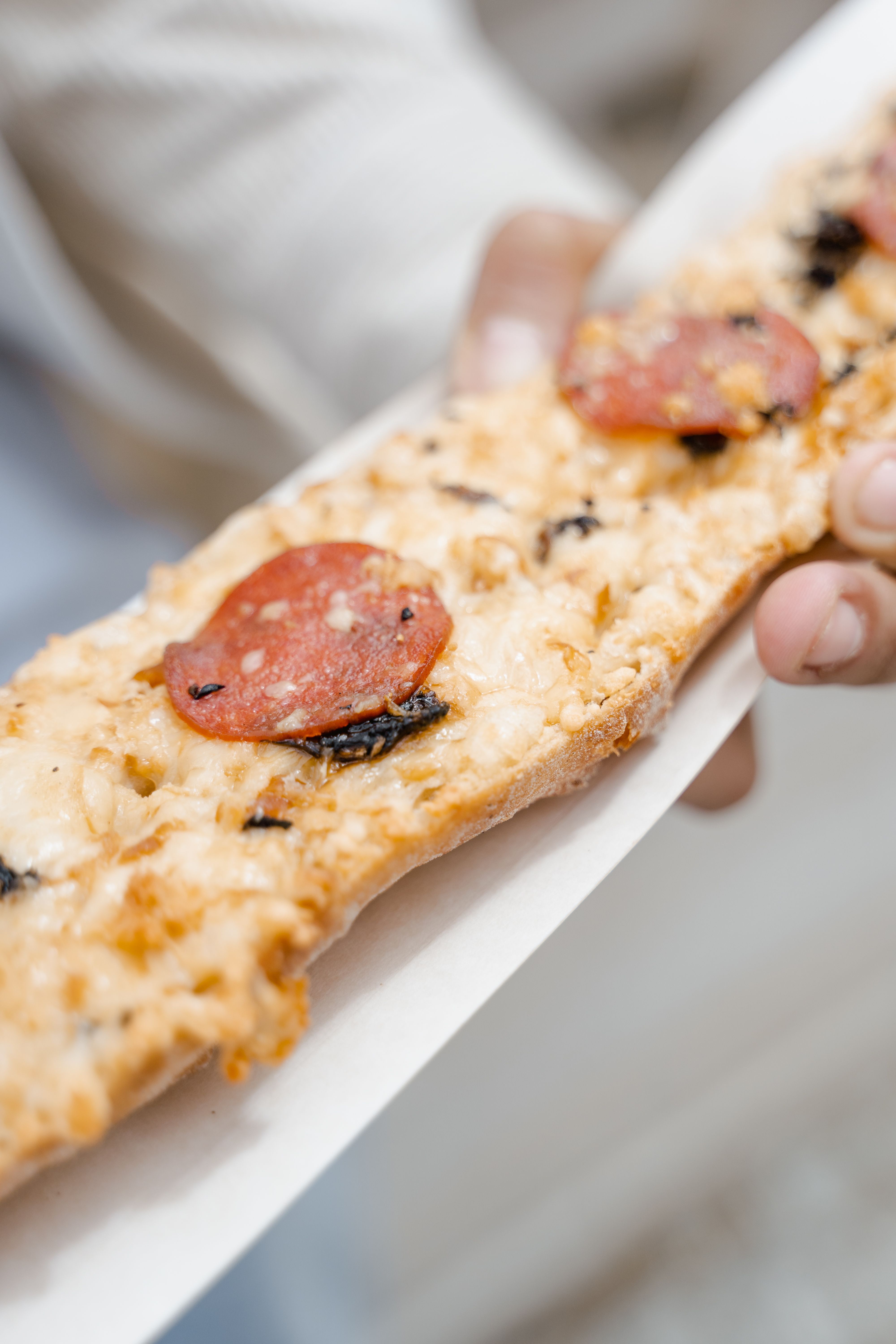
Photo: MART PRODUCTION / Pexels
The diets react (see scores below)
Common Ingredients
- baguette
- mushrooms
- cheese
- onion
- ketchup
- butter
- chives
Specific recipes may vary.
Incompatible with 8 of 11 diets
Diet Ratings
Zapiekanka is a Polish open-faced baguette snack that is fundamentally incompatible with ketogenic eating. The base is a baguette — a wheat bread product with approximately 45-50g of net carbs per 100g, which alone exceeds or nearly exhausts the entire daily carb allowance on keto. Ketchup adds further sugar-laden carbohydrates. While some individual ingredients (mushrooms, cheese, butter, chives, onion in small amounts) are keto-friendly, the baguette makes this dish entirely off-limits in its traditional form. There is no portion size of a baguette-based snack that would fit within keto macros without completely abandoning the dish concept itself.
Zapiekanka contains two clear animal-derived ingredients: cheese (dairy) and butter (dairy). Both are direct animal products excluded under all standard vegan definitions. The base ingredients — baguette, mushrooms, onion, ketchup, and chives — are plant-based, but the dish as traditionally prepared cannot be considered vegan. A vegan version could be made by substituting plant-based cheese and vegan butter/margarine, but the default recipe does not qualify.
Zapiekanka is a Polish open-faced sandwich built on a baguette — a wheat-based grain product that is one of the most clearly excluded foods in any paleo framework. Beyond the baguette, cheese is dairy (excluded), ketchup is a processed condiment typically containing refined sugar and additives (excluded), and butter is dairy (excluded or debated). The only paleo-compliant ingredients in this dish are mushrooms, onion, and chives. With multiple core violations — grains, dairy, and processed condiments — this dish scores at the very bottom of the paleo scale. There is no meaningful paleo version of this dish without replacing nearly every primary ingredient.
Zapiekanka is a Polish street food that conflicts with Mediterranean diet principles on multiple fronts. The base is a white baguette (refined grain), butter is used instead of olive oil as the fat source, and ketchup adds processed sugars. While mushrooms and onions are positive plant-based elements, and cheese is acceptable in moderation, the overall profile is dominated by refined carbohydrates, saturated fat from butter, and processed condiments. This dish has no traditional place in Mediterranean cuisine and contradicts the core emphasis on whole grains, olive oil as the primary fat, and minimally processed foods.
Zapiekanka is a Polish open-faced sandwich that is almost entirely plant-based and grain-based. The primary base is a baguette (grain/gluten), topped with mushrooms (fungi/plant), onion (plant), ketchup (plant-based, sugary condiment), and chives (plant). While it contains cheese and butter (animal-derived dairy), these are minor components in a dish that is fundamentally incompatible with the carnivore diet. The overwhelming majority of ingredients are explicitly excluded on carnivore: grains, vegetables, fungi, and processed plant-based condiments. This dish fails the carnivore criteria on nearly every ingredient.
Zapiekanka is a Polish open-faced baguette snack that violates Whole30 on multiple fronts. First, the baguette is a wheat-based bread, which is a grain and explicitly excluded. Second, even if the bread issue were somehow resolved, the dish itself constitutes 'recreating baked goods/junk food' — specifically an open-faced bread/pizza-style snack, which falls squarely under the prohibited category of bread, pizza crust, and similar items. Third, regular butter is excluded on Whole30 (only ghee/clarified butter is allowed). Fourth, standard ketchup almost universally contains added sugar. The dish is fundamentally incompatible with Whole30 in both ingredients and concept.
Zapiekanka contains multiple high-FODMAP ingredients that make it unsuitable during the elimination phase. The baguette is made from wheat flour, which is high in fructans — a primary FODMAP trigger. Onion is one of the highest-FODMAP foods tested by Monash University, containing significant fructans even in small amounts. Mushrooms (common varieties like button/portobello) are high in polyols (mannitol). Ketchup in typical serving amounts can contain excess fructose or high-fructose corn syrup depending on the brand. Even setting aside quantity concerns, the combination of wheat baguette, onion, and mushrooms alone is enough to make this dish a clear avoid during elimination. Cheese type matters (hard aged cheeses are low-FODMAP, soft cheeses are not), but the other ingredients already disqualify the dish.
Zapiekanka is a Polish open-faced sandwich made on a baguette (refined white bread) topped with sautéed mushrooms and onions, melted cheese, ketchup, and butter. While it contains DASH-friendly elements — mushrooms and onions are vegetables rich in potassium and fiber, and chives add micronutrients — the overall profile raises several concerns. The baguette is typically made from refined white flour rather than whole grain, which is not emphasized on DASH. The cheese, depending on type and quantity, contributes meaningful saturated fat and sodium. Butter adds saturated fat, which DASH limits. Ketchup, while modest in sodium per small serving, adds sodium and sugar; street-style zapiekanka often uses a generous amount. The combination of refined bread, full-fat cheese, butter, and ketchup puts this dish in 'caution' territory — acceptable occasionally and in controlled portions, but not a core DASH food. Modifications that would improve the score: using a whole-grain bread base, reducing butter or substituting olive oil, choosing a reduced-fat cheese, and using low-sodium ketchup or tomato-based sauce.
NIH DASH guidelines emphasize whole grains and low-fat dairy while limiting saturated fat and refined carbohydrates, placing this dish in a cautionary category. Some updated clinical interpretations note that the vegetable toppings (mushrooms, onions, chives) and modest portion size of a single zapiekanka could fit within a DASH meal plan when cheese and butter quantities are controlled, particularly given recent evidence questioning the magnitude of harm from moderate full-fat dairy consumption.
Zapiekanka is a Polish open-faced baguette topped with mushrooms, cheese, onion, ketchup, butter, and chives. From a Zone perspective, this dish presents significant challenges. The foundation is a white baguette — a high-glycemic, refined carbohydrate that Zone methodology explicitly classifies as 'unfavorable.' It delivers a rapid glucose spike with minimal fiber to moderate absorption. The cheese provides protein but is a fatty, high-saturated-fat source rather than the lean protein (skinless chicken, fish, egg whites) that Zone prioritizes — meaning it's difficult to hit the 30% protein target without also overshooting saturated fat. Butter adds additional saturated fat, conflicting with the Zone's preference for monounsaturated fats. Ketchup adds sugar-based carbohydrates on top of an already high-glycemic base. The mushrooms, onion, and chives are genuinely Zone-favorable — low-glycemic vegetables that contribute polyphenols and fiber. However, these favorable ingredients are minor players in a dish dominated by unfavorable ones. The macro ratio of the dish as served is likely to be carbohydrate-heavy with saturated fat rather than the 40/30/30 Zone target, and the carb load is primarily high-glycemic. While one could theoretically reconstruct a Zone-friendly version using whole grain bread, reduced cheese, and added lean protein, the traditional zapiekanka as described is very difficult to fit into Zone methodology without fundamental alteration.
Zapiekanka is a Polish open-faced baguette snack with a mixed inflammatory profile. On the positive side, mushrooms provide beta-glucans and antioxidants with modest anti-inflammatory properties, onions and chives supply quercetin and other polyphenols, and if the mushrooms are of beneficial varieties (e.g., shiitake), the benefit is amplified. However, the dish has several pro-inflammatory concerns: the white baguette is a refined carbohydrate with a high glycemic index that can promote inflammatory signaling; butter is a saturated fat that should be limited under anti-inflammatory principles; the cheese contributes saturated fat and falls in the 'moderate/limit' category depending on variety and quantity; and ketchup, while containing lycopene, typically contains added sugar and sometimes high-fructose corn syrup, making it a minor inflammatory concern. There are no omega-3 sources, no significant antioxidant-rich produce, no healthy oils like EVOO, and no anti-inflammatory spices like turmeric or ginger. Overall, this is an acceptable occasional snack but not aligned with anti-inflammatory eating as a regular choice. Substituting whole-grain bread for the baguette, EVOO for butter, and a tomato-herb spread for ketchup would substantially improve the profile.
Zapiekanka is a Polish street food consisting of a toasted open-faced baguette (refined white bread) topped with sautéed mushrooms, melted cheese, caramelized onion cooked in butter, ketchup, and chives. For GLP-1 patients, this dish is problematic on nearly every key criterion. The base is a refined white flour baguette — high glycemic, low fiber, and nutritionally empty. Cheese is the primary protein source, but the protein density per calorie is poor relative to lean proteins, and the fat content (saturated fat from cheese plus butter) is high, directly worsening GLP-1 side effects such as nausea, bloating, and reflux. The butter adds additional saturated fat with no nutritional benefit. Ketchup contributes added sugar. The overall dish is low in protein (likely 8–12g for a typical serving), low in fiber, high in refined carbohydrates, and high in fat — essentially the opposite of an ideal GLP-1-friendly meal. Gastric emptying is already slowed by GLP-1 medications, and a dense, fatty, refined-carb-heavy snack like this is likely to cause significant GI discomfort and provides minimal nutritional value per calorie consumed.
*See how scores were generated at our methodology page.
Nutritional profile
Six traits that cut across every diet.
Fiber & Plants
How much whole-plant food and fiber it delivers.
Healthy Fats
The quality of its fats (unsaturated, omega-3).
Whole / Unprocessed
How close it is to its natural, unprocessed form.
Gut Gentle
How easy it is on digestion (low FODMAP, few irritants).
Low Glycemic
How little it spikes your blood sugar.
Protein Density
How much protein it packs per calorie.
Controversy Index
Higher controversy = more disagreement between diets.
Diet-Specific Tips
 DASH — 4/10
View tips
- Refined white baguette rather than whole grain — not DASH-preferred carbohydrate base
- Cheese contributes saturated fat and sodium — amount and type are critical variables
- Butter adds saturated fat, which DASH limits
- Ketchup adds sodium and added sugar — often used generously in traditional preparation
- Mushrooms and onions are DASH-friendly vegetables providing potassium and fiber
- Overall sodium load from cheese plus ketchup plus butter can be substantial
- Could be improved significantly with whole-grain bread, reduced-fat cheese, and olive oil substitution
 Zone — 5/10
View tips
- White baguette is a high-glycemic refined carbohydrate, explicitly 'unfavorable' in Zone terminology
- Cheese is a fatty protein source high in saturated fat, not the lean protein Zone prefers
- Butter adds saturated fat instead of Zone-preferred monounsaturated fats (olive oil, avocado, almonds)
- Ketchup contributes added sugar, compounding the high-glycemic carb load
- Mushrooms, onion, and chives are Zone-favorable low-glycemic vegetables but are minor components
- Overall macro ratio skews toward high-glycemic carbs and saturated fat, far from the 40/30/30 Zone target
- Dish lacks lean protein sufficient to meet Zone's ~25g lean protein per meal guideline
 Anti-Inflammatory — 4/10
View tips
- White baguette is a refined carbohydrate with high glycemic index — pro-inflammatory
- Butter adds saturated fat, which anti-inflammatory guidelines recommend limiting
- Cheese contributes additional saturated fat; type and quantity matter
- Mushrooms provide beta-glucans and antioxidants — mild anti-inflammatory benefit
- Onions and chives supply quercetin and polyphenols — positive
- Ketchup typically contains added sugar; some brands use high-fructose corn syrup — minor pro-inflammatory concern
- No omega-3 fatty acids, EVOO, or strong anti-inflammatory spices present
- No fiber-rich whole grains or legumes to offset refined carbohydrate base