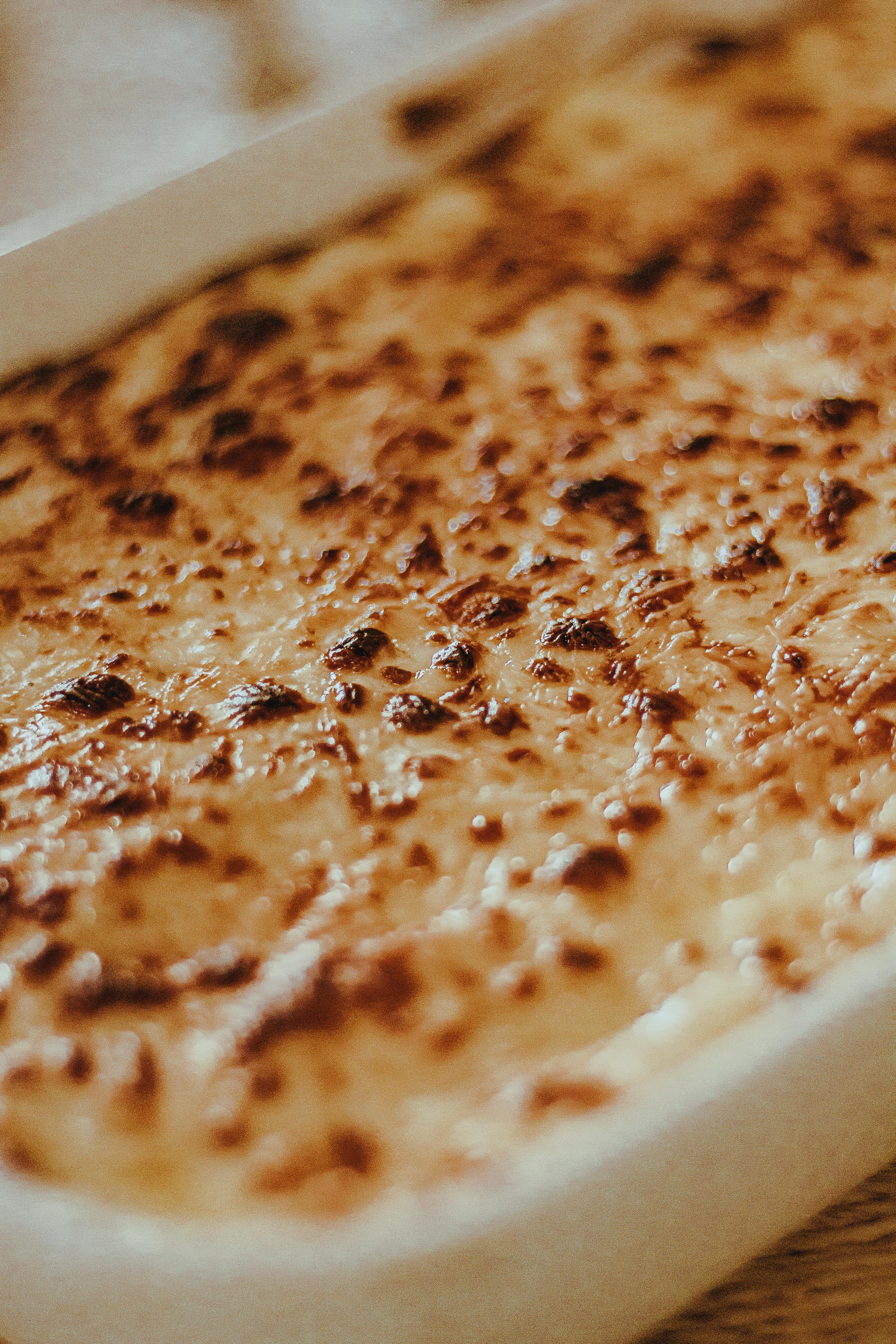
Photo: Marina Utrabo / Pexels
Portuguese
Bacalhau com Natas
The diets react (see scores below)
Common Ingredients
- salt cod
- potatoes
- cream
- onion
- butter
- flour
- milk
- nutmeg
- cheese
Specific recipes may vary.
Incompatible with 8 of 11 diets
Diet Ratings
Bacalhau com Natas is fundamentally incompatible with a ketogenic diet in its traditional form. The dish contains multiple high-carb ingredients: potatoes (the primary bulk ingredient, contributing ~15-17g net carbs per 100g), flour (used to thicken the béchamel-style sauce, ~76g net carbs per 100g), and milk (adds additional lactose-based carbs). Together, a standard serving would easily deliver 40-60g or more of net carbs, blowing the daily keto budget in a single meal. While the cream, butter, cheese, and salt cod are individually keto-friendly, the structural carbs from potatoes and flour make this dish incompatible with ketosis without radical reformulation (e.g., replacing potatoes with cauliflower and flour with xanthan gum).
Bacalhau com Natas is fundamentally incompatible with a vegan diet. The dish contains multiple animal products: salt cod (fish), cream (dairy), butter (dairy), milk (dairy), and cheese (dairy). Every protein and fat source in this dish is animal-derived. There is no plant-based version of this dish that could reasonably be called Bacalhau com Natas — the salt cod and dairy components are defining, non-negotiable elements of the recipe.
Bacalhau com Natas is fundamentally incompatible with the paleo diet. While salt cod itself could be a legitimate paleo protein, the dish is built around multiple non-paleo staples: cream, milk, butter, and cheese are all dairy products excluded by paleo guidelines. Flour is a grain-based thickener, also excluded. Salt cod introduces added salt, which is also discouraged. Nutmeg and onion are paleo-compliant, and potatoes occupy a gray area, but the core structure of this dish — a creamy, flour-thickened dairy gratin — is entirely at odds with paleo principles. There is no meaningful way to adapt this dish without fundamentally changing its identity.
Bacalhau com Natas presents a conflict within Mediterranean diet principles. The salt cod base is a genuine Mediterranean staple — preserved cod is deeply embedded in Portuguese culinary tradition and fish is strongly encouraged. However, the preparation method undermines the fish's nutritional profile significantly: heavy cream, butter, flour, and cheese create a rich béchamel-style sauce high in saturated fat and refined carbohydrates, replacing the canonical olive oil fat source with dairy fats. Potatoes add refined starchy carbohydrates with limited fiber benefit. While individual ingredients like onion, nutmeg, and milk are acceptable in moderation, the overall dish is a cream-heavy, butter-laden casserole that diverges considerably from the plant-forward, olive-oil-based Mediterranean ideal. It earns credit for the cod protein and its cultural authenticity, but the fat profile and preparation style push it into caution territory.
Some Mediterranean diet scholars argue that traditional regional dishes — even rich ones — should be evaluated in cultural context: Bacalhau com Natas is an occasional celebratory Portuguese dish, not a daily staple, and moderate dairy use is permitted under Mediterranean guidelines. A more permissive interpretation would note that if prepared with reduced cream and butter portions, the cod base still delivers meaningful omega-3 and lean protein benefits consistent with Mediterranean eating patterns.
Bacalhau com Natas is fundamentally incompatible with the carnivore diet. While the salt cod itself is an acceptable animal protein, the dish is built around multiple plant-based and processed ingredients. Potatoes are a starchy plant food, onion is a plant, flour is a grain-derived thickener, and nutmeg is a plant spice — all strictly excluded on carnivore. The cream, milk, butter, and cheese are dairy derivatives that are debated within the community, but their presence is irrelevant here given the dominant plant-based components. This dish cannot be modified into a carnivore-compatible meal without fundamentally changing its character.
Bacalhau com Natas contains multiple Whole30-excluded ingredients. Cream, milk, and cheese are all dairy products explicitly banned on Whole30 (only ghee and clarified butter are allowed as dairy exceptions). Butter is also excluded dairy. Flour is a grain-based ingredient, also explicitly excluded. This dish is fundamentally built on a béchamel-style sauce (butter, flour, milk/cream) and finished with cheese — every one of these core components violates Whole30 rules. There is no compliant version of this traditional Portuguese dish without a complete structural overhaul.
Bacalhau com Natas contains multiple high-FODMAP ingredients that make it unsuitable during the elimination phase. Onion is one of the highest-FODMAP foods (fructans) and is used in significant quantity as a base flavoring — there is no safe serving size. Milk used in the béchamel sauce contributes lactose, and cream also contains lactose (though at lower levels per tablespoon, typical sauce portions push it into high-FODMAP territory). Flour (wheat-based) adds fructans. Cheese varies by type, but if a melting cheese like a semi-soft variety is used, it may contribute additional lactose. The combination of onion, wheat flour, milk, and cream creates a multi-FODMAP hit across fructans, lactose, and potentially excess fructose pathways. Salt cod and potatoes themselves are low-FODMAP, but the rich béchamel-style sauce and onion make this dish a clear avoid during elimination.
Bacalhau com Natas is a Portuguese salt cod gratin that conflicts with DASH diet principles on multiple fronts. Salt cod (bacalhau) is extremely high in sodium — even after soaking and desalting, it retains substantial sodium levels well above DASH thresholds. The dish is further compounded by heavy cream, butter, and cheese, all of which are high in saturated fat and contradict DASH's emphasis on low-fat or fat-free dairy. While cod itself is an excellent lean protein aligned with DASH, the preparation method transforms it into a high-sodium, high-saturated-fat dish. The flour-thickened cream sauce (béchamel-style) adds refined carbohydrates with little nutritional benefit. The potatoes and onion are DASH-friendly vegetables, but they are insufficient to offset the heavy dairy fats and sodium load of the overall dish.
Bacalhau com Natas is a traditional Portuguese salt cod gratin that, while built around a Zone-favorable protein (salt cod/bacalhau is an excellent lean protein source), is heavily compromised by its other ingredients. The dish is dominated by potatoes (high-glycemic, explicitly 'unfavorable' in Zone terminology), cream, butter, flour, milk, and cheese — a combination that creates a macronutrient profile that is extremely high in saturated fat, high-glycemic carbohydrates, and refined flour. The cream, butter, and cheese together create a saturated fat load far beyond Zone's monounsaturated fat ideal. The potatoes and flour-thickened béchamel push carbohydrates into high-glycemic territory. The resulting dish is fundamentally impossible to balance into a 40/30/30 Zone ratio without radical reconstruction — essentially removing or replacing the majority of the dish's characteristic ingredients. While salt cod itself scores highly in Zone, this preparation buries it in anti-Zone components. A score of 3 reflects that it is just barely above a categorical 'avoid' due to the presence of quality lean protein, but the overall dish structure makes Zone compliance nearly impossible in any reasonable serving.
Bacalhau com Natas presents a conflicted anti-inflammatory profile. On the positive side, salt cod (bacalhau) is a lean white fish that provides protein and some omega-3 fatty acids, and onions contribute quercetin and other anti-inflammatory polyphenols. However, the dish is built around a rich béchamel-style sauce made from butter, cream, flour, and milk — a combination that is high in saturated fat and refined carbohydrates, both of which are on the 'limit' list in anti-inflammatory frameworks. The full-fat dairy components (cream, butter, cheese) are explicitly flagged as pro-inflammatory in anti-inflammatory diet guidelines due to saturated fat content and potential promotion of arachidonic acid pathways. Potatoes are neutral starch. Nutmeg adds a modest anti-inflammatory contribution but is negligible at culinary doses. The net profile is dominated by the heavy cream-butter-cheese base, which significantly blunts the anti-inflammatory benefit of the cod. This dish is acceptable as an occasional indulgence but is not appropriate as a regular feature of an anti-inflammatory eating pattern.
Bacalhau com Natas is a traditional Portuguese baked salt cod dish, but its preparation makes it highly problematic for GLP-1 patients. While salt cod itself is an excellent lean protein source, the dish is dominated by a rich béchamel-style sauce made from cream, butter, milk, and flour, plus melted cheese on top and starchy potatoes throughout. The fat load per serving is very high — primarily saturated fat from cream, butter, and cheese — which directly worsens GLP-1 side effects including nausea, bloating, and reflux. Gastric emptying is already slowed by GLP-1 medications, and a heavy, fatty, starchy dish like this will sit in the stomach for an extended and uncomfortable period. The dish is also calorie-dense with low nutrient density per calorie given the refined starch and fat contributions. Refined flour in the béchamel adds little nutritional value. The overall macro profile is high fat, high refined carbohydrate, and moderate protein — essentially the inverse of what GLP-1 patients need. A small portion might preserve some of the cod's protein benefit, but the sauce and potato components cannot be easily separated in a standard serving.
*See how scores were generated at our methodology page.
Nutritional profile
Six traits that cut across every diet.
Fiber & Plants
How much whole-plant food and fiber it delivers.
Healthy Fats
The quality of its fats (unsaturated, omega-3).
Whole / Unprocessed
How close it is to its natural, unprocessed form.
Gut Gentle
How easy it is on digestion (low FODMAP, few irritants).
Low Glycemic
How little it spikes your blood sugar.
Protein Density
How much protein it packs per calorie.
Controversy Index
Higher controversy = more disagreement between diets.
Diet-Specific Tips
 Mediterranean — 4/10
View tips
- Salt cod is a traditional Mediterranean fish source and earns credit as primary protein
- Heavy cream and butter replace olive oil as the dominant fat, significantly increasing saturated fat content
- Béchamel-style sauce made with flour and milk adds refined carbohydrates and dairy fat
- Cheese adds additional saturated fat beyond Mediterranean moderate dairy guidelines
- Potatoes provide starchy carbohydrates with limited fiber benefit
- No olive oil, vegetables, or legumes featured in the dish
- Dish is a traditional Portuguese recipe, not an everyday preparation — cultural context matters
- Overall macronutrient profile skews toward saturated fat and refined carbs, away from Mediterranean ideals
 Zone — 5/10
View tips
- Salt cod is an excellent lean protein source — favorable in Zone terminology
- Potatoes are explicitly 'unfavorable' high-glycemic carbohydrates in Zone — Sears specifically lists them as foods to avoid
- Cream and butter create a heavy saturated fat load, contradicting Zone's monounsaturated fat preference
- Flour-based béchamel adds refined, high-glycemic carbohydrates
- Cheese adds additional saturated fat on top of cream and butter
- The dish's macronutrient ratio is likely inverted from Zone ideals — high fat (saturated), moderate carb (high-GI), with protein diluted by other components
- No practical portion size of this dish as traditionally prepared can approximate 40/30/30 ratios
 Anti-Inflammatory — 4/10
View tips
- Salt cod provides lean protein and modest omega-3 fatty acids
- Cream, butter, and cheese contribute substantial saturated fat — flagged as pro-inflammatory
- Béchamel base uses refined flour — a refined carbohydrate
- Onions provide quercetin and polyphenols with anti-inflammatory activity
- No omega-3-rich oils (e.g., EVOO) featured prominently
- High caloric density from full-fat dairy components limits suitability for regular consumption