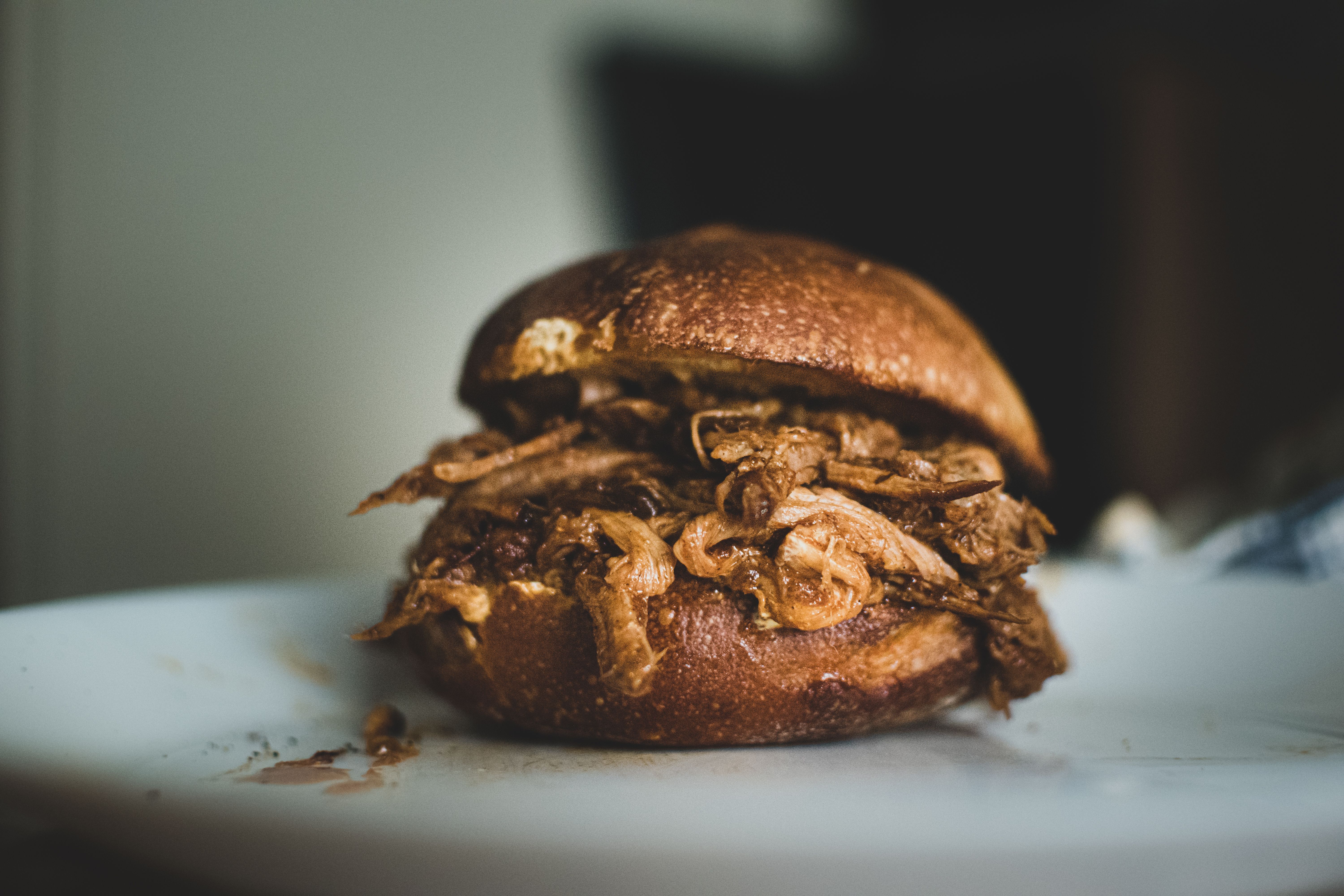
Photo: Vékony Richard / Pexels
The diets react (see scores below)
Common Ingredients
- pork
- garlic
- white wine
- paprika
- bay leaf
- bread roll
- mustard
- olive oil
Specific recipes may vary.
Incompatible with 7 of 11 diets
Diet Ratings
The Bifana is a Portuguese pork sandwich that is fundamentally incompatible with a ketogenic diet in its traditional form. While the pork filling itself — marinated in garlic, white wine, paprika, bay leaf, and olive oil — is entirely keto-friendly and would be an excellent protein and fat source, the defining element of the dish is the bread roll. A standard Portuguese bread roll (papo-seco) typically contains 25-35g of net carbs on its own, which alone can exceed or max out an entire day's carb budget on keto. The white wine marinade adds a small but non-trivial amount of residual carbs as well. The dish cannot be considered a Bifana without the bread — it would simply become a pork dish. As a complete, traditional snack, it must be rated as avoid.
Bifana is a Portuguese pork sandwich. Pork is an animal product (pig meat), which is categorically excluded from a vegan diet. There is no ambiguity here — this dish is built around sliced pork as its primary and essential ingredient. The remaining ingredients (garlic, white wine, paprika, bay leaf, bread roll, mustard, olive oil) are plant-based, but they serve only as marinade, seasoning, and vessel for the meat. The dish cannot be made vegan without fundamentally replacing its defining ingredient.
Bifana is a Portuguese pork sandwich, and while the pork, garlic, paprika, bay leaf, and olive oil are all paleo-approved ingredients, the dish is fundamentally defined by its bread roll — a wheat-based grain product that is strictly excluded from the paleo diet. Grains are one of the clearest disqualifiers in paleo, rejected across all major authorities due to their anti-nutrient content (lectins, gluten, phytates). Additionally, mustard in its commercial form often contains added salt, vinegar, or other additives, making it a minor concern. White wine is a debated item (alcohol) but not the primary issue here. The bread roll alone is sufficient to render this dish non-paleo, and since the bread is structural to the dish identity — not an optional garnish — the verdict is avoid.
The Bifana is a traditional Portuguese pork sandwich that conflicts with several Mediterranean diet principles. Pork (red/processed meat) is the primary protein, which should be limited to only a few times per month under Mediterranean guidelines. It is served in a white bread roll, a refined grain that the diet discourages. While the marinade contains olive oil, garlic, white wine, paprika, and bay leaf — all Mediterranean-friendly ingredients — these aromatics do not offset the core issues of red meat and refined bread. The dish is more of an occasional indulgence than a compatible staple.
Some Mediterranean diet researchers acknowledge that traditional Iberian and Southern European culinary practices do include moderate pork consumption, and Portugal's proximity to the Mediterranean means its food culture shares some overlap. A strict frequency limit (once weekly or less) rather than outright avoidance might be the appropriate framing in a traditional-diet context rather than a clinical guideline context.
Bifana is fundamentally incompatible with the carnivore diet. While the base protein is pork, the dish is defined by its bread roll — a grain-based plant food that is strictly excluded. Beyond the bread, the marinade contains multiple plant-derived ingredients: garlic, white wine (fermented grapes), paprika (a spice), bay leaf (a herb), mustard (plant-based condiment), and olive oil (plant oil). Every non-meat component violates carnivore principles. This is not a carnivore dish with minor infractions — it is structurally a sandwich built around a bread roll, making it impossible to adapt without completely deconstructing it into a different dish entirely.
A Bifana is a Portuguese pork sandwich served in a bread roll. The bread roll alone disqualifies this dish — grains (wheat) are explicitly excluded on Whole30, and bread/rolls also fall under the 'no recreating baked goods/junk food' rule. Beyond the bread, the white wine used in the marinade contains alcohol, which is also excluded. The pork, garlic, paprika, bay leaf, olive oil, and mustard (if compliant/no added sugar) could otherwise be acceptable, but two clear excluded ingredients — wheat bread and alcohol — make this dish incompatible with Whole30 as traditionally prepared.
A traditional Bifana contains two major high-FODMAP components that make it essentially incompatible with the elimination phase. First, garlic is one of the highest-FODMAP foods tested by Monash University, containing significant fructans even in small quantities — and in Bifana it is a core marinade ingredient used generously. Second, the bread roll is a standard wheat-based roll, which is high in fructans. Together these two ingredients make the dish clearly high-FODMAP at any standard serving size. White wine is low-FODMAP in small amounts (up to ~150ml), pork is naturally FODMAP-free, paprika and bay leaf are fine in culinary quantities, olive oil is FODMAP-free, and most mustards are low-FODMAP. However, the combination of garlic marinade plus wheat bread roll means there is no realistic way to eat a traditional Bifana during the elimination phase without significant FODMAP exposure.
Bifana is a Portuguese pork sandwich that presents a mixed DASH profile. The pork itself (typically thin-sliced pork loin or shoulder) can be lean, which DASH permits in limited quantities. The marinade ingredients — garlic, white wine, paprika, bay leaf, and olive oil — are all DASH-friendly, with garlic and olive oil actively beneficial for cardiovascular health. However, several concerns arise: (1) The bread roll is typically a refined white roll, not a whole grain, missing a DASH whole-grain opportunity and offering little fiber. (2) Mustard, while low in calories, adds sodium. (3) Pork cuts used in bifana vary — leaner cuts (loin) are acceptable, but fattier cuts increase saturated fat load. (4) As a snack/street food, portion control and preparation sodium are hard to assess — restaurant versions often use salted pork or add significant sodium. The dish is not inherently DASH-incompatible but requires modifications (whole-grain roll, lean pork loin, low-sodium mustard, sodium-conscious preparation) to fit comfortably within the plan.
NIH DASH guidelines recommend limiting red meat including pork, so a pork-based sandwich on a refined roll would generally be viewed cautiously. However, updated clinical interpretations note that lean pork loin is nutritionally comparable to chicken breast, and some DASH-oriented dietitians accept it as an occasional lean protein choice — particularly when prepared with heart-healthy ingredients like olive oil, garlic, and wine rather than saturated fats.
A bifana is a Portuguese pork sandwich served in a white bread roll, which creates two notable Zone concerns. First, the white bread roll is a high-glycemic, refined carbohydrate — an 'unfavorable' carb in Zone terminology that spikes insulin rapidly and lacks fiber. Second, pork (depending on the cut) can carry moderate saturated fat, making it less ideal than lean chicken or fish, though lean pork loin or tenderloin is acceptable. The positive elements are real: olive oil is a perfect monounsaturated fat source, garlic and paprika are anti-inflammatory polyphenol-rich ingredients, and the white wine marinade adds negligible caloric concern. Mustard is Zone-neutral. The core problem is structural — the white roll dominates the carbohydrate block with high-glycemic, low-fiber refined starch, making it difficult to hit the 40/30/30 ratio without significant modification. If the roll were replaced with a whole-grain or low-GI bread, or eaten open-faced with a smaller portion, the dish improves substantially. As traditionally served, the bread-to-protein ratio and glycemic load of the roll make this a caution-level food requiring careful portioning.
A bifana is a Portuguese pork sandwich with a genuinely mixed anti-inflammatory profile. On the positive side, garlic is a well-established anti-inflammatory ingredient rich in allicin and organosulfur compounds; olive oil provides oleocanthal and monounsaturated fats; paprika and bay leaf contribute antioxidant polyphenols; and white wine used in the marinade introduces small amounts of resveratrol-related compounds. These components collectively offer meaningful anti-inflammatory benefit. However, the dish centers on pork — a red/processed meat that anti-inflammatory guidelines recommend limiting due to arachidonic acid content and saturated fat, particularly if the cut is a fatty shoulder or loin with skin. The bread roll is typically a refined white roll, contributing refined carbohydrates with limited fiber and a moderate glycemic load, which is contrary to anti-inflammatory principles emphasizing whole grains. Mustard is generally neutral to mildly beneficial (contains glucosinolates). The overall dish is not inherently harmful, but its foundation of pork on a refined carb base keeps it in 'caution' territory. Preparation matters: a lean pork cut, quality olive oil, and a whole-grain roll would meaningfully improve the profile.
Some anti-inflammatory practitioners, particularly those following Mediterranean diet principles, would view this dish more favorably — the garlic-wine-olive oil marinade is essentially a Mediterranean cooking pattern, and moderate pork consumption in the context of an otherwise plant-rich diet is not considered problematic by Dr. Weil's framework. Stricter anti-inflammatory or autoimmune protocols (e.g., AIP) would rate this lower due to both the pork and the refined grain roll.
A bifana is a Portuguese pork sandwich served on a white bread roll. The pork is typically a thin-cut shoulder or loin marinated in white wine, garlic, paprika, and bay leaf — the marinade itself is GLP-1 friendly and adds flavor without significant fat or calories. However, several factors pull this dish toward caution rather than approve. First, the cut of pork used (often shoulder) is moderately fatty, not a lean protein source like chicken breast or pork tenderloin. Second, the white bread roll is a refined carbohydrate with low fiber and low nutrient density — a significant drawback given that every calorie must count on GLP-1 medications. Third, the sandwich format requires a meaningful serving size to deliver adequate protein, which may exceed what a GLP-1 patient can comfortably eat in one sitting given reduced gastric capacity and slowed emptying. On the positive side, the olive oil is an unsaturated fat, the marinade is low-sugar and low-irritant, mustard adds minimal calories, and pork does provide protein. If made with a lean pork loin cut and a whole-grain or smaller roll, this dish could approach an approve rating. In its traditional form with a standard white roll and shoulder cut, it lands solidly in caution territory.
Some GLP-1-focused dietitians would rate this lower (toward avoid) due to the refined white roll contributing empty carbohydrate calories and the unpredictable fat content of pork shoulder, which may worsen nausea or reflux in patients with active GI side effects. Others would accept it as a reasonable moderate-protein meal if portion size is controlled and the pork is lean, noting that the wine-based marinade does not add fat.
*See how scores were generated at our methodology page.
Nutritional profile
Six traits that cut across every diet.
Fiber & Plants
How much whole-plant food and fiber it delivers.
Healthy Fats
The quality of its fats (unsaturated, omega-3).
Whole / Unprocessed
How close it is to its natural, unprocessed form.
Gut Gentle
How easy it is on digestion (low FODMAP, few irritants).
Low Glycemic
How little it spikes your blood sugar.
Protein Density
How much protein it packs per calorie.
Controversy Index
Higher controversy = more disagreement between diets.
Diet-Specific Tips
 DASH — 4/10
View tips
- Pork is a red meat limited by DASH guidelines; leanness of cut determines acceptability
- Refined white bread roll lacks whole grains and fiber emphasized by DASH
- Olive oil, garlic, and paprika are DASH-compatible ingredients
- Mustard and seasoned pork preparation add sodium — a key DASH concern
- No saturated-fat-heavy ingredients, but sodium control depends heavily on preparation
- As street food, portion size and sodium content are difficult to standardize
 Zone — 4/10
View tips
- White bread roll is a high-glycemic 'unfavorable' carbohydrate in Zone terminology — the primary concern
- Pork is acceptable lean protein if using loin or tenderloin cuts; fattier cuts increase saturated fat load
- Olive oil is an ideal Zone monounsaturated fat source
- Garlic and paprika contribute anti-inflammatory polyphenols aligned with Sears' later anti-inflammatory focus
- Dish lacks vegetables entirely, missing Zone's emphasis on colorful low-glycemic vegetable carbs
- Portion control of the bread roll (half roll, open-faced) could bring this closer to Zone balance
 Anti-Inflammatory — 5/10
View tips
- Pork is a red meat — anti-inflammatory guidelines recommend limiting, not avoiding entirely
- Garlic is a potent anti-inflammatory ingredient (allicin, organosulfur compounds)
- Olive oil provides oleocanthal and heart-healthy monounsaturated fats
- Paprika and bay leaf contribute antioxidant polyphenols
- Refined white bread roll adds processed carbohydrates with minimal fiber
- White wine marinade introduces trace beneficial polyphenols
- Overall dish is moderate — beneficial herbs/fats offset by pork and refined bread
 GLP-1 Friendly — 4/10
View tips
- Pork cut is often fatty shoulder, not lean loin — protein quality present but fat content is a concern
- White bread roll adds refined carbohydrates with minimal fiber or nutrient density
- Olive oil and wine-based marinade are GLP-1 compatible fats and flavorings
- Moderate protein content but full sandwich may be difficult to finish given reduced gastric capacity
- No high-sugar, fried, carbonated, or highly spicy components — no major red flags
- Portion-sensitive: a half portion with a lean pork cut is significantly more GLP-1 friendly than the traditional full serving