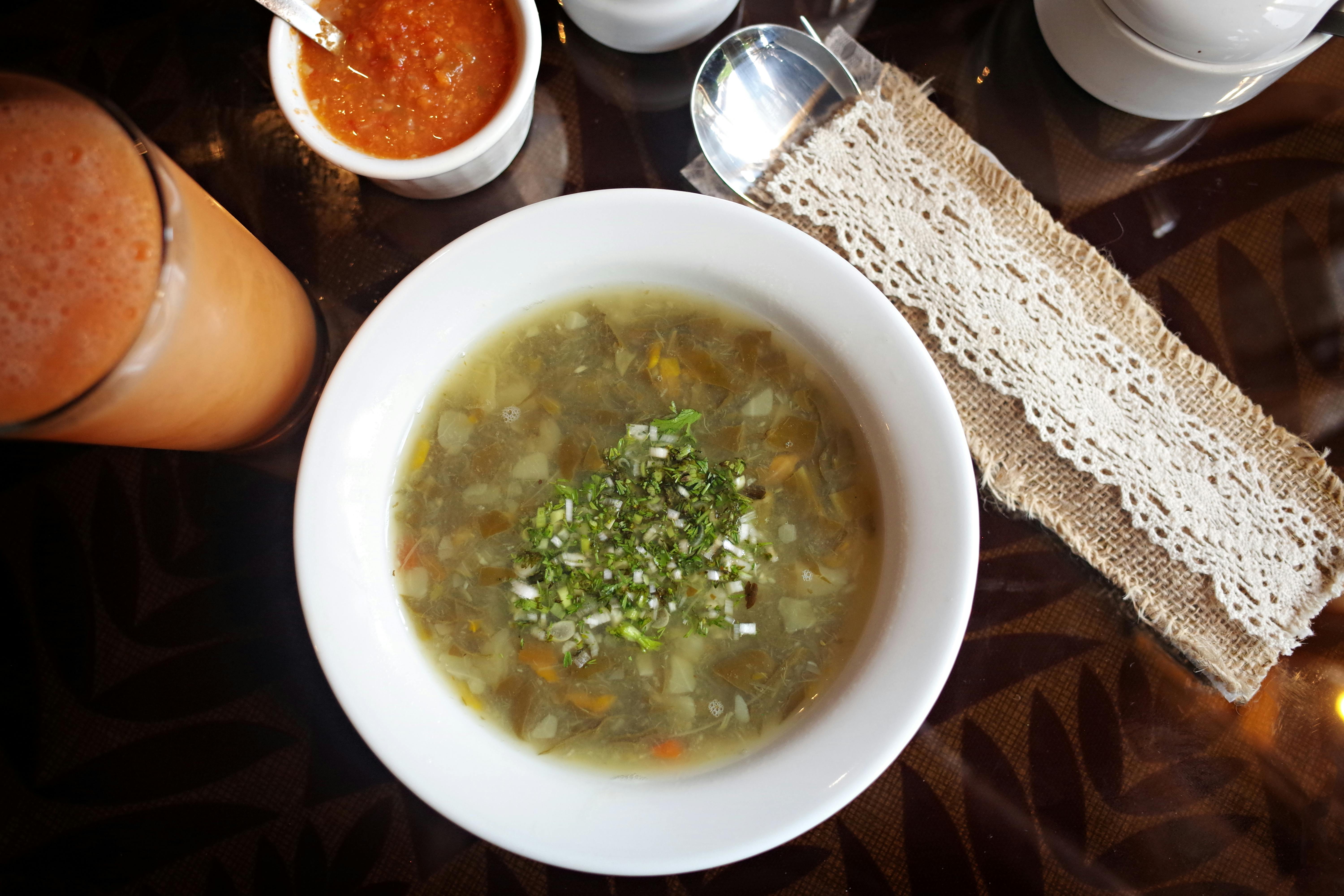
Photo: DΛVΞ GΛRCIΛ / Pexels
Portuguese
Caldo Verde
The diets react (see scores below)
Common Ingredients
- potatoes
- collard greens
- onion
- garlic
- olive oil
- chourico
- salt
- water
Specific recipes may vary.
Incompatible with 5 of 11 diets
Diet Ratings
Caldo Verde is fundamentally incompatible with a ketogenic diet due to its primary ingredient: potatoes. Potatoes are a high-starch vegetable with approximately 15-17g net carbs per 100g, and a standard bowl of Caldo Verde typically contains a substantial portion of potatoes, easily pushing net carbs well beyond the 20-50g daily limit in a single serving. The remaining ingredients are largely keto-friendly — collard greens are a fiber-rich leafy green, onion and garlic add minimal carbs in small amounts, olive oil is an excellent keto fat, and chourico (Portuguese smoked sausage) is a high-fat, moderate-protein meat. However, the potato base is the cornerstone of the dish and cannot be reduced to a keto-compatible quantity without fundamentally changing the recipe. The dish as traditionally prepared is not suitable for ketosis.
Caldo Verde as listed contains chouriço (Portuguese smoked pork sausage), which is an animal product. This is a direct meat ingredient, not a trace or cross-contamination issue, making the dish clearly non-vegan. The remaining ingredients — potatoes, collard greens, onion, garlic, olive oil, salt, and water — are all fully plant-based and would form the basis of an excellent vegan soup if the chouriço were omitted or replaced with a plant-based sausage alternative.
Caldo Verde contains several paleo-problematic ingredients. Salt is explicitly excluded from strict paleo. White potatoes occupy a debated gray zone — originally excluded by Cordain but increasingly accepted by modern paleo practitioners. Most critically, chourico (Portuguese smoked sausage) is a processed meat containing added salt, preservatives, and often other additives, which disqualifies it outright under paleo rules. The combination of these issues — processed meat, added salt, and debated white potatoes — pushes this dish into avoid territory despite the otherwise paleo-friendly base of collard greens, onion, garlic, and olive oil.
Mark Sisson and Whole30 both accept white potatoes, and some paleo practitioners tolerate minimally processed sausages if sourced from clean, additive-free producers. If chourico were replaced with a clean-ingredient chorizo or pork, salt omitted or minimized, this dish could shift toward caution territory for those following a more permissive modern paleo framework.
Caldo Verde is a traditional Portuguese soup with a strong Mediterranean character: abundant collard greens, garlic, onion, olive oil, and potatoes form a wholesome, plant-forward base. However, chouriço (a cured pork sausage) is a processed red meat high in saturated fat and sodium, which directly conflicts with Mediterranean diet principles limiting red and processed meats. The soup's virtues are significant — leafy greens are consumed in quantity, olive oil is the primary fat, and the dish is built around vegetables — but the chouriço inclusion prevents a full approval. A version made with minimal chouriço as flavoring rather than a primary ingredient, or substituted with a small amount of fish or omitted entirely, would rate much higher.
Some Mediterranean diet practitioners acknowledge that traditional Iberian soups like Caldo Verde reflect authentic regional eating patterns where cured pork appears as a flavoring agent in small quantities rather than as a main protein, and argue the overall dish profile — dominated by greens, olive oil, and vegetables — still fits within the diet's spirit. Conversely, strict modern clinical interpretations (e.g., PREDIMED-based guidelines) would flag any processed cured meat as a net negative regardless of quantity.
Caldo Verde is a traditional Portuguese soup that is fundamentally plant-based in its composition. The primary ingredients — potatoes, collard greens, onion, garlic, and olive oil — are all strictly excluded on the carnivore diet. While chouriço (Portuguese smoked sausage) is the one animal-derived component, it plays a minor supporting role and often contains additives. The dish is overwhelmingly plant-derived and cannot be adapted into a carnivore-compatible meal without essentially becoming a different dish entirely. This is a clear avoid with high confidence across all carnivore frameworks.
Most individual ingredients in Caldo Verde are straightforwardly Whole30 compliant: potatoes, collard greens, onion, garlic, olive oil, salt, and water are all approved whole foods. The critical variable is the chouriço (Portuguese smoked sausage). Like most cured/smoked sausages, commercially produced chouriço commonly contains added sugar, wine, and potentially other non-compliant additives. A careful label-read is essential — compliant versions with no added sugar or non-compliant ingredients do exist, but they are not the norm. If a verified compliant chouriço is used, the dish is fully Whole30 approved. The base soup itself is otherwise clean and unproblematic.
Official Whole30 guidelines allow cured meats if the label is compliant (no sugar, no non-compliant additives), so a technically compliant chouriço makes this dish fully approvable. However, the Whole30 community often cautions against leaning heavily on processed sausages as a dietary staple, as it may not honor the program's spirit of moving away from highly processed foods.
Caldo Verde contains two high-FODMAP ingredients that are core to the dish and cannot be reduced to safe levels without fundamentally altering the recipe. Onion and garlic are among the highest-fructan foods tested by Monash University and are high-FODMAP at any reasonable serving size. Even small amounts of onion or garlic cooked into a soup broth will leach fructans into the liquid, making the entire pot high-FODMAP. Chourico (Portuguese chorizo) may also contain garlic and onion powder as seasoning ingredients, compounding the problem. Potatoes and collard greens are low-FODMAP, and olive oil is safe, but the foundational aromatics make this dish incompatible with the elimination phase. The dish cannot be made low-FODMAP simply by reducing portions — the fructans dissolve into the broth and affect every spoonful.
Caldo Verde presents a mixed DASH diet profile. The base ingredients — potatoes, collard greens, onion, garlic, and olive oil — are strongly DASH-compatible. Collard greens are rich in potassium, calcium, magnesium, and fiber; potatoes provide potassium; olive oil is the preferred DASH fat. However, chouriço (Portuguese smoked sausage) is a processed red meat high in sodium, saturated fat, and nitrates — all of which DASH explicitly limits. Additionally, salt is added separately, pushing total sodium further. As commonly prepared, a single serving can easily exceed 600–900mg of sodium depending on portion size and chouriço quantity, making it difficult to fit within the DASH daily sodium targets (<2,300mg or especially <1,500mg). The dish is not inherently incompatible with DASH but requires significant modification to qualify as approved.
NIH DASH guidelines explicitly limit processed red meats like chouriço due to high sodium and saturated fat content, making the traditional recipe a caution at best. However, some DASH-oriented clinicians note that if chouriço is used in very small amounts as a flavoring agent (rather than a primary protein), and salt is minimized, the vegetable-forward base of this soup can be made DASH-compatible — a low-sodium chicken sausage substitute would elevate the score considerably.
Caldo Verde presents a mixed Zone Diet profile. On the positive side, it contains collard greens (an excellent low-glycemic, polyphenol-rich vegetable), olive oil (ideal monounsaturated fat), onion, and garlic — all favorable Zone ingredients. However, the dish has two significant Zone concerns: (1) Potatoes are explicitly classified as an 'unfavorable' high-glycemic carbohydrate in Dr. Sears' Zone framework, spiking insulin and disrupting the hormonal balance the Zone targets. They are the primary carbohydrate source here. (2) Chouriço (Portuguese smoked sausage) is a high-saturated-fat, processed meat with a poor omega-6 fatty acid profile — the opposite of the lean protein and anti-inflammatory fat sources Sears recommends. While chouriço does provide protein, it comes with significant saturated fat and is processed. A Zone practitioner could adapt this soup by dramatically reducing potato quantity, increasing collard greens, and substituting lean chicken or fish for the chouriço, but as traditionally prepared, the macronutrient and glycemic profile skews away from Zone ideals. The dish as served would be carbohydrate-heavy from high-GI potatoes and protein-deficient relative to Zone ratios.
Some Zone practitioners argue that potatoes in a soup context — where they are diluted with water and accompanied by fiber-rich collard greens — have a moderately blunted glycemic impact compared to eating plain potatoes. Additionally, Sears' later writings softened the absolute prohibition on saturated fat, meaning a small amount of chouriço may be acceptable in context. A flexible Zone approach might allow a small portion of this soup as part of a larger Zone-balanced meal with added lean protein.
Caldo Verde is a traditional Portuguese soup with a genuinely mixed anti-inflammatory profile. On the positive side, collard greens are a standout anti-inflammatory ingredient — rich in vitamins K and C, carotenoids, and glucosinolates that actively reduce inflammatory markers. Garlic and onion both provide anti-inflammatory sulfur compounds and flavonoids (quercetin). Olive oil, a cornerstone of the anti-inflammatory diet, adds oleocanthal and monounsaturated fats. Potatoes are neutral-to-mildly-beneficial in this context — they provide resistant starch and potassium, though some anti-inflammatory protocols flag white potatoes as high-glycemic. The problematic element is chouriço (Portuguese smoked sausage), a processed red meat high in saturated fat, sodium, and nitrates/nitrites — all of which are linked to elevated inflammatory markers (CRP, IL-6). The anti-inflammatory diet explicitly limits processed meats and red meat. However, chouriço is used in small quantities in traditional preparations (primarily for flavor), which mitigates — but does not eliminate — the concern. The overall dish sits in 'caution' territory: a largely vegetable-based preparation undermined by a processed meat component that prevents a full approval.
Some anti-inflammatory practitioners following Mediterranean-adjacent frameworks (including Dr. Weil's broader pyramid emphasis on dietary patterns over individual ingredients) would argue that a small amount of chouriço in a vegetable-dominant soup is an acceptable cultural accommodation and does not meaningfully shift the dish's overall inflammatory load. Conversely, stricter anti-inflammatory protocols and researchers focused on processed meat and nitrate exposure (e.g., IARC classifications) would rate this more harshly, potentially scoring it a 3-4 due to the processed meat presence regardless of quantity.
Caldo Verde is a traditional Portuguese soup with a mixed nutritional profile for GLP-1 patients. On the positive side, it contains collard greens (high fiber, nutrient-dense, easy to digest when cooked), onion and garlic (digestive support, micronutrient value), olive oil (unsaturated fat, acceptable in moderation), and a broth base that supports hydration. Potatoes provide some fiber and potassium but are a refined carbohydrate source with moderate glycemic impact and low protein density. The primary concern is chouriço — a cured, fatty pork sausage high in saturated fat, sodium, and often additively processed. This is the ingredient that pulls the score down for GLP-1 patients, as high-fat processed meats can worsen nausea, bloating, and reflux. The dish also lists 'none' as primary protein, which is accurate given that chouriço is a flavoring component in traditional portions rather than a protein anchor. As served, this soup is unlikely to meet the 15–30g per meal protein target. It scores as caution rather than avoid because the vegetable and broth components are genuinely beneficial, it is easy to digest in small portions, and the dish can be modified — reducing chouriço quantity or substituting a lean protein — to improve its GLP-1 compatibility significantly.
Some GLP-1-focused dietitians may rate this more favorably, noting that soups are generally well-tolerated due to high water content, easy digestibility, and natural portion control, and that a small amount of chouriço provides flavor satisfaction that supports adherence. Others would flag the high sodium content of chouriço and the low protein density as disqualifying for patients who are already struggling to meet daily protein targets on reduced caloric intake.
*See how scores were generated at our methodology page.
Nutritional profile
Six traits that cut across every diet.
Fiber & Plants
How much whole-plant food and fiber it delivers.
Healthy Fats
The quality of its fats (unsaturated, omega-3).
Whole / Unprocessed
How close it is to its natural, unprocessed form.
Gut Gentle
How easy it is on digestion (low FODMAP, few irritants).
Low Glycemic
How little it spikes your blood sugar.
Protein Density
How much protein it packs per calorie.
Controversy Index
Higher controversy = more disagreement between diets.
Diet-Specific Tips
 Mediterranean — 5/10
View tips
- Collard greens provide abundant leafy vegetables — strongly Mediterranean
- Extra virgin olive oil as primary fat — core Mediterranean principle
- Garlic and onion — traditional Mediterranean aromatics
- Chouriço is a processed cured red meat high in saturated fat and sodium — contradicts Mediterranean guidelines
- Potatoes are acceptable but less preferred than other vegetables
- Small chouriço quantity as flavoring mitigates but does not eliminate the concern
- Traditional Portuguese dish — peripheral but related to Mediterranean culinary traditions
 Whole30 — 5/10
View tips
- Chouriço commonly contains added sugar and wine — label verification is required
- Potatoes are fully Whole30 compliant
- Collard greens, onion, garlic, olive oil, salt, and water are all approved ingredients
- A compliant (sugar-free, additive-free) chouriço would make the entire dish approved
- Wine used in traditional chouriço preparation is an additional non-compliant risk factor
 DASH — 4/10
View tips
- Chouriço is a high-sodium, high-saturated-fat processed red meat explicitly limited by DASH
- Added salt compounds the sodium burden, risking exceedance of both 2,300mg and 1,500mg daily targets
- Collard greens are a DASH superfood: rich in potassium, calcium, magnesium, and fiber
- Potatoes contribute beneficial potassium and complex carbohydrates
- Olive oil aligns with DASH preferred fat sources
- Garlic and onion are DASH-friendly aromatics with no sodium concerns
- Score improves significantly if chouriço is omitted or replaced with a low-sodium lean protein and salt is minimized
 Zone — 4/10
View tips
- Potatoes are explicitly 'unfavorable' high-glycemic carbs in Zone Diet methodology
- Chouriço is a processed, high-saturated-fat meat inconsistent with lean protein guidelines
- Collard greens are an excellent Zone-favorable low-glycemic carbohydrate and polyphenol source
- Olive oil is an ideal Zone monounsaturated fat
- Dish is carbohydrate-heavy with insufficient lean protein for proper Zone block ratios
- Traditional preparation does not meet 40/30/30 macro ratio without significant modification
- Onion and garlic are Zone-favorable aromatic vegetables
 Anti-Inflammatory — 5/10
View tips
- Collard greens: highly anti-inflammatory — glucosinolates, carotenoids, vitamins K and C
- Olive oil: core anti-inflammatory fat (oleocanthal, MUFAs)
- Garlic and onion: anti-inflammatory flavonoids and sulfur compounds
- Chouriço: processed red meat — pro-inflammatory; high saturated fat, sodium, nitrates
- Potatoes: neutral-to-mixed; high glycemic index is a mild concern in some frameworks
- Small chouriço quantity relative to total dish volume reduces but does not eliminate concern
 GLP-1 Friendly — 5/10
View tips
- Chouriço is high in saturated fat and sodium, a processed meat that may worsen GLP-1 GI side effects
- Low protein density — unlikely to meet 15–30g per meal protein target without modification
- Collard greens are excellent: high fiber, nutrient-dense, and easy to digest when cooked
- Broth base supports hydration, a key GLP-1 dietary priority
- Potatoes add carbohydrates with moderate glycemic impact and minimal protein contribution
- Olive oil is an acceptable unsaturated fat in small amounts
- High water content of soup format supports GLP-1 hydration needs
- Dish is highly modifiable — reducing chouriço and adding lean protein (e.g., white beans, shredded chicken) would substantially improve GLP-1 compatibility