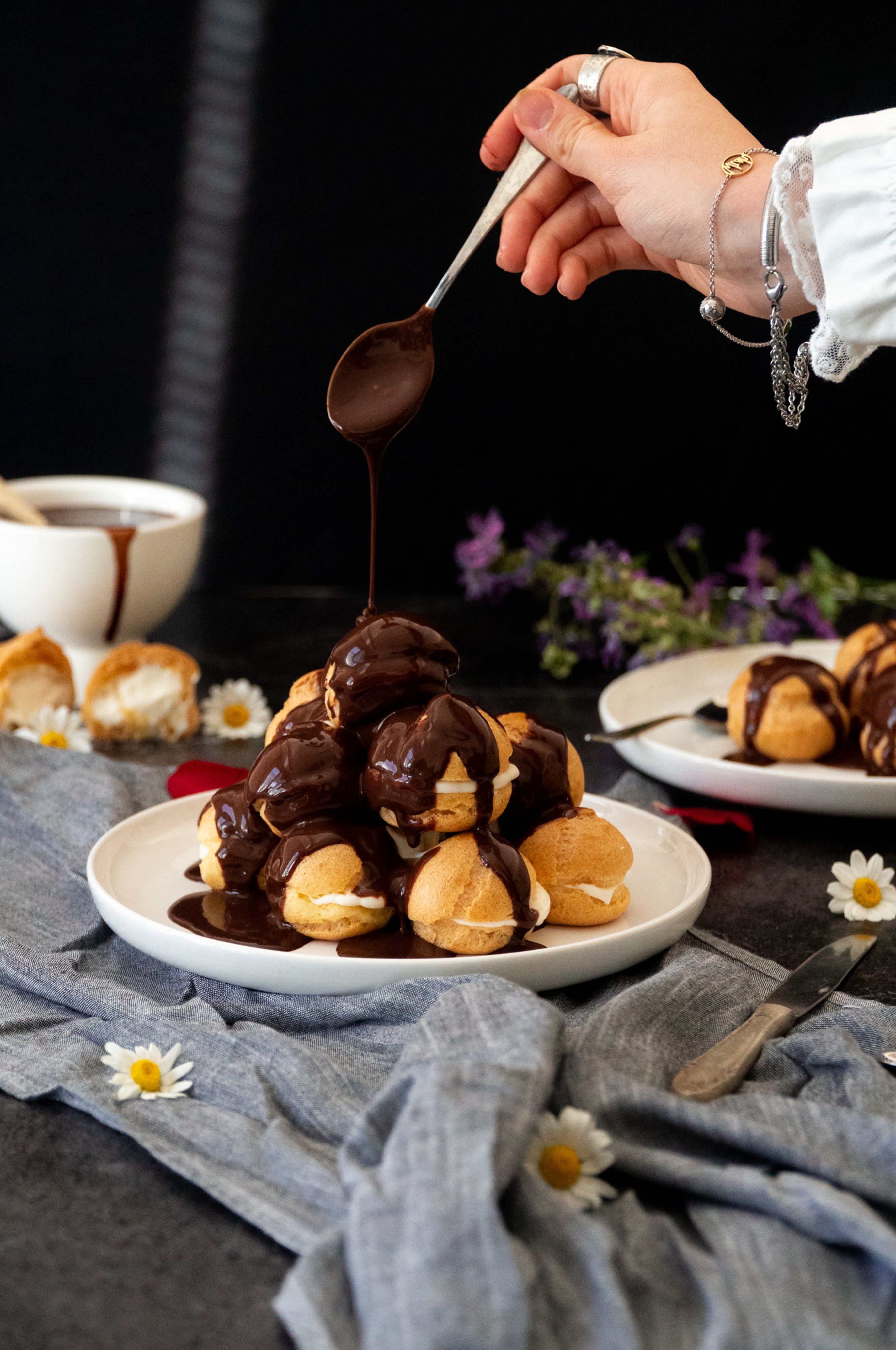
Photo: senanur ulusoy / Pexels
French
Profiteroles
The diets react (see scores below)
Common Ingredients
- flour
- butter
- eggs
- water
- salt
- milk
- sugar
- vanilla
- chocolate
- cream
Specific recipes may vary.
Incompatible with 11 of 11 diets
Diet Ratings
Profiteroles are fundamentally incompatible with ketogenic diets. The choux pastry shell is made from wheat flour, a grain that delivers high net carbs immediately. The filling is a cream custard or whipped cream sweetened with sugar and vanilla, and the topping is chocolate sauce made with sugar. Every component — flour, sugar, milk, and chocolate glaze — contributes significant net carbohydrates. A standard serving of 3 profiteroles can easily contain 40-60g of net carbs, which alone can exceed an entire day's keto carb allowance. There is no meaningful modification possible while keeping this dish recognizable as profiteroles.
Profiteroles are fundamentally non-vegan. The choux pastry shell alone contains both butter and eggs — two clear animal products. The filling is typically cream (dairy), and the dish also lists milk as an ingredient. The chocolate sauce often contains dairy as well. Every major component of this classic French dessert relies on animal-derived ingredients, making it entirely incompatible with a vegan diet. There is no ambiguity here: eggs, butter, cream, and milk are all excluded under any mainstream definition of veganism.
Profiteroles are fundamentally incompatible with the Paleo diet. The choux pastry shell is built on wheat flour, a grain explicitly excluded from Paleo. The filling and topping contain dairy (milk, cream, butter), refined sugar, salt, and chocolate (typically processed with sugar and dairy). Nearly every ingredient in this dish falls into a prohibited category. There is no meaningful paleo substitution that would preserve the dish as profiteroles — this is a structurally non-paleo food.
Profiteroles are a classic French pastry that fundamentally conflicts with Mediterranean diet principles. The dish is made from refined white flour (not a whole grain), butter (not olive oil), and filled/topped with sugar, cream, and chocolate — a combination of refined carbohydrates, added sugars, saturated fats, and heavily processed ingredients. There is virtually no plant-forward, whole food content. This is exactly the type of dessert the Mediterranean diet minimizes or eliminates entirely.
Profiteroles are a classic French pastry that is fundamentally incompatible with the carnivore diet. The choux pastry shell is made from flour (a grain/plant product), and the dish is filled and topped with sugar, vanilla, chocolate, and cream. While a few ingredients are animal-derived (butter, eggs, milk, cream), the majority of the dish's structure, flavor, and caloric content comes from plant-based and processed ingredients. Flour, sugar, vanilla, and chocolate are all strictly excluded on the carnivore diet. This is essentially a grain-based, sugar-laden dessert with only incidental animal-derived components.
Profiteroles contain multiple excluded ingredients and also fall squarely into the 'no recreating baked goods/junk food' rule. The choux pastry shell is made with flour (a grain, excluded). The dish also contains sugar (excluded added sugar), dairy milk (excluded), and cream (excluded dairy). Butter is excluded (only ghee/clarified butter is permitted). Beyond the individual ingredients, profiteroles are a classic pastry/dessert — exactly the category of baked goods and junk food that Whole30 explicitly prohibits recreating even with compliant ingredients. This is a clear, multi-layered violation of the program.
Profiteroles are high-FODMAP across multiple components. The choux pastry shell is made with wheat flour, which is high in fructans — a primary FODMAP trigger. The cream filling (crème pâtissière or whipped cream) typically contains milk and/or cream; while heavy cream is low-FODMAP, a custard-based filling uses significant quantities of lactose-containing milk. The chocolate sauce adds further concern if made with regular milk chocolate (lactose) or if it contains high-fructose corn syrup. Individually, butter and eggs are low-FODMAP, and plain dark chocolate in small amounts (~30g) can be low-FODMAP, but the combination of wheat flour (fructans) and lactose-heavy dairy in a standard serving makes this dish clearly high-FODMAP during the elimination phase. There is no realistic way to consume a standard serving of profiteroles (2–3 pieces) without exceeding FODMAP thresholds for fructans from wheat flour alone.
Profiteroles are a classic French pastry (choux pastry filled with cream and topped with chocolate sauce) that conflicts with DASH diet principles on multiple levels. The dish combines butter and cream (high saturated fat), refined white flour (not a whole grain), added sugar, and chocolate — all of which DASH explicitly limits. The cream filling is full-fat dairy, directly contrary to DASH's emphasis on fat-free or low-fat dairy. The chocolate topping adds further saturated fat and significant added sugar. Butter appears both in the choux pastry shell and potentially in the chocolate sauce, compounding saturated fat content. There is virtually no fiber, potassium, magnesium, or calcium benefit. This is a high-calorie, high-saturated-fat, high-sugar dessert with no redeeming DASH-aligned nutritional profile.
Profiteroles are a French pastry consisting of choux pastry (flour, butter, eggs, water, salt) filled with cream and topped with chocolate sauce. From a Zone Diet perspective, this dish is highly problematic on multiple fronts. The macronutrient ratio is far from the Zone's 40/30/30 target: it is dominated by refined carbohydrates (white flour, sugar), saturated fat (butter, cream), and chocolate, with virtually no lean protein. The choux pastry shell is made from refined white flour — a high-glycemic carb that Sears explicitly marks as unfavorable. The cream filling contributes heavily to saturated fat intake, the opposite of the Zone's preference for monounsaturated fats. The chocolate sauce adds additional sugar and saturated fat. There is no practical way to incorporate profiteroles into a Zone-balanced meal or snack without completely undermining the 40/30/30 ratio. Unlike many foods rated 'caution' because portion control can bring them into Zone compliance, profiteroles have no structural Zone-friendly elements — they combine high-GI refined carbs, saturated fat, and sugar with negligible lean protein, making them nearly impossible to balance within the Zone framework.
Profiteroles are a classic French pastry (choux puffs) filled with cream and topped with chocolate sauce. From an anti-inflammatory perspective, this dish is problematic across nearly every ingredient. The choux pastry is made with refined white flour (refined carbohydrate, stripped of fiber and nutrients), butter (saturated fat, to be limited), and milk. The filling is heavy cream (full-fat dairy, high in saturated fat), and the topping is chocolate — likely sweetened milk chocolate or a ganache made with more cream and sugar rather than high-cacao dark chocolate. Added sugar is present throughout, and the overall dish is high in refined carbohydrates, saturated fat, and sugar — three of the primary dietary drivers of inflammatory markers like CRP and IL-6. There are no meaningful anti-inflammatory components: no omega-3s, no polyphenols (unless the chocolate is >70% cacao, which is unlikely in a standard profiterole preparation), no fiber, no antioxidant-rich ingredients. The cream-heavy filling and butter-based pastry place this firmly in the 'limit to avoid' category. This is an occasional indulgence food, not compatible with anti-inflammatory dietary principles.
Profiteroles are a poor fit for GLP-1 patients on virtually every dimension. The choux pastry shell is made from butter, flour, and eggs — delivering refined carbohydrates and saturated fat with minimal protein or fiber. The filling is heavy cream (whipped or pastry cream), and the topping is chocolate ganache made with cream and sugar. The result is a high-fat, high-sugar, low-protein, low-fiber dessert with essentially no nutrient density per calorie. The combination of cream and butter significantly worsens GLP-1 side effects: high fat slows gastric emptying further beyond what the medication already causes, increasing risk of nausea, bloating, and reflux. The sugar load offers empty calories at a time when every calorie must count nutritionally. There is no meaningful protein contribution and negligible fiber. Even as an occasional small treat, the fat and sugar content make this a high-risk choice for GI side effects and counterproductive to the nutritional goals of GLP-1 therapy.
*See how scores were generated at our methodology page.
Nutritional profile
Six traits that cut across every diet.
Fiber & Plants
How much whole-plant food and fiber it delivers.
Healthy Fats
The quality of its fats (unsaturated, omega-3).
Whole / Unprocessed
How close it is to its natural, unprocessed form.
Gut Gentle
How easy it is on digestion (low FODMAP, few irritants).
Low Glycemic
How little it spikes your blood sugar.
Protein Density
How much protein it packs per calorie.
Controversy Index
Higher controversy = more disagreement between diets.