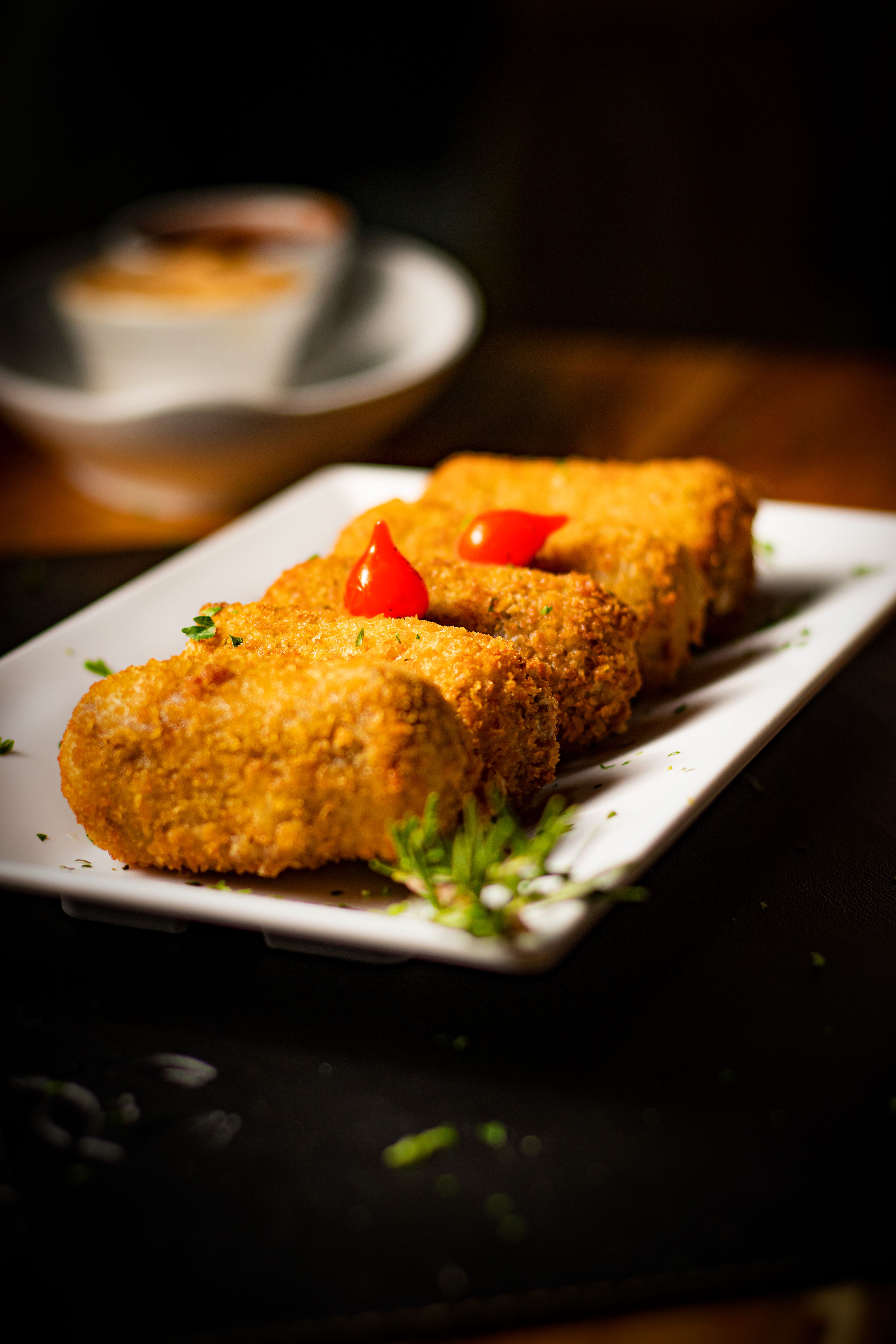
Puerto-Rican
Alcapurrias
The diets react (see scores below)
Common Ingredients
- green bananas
- taro
- ground beef
- sofrito
- annatto
- olives
- oil
Specific recipes may vary.
Incompatible with 9 of 11 diets
Diet Ratings
Alcapurrias are fundamentally incompatible with ketogenic eating. The dough shell is made from green bananas and taro root, both of which are extremely high in starchy carbohydrates. Green bananas are dense in resistant starch and net carbs (roughly 20-25g net carbs per 100g), and taro is similarly starchy (roughly 30g net carbs per 100g). A single alcapurria fritter typically weighs 100-150g, meaning the carb load from the dough alone can easily exceed 30-40g net carbs per piece — potentially blowing the entire daily keto carb budget in one snack. The filling ingredients (ground beef, sofrito, olives) are keto-friendly, but they are entirely overshadowed by the carbohydrate-heavy masa. There is no realistic portion adjustment that makes this dish keto-compatible while preserving its identity as alcapurrias.
Alcapurrias are a traditional Puerto Rican fritter made from a masa of green bananas and taro, stuffed with a seasoned ground beef filling. The primary protein is ground beef, which is unambiguously an animal product and excluded from a vegan diet. While the masa base (green bananas, taro, annatto, sofrito) and accompaniments (olives, oil) are entirely plant-based, the ground beef filling makes the dish non-vegan. A vegan adaptation could substitute the beef with plant-based protein (e.g., jackfruit, lentils, or plant-based ground meat), which would make the dish fully compliant.
Alcapurrias are traditional Puerto Rican fritters made from a masa (dough) of green bananas and taro, stuffed with seasoned ground beef, then deep-fried. While several individual ingredients are paleo-compliant — taro (an approved tuber), ground beef, sofrito (herb/vegetable blend), annatto (natural spice), and olives — the dish has two critical disqualifying factors. First, the 'oil' used for deep-frying is almost certainly a seed oil (canola, vegetable, or soybean oil) in traditional and commercial preparation, which is explicitly excluded from paleo. Second, green bananas in this context are used as a starchy dough base (masa), not as a whole fruit, and the heavily processed, fried dough form contradicts paleo philosophy even if green bananas themselves are technically a fruit. Olives may also contain added salt or preservatives depending on preparation. The deep-frying in seed oil alone is sufficient to classify this as avoid.
A paleo-leaning cook could argue that if coconut oil or avocado oil is substituted for frying, and olives are sourced without additives, the core ingredients (green banana, taro, grass-fed beef, sofrito, annatto) are all ancestral foods. Some flexible paleo practitioners would accept this dish with those substitutions, pushing it into caution territory.
Alcapurrias are deep-fried fritters made from a green banana and taro masa filled with seasoned ground beef. While several individual ingredients have Mediterranean-compatible qualities — green bananas and taro are whole plant-based starches, sofrito is a vegetable-herb base similar to Mediterranean soffritto, and olives are a staple Mediterranean ingredient — the dish as a whole conflicts with Mediterranean principles in two key ways. First, ground beef is the primary protein, and red meat is restricted to only a few times per month in the Mediterranean diet. Second, and more critically, alcapurrias are deep-fried in oil (typically not extra virgin olive oil), making them a high-fat, heavily processed snack format that the Mediterranean diet discourages. The frying method transforms otherwise acceptable ingredients into a calorically dense, pro-inflammatory preparation. The combination of red meat and deep-frying places this firmly in 'avoid' territory.
Some Mediterranean diet interpreters might note the dish's plant-forward base (taro, green banana) and vegetable sofrito as partially redeeming qualities, and if baked rather than fried and prepared with olive oil, a modified version could approach 'caution' territory. The use of olives also reflects a Mediterranean-adjacent flavor profile.
Alcapurrias are fundamentally incompatible with the carnivore diet. The dish is essentially a plant-based fritter filled with meat: the outer shell is made from green bananas and taro (starchy plant foods), and the filling includes sofrito (a blend of plant aromatics), annatto (a plant-based spice/colorant), olives (a plant fruit), and plant oil. While ground beef is present as the protein, it is a minor component surrounded entirely by excluded plant ingredients. No modification short of discarding the entire recipe structure would make this carnivore-compliant. The verdict is clear and uncontested across all carnivore tiers.
Alcapurrias are a traditional Puerto Rican fried fritter where a dough made from grated green bananas and taro encases a seasoned meat filling. While the individual ingredients (green bananas, taro, ground beef, sofrito, annatto, olives, oil) are individually Whole30-compatible, the dish falls squarely into the prohibited 'no recreating baked goods or junk food' category. The Whole30 program explicitly lists fritters and fried snack items under the spirit-of-the-program violation, and alcapurrias are effectively a fried snack/fritter — comparable to chips, tots, or other fried starchy snack formats that are explicitly excluded. The dough is formed into a fritter shape and deep-fried, making this a junk food recreation even with compliant ingredients. Additionally, commercial or restaurant versions of alcapurrias frequently contain added sugar, seasonings with non-compliant additives, or other excluded ingredients, requiring extreme caution with sourcing.
Alcapurrias are a traditional Puerto Rican fritter made from a masa of green bananas and taro, filled with seasoned ground beef. Multiple ingredients raise significant FODMAP concerns. Green bananas contain moderate fructans and are not clearly tested by Monash at typical serving sizes used in this dish — a full alcapurria uses a substantial amount of masa. Taro (yautía) has limited Monash testing but is known to contain GOS and polyols at standard servings. Sofrito is the most definitive problem: traditional Puerto Rican sofrito invariably contains onion and garlic, both high-FODMAP fructan sources, and typically at quantities that exceed safe thresholds even for a single serving. Olives are generally low-FODMAP at small amounts but add complexity. Annatto and oil are low-FODMAP. The combination of potentially problematic masa ingredients plus high-FODMAP sofrito (onion, garlic) makes this dish unsuitable during the elimination phase at a standard serving of 1-2 alcapurrias.
Monash University has not directly tested alcapurrias or traditional Puerto Rican sofrito blends, so exact FODMAP load per serving is uncertain. Some FODMAP practitioners might argue that if sofrito is made with garlic-infused oil and the green shoots of scallions only (omitting onion and garlic cloves), and taro is used in small amounts, a modified version could be tolerated — but standard commercial or home preparation almost certainly includes onion and garlic, making the dish unsafe for most elimination-phase followers.
Alcapurrias are a traditional Puerto Rican fritter made with a dough of green bananas and taro (both DASH-friendly starchy vegetables with fiber and potassium), filled with seasoned ground beef and fried in oil. The individual ingredients have mixed DASH compatibility. Green bananas and taro are nutrient-dense whole foods well-aligned with DASH principles. Ground beef introduces saturated fat, though leaner versions are better tolerated. Sofrito (a blend of herbs, garlic, peppers, onion) is generally low-sodium and DASH-friendly. Olives, while containing heart-healthy monounsaturated fat, are high in sodium — a key DASH concern. The critical issue is the deep-frying preparation method, which substantially increases total fat and caloric content. This frying in oil (likely vegetable oil) significantly departs from DASH guidelines, which emphasize limiting total fat. As a street food/snack, portion control is also a challenge. The combination of deep frying, moderate saturated fat from beef, and sodium from olives and seasoning places alcapurrias in the 'caution' zone — acceptable very occasionally but not a regular DASH-compatible food without significant modification (baking, leaner beef, reduced olives).
NIH DASH guidelines do not address alcapurrias specifically; traditional interpretation would flag the deep-frying and sodium from olives as concerns. However, some DASH-oriented clinicians note that the taro and green banana base provides meaningful fiber, potassium, and magnesium, and that a baked or air-fried version with lean ground beef could be adapted to align more closely with DASH principles.
Alcapurrias are deep-fried fritters made primarily from a masa of green bananas and taro, stuffed with seasoned ground beef. From a Zone perspective, this dish presents multiple structural problems. The carbohydrate base — green bananas and taro — is starchy and high-glycemic (green bananas are explicitly listed as 'unfavorable' carbs in Sears' Zone books, similar to ripe bananas), creating a dense carb load that is difficult to portion into Zone-friendly blocks without consuming a very small, unsatisfying amount. Deep-frying adds a large, uncontrolled fat load, and the frying oil is typically omega-6-heavy vegetable oil, which directly contradicts Zone's anti-inflammatory focus. The ground beef filling could provide some protein, but the protein-to-carb ratio in the overall dish is heavily skewed toward carbohydrates and fat, making the 40/30/30 block ratio nearly impossible to achieve with this food as a snack component. The combination of high-GI starch, deep-fry fat, and poor macronutrient ratio places this firmly in 'avoid' territory for Zone practitioners.
Some Zone practitioners note that green bananas, while starchy, have a lower glycemic index than ripe bananas due to their resistant starch content, which slightly improves their Zone compatibility. Taro also has a moderate rather than extreme glycemic index. A very small alcapurria (one small piece) could theoretically be counted as a partial carb block. However, given that the dish is always deep-fried and the carb density per piece is high, real-world portioning to Zone ratios is impractical, making the 'avoid' verdict appropriate for most contexts.
Alcapurrias present a mixed anti-inflammatory profile. On the positive side, green bananas and taro are resistant-starch-rich whole foods with modest fiber content and a lower glycemic impact than refined carbohydrates, supporting gut health and a favorable microbiome. Sofrito typically contains onion, garlic, peppers, cilantro, and tomato — a genuinely anti-inflammatory herb and vegetable base rich in polyphenols and allicins. Annatto (achiote) contains bixin, a carotenoid with emerging anti-inflammatory research support. Olives contribute monounsaturated fats and polyphenols comparable to olive oil. However, the dish has significant limiting factors: ground beef is a red meat with saturated fat and arachidonic acid, both of which are pro-inflammatory in excess per anti-inflammatory frameworks. The cooking method — deep frying in oil — is the largest concern. If fried in refined seed oils (common commercially), this introduces oxidized omega-6 fatty acids, a clear anti-inflammatory red flag. The oil type is unspecified, which creates meaningful uncertainty. As a snack, portion size matters: a single alcapurria occasionally is far less problematic than regular consumption. The dish is not inherently disqualifying, but the combination of red meat and deep frying pulls it firmly into 'caution' territory.
Some anti-inflammatory nutrition perspectives (e.g., Mediterranean-adjacent frameworks) would view alcapurrias more favorably if fried in olive oil and consumed occasionally, noting the whole-food vegetable base and resistant starch content as net positives. Conversely, stricter anti-inflammatory protocols (such as those aligned with Dr. Weil's emphasis on minimizing red meat and avoiding frying) would rate this closer to 'avoid' given the ground beef and deep-frying combination, regardless of the beneficial ingredients.
Alcapurrias are deep-fried fritters made from a masa of green banana and taro stuffed with seasoned ground beef. While the filling ingredients (green banana, taro, ground beef, sofrito) have some nutritional merit in isolation, the preparation method — deep frying in oil — makes this a poor choice for GLP-1 patients. The high fat content from frying directly worsens the most common GLP-1 side effects: nausea, bloating, and reflux. Gastric emptying is already slowed by the medication; adding a heavy, greasy, fried food significantly increases GI distress risk. Protein content per serving is modest relative to calorie load — the masa shell dominates the macronutrient profile with refined starchy carbohydrates and absorbed frying oil. As a snack category item, it offers poor nutrient density per calorie, which is especially problematic given reduced appetite. The olives add additional fat. There is no meaningful fiber contribution relative to the caloric cost. This is a textbook example of a calorie-dense, fat-heavy, fried food that conflicts with nearly every GLP-1 dietary priority.
*See how scores were generated at our methodology page.
Nutritional profile
Six traits that cut across every diet.
Fiber & Plants
How much whole-plant food and fiber it delivers.
Healthy Fats
The quality of its fats (unsaturated, omega-3).
Whole / Unprocessed
How close it is to its natural, unprocessed form.
Gut Gentle
How easy it is on digestion (low FODMAP, few irritants).
Low Glycemic
How little it spikes your blood sugar.
Protein Density
How much protein it packs per calorie.
Controversy Index
Higher controversy = more disagreement between diets.
Diet-Specific Tips
 DASH — 4/10
View tips
- Deep-fried preparation significantly increases total fat content — major DASH concern
- Olives contribute notable sodium, conflicting with DASH sodium limits (<2,300mg/day)
- Green bananas and taro are potassium- and fiber-rich, DASH-positive base ingredients
- Ground beef introduces saturated fat; leaner beef (>90% lean) would improve DASH compatibility
- Sofrito is herb/vegetable-based and generally low in sodium — DASH-friendly component
- Portion control difficult as a street snack; caloric density elevated by frying oil
- Baking or air-frying would substantially improve DASH compatibility of this dish
 Anti-Inflammatory — 4/10
View tips
- Green bananas and taro provide resistant starch and fiber — supportive of gut microbiome and anti-inflammatory pathways
- Sofrito base (garlic, onion, peppers, herbs) is rich in anti-inflammatory polyphenols and allicin
- Annatto contributes bixin, a carotenoid with anti-inflammatory properties
- Olives add monounsaturated fats and polyphenols
- Ground beef is a red meat — contains saturated fat and arachidonic acid, both pro-inflammatory in regular consumption
- Deep frying is a pro-inflammatory cooking method, especially if seed oils are used — oxidized omega-6 fatty acids are a concern
- Oil type is unspecified; outcome differs significantly between extra virgin olive oil and refined vegetable oils
- Snack context suggests potential for repeated consumption, amplifying cumulative inflammatory load