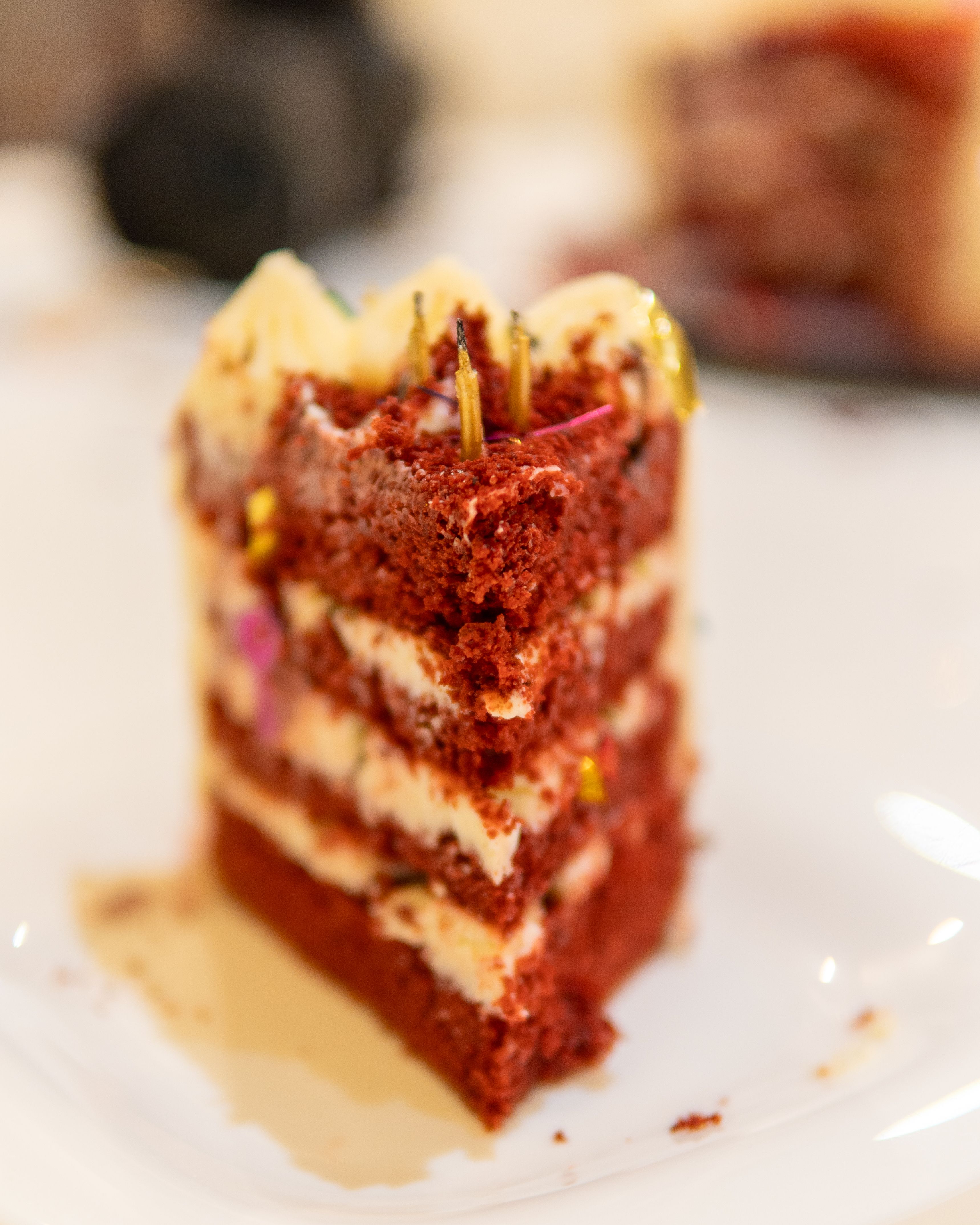
Photo: Israyosoy S. / Pexels
American
Red Velvet Cake
The diets react (see scores below)
Common Ingredients
- flour
- sugar
- cocoa powder
- buttermilk
- vinegar
- eggs
- butter
- food coloring
- cream cheese
- powdered sugar
- vanilla
Specific recipes may vary.
Incompatible with 11 of 11 diets
Diet Ratings
Red Velvet Cake is fundamentally incompatible with a ketogenic diet. It contains flour (a grain-based, high-carb ingredient), multiple sources of sugar (granulated sugar and powdered sugar in the cream cheese frosting), and buttermilk — all of which are dense sources of net carbohydrates. A single standard slice can easily contain 50-80g of net carbs, which alone exceeds or meets the entire daily carb limit for ketosis. There is no realistic portion size that makes this food keto-compatible. The only keto-friendly ingredients present are eggs, butter, cream cheese, cocoa powder (in small amounts), and vanilla.
Red Velvet Cake as described contains multiple animal-derived ingredients that disqualify it from a vegan diet. Eggs are a direct animal product. Butter is dairy-derived. Buttermilk is a dairy product. Cream cheese is dairy-derived. These are not trace or cross-contamination concerns — they are core structural ingredients in this recipe. There is no ambiguity here; this dish is firmly non-vegan. Vegan versions of red velvet cake do exist using plant-based milk with apple cider vinegar as a buttermilk substitute, flax eggs or aquafaba, vegan butter, and dairy-free cream cheese, but the dish as presented does not qualify.
Red Velvet Cake is essentially the opposite of a paleo-compliant food. Nearly every ingredient violates paleo principles: wheat flour is a grain explicitly excluded from the paleo diet; refined sugar and powdered sugar are processed refined sugars with no place in paleo eating; buttermilk and cream cheese are dairy products; butter is a dairy derivative (unlike ghee, it retains milk solids and is not generally accepted even by more lenient paleo frameworks); and artificial food coloring is a processed additive. Even the cocoa powder, while sometimes accepted in paleo contexts, is buried under so many non-compliant ingredients that it offers no redemption. This is a heavily processed, grain- and dairy-laden dessert with no meaningful paleo-compatible qualities.
Red Velvet Cake is a highly processed American dessert that contradicts nearly every principle of the Mediterranean diet. It is built on refined white flour and large quantities of added sugar (both granulated and powdered), with butter as the primary fat rather than olive oil. The cream cheese frosting adds significant saturated fat and more sugar. Artificial food coloring has no nutritional value. While eggs and buttermilk are individually acceptable in moderation within Mediterranean eating, they serve here as vehicles for a sugar- and refined-grain-laden confection. There are no plant-forward, whole-food, or health-promoting elements present. This is precisely the type of processed, high-sugar, refined-grain dessert the Mediterranean diet explicitly minimizes.
Red Velvet Cake is almost entirely composed of plant-derived and processed ingredients that are completely incompatible with the carnivore diet. Flour and sugar are the primary base ingredients — both strictly excluded grains and refined carbohydrates. Cocoa powder is a plant product. Buttermilk and butter are the only animal-derived components, but they are minority ingredients in a cake that is fundamentally a grain-and-sugar confection. Cream cheese is dairy but paired with powdered sugar, making it a processed sweet topping. Food coloring and vanilla are synthetic or plant-derived additives. This dish has no meaningful animal protein, is loaded with refined carbohydrates and sugar, and represents the antithesis of carnivore eating principles.
Red Velvet Cake violates Whole30 on multiple levels. First, it contains flour (a grain/wheat product), which is explicitly excluded. Second, it contains added sugar in multiple forms (granulated sugar and powdered sugar). Third, buttermilk and cream cheese are dairy products, which are excluded (ghee and clarified butter are the only dairy exceptions). Fourth, butter is excluded dairy. Even setting aside the individual excluded ingredients, Red Velvet Cake is quintessentially a baked good/dessert — exactly the category of 'junk food recreation' that Whole30 Rule 4 explicitly prohibits, regardless of ingredient compliance.
Red Velvet Cake contains multiple high-FODMAP ingredients that make it unsuitable during the elimination phase. The primary issue is regular wheat flour, which is high in fructans — one of the most problematic FODMAP categories. Buttermilk is high in lactose, and the cream cheese frosting, while lower in lactose than milk, is typically consumed in quantities that push it into high-FODMAP territory. Powdered sugar in large amounts used in frosting can also be problematic. Even a standard single slice combines significant fructan load (wheat flour) with lactose load (buttermilk, cream cheese), making this dish clearly high-FODMAP at any realistic serving size during elimination.
Red Velvet Cake is fundamentally incompatible with the DASH diet. It is a dessert high in added sugars (granulated sugar and powdered sugar), saturated fat (butter and cream cheese frosting), and refined carbohydrates (white flour), while offering virtually no nutritional benefits emphasized by DASH — no significant potassium, magnesium, calcium, or fiber. The cream cheese frosting is a full-fat dairy product, directly contrary to DASH's low-fat dairy recommendation. Butter contributes saturated fat, which DASH explicitly limits. The large amounts of added sugar place this firmly in the 'sweets' category that DASH restricts to 5 or fewer servings per week, and a single slice of Red Velvet Cake likely exceeds that weekly allowance in one serving. This is a treat food with no meaningful DASH-aligned nutrients.
Red Velvet Cake is essentially a dessert built from the most Zone-unfavorable ingredients possible: refined white flour (high-glycemic, empty carbs), multiple forms of sugar (granulated sugar and powdered sugar in the frosting), and butter (saturated fat). The cream cheese frosting adds additional saturated fat and sugar. There is no meaningful lean protein, no low-glycemic carbohydrate, and no monounsaturated fat. The macronutrient ratio is wildly skewed — overwhelmingly carbohydrate-dominant with the wrong kind of carbs (high-glycemic, high-sugar), the wrong kind of fat (saturated), and essentially no usable protein block. Even a small slice delivers a glycemic spike that would disrupt eicosanoid balance, which is the core concern in Sears' Zone framework. Unlike many foods that can be portioned into Zone blocks, Red Velvet Cake cannot be meaningfully balanced within a Zone meal — there is no realistic portion size that produces a 40/30/30 ratio without adding significant lean protein and fat on the side, at which point the cake itself contributes only glycemic disruption. This is precisely the category of 'treat' food that the Zone Diet identifies as pro-inflammatory and hormonally destabilizing.
Red Velvet Cake is a strongly pro-inflammatory dessert by anti-inflammatory diet standards. The primary ingredients — refined white flour, white sugar, and powdered sugar — are high-glycemic refined carbohydrates that drive insulin spikes and elevate inflammatory markers like CRP and IL-6. Butter contributes saturated fat, which in significant quantities is linked to increased inflammatory signaling. The cream cheese frosting adds more saturated fat and sugar. Red food coloring (typically synthetic dye such as Red 40) falls into the artificial additive category that anti-inflammatory frameworks recommend avoiding. While the recipe does contain small amounts of cocoa powder — which has genuine polyphenol content — the quantity used in red velvet is minimal (much less than in dark chocolate) and is overwhelmed by the inflammatory load of the other ingredients. Buttermilk and eggs are relatively neutral, and vinegar is benign. Overall, this cake is essentially a delivery vehicle for refined sugar, refined flour, saturated fat, and artificial additives — the core targets of anti-inflammatory dietary guidance.
Red Velvet Cake is a poor fit for GLP-1 patients on virtually every relevant dimension. It is high in refined sugar (sugar and powdered sugar as two of the dominant ingredients), high in saturated fat (butter, cream cheese frosting), made with refined flour offering negligible fiber, and contains no meaningful protein source despite eggs appearing in the ingredient list. The cream cheese frosting adds additional fat and sugar with essentially no nutritional return. Caloric density per bite is high while nutrient density per calorie is extremely low — the opposite of what GLP-1 patients need when appetite is suppressed. As a snack category item, it would displace a protein- or fiber-rich option at a moment when nutritional efficiency matters most. The high fat and sugar content also increase the likelihood of GI side effects including nausea, bloating, and reflux, which are already common on GLP-1 medications. Food coloring and artificial additives add no value. There is no realistic portion or preparation modification that rehabilitates this food for regular inclusion in a GLP-1 dietary pattern.
*See how scores were generated at our methodology page.
Nutritional profile
Six traits that cut across every diet.
Fiber & Plants
How much whole-plant food and fiber it delivers.
Healthy Fats
The quality of its fats (unsaturated, omega-3).
Whole / Unprocessed
How close it is to its natural, unprocessed form.
Gut Gentle
How easy it is on digestion (low FODMAP, few irritants).
Low Glycemic
How little it spikes your blood sugar.
Protein Density
How much protein it packs per calorie.
Controversy Index
Higher controversy = more disagreement between diets.