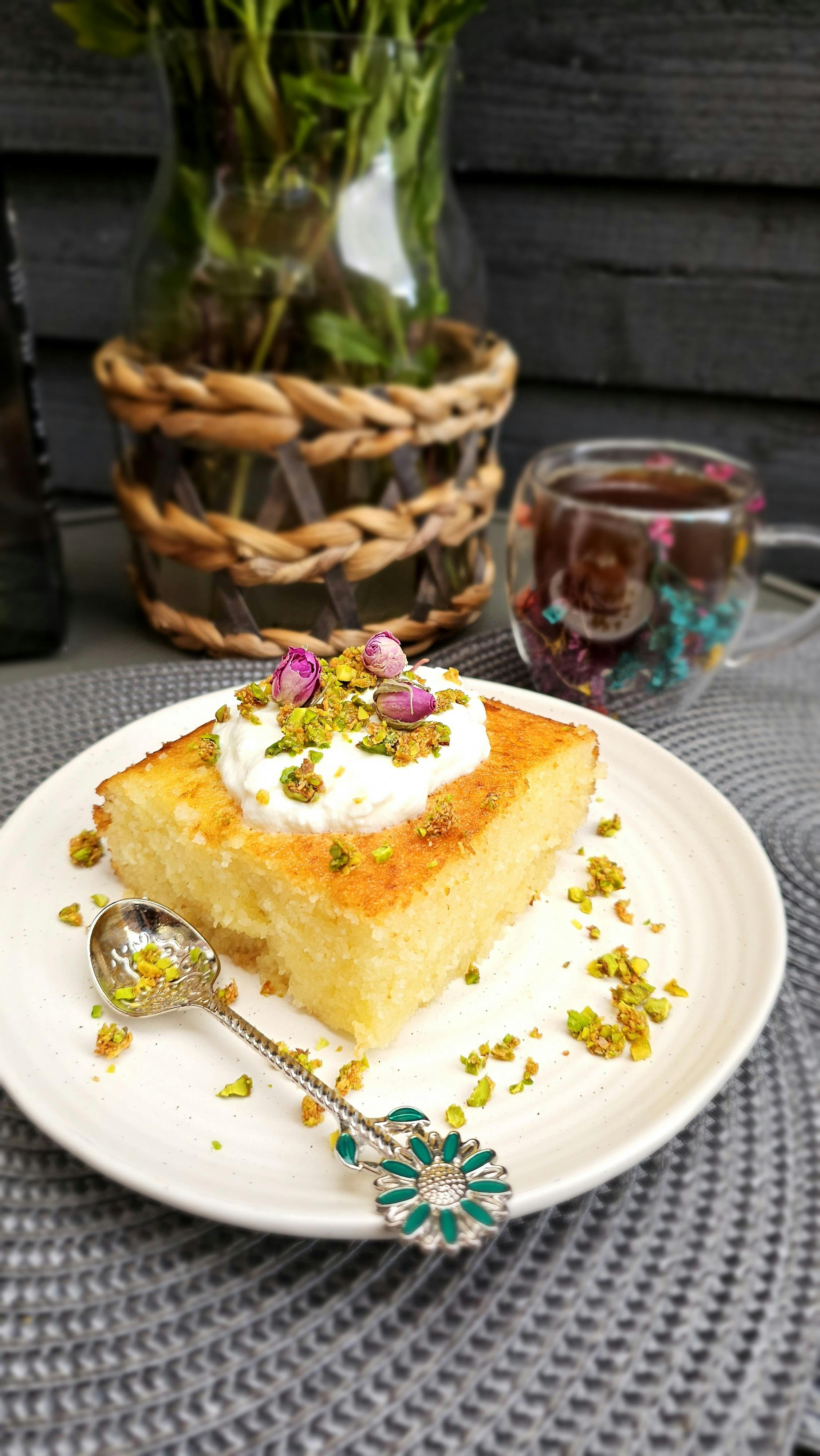
Photo: Codrin Alex / Pexels
The diets react (see scores below)
Common Ingredients
- semolina
- eggs
- yogurt
- sugar
- coconut
- baking powder
- butter
- water
Specific recipes may vary.
Incompatible with 11 of 11 diets
Diet Ratings
Revani is a Turkish semolina cake soaked in sugar syrup, representing one of the most keto-incompatible foods possible. Semolina is a refined grain flour extremely high in carbohydrates (roughly 70g net carbs per 100g), and the dish is heavily sweetened with sugar both in the batter and the syrup soak. A single serving would easily contain 50-80g of net carbs, far exceeding the entire daily keto allowance. The combination of high-glycemic semolina and added sugar will immediately and decisively break ketosis. There are no meaningful keto-friendly elements to offset these ingredients.
Revani contains multiple animal-derived ingredients that disqualify it from a vegan diet. Eggs and yogurt are direct animal products, butter is a dairy derivative, and together these three ingredients make this Turkish semolina cake clearly non-vegan. The remaining ingredients — semolina, sugar, coconut, baking powder, and water — are plant-based, but the presence of three distinct animal products leaves no ambiguity. A vegan version could theoretically be made by substituting flax eggs or aquafaba for eggs, plant-based yogurt for dairy yogurt, and vegan butter or coconut oil for butter, but the traditional recipe as described is not vegan-compliant.
Revani is a Turkish semolina cake that is fundamentally incompatible with the paleo diet. Semolina is a wheat-derived grain product — the single biggest red flag and a clear paleo violation. Yogurt is a dairy product, also excluded. Refined sugar is explicitly prohibited. Baking powder is a processed additive. Butter is dairy (debated at best). Multiple core ingredients independently disqualify this dish, making it one of the least paleo-compatible foods possible.
Revani is a traditional Turkish semolina cake soaked in sugar syrup, which places it firmly in the 'avoid' category from a Mediterranean diet perspective. The dish is high in added sugar (a primary ingredient), uses refined semolina rather than whole grain, and is made with butter rather than olive oil as the fat source. Coconut adds saturated fat not typical of Mediterranean cuisine. While eggs and yogurt are moderately acceptable ingredients, they are overwhelmed by the high sugar and refined grain content. This is an occasional indulgence treat, not a Mediterranean diet staple.
Some Mediterranean diet interpretations acknowledge that traditional sweets made with semolina, eggs, and yogurt — as found across Greek, Turkish, and Levantine cuisines — are part of the cultural fabric of the diet and acceptable in very small, infrequent portions. The Oldways Mediterranean Diet pyramid does allow for sweets in moderation, and homemade versions with whole ingredients are preferable to processed alternatives.
Revani is a Turkish semolina cake that is fundamentally incompatible with the carnivore diet. The dish is built almost entirely on plant-derived and processed ingredients: semolina (a wheat product), sugar, coconut, and baking powder are all strictly forbidden on carnivore. While eggs, yogurt, and butter are animal-derived, they are minor components in a dish whose foundation is grain-based and heavily sweetened. No amount of animal-derived ingredients can redeem a food that is primarily a grain-based dessert with added sugar. This is clearly an avoid across all tiers of carnivore eating.
Revani contains multiple excluded ingredients: semolina (a wheat/grain product), sugar (added sugar), yogurt (dairy), and butter (dairy — not ghee/clarified butter). Even setting aside the individual excluded ingredients, Revani is a sweet cake/dessert, which falls squarely under the Whole30 rule against recreating baked goods and junk food, even with otherwise compliant ingredients. This dish fails on multiple fronts simultaneously.
Revani is a Turkish semolina cake that contains multiple high-FODMAP ingredients. Semolina is made from durum wheat and is high in fructans, making it a primary FODMAP concern — this alone would flag the dish as high-FODMAP during elimination. Yogurt contains lactose (high-FODMAP at standard servings beyond 2 tablespoons of regular yogurt). Coconut is low-FODMAP at small amounts (around 1/4 cup desiccated) but Revani often uses it in quantities that may exceed safe thresholds. The remaining ingredients — eggs, sugar, butter, baking powder, and water — are individually low-FODMAP. However, the combination of semolina (fructans) and yogurt (lactose) in a standard serving of this cake makes it clearly high-FODMAP during the elimination phase. Even small servings would likely contain meaningful fructan loads from the semolina base.
Some clinical FODMAP practitioners note that durum wheat semolina may have slightly different fructan profiles than standard wheat flour, and very small tasting portions might technically fall below Monash threshold values; however, a realistic serving of Revani as a snack would almost certainly exceed safe fructan limits, and the concurrent lactose from yogurt adds further FODMAP burden. Monash University has not specifically tested Revani as a dish, adding uncertainty to precise per-serving calculations.
Revani is a Turkish semolina cake soaked in sugar syrup, making it a high-sugar, high-fat dessert that conflicts with multiple core DASH principles. The dish contains significant amounts of added sugar (both in the batter and the syrup), butter (saturated fat), and coconut (a tropical oil/saturated fat that DASH explicitly limits). The semolina used is refined grain rather than a whole grain. Yogurt is a DASH-friendly ingredient, but its benefit is overwhelmed by the other problematic components. Together, these factors place Revani firmly in the 'avoid' category for the DASH eating plan.
Revani is a Turkish semolina cake soaked in sugar syrup, and its macronutrient profile is fundamentally incompatible with Zone Diet principles. The dish is dominated by high-glycemic carbohydrates — semolina (a refined grain with moderate-to-high glycemic index) combined with significant added sugar — with no meaningful lean protein source listed. Butter adds saturated fat rather than the preferred monounsaturated fats. The resulting macro ratio is heavily skewed toward carbohydrates and fat, with virtually no protein balance, making it essentially impossible to fit into a Zone block structure as a snack without extreme portioning that would render the dish unrecognizable. Even a very small portion would deliver a high glycemic load that would spike insulin — the exact hormonal response Zone Diet is designed to prevent. This is a dessert-category item with sugar as a core structural ingredient, placing it firmly in the 'avoid' category alongside other sweets and pastries.
Revani is a Turkish semolina cake soaked in sugar syrup, and its ingredient profile is largely pro-inflammatory. The dominant concerns are: (1) refined semolina — a high-glycemic refined grain that drives blood sugar spikes and downstream inflammatory signaling; (2) substantial added sugar, both within the batter and in the syrup that defines the dish — excess sugar is one of the clearest dietary drivers of elevated CRP and IL-6; (3) butter, a source of saturated fat that the anti-inflammatory framework consistently flags for limitation; (4) coconut, which adds additional saturated fat. Eggs and yogurt are moderate ingredients on their own, but they cannot offset the cumulative inflammatory load of refined starch, sugar, and saturated fat in this formulation. There are no meaningful anti-inflammatory contributors — no omega-3s, no polyphenols, no fiber-rich whole grains, no antioxidant-dense vegetables or spices. This is a dessert/sweet snack built almost entirely from the ingredient categories the anti-inflammatory framework places in the 'limit' or 'avoid' columns. An occasional small serving would not be catastrophic, but as evaluated the dish rates poorly.
Revani is a traditional Turkish semolina cake soaked in sugar syrup, made primarily from refined semolina, sugar, butter, and coconut. It is essentially a dessert masquerading as a snack and fails on nearly every GLP-1 dietary priority. It provides negligible protein (no primary protein source; eggs and yogurt contribute minimally in typical recipe proportions), very high sugar content from both added sugar and the syrup soak, moderate-to-high saturated fat from butter, and low fiber despite the semolina base. The high sugar load is particularly problematic — it delivers empty calories at a time when every bite must count nutritionally, and can cause blood sugar spikes and rapid return of hunger. The butter contributes saturated fat that may worsen GLP-1 GI side effects. There is no meaningful redeeming nutritional profile for a GLP-1 patient: low protein, low fiber, high sugar, high refined carbohydrate, and moderate fat. Even a small portion delivers a poor nutrient-to-calorie ratio.
*See how scores were generated at our methodology page.
Nutritional profile
Six traits that cut across every diet.
Fiber & Plants
How much whole-plant food and fiber it delivers.
Healthy Fats
The quality of its fats (unsaturated, omega-3).
Whole / Unprocessed
How close it is to its natural, unprocessed form.
Gut Gentle
How easy it is on digestion (low FODMAP, few irritants).
Low Glycemic
How little it spikes your blood sugar.
Protein Density
How much protein it packs per calorie.
Controversy Index
Higher controversy = more disagreement between diets.