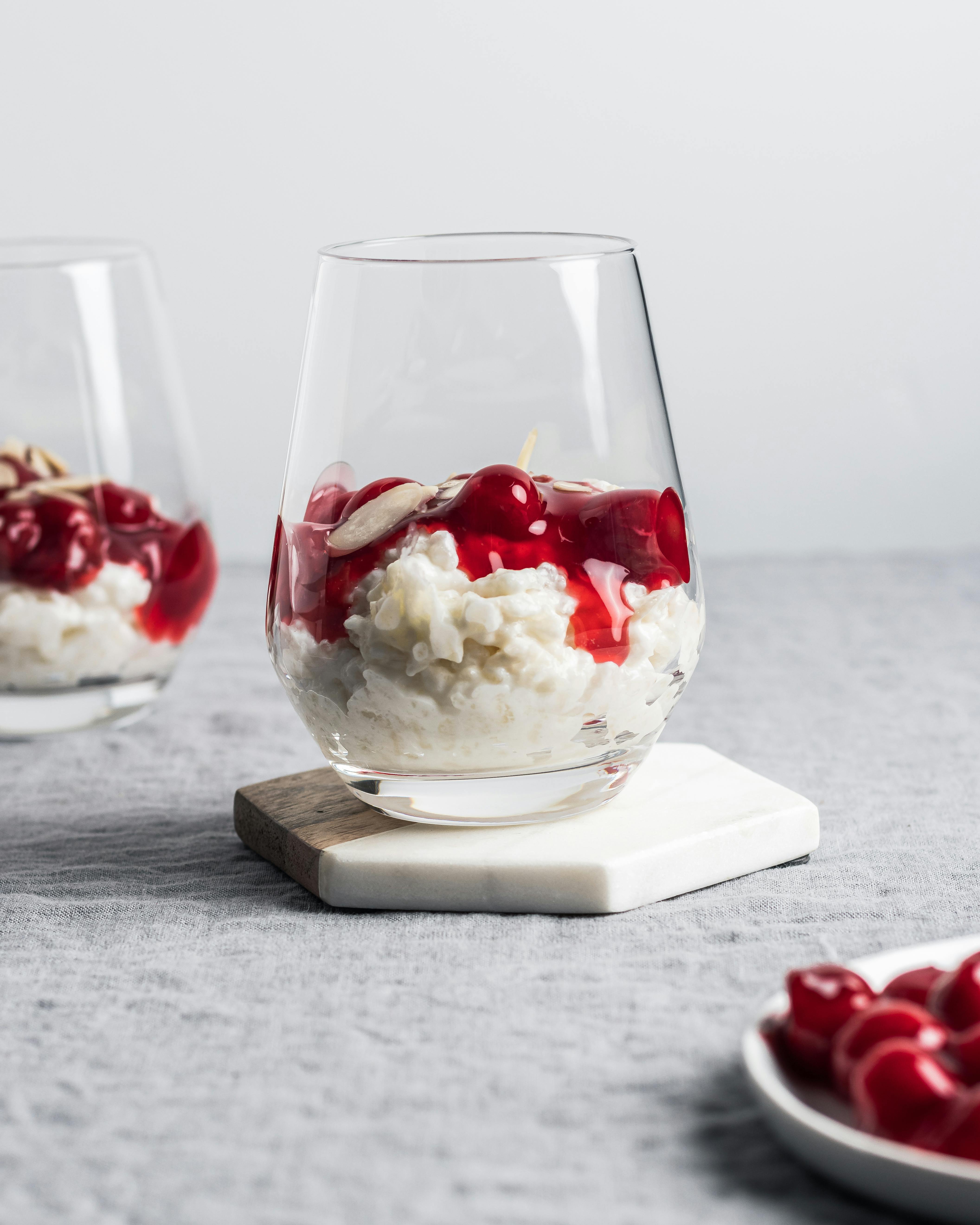
Photo: Anna Pyshniuk / Pexels
The diets react (see scores below)
Common Ingredients
- rice
- milk
- cream
- egg yolks
- sugar
- vanilla
- almonds
- cherry sauce
Specific recipes may vary.
Incompatible with 10 of 11 diets
Diet Ratings
Risalamande is a traditional Danish rice pudding dessert that is fundamentally incompatible with ketogenic eating. Rice is a high-glycemic grain and the single largest ingredient, contributing a massive carbohydrate load. A standard serving easily delivers 30-50g of net carbs from the rice alone, before accounting for added sugar and the cherry sauce (which is essentially sweetened fruit syrup). Together, these ingredients would almost certainly blow an entire day's keto carb budget in a single serving. While cream, egg yolks, and almonds are individually keto-friendly, they are overwhelmed by the anti-keto components. There is no realistic portion size that makes this dish compatible with ketosis.
Risalamande is a traditional Danish rice pudding dessert containing multiple animal-derived ingredients that are clearly excluded under vegan principles. Milk and cream are dairy products, and egg yolks are an animal product. These are not trace contaminants or processing aids — they are core, structural ingredients of the dish. There is no meaningful debate within the vegan community about whether dairy and eggs are animal products. This dish is fundamentally incompatible with a vegan diet as defined by all major vegan organizations.
Risalamande is a traditional Danish rice pudding dessert that is fundamentally incompatible with the Paleo diet. It contains multiple clearly prohibited ingredients: rice (a grain), milk and cream (dairy), and refined sugar. These are not edge cases or debated items — grains, dairy, and refined sugar are unambiguously excluded from Paleo. The almonds are the only clearly Paleo-compliant ingredient, and the vanilla and cherry sauce (if made from whole cherries) could be acceptable, but the core structure of the dish is built entirely on non-Paleo foundations. No reasonable interpretation of Paleo would accommodate this dish.
Risalamande is a traditional Danish Christmas rice pudding dessert that conflicts with Mediterranean diet principles on multiple fronts. It is heavy in cream and egg yolks (high saturated fat), contains added sugar as a primary ingredient, and uses white refined rice as its base. While dairy and eggs are acceptable in moderation in the Mediterranean diet, this dish centers them in a high-fat, high-sugar dessert context rather than as minor additions. The cherry sauce adds further refined sugar. This is a Northern European indulgence dish with no meaningful alignment to Mediterranean dietary patterns — it is not plant-forward, not olive oil-based, and is explicitly a sugar- and saturated-fat-heavy treat.
Risalamande is a Danish rice pudding dessert that is fundamentally incompatible with the carnivore diet. The dish is built on rice, a grain, which is a plant food entirely excluded from carnivore. Additional plant-based ingredients include sugar, vanilla, almonds, and cherry sauce — all strictly forbidden. While milk, cream, and egg yolks are animal-derived, they are minor components in a dish whose very foundation is a grain-based starch. No amount of dairy content redeems a dish where the primary ingredient is rice. This is a plant-dominant dessert with sugar and multiple plant additives.
Risalamande is a traditional Danish rice pudding dessert containing multiple excluded ingredients. Rice is a grain and is explicitly excluded on Whole30. Milk and cream are dairy products, both excluded (only ghee and clarified butter are allowed dairy exceptions). Sugar is an added sweetener, explicitly excluded. These are not minor or debatable violations — this dish is built on a foundation of excluded ingredients (grain + dairy + added sugar), making it completely incompatible with the Whole30 program.
Risalamande is a traditional Danish rice pudding dessert that contains several high-FODMAP ingredients at standard serving sizes. The primary concern is milk: regular cow's milk is high in lactose, and a standard portion of risalamande uses significant quantities of both milk and cream. While heavy cream is relatively low in lactose per tablespoon, the quantities used in risalamande push it into moderate-to-high lactose territory. More critically, milk as a base ingredient makes this dish high-FODMAP due to lactose (a disaccharide). Cherry sauce is a significant additional problem — cherries are high in polyols (sorbitol) and are rated as high-FODMAP by Monash University, and a cherry sauce served alongside risalamande would typically contain enough cherries to be problematic. Rice itself is low-FODMAP, almonds are low-FODMAP at small servings (~10 almonds), sugar and egg yolks are low-FODMAP, and vanilla extract is generally considered low-FODMAP. However, the combination of lactose from milk and polyols from cherry sauce makes this dish unsuitable during the elimination phase without significant modification (e.g., substituting lactose-free milk and omitting cherry sauce).
Monash University rates heavy cream as low-FODMAP at up to 125ml per serving, and if the milk portion were replaced with lactose-free milk, the base pudding could potentially be made low-FODMAP. Some clinical FODMAP practitioners might suggest a modified version is manageable, but the traditional recipe with regular milk and cherry sauce is clearly avoid-level during strict elimination.
Risalamande is a traditional Danish rice pudding dessert made with heavy cream, egg yolks, and sugar — a combination that conflicts with core DASH principles on multiple fronts. Heavy cream is a full-fat dairy product high in saturated fat, directly opposed to DASH's emphasis on fat-free or low-fat dairy. Egg yolks add dietary cholesterol and additional saturated fat. Sugar is a primary ingredient, placing this firmly in the 'sweets' category that DASH explicitly limits. The cherry sauce typically adds significant added sugar on top. While rice and almonds are individually DASH-compatible, and almonds are actively encouraged, they are minor contributors in this context. The dish is calorie-dense, high in saturated fat, and high in added sugars, making it a poor fit for DASH dietary goals regardless of its relatively low sodium content.
Risalamande is a Danish rice pudding dessert that is fundamentally incompatible with Zone Diet principles. The dish is built on white rice (high-glycemic carbohydrate), heavy cream, egg yolks, and added sugar — a combination that virtually guarantees an unfavorable macronutrient ratio. The carbohydrate load is dominated by high-glycemic sources (white rice + sugar + cherry sauce), which Sears explicitly categorizes as 'unfavorable' and flags for spiking insulin. The fat profile is heavily saturated (cream, egg yolks) rather than monounsaturated, working against the anti-inflammatory focus of the Zone. The protein contribution is minimal and comes from dairy rather than lean protein sources. The cherry sauce adds additional sugar and glycemic load. Even with careful portioning, the inherent structure of this dish — a sugar-and-starch-based dessert bound with saturated fat — cannot be restructured into a balanced Zone block meal. The almonds are the only favorable Zone component, providing monounsaturated fat, but they are insufficient to offset the rest of the dish.
Risalamande is a traditional Danish rice pudding dessert made with rice, milk, cream, egg yolks, sugar, vanilla, almonds, and cherry sauce. From an anti-inflammatory standpoint, this dish has a mixed profile. On the positive side, almonds provide vitamin E, healthy monounsaturated fats, and modest anti-inflammatory properties. Cherries (in the cherry sauce) are actually one of the better anti-inflammatory fruits, rich in anthocyanins and shown to reduce CRP and uric acid levels. Vanilla contains small amounts of vanillin, a polyphenol with mild antioxidant activity. However, the dish is weighted heavily toward pro-inflammatory components: full-fat cream is high in saturated fat, which at elevated intake is associated with increased inflammatory markers. Added sugar is a significant concern — risalamande typically contains substantial amounts, and sugar drives insulin spikes and promotes inflammatory pathways. Egg yolks are a moderate concern (mixed evidence, but acceptable in moderation). White rice is a refined carbohydrate with a moderate-to-high glycemic index that offers little fiber or antioxidant benefit. The overall profile is a high-sugar, high-saturated-fat dish with only modest anti-inflammatory contributions from almonds and cherries. As an occasional treat it is not catastrophic, but it does not align well with anti-inflammatory dietary principles.
Risalamande is a traditional Danish rice dessert made with full-fat cream, milk, egg yolks, sugar, and cherry sauce — a combination that is poorly suited for GLP-1 patients on nearly every priority axis. Fat content is high due to heavy cream and egg yolks, which is likely to worsen GLP-1 side effects including nausea, bloating, and reflux given slowed gastric emptying. Sugar content is significant from both the base dessert and the cherry sauce, contributing empty calories with minimal nutritional return. Protein content is very low — dairy here comes primarily from cream rather than protein-dense sources like cottage cheese or Greek yogurt. Fiber is essentially absent. The dish is calorie-dense per small serving with poor nutrient density, meaning the reduced appetite window GLP-1 patients have is poorly used. Almonds provide a small amount of healthy unsaturated fat and minor protein, but not enough to redeem the overall profile. This is a celebratory dessert appropriate for occasional indulgence in the general population but a poor fit for the GLP-1 dietary framework.
*See how scores were generated at our methodology page.
Nutritional profile
Six traits that cut across every diet.
Fiber & Plants
How much whole-plant food and fiber it delivers.
Healthy Fats
The quality of its fats (unsaturated, omega-3).
Whole / Unprocessed
How close it is to its natural, unprocessed form.
Gut Gentle
How easy it is on digestion (low FODMAP, few irritants).
Low Glycemic
How little it spikes your blood sugar.
Protein Density
How much protein it packs per calorie.
Controversy Index
Higher controversy = more disagreement between diets.
Diet-Specific Tips
 Anti-Inflammatory — 4/10
View tips
- Full-fat cream is high in saturated fat, associated with pro-inflammatory effects at regular intake
- Added sugar is a primary anti-inflammatory concern, driving insulin response and inflammatory markers
- White rice is a refined carbohydrate with minimal fiber and a moderate-to-high glycemic load
- Cherries (cherry sauce) are a genuinely anti-inflammatory fruit, rich in anthocyanins shown to reduce CRP
- Almonds contribute vitamin E and healthy monounsaturated fats with modest anti-inflammatory benefit
- Egg yolks are nutritionally mixed but acceptable in moderation
- Dish is dessert-category — high sugar and cream content dominate the inflammatory profile