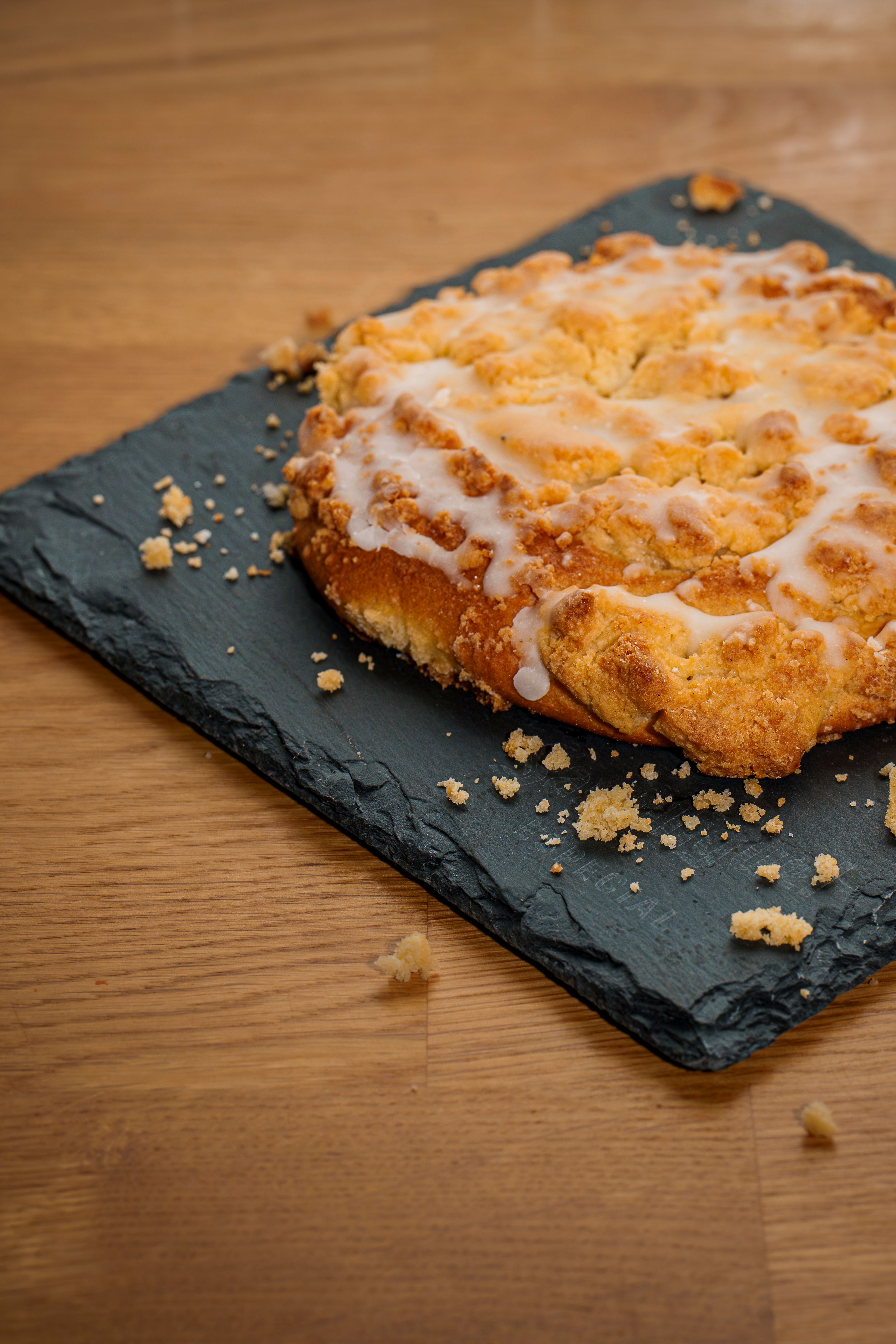
Photo: Nadine Ginzel / Pexels
The diets react (see scores below)
Common Ingredients
- flour
- butter
- sugar
- eggs
- dried fruit
- baking powder
- cinnamon
- salt
Specific recipes may vary.
Incompatible with 11 of 11 diets
Diet Ratings
Rock Cake is fundamentally incompatible with a ketogenic diet. Its primary ingredients — wheat flour, sugar, and dried fruit — are all high-carb, keto-forbidden foods. Flour alone provides dense net carbs from refined grains, sugar adds direct glucose load, and dried fruit is among the highest-carb forms of any fruit due to concentrated sugars and minimal water content. A single rock cake would likely contain 30-45g of net carbs, potentially exceeding the entire daily keto carb allowance in one snack. While it does contain butter and eggs (keto-friendly components), these are vastly outweighed by the carbohydrate-heavy ingredients. There is no reasonable portion size that would make this compatible with ketosis.
Rock Cake contains two clear animal-derived ingredients: butter (dairy) and eggs. Both are explicitly excluded under vegan dietary rules. The remaining ingredients — flour, sugar, dried fruit, baking powder, cinnamon, and salt — are plant-based, but the presence of butter and eggs makes this dish non-vegan in its traditional form. A vegan version is entirely achievable by substituting plant-based butter (e.g., vegan margarine or coconut oil) and a flax egg or commercial egg replacer, but the dish as listed does not qualify.
Rock Cake is fundamentally incompatible with the Paleo diet. The primary ingredient is flour (wheat), which is a grain and strictly excluded from Paleo. Butter is a dairy product, also excluded. Sugar is a refined sweetener, excluded. Baking powder typically contains cornstarch or other grain-derived agents, excluded. Salt is an added ingredient discouraged on Paleo. The only Paleo-compliant ingredients in this dish are eggs, dried fruit, and cinnamon. With the majority of the recipe built around grains, dairy, and refined sugar, this is a clear avoid with no meaningful gray area.
Rock Cake is a British baked good built on refined flour, butter, and added sugar — all ingredients that contradict core Mediterranean diet principles. Butter replaces olive oil as the fat source, refined white flour is used instead of whole grains, and added sugar is present. While eggs and dried fruit have some redeeming qualities, they are minor positives overwhelmed by the overall profile of a processed, sugar-laden baked snack with high saturated fat content. This is not a Mediterranean staple in any regional tradition.
Rock Cake is a quintessential plant-based baked good that is entirely incompatible with the carnivore diet. The primary ingredient is flour (a grain), combined with sugar, dried fruit, baking powder, and cinnamon — all strictly excluded plant-derived foods. While eggs and butter are present, they are minor components in an otherwise heavily plant-based recipe. The dish represents exactly the type of processed, carbohydrate-heavy, plant-forward food that the carnivore diet categorically eliminates. There is no meaningful animal-protein component, and the overall food matrix is the antithesis of carnivore principles.
Rock Cake contains multiple excluded ingredients: flour (a grain), butter (dairy), and sugar (added sugar). Additionally, as a baked good — a cake — it falls squarely into the 'no recreating baked goods' rule that Whole30 explicitly prohibits, regardless of ingredient modifications. Even if compliant substitutes were used for every ingredient, recreating a cake violates the spirit and explicit rules of the Whole30 program.
Rock Cake contains two primary high-FODMAP ingredients that make it unsuitable during the elimination phase. First, regular wheat flour is the base of this recipe and is high in fructans — a key FODMAP that must be avoided. There is no gluten-free or low-FODMAP flour substitute indicated. Second, dried fruit (typically a mix of raisins, currants, and/or sultanas) is concentrated in fructose and polyols; even small amounts of dried fruit can push a serving into high-FODMAP territory. Raisins and currants are among the highest-FODMAP dried fruits, with Monash flagging them as high-FODMAP at very small quantities. The remaining ingredients — butter, eggs, sugar, baking powder, cinnamon, and salt — are individually low-FODMAP and pose no concern. However, the combination of wheat flour and dried fruit makes this a clearly high-FODMAP food at any standard serving size. A low-FODMAP adaptation would require substituting gluten-free flour and eliminating or strictly limiting dried fruit to a very small quantity of a lower-FODMAP option.
Rock Cake is a traditional British baked good that is fundamentally incompatible with the DASH diet. It is made primarily from refined white flour (not a whole grain), butter (high in saturated fat), and sugar (added sugars), with salt and baking powder adding sodium. While dried fruit provides some potassium and fiber, and eggs contribute protein, the overall nutritional profile is dominated by saturated fat, refined carbohydrates, and added sugars — all of which DASH explicitly limits. Butter as the primary fat is high in saturated fat, directly conflicting with DASH's emphasis on limiting saturated fat and replacing it with unsaturated fats. The refined flour offers minimal fiber compared to whole grain alternatives. This is a sweet baked snack in a category DASH advises minimizing.
Rock cake is a quintessential high-glycemic baked good that conflicts with nearly every Zone Diet principle simultaneously. The base is refined white flour (high-glycemic carbohydrate), sweetened with sugar (a pure glycemic spike trigger), enriched with butter (saturated fat, not monounsaturated), and loaded with dried fruit (extremely concentrated sugar — raisins and currants are explicitly listed as 'unfavorable' in Zone methodology due to their very high glycemic density). There is no meaningful lean protein source — eggs contribute some protein but are buried beneath a macro profile dominated by refined carbs and saturated fat. The 40/30/30 ratio cannot be achieved with this food as a component without such radical portion reduction (a few bites) that it ceases to function as a snack. Even then, the saturated fat from butter and the glycemic load from flour, sugar, and dried fruit make this a poor Zone building block. This food drives insulin spikes rather than the stable insulin response the Zone targets. It is not a case of needing careful portioning — it is structurally incompatible with Zone macro architecture.
Rock Cake is a traditional British baked good with a pro-inflammatory nutritional profile. The base is refined white flour, a refined carbohydrate that drives blood sugar spikes and elevated insulin, both linked to increased inflammatory markers. Butter contributes saturated fat, which at regular intake is associated with modest increases in inflammatory markers compared to unsaturated fats. Added sugar is a direct driver of inflammation via AGE (advanced glycation end-products) formation and NF-κB pathway activation. Eggs and dried fruit offer minor redeeming qualities — eggs provide some choline and selenium, and dried fruit provides polyphenols and fiber — but in small quantities relative to the overall inflammatory load of the recipe. Cinnamon is a genuinely anti-inflammatory spice with research supporting blood sugar modulation, but the culinary quantity used here is insufficient to meaningfully offset the refined flour, butter, and sugar. This is essentially a small cake — a refined carbohydrate and saturated fat vehicle with minimal fiber, no omega-3s, no significant antioxidant density, and no whole grains. Occasional consumption is unlikely to cause harm, but it has no place as a regular feature of an anti-inflammatory diet.
A rock cake is a traditional British baked good built on a foundation of refined flour, butter, and sugar — a combination that scores poorly across nearly every GLP-1 dietary criterion. It offers minimal protein (eggs contribute a small amount but are diluted across the whole batch), negligible fiber, high saturated fat from butter, and significant refined carbohydrates and added sugar. The dried fruit adds a modest amount of natural sugar and trace fiber but does not meaningfully redeem the nutritional profile. Because GLP-1 patients eat far fewer calories overall, every bite must deliver meaningful nutrition — protein, fiber, or micronutrients — and a rock cake delivers almost none of these. The high fat and sugar content also risks worsening common GLP-1 side effects including nausea, bloating, and blood sugar fluctuation. It is a textbook empty-calorie food in this clinical context.
*See how scores were generated at our methodology page.
Nutritional profile
Six traits that cut across every diet.
Fiber & Plants
How much whole-plant food and fiber it delivers.
Healthy Fats
The quality of its fats (unsaturated, omega-3).
Whole / Unprocessed
How close it is to its natural, unprocessed form.
Gut Gentle
How easy it is on digestion (low FODMAP, few irritants).
Low Glycemic
How little it spikes your blood sugar.
Protein Density
How much protein it packs per calorie.
Controversy Index
Higher controversy = more disagreement between diets.