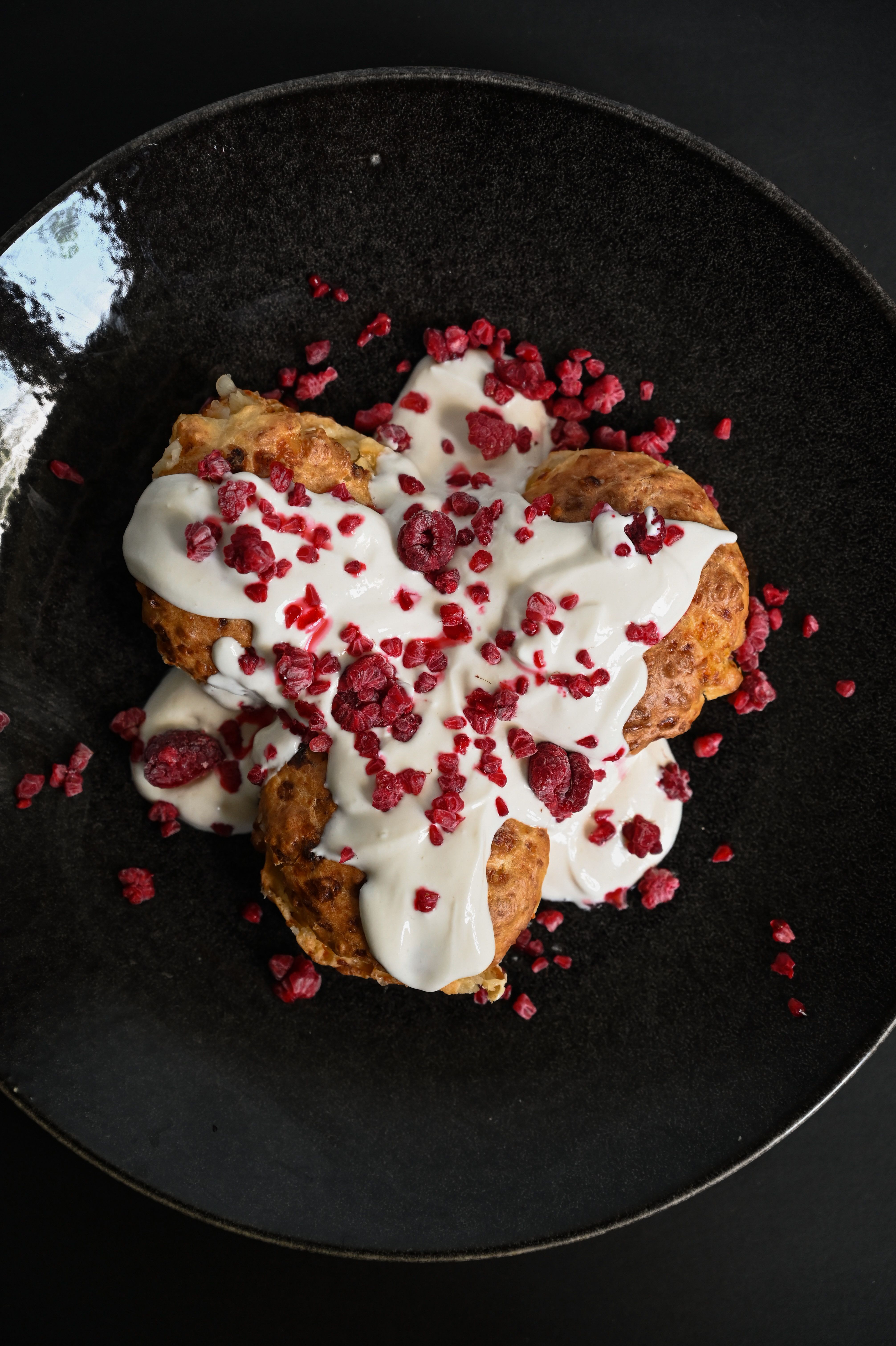
Photo: Aleyna Yetkin / Pexels
The diets react (see scores below)
Common Ingredients
- cottage cheese
- flour
- eggs
- semolina
- sour cream
- jam
- sugar
- baking soda
Specific recipes may vary.
Incompatible with 9 of 11 diets
Diet Ratings
Papanasi are Romanian fried/boiled cheese doughnuts that are fundamentally incompatible with a ketogenic diet. The dish contains multiple high-carb ingredients: wheat flour and semolina are grain-based starches that alone would exceed the entire daily net carb allowance in a single serving. Sugar is added directly to the dough, and jam (typically high-sugar fruit preserve) is served as a topping. Even the cottage cheese, while lower in carbs, is combined with enough carb-dense ingredients to make this dish entirely off-limits. A single serving could easily contain 50-80g of net carbs, shattering ketosis immediately. There is no meaningful portion-control strategy that would make this dish keto-compatible given its structural reliance on flour, semolina, sugar, and jam.
Papanasi is a traditional Romanian fried/boiled cheese dumpling that is fundamentally incompatible with a vegan diet. The dish contains multiple animal-derived ingredients: cottage cheese (dairy), eggs (animal product), and sour cream (dairy). These are not incidental or trace ingredients — they are structural components of the dish. There is no plant-based version of this dish implied by the traditional recipe. All three animal-derived ingredients would need to be substituted entirely to produce a vegan version.
Papanasi is a traditional Romanian fried/boiled cheese dumpling that is fundamentally incompatible with the Paleo diet. The dish contains multiple non-paleo ingredients: flour and semolina are grain-based products explicitly excluded from Paleo; cottage cheese and sour cream are dairy products not permitted; sugar is refined and excluded; and jam typically contains refined sugar and may include additives. While eggs are Paleo-approved, they are the only compliant ingredient in this dish. The sheer number of core violations — grains, dairy, and refined sugar simultaneously — makes this a clear and unambiguous avoid.
Papanasi are Romanian fried/boiled cheese doughnuts that conflict with Mediterranean diet principles on multiple fronts. The dish is built around refined flour and semolina (refined grains), added sugar, and jam (concentrated added sugar), with sour cream as a topping — all elements the Mediterranean diet minimizes or discourages. While cottage cheese and eggs are acceptable in moderation, they are supporting ingredients in what is fundamentally a sweet, refined-grain-based dessert/snack. The overall nutritional profile — high in refined carbohydrates, added sugars, and saturated fat from sour cream — places this firmly in the 'avoid' category. It is not a traditional Mediterranean dish and does not align with the diet's emphasis on whole, minimally processed foods.
Some Mediterranean diet interpreters allow occasional dairy-rich desserts in the spirit of the diet's flexible, enjoyment-centered philosophy, particularly when cottage cheese provides protein. However, the combination of refined flour, semolina, jam, and added sugar in a single dish makes even moderate accommodation difficult to justify under mainstream Mediterranean guidelines.
Papanasi is a Romanian fried/boiled cheese dumpling that is fundamentally incompatible with the carnivore diet. While it contains some animal-derived ingredients (cottage cheese, eggs, sour cream), the dish is dominated by plant-based and processed components: flour and semolina are grain-based carbohydrates that are strictly excluded, sugar is a processed sweetener with no place on carnivore, jam is fruit-derived and sugar-laden, and baking soda is a non-animal additive. The presence of multiple plant-derived and processed ingredients makes this an unambiguous avoid — the animal-derived ingredients do not redeem the dish when the structural base is built on grains and sugar.
Papanasi contains multiple excluded ingredients that make it entirely incompatible with the Whole30 program. Flour (a grain product), semolina (also a grain/wheat product), sour cream (dairy), sugar (added sugar), and jam (typically contains added sugar) are all explicitly prohibited. Additionally, even if those ingredients were somehow substituted, this dish falls squarely into the 'no recreating baked goods/junk food' rule — papanasi are essentially fried doughnuts/pancakes, a category explicitly banned by the program regardless of ingredient compliance.
Papanasi is a traditional Romanian fried/boiled cheese dumpling that contains multiple high-FODMAP ingredients. Cottage cheese is high in lactose and is a primary ingredient used in large quantities — this alone makes the dish problematic during elimination. Sour cream also contains lactose (moderate amounts per serving, but adds to cumulative load). Flour (wheat) contributes fructans, another major FODMAP category. Jam is typically made with high-fructose fruits (e.g., strawberry, blueberry at large servings, plum) and may contain excess fructose or polyols depending on the fruit used. Semolina is also wheat-derived and contributes fructans. The combination of lactose (cottage cheese + sour cream), fructans (wheat flour + semolina), and potentially excess fructose/polyols (jam) makes this dish high-FODMAP across multiple FODMAP categories simultaneously. Even with portion reduction, the lactose load from cottage cheese as a primary ingredient cannot be brought into a safe range at any realistic serving of this dish.
Some FODMAP practitioners note that certain cottage cheese products (especially dry-curd or lactose-free variants) could reduce the lactose burden, and that small experimental portions might be tolerated by individuals who have reintroduced lactose successfully. However, during the strict elimination phase, Monash University classifies regular cottage cheese as high-FODMAP due to lactose, and the additional wheat-based ingredients make modification insufficient to render this dish safe.
Papanasi are Romanian fried (or occasionally boiled) cheese doughnuts made from cottage cheese, flour, semolina, and eggs, topped with sour cream and jam. While cottage cheese aligns well with DASH as a low-fat dairy source of calcium and protein, the dish as a whole presents several concerns. The added sugar and jam contribute significant added sugars, which DASH limits. Sour cream is a full-fat dairy product that DASH advises against, adding saturated fat. The flour and semolina are refined grains rather than the whole grains DASH emphasizes. When fried (the traditional preparation), the saturated and total fat content rises further. The overall caloric density and macronutrient profile place this more in the 'treat' category. That said, the dish is not inherently high in sodium, and cottage cheese does provide meaningful protein and calcium. A modified version using low-fat cottage cheese, whole grain flour, baked rather than fried preparation, low-sugar jam, and Greek low-fat yogurt instead of sour cream could shift the score higher, but as traditionally prepared this dish warrants caution.
NIH DASH guidelines discourage full-fat dairy (sour cream), refined grains, and added sugars, which Papanasi contains in notable quantities. However, some updated DASH-aligned clinicians note that cottage cheese provides strong calcium and protein benefits, and occasional moderate portions of dessert-style foods can fit within an overall DASH-compliant eating pattern without significantly impacting cardiovascular outcomes — particularly for non-hypertensive individuals where the sodium concern is less pressing.
Papanasi are traditional Romanian fried (or boiled) cheese doughnuts served with sour cream and jam, and they present multiple Zone Diet problems simultaneously. While cottage cheese as a base protein is actually Zone-friendly and lean, the dish is dominated by high-glycemic carbohydrates: flour, semolina, and added sugar form the bulk of the carb load, and the jam topping adds a concentrated sugar hit. This creates a carb-heavy macro profile that is structurally incompatible with the 40/30/30 Zone ratio — carbohydrates would likely constitute 60-70%+ of calories. The added sugar and jam are explicitly 'unfavorable' or 'avoid' carb sources in Zone terminology. Sour cream adds saturated fat without meaningful monounsaturated fat benefit. As a snack specifically, the portion would need to be extremely small to approach Zone balance, but even a single papanas delivers enough flour, semolina, sugar, and jam to blow out carb blocks with essentially no way to compensate. This is not a food that can be 'portioned into balance' at any reasonable serving size — it is structurally a dessert/treat with a macro profile antithetical to Zone principles.
Papanasi are traditional Romanian fried (or boiled) cheese doughnuts topped with sour cream and jam. The ingredient profile is a mixed bag from an anti-inflammatory standpoint. Cottage cheese provides protein and some beneficial nutrients, and eggs contribute choline and selenium, but sour cream is a full-fat dairy product associated with saturated fat intake, which anti-inflammatory guidelines recommend limiting. The refined white flour and semolina are refined carbohydrates with a high glycemic index, which can promote inflammatory markers like CRP when consumed regularly. Added sugar compounds this glycemic concern, and jam typically contains significant added sugar or high-fructose corn syrup. The dish lacks meaningful anti-inflammatory contributors — there are no omega-3 sources, colorful vegetables, polyphenol-rich foods, or beneficial spices. As a traditional snack/dessert, Papanasi falls squarely in the 'acceptable occasionally' category: it is not laden with trans fats or processed additives, but it delivers a combination of refined carbohydrates, added sugar, and saturated fat that, consumed regularly, would be counterproductive to an anti-inflammatory dietary pattern.
Papanasi are Romanian fried (or occasionally baked) cheese doughnuts traditionally made with cottage cheese, flour, semolina, and eggs, then topped with sour cream and fruit jam. While cottage cheese and eggs provide a meaningful protein base, the overall nutritional profile is problematic for GLP-1 patients. The dish is high in refined carbohydrates (flour, semolina, sugar), contains added sugar both in the batter and via jam topping, and is typically deep-fried, adding significant fat that worsens nausea, bloating, and reflux — the most common GLP-1 side effects. Sour cream adds saturated fat with minimal protein payoff. The jam contributes empty sugar calories with no fiber or protein benefit. Even a single serving is calorie-dense, carbohydrate-heavy, and fat-heavy relative to its protein content, making it a poor nutritional trade-off for patients who are eating significantly less overall. The semolina and refined flour also slow digestion further on top of already slowed gastric emptying from GLP-1 medication. As a snack category item, this is especially problematic — snacks should be high-protein, low-fat, and easy to digest for GLP-1 patients, and papanasi meets none of those criteria.
Some GLP-1 dietitians note that cottage cheese is a genuinely good protein source and that a baked (not fried) version of papanasi with reduced sugar, low-fat sour cream, and a berry topping could be modified into a more acceptable occasional treat; however, the traditional preparation as described scores poorly and individual tolerance to the fat and refined carbohydrate load varies considerably among GLP-1 patients.
*See how scores were generated at our methodology page.
Nutritional profile
Six traits that cut across every diet.
Fiber & Plants
How much whole-plant food and fiber it delivers.
Healthy Fats
The quality of its fats (unsaturated, omega-3).
Whole / Unprocessed
How close it is to its natural, unprocessed form.
Gut Gentle
How easy it is on digestion (low FODMAP, few irritants).
Low Glycemic
How little it spikes your blood sugar.
Protein Density
How much protein it packs per calorie.
Controversy Index
Higher controversy = more disagreement between diets.
Diet-Specific Tips
 DASH — 4/10
View tips
- Cottage cheese is a DASH-friendly low-fat dairy protein source
- Sour cream is full-fat dairy, limited on DASH
- Jam and added sugar contribute excess added sugars, which DASH restricts
- Flour and semolina are refined grains, not whole grains as DASH emphasizes
- Traditional frying increases saturated and total fat content
- Low sodium content is a positive factor
- Baked preparation and low-sugar jam substitution would improve DASH compatibility
 Anti-Inflammatory — 4/10
View tips
- Refined white flour and semolina are high-glycemic refined carbohydrates that can elevate inflammatory markers
- Added sugar in the dough and jam topping is a pro-inflammatory concern
- Sour cream is a full-fat dairy product; anti-inflammatory guidelines recommend limiting saturated fat intake
- Cottage cheese provides protein and is relatively lower in fat than other dairy, a modest positive
- Eggs contribute some beneficial nutrients (choline, selenium) but do not shift the overall profile
- No significant anti-inflammatory contributors present (no omega-3s, antioxidants, polyphenols, or beneficial spices)
- Typically fried, adding further concern around cooking oils used
- Acceptable as an occasional indulgence but not aligned with regular anti-inflammatory eating