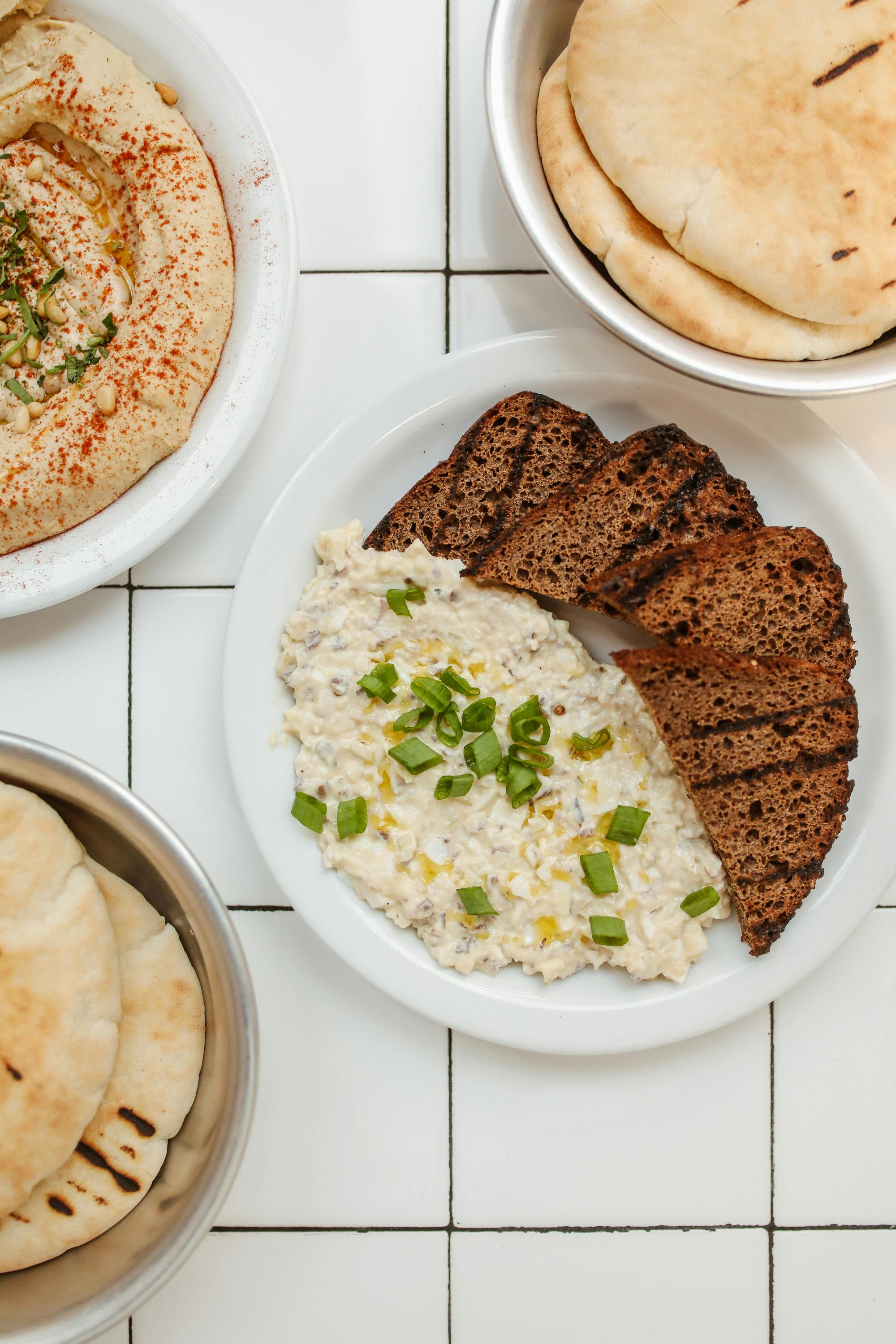
Photo: Polina Tankilevitch / Pexels
Romanian
Salata de Vinete
The diets react (see scores below)
Common Ingredients
- eggplant
- onion
- sunflower oil
- salt
- lemon
- garlic
Specific recipes may vary.
Incompatible with 3 of 11 diets
Diet Ratings
Salata de Vinete is a Romanian roasted eggplant spread made with eggplant, onion, sunflower oil, salt, lemon, and garlic. Eggplant itself has a moderate net carb count (~3-4g per 100g after subtracting fiber), making it manageable in small portions. However, the addition of onion and lemon juice adds incremental carbs, and sunflower oil, while adding fat, is high in omega-6 polyunsaturated fats which many strict keto practitioners consider suboptimal compared to more stable saturated or monounsaturated fats. A typical condiment serving (2-4 tbsp) keeps net carbs low enough for keto, but larger portions common in Romanian cuisine could push carb limits. The dish is whole-food based with no added sugars or grains, which is a positive.
Some strict keto practitioners would flag sunflower oil as inflammatory due to its high omega-6 content, recommending avoidance entirely in favor of olive oil or animal fats. A minority of very low-carb adherents also consider eggplant's moderate carb density a risk for those with strict sub-20g net carb daily limits.
Salata de Vinete is a traditional Romanian roasted eggplant salad. All listed ingredients — eggplant, onion, sunflower oil, salt, lemon, and garlic — are entirely plant-based with no animal products or animal-derived ingredients. This is a whole-food preparation with minimal processing, making it an excellent fit for a vegan diet. Note that some traditional Romanian recipes include mayonnaise, which would render it non-vegan, but this version explicitly uses sunflower oil and lemon as the fat and acid components, confirming full vegan compliance.
Salata de Vinete is a Romanian roasted eggplant salad that would otherwise be paleo-friendly, but two of its core ingredients are clear paleo violations. Sunflower oil is explicitly excluded from paleo as a seed oil — it should be replaced with olive oil, avocado oil, or another approved fat. Added salt is also excluded from strict paleo. These are not gray-area ingredients; both are unambiguously on the avoid list. The dish could be made paleo-compliant with simple substitutions (olive oil instead of sunflower oil, omitting added salt), but as traditionally prepared it does not qualify.
Salata de Vinete is a Romanian roasted eggplant salad made from whole, minimally processed plant-based ingredients. Eggplant, onion, garlic, lemon, and salt are all staples of Mediterranean eating, and the dish is structurally very similar to Middle Eastern and Greek eggplant preparations like melitzanosalata or baba ganoush. The primary concern is the use of sunflower oil rather than extra virgin olive oil, which is the canonical fat of the Mediterranean diet. Sunflower oil is a refined vegetable oil that, while not harmful, lacks the polyphenol content and monounsaturated fat profile that make olive oil a cornerstone of the diet's health benefits. Setting aside the oil substitution, the dish is otherwise fully aligned with Mediterranean principles: plant-forward, fiber-rich, low in saturated fat, and free of processed ingredients or added sugars.
Traditional Romanian cooking commonly uses sunflower oil, and some broader interpretations of the Mediterranean diet acknowledge regional plant-based oils as acceptable substitutes. A strict Mediterranean diet practitioner, however, would recommend replacing sunflower oil with extra virgin olive oil to align with core dietary guidelines and maximize health benefits.
Salata de Vinete is a Romanian eggplant salad made entirely from plant-based ingredients. Every single component — eggplant, onion, sunflower oil, lemon, and garlic — is explicitly excluded from the carnivore diet. There is no animal-derived ingredient whatsoever. Sunflower oil is a seed oil, which is one of the most strongly condemned foods in carnivore circles due to its high omega-6 polyunsaturated fat content. This dish has zero compatibility with the carnivore diet under any interpretation or tier.
Salata de Vinete is a traditional Romanian roasted eggplant salad made entirely from Whole30-compliant ingredients. Eggplant, onion, sunflower oil, salt, lemon, and garlic are all explicitly allowed whole foods with no excluded ingredients. Sunflower oil is a natural fat and fully permitted. This is an unprocessed, whole-food condiment that aligns perfectly with the spirit and letter of the Whole30 program.
Salata de Vinete is a Romanian roasted eggplant salad that traditionally contains two high-FODMAP ingredients: onion and garlic. Both are among the highest-fructan foods tested by Monash University and must be strictly avoided during the elimination phase. Eggplant itself is low-FODMAP at a standard serving (up to ~75g), and sunflower oil, salt, and lemon juice are all low-FODMAP. However, the presence of both raw onion and garlic — typically used in meaningful, flavor-defining quantities in this dish — makes the traditional preparation unacceptable during elimination. The dish cannot be meaningfully prepared without these ingredients while remaining 'Salata de Vinete.' A modified version using garlic-infused oil and omitting onion (or substituting the green tops of scallions) could be made low-FODMAP, but the traditional recipe as described must be avoided.
Salata de Vinete is a Romanian roasted eggplant salad/spread made with DASH-friendly core ingredients: eggplant (rich in fiber, potassium, and antioxidants), onion, garlic, and lemon are all excellent DASH foods. Sunflower oil is an unsaturated vegetable oil, which DASH permits. The main concern is sodium content from added salt, which can vary significantly by preparation — home recipes often add a moderate-to-high amount of salt, and as a condiment it may be eaten alongside other sodium-containing foods, raising cumulative intake. Additionally, sunflower oil quantity can be generous in traditional recipes, increasing total fat and calorie load, though the fat is unsaturated. The dish is not inherently DASH-unfriendly but requires portion awareness and sodium control to align well with DASH targets.
NIH DASH guidelines would straightforwardly approve the vegetable base (eggplant, onion, garlic) and unsaturated oil, but flag variable added salt as a concern. An updated clinical interpretation emphasizes that when prepared with minimal salt and consumed in typical condiment portions, this dish is essentially a vegetable-forward spread consistent with DASH principles — some DASH dietitians would rate it higher if sodium is controlled in preparation.
Salata de Vinete is a Romanian roasted eggplant dip/spread made from eggplant, onion, lemon, garlic, and sunflower oil. The Zone-friendly elements are strong: eggplant is a low-glycemic, high-fiber vegetable (favorable Zone carb), onion and garlic are polyphenol-rich Zone-favorable vegetables, and lemon adds minimal carbs with beneficial polyphenols. The primary concern is the fat source — sunflower oil is high in omega-6 polyunsaturated fats, which directly contradicts Zone Diet's anti-inflammatory principles favoring monounsaturated fats (olive oil, avocado). Dr. Sears explicitly identifies omega-6-heavy seed oils as pro-inflammatory and contrary to Zone goals. As a condiment used in small amounts, the omega-6 load is manageable, but it cannot be considered a favorable Zone fat source. If prepared with olive oil instead of sunflower oil, this dish would score significantly higher. In its traditional form, it earns a cautious approval — the vegetable base is excellent, but the fat selection is problematic from a Zone anti-inflammatory standpoint.
Some Zone practitioners focus primarily on macronutrient ratios rather than fat quality, and would note that as a condiment used in small portions, the omega-6 content of sunflower oil is unlikely to meaningfully disrupt Zone balance. In this view, the favorable low-glycemic vegetable base (eggplant, onion, garlic) makes this a reasonable Zone condiment when portioned appropriately. However, Sears' later works (The OmegaRx Zone, The Zone Diet anti-inflammatory framework) are unambiguous that omega-6 seed oils should be minimized regardless of portion size.
Salata de Vinete is a Romanian roasted eggplant salad blended with onion, garlic, lemon juice, and sunflower oil. The dish has several strong anti-inflammatory components: eggplant contains nasunin and chlorogenic acid, both potent antioxidants; garlic is well-established as anti-inflammatory via allicin and organosulfur compounds; onion provides quercetin; and lemon juice adds vitamin C. The main complicating factor is the sunflower oil. Most anti-inflammatory frameworks — including Dr. Weil's pyramid — discourage regular use of sunflower oil due to its high omega-6 (linoleic acid) content, which can tip the omega-6:omega-3 ratio toward a pro-inflammatory state. However, the oil is used as a condiment (small amounts per serving), which meaningfully reduces the concern. If extra virgin olive oil were substituted, this dish would likely score an 8–9. As prepared with sunflower oil, it lands in cautious territory — the vegetable and allium base is genuinely anti-inflammatory, but the oil is the limiting factor.
Most anti-inflammatory protocols (Dr. Weil, IF Rating system) flag sunflower oil as a food to avoid or minimize due to high omega-6 content and oxidation risk at heat. However, mainstream nutrition bodies (AHA, WHO) consider high-oleic sunflower oil acceptable, and some researchers note that the overall omega-6 burden from a condiment-quantity serving is modest. The anti-inflammatory benefit of the eggplant and garlic base may outweigh the oil concern at realistic serving sizes.
Salata de Vinete is a Romanian roasted eggplant spread made by blending or finely chopping fire-roasted eggplant with onion, sunflower oil, lemon juice, garlic, and salt. It is a condiment served in small portions, typically spread on bread. As a condiment it is not expected to contribute meaningful protein, and it contributes very little fiber per typical serving. Its main positives for GLP-1 patients are that eggplant is low-calorie, easy to digest when roasted and pureed, and the lemon and garlic add flavor without problematic additives. The main concern is sunflower oil: traditional recipes can be oil-heavy, and sunflower oil (while a polyunsaturated fat) adds significant fat calories to a food that otherwise offers little protein or fiber. At a condiment-level serving (1-2 tablespoons), fat load is manageable and the spread is a reasonable way to add flavor and vegetable variety to a GLP-1-compliant meal. At larger servings or when used as a dip consumed in volume, the fat-to-nutrient ratio becomes unfavorable. The dish is not fried, not spicy, not carbonated, not high-sugar, and is easy to digest — so it avoids the major GLP-1 side-effect triggers. Score reflects its acceptability as a small-portion condiment paired with high-protein foods, with a caution on oil quantity and the absence of meaningful protein or fiber contribution.
Some GLP-1-focused dietitians would view this favorably as a whole-food, minimally processed vegetable-based spread and consider the oil quantity negligible at condiment portions, particularly given that unsaturated fats from sunflower oil are preferable to saturated alternatives. Others would caution that because GLP-1 patients eat so little overall, even condiment-level fat calories compete with protein and fiber for limited stomach capacity and caloric budget, and would recommend limiting oil-based spreads in favor of higher-protein options like hummus or cottage cheese-based dips.
*See how scores were generated at our methodology page.
Nutritional profile
Six traits that cut across every diet.
Fiber & Plants
How much whole-plant food and fiber it delivers.
Healthy Fats
The quality of its fats (unsaturated, omega-3).
Whole / Unprocessed
How close it is to its natural, unprocessed form.
Gut Gentle
How easy it is on digestion (low FODMAP, few irritants).
Low Glycemic
How little it spikes your blood sugar.
Protein Density
How much protein it packs per calorie.
Controversy Index
Higher controversy = more disagreement between diets.
Diet-Specific Tips
 Keto — 5/10
View tips
- Eggplant has ~3-4g net carbs per 100g — manageable in condiment portions
- Onion and lemon juice add incremental carbohydrates
- Sunflower oil is high in omega-6 fats, considered suboptimal by many keto practitioners
- No added sugars, grains, or highly processed ingredients
- Portion-dependent: small condiment servings are keto-compatible, larger servings may not be
- Whole, unprocessed ingredients align with keto food quality principles
 Vegan — 9/10
View tips
- All ingredients are whole plant foods
- No animal products or animal-derived ingredients present
- Sunflower oil and lemon replace mayo (the common non-vegan variant)
- Minimal processing — roasted and blended vegetables
- No cross-contamination concerns inherent to the dish category
 Mediterranean — 8/10
View tips
- Eggplant is a core Mediterranean vegetable, widely used across Greek, Turkish, and Levantine cuisines
- All ingredients are whole, minimally processed plant foods
- No meat, dairy, added sugar, or refined grains
- Sunflower oil deviates from the Mediterranean standard of extra virgin olive oil
- Garlic and lemon are classic Mediterranean flavor enhancers with documented health benefits
- Dish is structurally analogous to Mediterranean eggplant preparations like melitzanosalata
 Whole30 — 9/10
View tips
- Eggplant: whole vegetable, fully compliant
- Onion: whole vegetable, fully compliant
- Sunflower oil: natural fat, fully compliant
- Salt: explicitly allowed
- Lemon: whole fruit/juice, fully compliant
- Garlic: whole food, fully compliant
- No excluded ingredients present
- Whole, minimally processed condiment honoring Whole30 spirit
 DASH — 6/10
View tips
- Eggplant is a DASH-approved vegetable rich in fiber, potassium, and antioxidants
- Onion, garlic, and lemon juice contribute beneficial phytonutrients with minimal sodium
- Sunflower oil is an unsaturated fat acceptable within DASH guidelines, but quantity should be moderated
- Added salt is the primary DASH concern — sodium content depends heavily on preparation and can undermine DASH sodium targets
- As a condiment, portion size is typically small, limiting overall impact
- No saturated fat, cholesterol, added sugar, or processed ingredients present
- Low-sodium preparation would elevate this dish closer to a full DASH approval
 Zone — 5/10
View tips
- Eggplant is a favorable Zone carbohydrate — low glycemic, high fiber, low net carbs
- Sunflower oil is high in omega-6 fatty acids, directly opposing Zone's anti-inflammatory fat recommendations
- Olive oil substitution would make this a strongly Zone-favorable dish
- Onion, garlic, and lemon are polyphenol-rich, supporting Zone's anti-inflammatory goals
- As a condiment, portion sizes are small, limiting but not eliminating omega-6 concern
- No protein component — must be paired with lean protein to complete a Zone meal
- No high-glycemic ingredients; the carb profile is otherwise Zone-friendly
 Anti-Inflammatory — 5/10
View tips
- Eggplant rich in nasunin and chlorogenic acid — potent antioxidants
- Garlic provides allicin and organosulfur compounds with established anti-inflammatory effects
- Onion contains quercetin, a flavonoid with anti-inflammatory properties
- Sunflower oil is high in omega-6 linoleic acid — flagged by most anti-inflammatory protocols
- Condiment-level serving limits total omega-6 exposure from this dish
- Lemon juice adds vitamin C; no added sugar or processed additives
- Substituting EVOO would significantly improve the anti-inflammatory profile
 GLP-1 Friendly — 5/10
View tips
- Low protein — contributes negligible protein as a condiment, not a concern at this category but limits score
- Low fiber per serving — eggplant has fiber but typical condiment portions deliver minimal amounts
- Sunflower oil content is the primary concern — fat load depends heavily on recipe generosity
- Roasted eggplant is easy to digest and well-tolerated with slowed gastric emptying
- No GLP-1 side-effect triggers: not fried, not spicy, not carbonated, not high-sugar
- Portion-sensitive: acceptable as a small spread, less appropriate consumed in large quantities
- Whole-food, minimally processed ingredients — nutrient density is moderate for a condiment
- Best used as a flavor vehicle alongside high-protein, high-fiber GLP-1-friendly foods