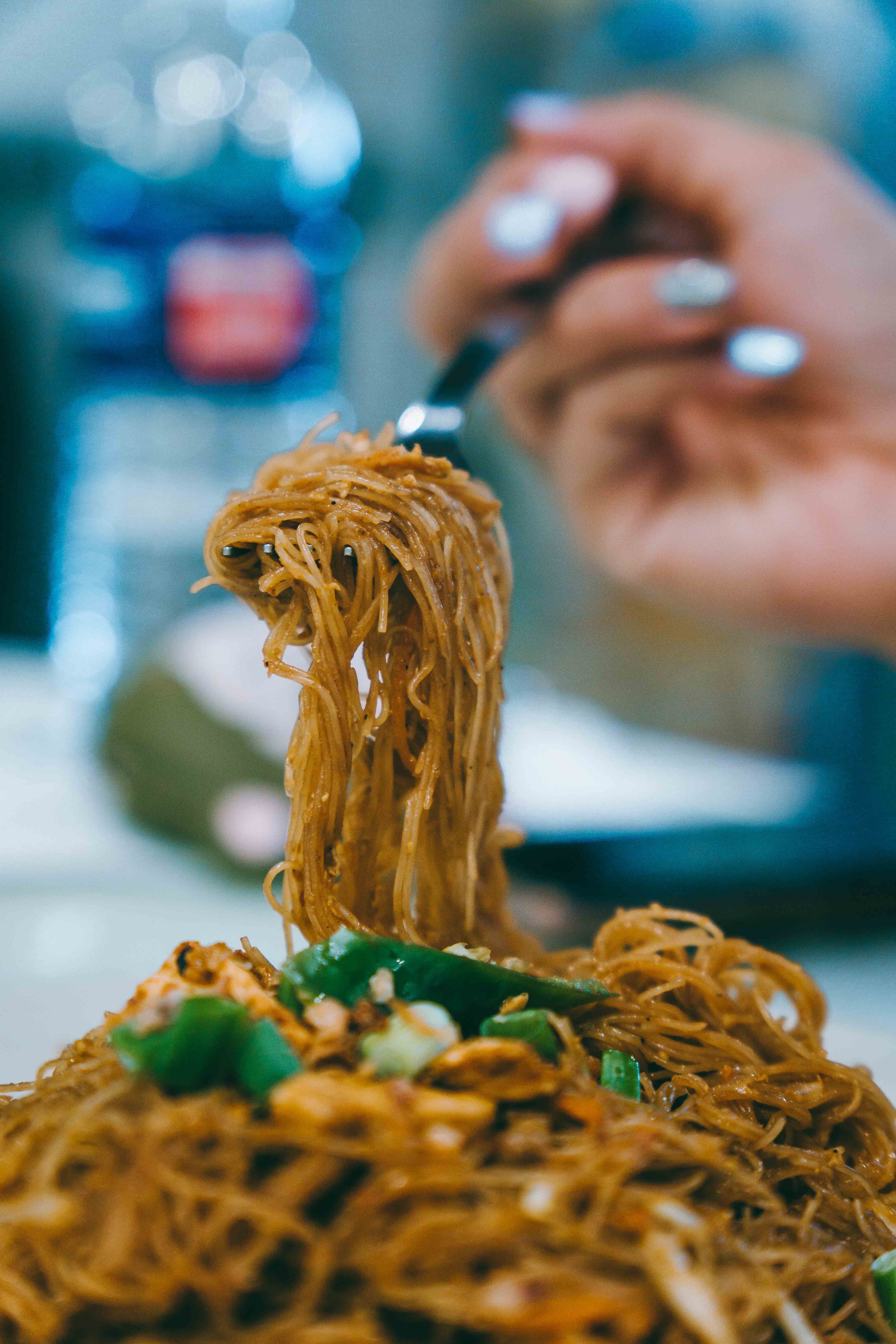
Photo: Theodore Nguyen / Pexels
The diets react (see scores below)
Common Ingredients
- glass noodles
- pork
- soy sauce
- ginger
- garlic
- onion
- carrot
- green onion
Specific recipes may vary.
Incompatible with 8 of 11 diets
Diet Ratings
Sapasui is a Samoan-style chop suey built around glass noodles (bean thread/mung bean noodles), which are the dominant ingredient and a serious keto problem. A standard serving of glass noodles contains roughly 25-30g of net carbs per 50g dry weight, and a typical main-dish portion would easily push well past the 20-50g daily keto limit on its own. The dish is essentially a noodle dish with pork and vegetables — the pork is keto-friendly, garlic, ginger, and green onion are fine in small amounts, but the glass noodles are the structural core of the dish and cannot be reduced to a negligible portion without fundamentally changing the dish. Carrots add additional net carbs (~4-6g per medium carrot). Soy sauce contributes minimal carbs. There is no practical way to consume Sapasui as traditionally prepared while maintaining ketosis.
Sapasui is a Samoan-style glass noodle dish whose primary protein is pork, a clear animal product. Pork is unambiguously excluded under all vegan frameworks. The remaining ingredients (glass noodles, soy sauce, ginger, garlic, onion, carrot, green onion) are all plant-based, but the presence of pork renders the dish non-vegan as prepared. A vegan adaptation could substitute the pork with tofu, tempeh, or mushrooms.
Sapasui (Samoan chop suey) contains two clear paleo violations: glass noodles and soy sauce. Glass noodles are made from mung bean starch or sweet potato starch — if mung bean-based, they are a legume derivative and firmly excluded; even sweet potato-based versions are highly processed starch products incompatible with paleo philosophy. Soy sauce is a fermented soy product (a legume) and also typically contains wheat, making it doubly non-paleo. The remaining ingredients — pork, ginger, garlic, onion, carrot, and green onion — are all paleo-approved, but the foundational structure of the dish relies on excluded ingredients that cannot be separated from the dish as traditionally prepared.
Sapasui is a Samoan-style chop suey that conflicts with Mediterranean diet principles on multiple fronts. Pork is a red meat that should be limited to only a few times per month in the Mediterranean diet. Glass noodles are refined, starchy noodles with minimal nutritional value compared to whole grains. Soy sauce introduces high sodium and is not part of the Mediterranean culinary tradition. The dish lacks olive oil as the primary fat, contains no legumes, and is not plant-forward. While there are some vegetables present (carrot, onion, green onion, garlic, ginger), they appear as minor supporting ingredients rather than the focus. The overall profile — refined noodles, red meat, high-sodium condiment, no olive oil — places this firmly outside Mediterranean diet principles.
Sapasui is a Samoan-style glass noodle stir-fry that is fundamentally incompatible with the carnivore diet. While it does contain pork, the dish is dominated by plant-based and processed ingredients: glass noodles (starch-based, typically made from mung beans or sweet potato), soy sauce (fermented soy — a legume product), ginger, garlic, onion, carrot, and green onion. The majority of the dish's components are explicitly excluded from the carnivore diet. Only the pork itself would be considered acceptable.
Sapasui contains two excluded ingredients: glass noodles and soy sauce. Glass noodles are a grain-based or starch-based noodle product (typically made from mung bean starch or sweet potato starch) that falls into the excluded 'pasta or noodles' category under Whole30's no-recreating rule, and also represents a processed starch product. More critically, soy sauce is a soy-based product, and soy is explicitly excluded as a legume on Whole30. The remaining ingredients — pork, ginger, garlic, onion, carrot, and green onion — are all fully compliant, but the presence of soy sauce alone is a disqualifying excluded ingredient. Coconut aminos could substitute for soy sauce, but glass noodles have no compliant substitute that would preserve the dish's character, and even with substitutions the noodle component violates the program's explicit prohibition on noodles.
Sapasui contains multiple high-FODMAP ingredients that make it unsuitable during the elimination phase. Garlic and onion are among the highest-FODMAP foods tested by Monash University, both containing significant fructans even in small amounts. Regular onion is high-FODMAP at any typical culinary serving, and garlic is high-FODMAP at even 1/4 clove. These two ingredients alone disqualify the dish. Soy sauce in small amounts (1 tablespoon) is considered low-FODMAP, and glass noodles (mung bean vermicelli) are low-FODMAP. Pork, ginger, carrot, and green onion (green tops only) are also low-FODMAP. However, the presence of garlic and onion as core aromatics — standard in this dish — means it cannot be made low-FODMAP without fundamentally altering the recipe. Even if garlic-infused oil were substituted for garlic, the onion remains a critical problem.
Sapasui (Samoan chop suey) is a glass noodle dish that poses significant challenges for the DASH diet. The primary concerns are: (1) Soy sauce is the dominant seasoning and is extremely high in sodium — even a modest 2-3 tablespoons can contribute 1,500–2,500mg of sodium, potentially exceeding the entire daily DASH sodium limit in one dish. (2) Pork, especially as commonly used in Samoan cooking (often fattier cuts like shoulder or belly), is a red meat that DASH recommends limiting due to saturated fat content. (3) Glass noodles are refined starch with minimal fiber, potassium, or micronutrient value — not a DASH-emphasized carbohydrate. Positive elements include aromatic vegetables (garlic, onion, ginger, green onion, carrot) which contribute some fiber, potassium, and beneficial phytonutrients. However, these positives are heavily outweighed by the sodium burden from soy sauce. A modified version using low-sodium soy sauce (or tamari), lean pork loin, and increased vegetable content could improve the score to caution range.
NIH DASH guidelines explicitly target sodium reduction and limit red meat, making traditional Sapasui a poor fit. However, some DASH-aligned clinicians note that if low-sodium soy sauce is used and the pork portion is modest (≤3 oz of lean loin), the dish's vegetable aromatics and moderate protein could place it in the caution category — the sodium issue is preparation-dependent rather than inherent to the dish concept.
Sapasui (Samoan chop suey) centers on glass noodles (mung bean starch noodles), which are the primary carbohydrate source. While glass noodles have a moderate glycemic index — lower than white rice or wheat noodles — they are still a refined starch with minimal fiber, making them an 'unfavorable' Zone carbohydrate. They can technically count as Zone carb blocks but displace the preferred low-glycemic vegetables. The pork component is a moderate Zone protein: acceptable but less ideal than skinless chicken or fish due to higher saturated fat content, depending on the cut. The vegetables present (carrot, onion, garlic, ginger, green onion) are favorable Zone carbs, and their inclusion partially offsets the glass noodles. Soy sauce adds sodium but negligible macronutrient distortion. The dish can be modified toward Zone compliance by significantly reducing glass noodles, increasing vegetables, trimming pork to lean cuts, and controlling portion size — but as traditionally prepared, the noodle-heavy ratio skews carb quality unfavorably and the fat profile of pork is less optimal than Zone-preferred lean proteins.
Some Zone practitioners note that glass noodles have a glycemic index around 26-35, substantially lower than white rice (GI ~72) or wheat pasta (GI ~50), which could argue for treating them more favorably than typical 'unfavorable' starches. Dr. Sears' later writings in 'The Zone' and 'Mastering the Zone' emphasize glycemic load and insulin response over strict favorable/unfavorable categorizations, which might allow glass noodles in controlled portions with a more permissive view than traditional Zone block counting suggests.
Sapasui (Samoan-style glass noodles) presents a mixed anti-inflammatory profile. On the positive side, ginger and garlic are well-established anti-inflammatory spices, onion and carrot contribute antioxidants and carotenoids, and green onion adds polyphenols. Glass noodles (made from mung bean starch) are relatively neutral — lower glycemic than wheat noodles and free of gluten. Soy sauce in typical culinary quantities is largely neutral, though sodium-heavy. The main concern is pork: as a red/processed meat depending on the cut, it sits in the 'limit' category of anti-inflammatory frameworks. Lean pork cuts (loin, tenderloin) are closer to poultry in fat profile and less inflammatory than fatty cuts like belly or shoulder, which carry more saturated fat. Traditional Sapasui often uses fatty cuts, which would lower the score further. Overall, the dish has a reasonable vegetable and spice base undermined by pork as the primary protein and the refined starch in glass noodles providing little fiber.
Some anti-inflammatory practitioners, including those following Mediterranean-adjacent approaches, consider lean pork acceptable in moderation given its protein quality and micronutrient content (selenium, B vitamins). The dish's ginger-garlic backbone and vegetable content could tip it toward approval in a lenient reading, particularly if lean cuts are used. Stricter anti-inflammatory protocols (e.g., Andrew Weil's emphasis on minimizing red meat) would rate it closer to a 4.
Sapasui (Samoan chop suey) is a mixed dish with meaningful nutritional tradeoffs for GLP-1 patients. Glass noodles (mung bean starch) are the primary carbohydrate base — they are low in protein and fiber, essentially empty calories with a moderate glycemic impact. Pork is the protein source, but the cut matters enormously: traditional Sapasui often uses fattier cuts (pork shoulder, belly) which introduce significant saturated fat and can worsen GLP-1 side effects like nausea, bloating, and reflux. The vegetables — carrot, onion, green onion, garlic, ginger — add micronutrients, some fiber, and digestive support (ginger is actually beneficial for GLP-1-related nausea). Soy sauce is high in sodium, which is a secondary concern. The dish is soft-textured and easy to digest, which is a genuine advantage for GLP-1 patients. Overall protein density is moderate at best, and will depend heavily on pork-to-noodle ratio. The dish is neither a clear approve nor avoid — it lands in caution territory, improvable by using a leaner pork cut (loin or tenderloin), increasing vegetable volume, reducing noodle portion, and pairing with a high-protein side.
Some GLP-1-focused dietitians may rate this more favorably if prepared with lean pork loin, noting the soft texture, vegetable content, and ginger's anti-nausea properties make it a reasonable comfort food option in small portions. Others would flag the glass noodle base as nutritionally empty and the traditional fatty pork as a meaningful GI risk, placing it closer to avoid depending on preparation.
*See how scores were generated at our methodology page.
Nutritional profile
Six traits that cut across every diet.
Fiber & Plants
How much whole-plant food and fiber it delivers.
Healthy Fats
The quality of its fats (unsaturated, omega-3).
Whole / Unprocessed
How close it is to its natural, unprocessed form.
Gut Gentle
How easy it is on digestion (low FODMAP, few irritants).
Low Glycemic
How little it spikes your blood sugar.
Protein Density
How much protein it packs per calorie.
Controversy Index
Higher controversy = more disagreement between diets.
Diet-Specific Tips
 Zone — 5/10
View tips
- Glass noodles are a refined starch with low fiber — classified as 'unfavorable' Zone carb despite moderate GI
- Pork has higher saturated fat than Zone-preferred lean proteins; lean cuts (loin) improve this significantly
- Vegetables (carrot, onion, ginger, garlic, green onion) are favorable Zone carbohydrates that partially balance the dish
- Dish is heavily carb-weighted by noodles, making 40/30/30 macro balance difficult without significant modification
- Reducing noodles and increasing vegetables while using lean pork can bring this into Zone compliance
- No added fats beyond what's in pork; monounsaturated fat source like a drizzle of olive oil would be needed to hit Zone fat target
 Anti-Inflammatory — 5/10
View tips
- Pork is a 'limit' protein in anti-inflammatory frameworks — fatty cuts increase saturated fat load
- Ginger and garlic are potent anti-inflammatory spices and positively impact the dish's profile
- Glass noodles are lower glycemic than wheat noodles but still a refined starch with minimal fiber
- Carrot and onion contribute antioxidants and carotenoids
- Soy sauce adds sodium; high sodium intake is associated with inflammatory pathways in excess
- No omega-3-rich ingredients to counterbalance omega-6 from pork fat
 GLP-1 Friendly — 5/10
View tips
- Glass noodles are low in protein and fiber — nutritionally thin carbohydrate base
- Pork cut is the critical variable: fatty cuts (shoulder, belly) worsen GLP-1 side effects significantly
- Ginger is beneficial — evidence supports its role in reducing nausea, directly relevant to GLP-1 side effects
- Soft texture supports easy digestibility, an advantage for patients with slowed gastric emptying
- High sodium from soy sauce is a secondary concern, especially if fluid retention is an issue
- Vegetable mix adds micronutrients and modest fiber but volume is small relative to noodles
- Improvable dish: lean pork, reduced noodle portion, added legumes or extra vegetables would elevate the score