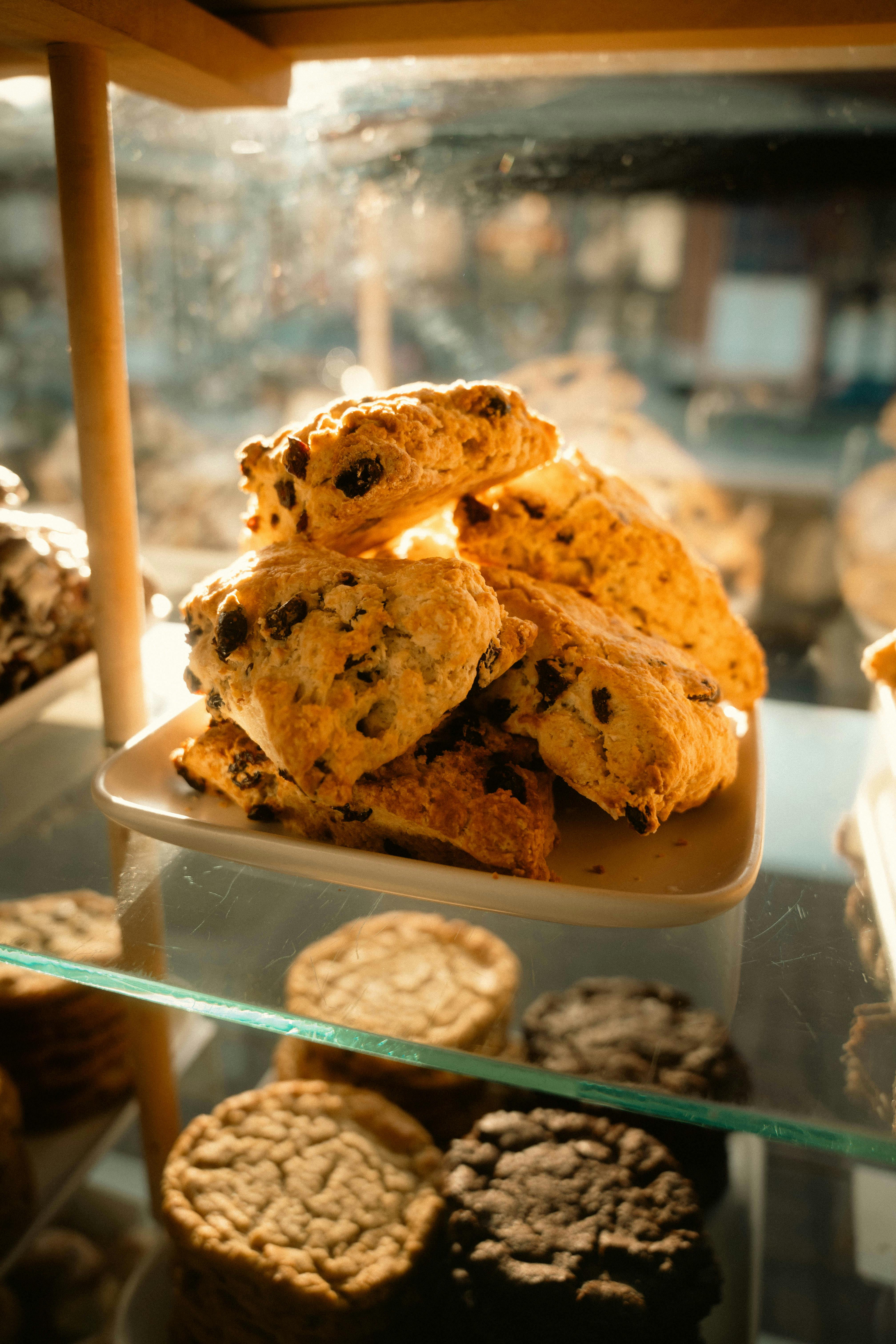
Photo: James Collington / Pexels
The diets react (see scores below)
Common Ingredients
- flour
- butter
- sugar
- baking powder
- salt
- eggs
- milk
Specific recipes may vary.
Incompatible with 8 of 11 diets
Diet Ratings
A traditional British scone is built almost entirely on flour and sugar — two ingredients that are fundamentally incompatible with ketogenic eating. Wheat flour is extremely high in net carbs (roughly 70-75g net carbs per 100g), and added sugar compounds the problem further. A single standard scone (approximately 60-80g) can deliver 30-40g of net carbs on its own, which meets or exceeds an entire day's carb budget on a strict ketogenic protocol. The remaining ingredients — butter, eggs, and milk — are acceptable on keto, but they cannot offset the dominant grain and sugar base. This food will reliably break ketosis.
Traditional British scones contain multiple animal-derived ingredients: butter (dairy), eggs, and milk. These are clear animal products that make this dish incompatible with a vegan diet. There is no ambiguity here — all three ingredients are unequivocally excluded under vegan dietary rules. Vegan versions of scones can be made by substituting plant-based butter (e.g., vegan margarine), flax eggs or commercial egg replacers, and plant-based milk (oat, almond, soy), but the dish as described with its listed ingredients is not vegan.
A traditional British scone is fundamentally incompatible with the Paleo diet. The primary ingredient is wheat flour, a grain that is explicitly excluded from Paleo eating. Beyond flour, the recipe also contains butter and milk (dairy), refined sugar, added salt, and baking powder (a processed leavening agent). With multiple core Paleo violations — grains, dairy, refined sugar, added salt, and processed additives — this dish fails on nearly every dimension of Paleo compliance. Eggs are the only ingredient that would be considered Paleo-approved.
Scones are a quintessentially British baked good that conflicts with Mediterranean diet principles on multiple fronts. They are made with refined white flour (a refined grain), butter (saturated animal fat rather than olive oil), and added sugar — three ingredients that the Mediterranean diet discourages. There are no vegetables, legumes, whole grains, or olive oil involved. The eggs and milk are minor components and do not redeem the overall profile. This is a processed baked good high in refined carbohydrates and saturated fat, placing it firmly in the 'avoid' category.
Scones are fundamentally incompatible with the carnivore diet. The primary ingredient is flour, a grain-based plant product that is explicitly excluded from all tiers of carnivore eating. Sugar adds another plant-derived substance, and baking powder typically contains plant-derived starches. While eggs, butter, and milk are animal-derived ingredients present in the recipe, they are minor components in a dish that is structurally defined by its grain base. No version of the carnivore diet — from the broadest 'animal-based' approach to the strictest Lion Diet — permits grain-based baked goods.
Scones contain multiple excluded ingredients and fall into a prohibited food category. Flour (wheat grain) is excluded, butter (dairy) is excluded, sugar (added sugar) is excluded, and milk (dairy) is excluded. Beyond the individual ingredients, scones are explicitly listed-adjacent baked goods that Whole30 Rule 4 prohibits even when made with compliant ingredients — they are the archetypal 'baked good' the program forbids recreating. This dish fails on both the ingredient level and the spirit-of-the-program level simultaneously.
A traditional British scone is made with wheat flour as its primary ingredient, which is high in fructans — one of the most problematic FODMAPs. A standard scone serving (one scone, approximately 50–80g) contains a significant quantity of wheat flour, well above any low-FODMAP threshold. Additionally, milk adds lactose, compounding the FODMAP load. While butter, eggs, sugar, baking powder, and salt are individually low-FODMAP, the wheat flour and milk make this dish clearly high-FODMAP at any realistic serving size. A gluten-free flour blend with lactose-free milk could produce a low-FODMAP equivalent, but a standard traditional scone as described must be avoided during the elimination phase.
A traditional British scone is made with refined white flour, butter (saturated fat), sugar (added sweetener), salt, and whole milk — none of which align well with core DASH dietary principles. DASH emphasizes whole grains over refined flour, limits saturated fat (butter is high in it), limits added sugars, and restricts sodium. However, scones are not in the same category as heavily processed or extremely high-sodium foods like bacon or processed meats. A single scone consumed occasionally fits within DASH's allowance for occasional discretionary foods, but it should not be a regular snack. It offers minimal potassium, fiber, or magnesium. The use of refined flour rather than whole-grain flour is a specific DASH concern, as DASH recommends 6-8 daily servings of grains with at least half being whole grains. Swapping to whole wheat flour, reducing butter and sugar, and using low-fat milk would improve its DASH compatibility significantly.
A traditional British scone is built almost entirely from refined white flour and sugar — both high-glycemic carbohydrates that Dr. Sears explicitly classifies as 'unfavorable' in Zone terminology. The dominant macronutrient is rapidly digested starch and sugar, which drives an insulin spike contrary to the Zone's core anti-inflammatory goal. Fat comes primarily from butter, which is saturated rather than the monounsaturated fats (olive oil, avocado, almonds) the Zone favors. There is minimal protein — eggs and milk contribute some, but the ratio is far off from the 40/30/30 target. A typical scone runs roughly 70-75% calories from carbohydrates, 20-25% from fat (saturated), and only 5-8% from protein, essentially the inverse of what the Zone prescribes. While a very small portion could technically occupy a carbohydrate block, the glycemic load, saturated fat profile, nutritional emptiness, and near-zero protein make it extremely difficult to incorporate into a Zone-balanced snack without significant structural changes. It scores a 3 rather than 1-2 only because it is a real food (not pure sugar or soda) and could theoretically be used as a tiny carb block in an otherwise well-constructed meal.
A traditional British scone is made primarily from refined white flour, butter, and sugar — a trifecta of pro-inflammatory ingredients. Refined flour is a high-glycemic refined carbohydrate that spikes blood sugar and promotes insulin-driven inflammation. Butter contributes saturated fat, which at these levels is flagged as inflammatory in anti-inflammatory frameworks. Added sugar further drives inflammatory pathways by elevating AGEs (advanced glycation end-products) and promoting oxidative stress. The dish contains no omega-3 fatty acids, no antioxidants, no polyphenols, no fiber, and no anti-inflammatory herbs or spices. Eggs and milk offer minor nutritional value but do not offset the predominantly pro-inflammatory ingredient profile. Baking powder and salt are neutral. This is essentially a refined carbohydrate and saturated fat delivery vehicle with no meaningful anti-inflammatory benefit. Occasional consumption may be tolerable for healthy individuals, but it is antithetical to anti-inflammatory dietary principles and should be avoided or treated as a rare exception.
A traditional British scone is primarily made of refined flour, butter, and sugar — offering little protein, minimal fiber, and a notable amount of saturated fat from butter. For GLP-1 patients eating significantly fewer calories overall, a scone represents poor nutritional value per calorie: it is calorie-dense without delivering meaningful protein or fiber to justify those calories. The refined carbohydrates digest quickly, offering little satiety despite the slowed gastric emptying GLP-1s cause. Butter contributes saturated fat, which can worsen nausea and GI discomfort. The small amount of egg and milk adds marginal protein but not enough to meaningfully shift the nutritional profile. While a scone is not fried, extremely spicy, alcoholic, or carbonated, its combination of refined grain, saturated fat, added sugar, and near-zero protein makes it a poor fit for GLP-1 dietary priorities. It scores at the very bottom of the caution range, nearly qualifying as avoid — the only reason it does not score lower is that it is not actively harmful in the way fried or high-sugar foods are, and a very occasional, small portion is unlikely to cause acute side effects.
*See how scores were generated at our methodology page.
Nutritional profile
Six traits that cut across every diet.
Fiber & Plants
How much whole-plant food and fiber it delivers.
Healthy Fats
The quality of its fats (unsaturated, omega-3).
Whole / Unprocessed
How close it is to its natural, unprocessed form.
Gut Gentle
How easy it is on digestion (low FODMAP, few irritants).
Low Glycemic
How little it spikes your blood sugar.
Protein Density
How much protein it packs per calorie.
Controversy Index
Higher controversy = more disagreement between diets.
Diet-Specific Tips
 DASH — 4/10
View tips
- Refined white flour — DASH recommends whole grains
- Butter contributes saturated fat, which DASH limits
- Added sugar, though modest, conflicts with DASH guidance on limiting sweets
- Salt added during preparation contributes to sodium load
- Minimal fiber, potassium, magnesium, or calcium relative to DASH priorities
- Occasional consumption is tolerable within DASH discretionary allowances
- Whole-wheat, reduced-butter, low-fat milk version would rate higher (score 5-6)
 Zone — 5/10
View tips
- High-glycemic refined white flour is an 'unfavorable' Zone carbohydrate driving insulin spikes
- Added sugar compounds glycemic load, further opposing Zone principles
- Butter provides saturated fat rather than Zone-preferred monounsaturated fat
- Virtually no lean protein — macronutrient ratio is approximately 75/5/20 (carb/protein/fat), far from 40/30/30
- No fiber, polyphenols, or omega-3s — nutritionally empty from a Zone anti-inflammatory perspective
- Would require radical re-engineering (almond flour, egg white addition, no sugar) to approach Zone compatibility
 GLP-1 Friendly — 5/10
View tips
- Very low protein — no meaningful protein source in the ingredient list
- Negligible dietary fiber from refined white flour
- Saturated fat from butter may worsen GLP-1-related nausea and bloating
- High refined carbohydrate content with rapid glycemic impact
- Poor nutrient density per calorie — counterproductive given reduced appetite on GLP-1s
- Added sugar further reduces nutritional value
- Not portion-friendly — a standard scone is already a full snack-sized serving with minimal nutritional return