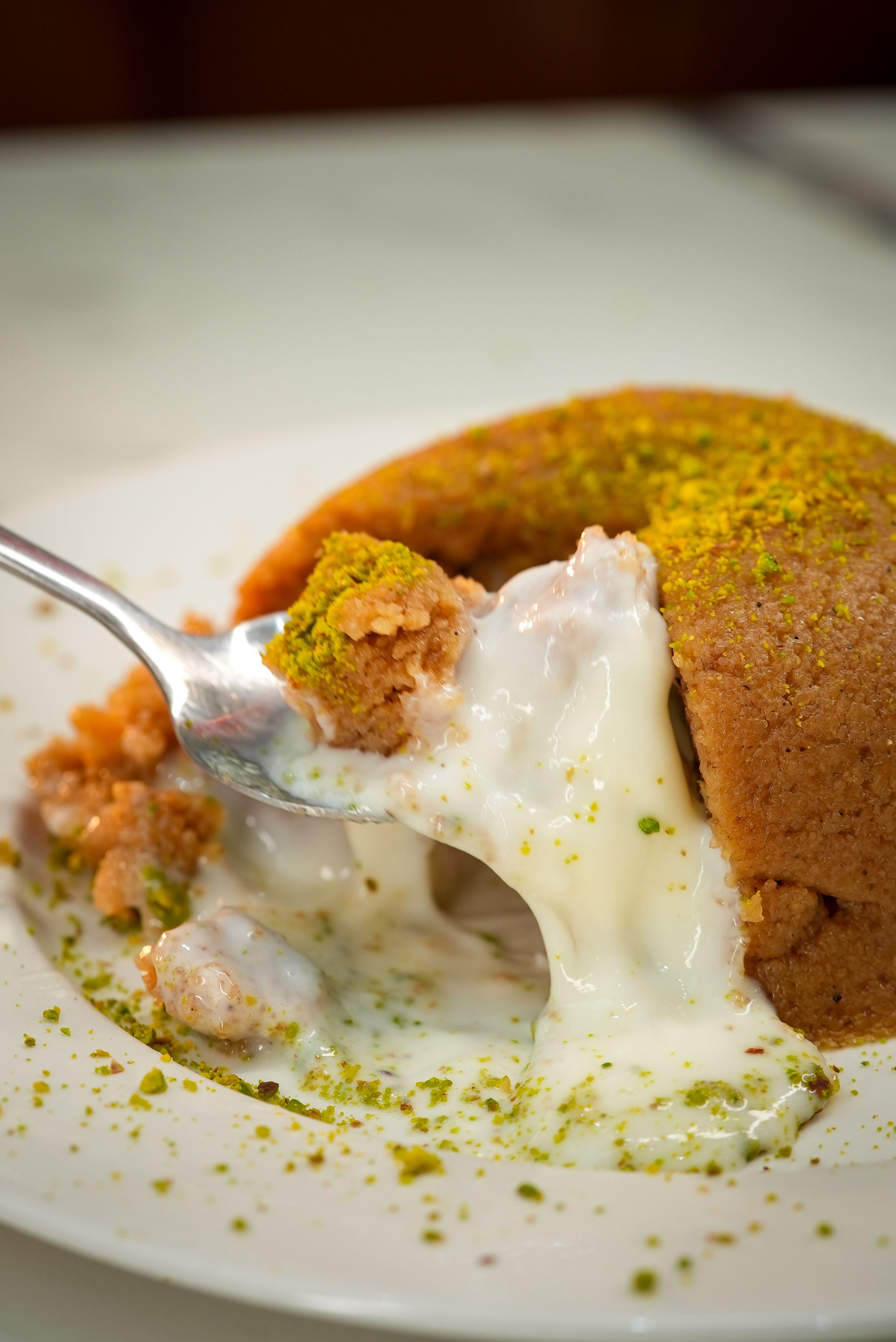
Middle-Eastern
Semolina Pudding
The diets react (see scores below)
Common Ingredients
- semolina flour
- milk
- sugar
- butter
- rose water
- almonds
- pine nuts
- cinnamon
Specific recipes may vary.
Incompatible with 7 of 11 diets
Diet Ratings
Semolina pudding is fundamentally incompatible with a ketogenic diet. Semolina flour is a refined grain product with extremely high net carbs (approximately 70g net carbs per 100g), and a single serving of this pudding would almost certainly exceed the entire daily keto carb allowance. Compounded by added sugar as a core ingredient and milk (which contains lactose/carbs), this dish delivers a triple carbohydrate hit from grain, refined sugar, and dairy sugars simultaneously. The butter, almonds, and pine nuts are keto-friendly components, but they are overwhelmed by the dominant high-carb ingredients. There is no reasonable portion size that makes this dish compatible with maintaining ketosis.
Semolina Pudding as described contains multiple animal-derived ingredients that disqualify it from vegan compliance. Milk is a dairy product and butter is an animal fat, both clearly excluded under vegan dietary rules. The remaining ingredients — semolina flour, sugar, rose water, almonds, pine nuts, and cinnamon — are all plant-based, but the presence of milk and butter makes this dish non-vegan. A vegan version could be prepared by substituting plant-based milk (oat, almond, coconut) and vegan butter, which are widely available.
Semolina Pudding is fundamentally incompatible with the Paleo diet. Semolina flour is a wheat-derived grain product — one of the most clearly excluded foods in all paleo frameworks. Milk is dairy, also explicitly excluded. Refined sugar is a processed sweetener with no place in paleo eating. Butter, while sometimes debated, is a dairy product discouraged by strict paleo guidelines. The only paleo-friendly ingredients in this dish are almonds, pine nuts, cinnamon, and rose water — minor garnishes that cannot redeem a dish built on three major paleo violations. This dish is essentially grain + dairy + refined sugar, which represents a clean sweep of core paleo exclusions.
Semolina pudding contains several ingredients that conflict with Mediterranean diet principles. Semolina flour is a refined grain, not a whole grain, and combined with added sugar and butter (rather than olive oil), this dish leans heavily toward the 'minimize' category. The dairy (milk) and nuts (almonds, pine nuts) are Mediterranean-friendly, and cinnamon and rose water are fine, but the overall profile — refined grain base, significant added sugar, butter as the fat — makes this a treat that contradicts the diet's core emphasis on whole grains, minimal added sugars, and olive oil as the primary fat. As an occasional indulgence it might be tolerated, but it should not be a regular snack.
Some traditional Eastern Mediterranean and Levantine culinary traditions incorporate semolina-based sweets as part of a culturally embedded dietary pattern, and certain Mediterranean diet researchers argue that overall dietary pattern matters more than individual foods. In this view, small portions of traditional sweets like this, eaten infrequently within an otherwise plant-forward diet, could be considered culturally acceptable rather than categorically avoided.
Semolina Pudding is almost entirely plant-derived and incompatible with the carnivore diet. The dominant ingredients — semolina flour (a wheat grain), sugar, rose water, almonds, pine nuts, and cinnamon — are all explicitly excluded plant foods. Even the butter and milk, which are animal-derived dairy, are minor components overwhelmed by grains, sugar, nuts, and plant-based flavorings. This dish represents the exact opposite of carnivore principles: a grain-based, sugar-sweetened, plant-additive-laden dessert with only trace animal content.
Semolina Pudding contains multiple excluded ingredients that make it clearly non-compliant with Whole30. Semolina is a wheat-derived grain product, which is explicitly excluded. Milk is dairy, which is excluded (ghee/clarified butter is the only dairy exception, and regular butter used here is also excluded). Sugar is an added sweetener, explicitly banned on Whole30. This dish has at least four excluded ingredients: semolina flour (grain), milk (dairy), sugar (added sugar), and butter (dairy). There is no compliant version of this dish possible, as its foundational ingredients are all excluded.
Semolina pudding contains multiple high-FODMAP ingredients that make it unsuitable during the elimination phase. Semolina is made from durum wheat, which is high in fructans — a primary FODMAP trigger. Milk is high in lactose, another significant FODMAP, and a standard pudding serving would contain a meaningful quantity of milk. Together, these two ingredients alone make this dish high-FODMAP at any realistic serving size. Almonds are low-FODMAP only at 10 nuts (approximately 12g) per Monash; a standard pudding topping may exceed this. Pine nuts are low-FODMAP at small servings (around 1 tablespoon). Sugar, butter, rose water, and cinnamon are generally low-FODMAP. However, the combination of wheat-based semolina and lactose-containing milk creates a dual FODMAP burden (fructans + lactose) that cannot be mitigated by portion control in a dish of this nature.
Semolina pudding contains a mix of DASH-compatible and problematic ingredients. Semolina flour (refined grain, not whole grain), sugar, and butter are the main concerns — refined grains lack the fiber of whole grains preferred by DASH, added sugar should be minimized, and butter is a saturated fat source that DASH limits. Milk is acceptable as a low-fat dairy source in DASH, but whole milk is typically used in this dish. Almonds and pine nuts are DASH-friendly (healthy unsaturated fats, magnesium, protein), and cinnamon is neutral. Rose water adds no nutritional concern. The overall dish is a dessert/sweet snack with notable added sugar and saturated fat from butter, placing it in the 'caution' range — acceptable occasionally in small portions but not a core DASH food. Sodium content is low, which is a positive factor.
NIH DASH guidelines recommend limiting added sugars and saturated fats (butter), which this dish contains in meaningful amounts. However, some updated clinical interpretations note that small portions of nutrient-mixed desserts — particularly those with nuts providing magnesium and healthy fats — can fit within a flexible DASH pattern, especially if dairy is low-fat and butter is minimized.
Semolina Pudding is a challenging dish for the Zone Diet, sitting at the lower end of the caution range. The core problem is its macronutrient profile: semolina flour is a refined, high-glycemic carbohydrate (moderate-to-high GI), and added sugar compounds the glycemic load significantly. Together, these create a carbohydrate-heavy dish that would blow out the 40% carb block allocation with very little protein or fat to balance it. Milk provides some protein and fat, almonds and pine nuts contribute monounsaturated fats (a Zone positive), and cinnamon has some anti-inflammatory polyphenol value — but these favorable elements are minor against the dominant semolina-sugar base. Butter adds saturated fat, which the Zone discourages. As a snack, it lacks the lean protein component Zone requires (a Zone snack should still approximate 1 block each of protein, carb, and fat). A typical serving would be disproportionately carbohydrate-heavy with insufficient protein, making Zone balancing very difficult without dramatically reducing portion size to near-negligible amounts. This is not a categorically excluded food — the nuts and dairy provide some block-compatible nutrition — but it is an 'unfavorable' high-glycemic dish that requires extreme portioning caution.
Semolina pudding presents a mixed anti-inflammatory profile. On the positive side, almonds and pine nuts contribute healthy monounsaturated fats, vitamin E, and some anti-inflammatory properties. Cinnamon is a well-established anti-inflammatory spice with polyphenols that can help modulate blood sugar and reduce inflammatory markers. Rose water has mild antioxidant properties. However, the dish is anchored by several pro-inflammatory or neutral-at-best ingredients: semolina flour is a refined grain with a high glycemic index that can spike blood sugar and promote low-grade inflammation; added sugar compounds this glycemic burden; and butter is a saturated fat that anti-inflammatory guidelines recommend limiting. Milk is moderate — acceptable in small amounts but full-fat dairy adds saturated fat. The overall dish is a sweetened, butter-enriched refined grain dessert, which structurally resembles the types of refined-carbohydrate, added-sugar foods the anti-inflammatory framework cautions against. The saving graces — nuts and cinnamon — are present but in relatively small quantities compared to the dominant refined grain and sugar base. Occasional consumption is acceptable, but it should not be a dietary staple.
Semolina pudding is a refined-grain-based dessert with moderate calories but poor protein density, significant added sugar, and butter contributing saturated fat — all of which are suboptimal for GLP-1 patients. Semolina flour is a refined carbohydrate with low fiber content, offering little to stabilize blood sugar or support satiety. The sugar content is a meaningful concern given the priority on nutrient density per calorie. Butter adds saturated fat, which may worsen GLP-1 GI side effects (nausea, reflux). Milk provides some protein and calcium, but not enough to meaningfully move the protein needle per serving. On the positive side, almonds and pine nuts contribute small amounts of healthy unsaturated fats, protein, and fiber, and the dish is soft-textured and easy to digest — a mild benefit for patients experiencing gastroparesis-like slowing. Rose water and cinnamon are benign. Portion size matters significantly: a very small serving (2–3 tablespoons) is far less problematic than a full bowl. As a snack, it competes against much higher-protein, higher-fiber options and offers mostly empty refined carbohydrate calories. It is not categorically off-limits, but it is a poor use of limited appetite capacity on GLP-1 medications.
Some GLP-1-focused dietitians may permit small portions of semolina pudding as a culturally meaningful food that supports dietary adherence, arguing that complete elimination of traditional comfort foods increases dropout risk — particularly if the portion is small and paired with a protein source. Others would caution more firmly against it given the refined carbohydrate and added sugar content, which are especially counterproductive when total caloric intake is severely reduced.
*See how scores were generated at our methodology page.
Nutritional profile
Six traits that cut across every diet.
Fiber & Plants
How much whole-plant food and fiber it delivers.
Healthy Fats
The quality of its fats (unsaturated, omega-3).
Whole / Unprocessed
How close it is to its natural, unprocessed form.
Gut Gentle
How easy it is on digestion (low FODMAP, few irritants).
Low Glycemic
How little it spikes your blood sugar.
Protein Density
How much protein it packs per calorie.
Controversy Index
Higher controversy = more disagreement between diets.
Diet-Specific Tips
 DASH — 4/10
View tips
- Added sugar is a DASH concern — should be limited to ≤5 servings/week of sweets
- Butter contributes saturated fat, which DASH recommends limiting
- Semolina is a refined grain; DASH emphasizes whole grains over refined
- Almonds and pine nuts are DASH-approved: healthy fats, magnesium, protein
- Milk contributes calcium and protein, though whole milk is higher in saturated fat
- Low sodium content is a positive for DASH compatibility
- Small portions could fit within DASH's allowance for occasional sweets
 Zone — 5/10
View tips
- Semolina flour is a refined, moderate-to-high glycemic carbohydrate — classified 'unfavorable' in Zone terminology
- Added sugar significantly elevates glycemic load, pushing the dish toward avoid territory
- Butter adds saturated fat, which Zone discourages in favor of monounsaturated fats
- Almonds and pine nuts are Zone-favorable monounsaturated fat sources — a partial positive
- Milk contributes modest protein and fat blocks but insufficient to offset the carbohydrate imbalance
- Cinnamon has anti-inflammatory polyphenol value consistent with Sears' later writings
- As a snack, the dish lacks adequate lean protein to achieve even a 1-block Zone balance
- Rose water is nutritionally negligible — no Zone impact
 Anti-Inflammatory — 4/10
View tips
- Semolina flour is a refined grain with high glycemic index — pro-inflammatory at regular intake
- Added sugar compounds the glycemic load and inflammatory burden
- Butter contributes saturated fat, which anti-inflammatory guidelines recommend limiting
- Almonds and pine nuts provide monounsaturated fats and vitamin E — anti-inflammatory benefit
- Cinnamon is a well-supported anti-inflammatory spice
- Full-fat dairy (milk + butter) should be moderated under anti-inflammatory principles
- Overall dish structure mirrors pro-inflammatory pattern: refined carbs + sugar + saturated fat
 GLP-1 Friendly — 4/10
View tips
- Low protein density — milk contributes minimally; does not meet 15–30g per meal/snack protein target
- Refined carbohydrate base (semolina) with low fiber — poor blood sugar stability
- Added sugar increases glycemic load with minimal nutritional return
- Butter adds saturated fat, may worsen nausea or reflux on GLP-1 medications
- Soft texture is easy to digest — mild positive for GI-sensitive patients
- Almonds and pine nuts offer small amounts of unsaturated fat and protein but insufficient to offset drawbacks
- Highly portion-sensitive — a very small serving is far less problematic
- Competes poorly against high-protein, high-fiber snack alternatives for limited appetite capacity