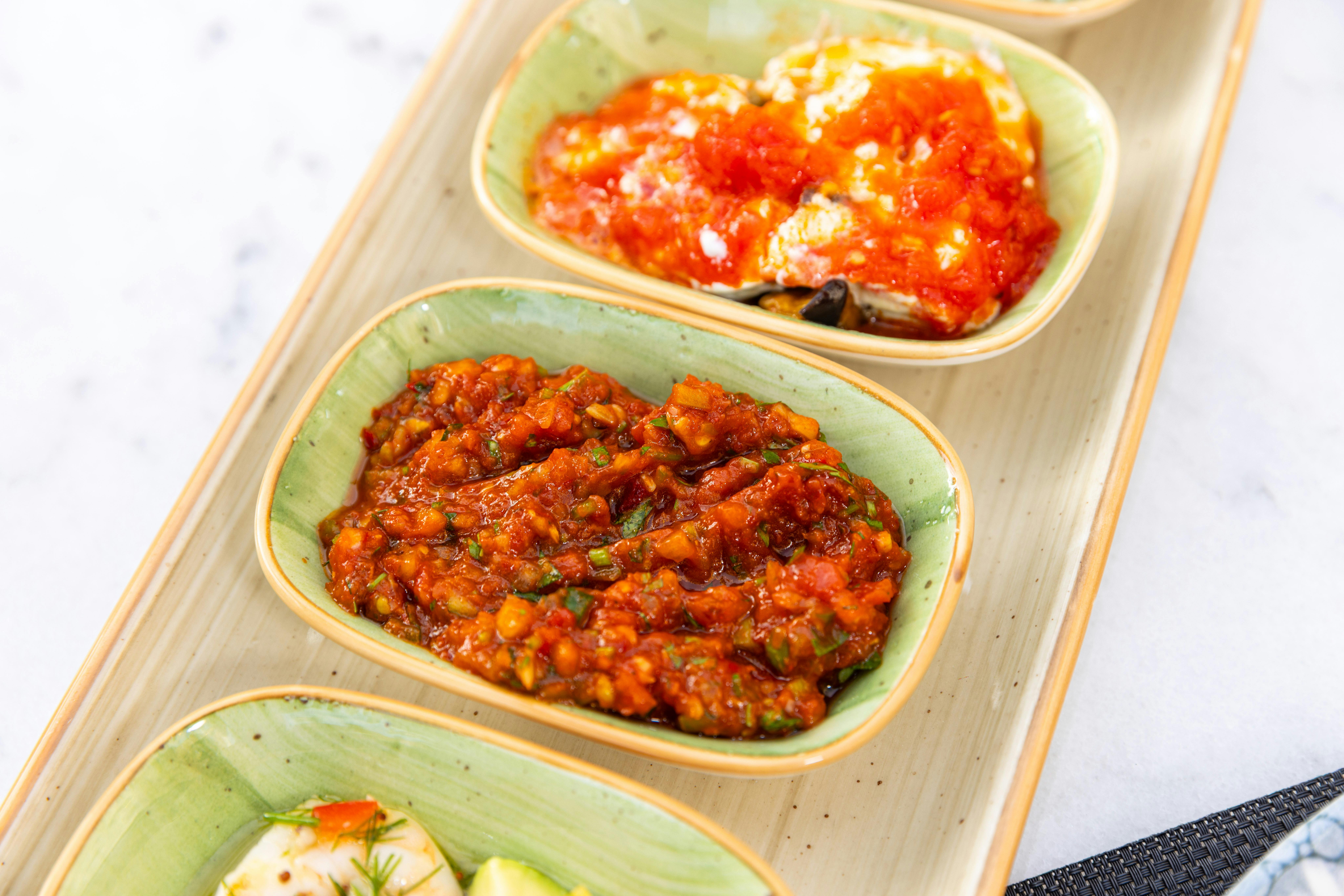
Photo: Ahmet ÇÖTÜR / Pexels
The diets react (see scores below)
Common Ingredients
- red bell peppers
- eggplant
- garlic
- olive oil
- vinegar
- salt
Specific recipes may vary.
Incompatible with 3 of 11 diets
Diet Ratings
Ajvar is a roasted red pepper and eggplant relish made with keto-friendly ingredients (olive oil, garlic, vinegar, salt), but red bell peppers are the primary ingredient and carry a moderate carb load. A standard 2-tablespoon serving contains roughly 3-4g net carbs, which is manageable, but Ajvar is often used generously as a condiment or spread. Red bell peppers have about 4-5g net carbs per 100g, and eggplant adds minimal additional carbs. The olive oil base is keto-friendly, and there are no added sugars or grains. Small, controlled portions can fit within a daily keto budget, but liberal use could push someone toward or over their carb limit, especially combined with other carb sources throughout the day.
Strict keto practitioners argue that red bell peppers are too carb-dense compared to lower-carb vegetables and that even condiment-sized portions accumulate meaningfully when eating patterns are tracked rigorously; they would recommend avoiding Ajvar entirely or substituting with a green pepper or zucchini-based alternative to reduce carb exposure.
Ajvar is a traditional Balkan roasted red pepper and eggplant relish made entirely from plant-based ingredients. All components — red bell peppers, eggplant, garlic, olive oil, vinegar, and salt — are unambiguously vegan. The dish is also predominantly whole-food in nature, with minimal processing, which aligns well with whole-food plant-based principles. There are no animal products, animal-derived additives, or ethically contested ingredients present.
Ajvar contains three problematic ingredients from a strict paleo perspective. Salt is explicitly excluded as an added ingredient under paleo rules. Vinegar, while derived from natural sources, is a processed/fermented product that most paleo authorities exclude. Salt alone disqualifies traditional ajvar as prepared — it is a core, non-optional component of the condiment. The base vegetables (red bell peppers, eggplant, garlic) and olive oil are fully paleo-approved, but the combination with added salt and vinegar pushes this into avoid territory. A home-modified version omitting salt and vinegar would score much higher.
Ajvar is an excellent fit for the Mediterranean diet. It is composed entirely of whole, plant-based ingredients — roasted red bell peppers and eggplant as the base, flavored with garlic, and bound with extra virgin olive oil. These are precisely the kinds of vegetables and preparations celebrated across Mediterranean cuisines (similar to Spanish escalivada or Italian caponata). There are no refined grains, added sugars, processed ingredients, or animal products. The vinegar and salt are minimal seasoning agents. As a vegetable-forward condiment with olive oil as the fat, it aligns perfectly with core Mediterranean diet principles.
Ajvar is a Serbian roasted red pepper and eggplant relish that is entirely plant-based. Every single ingredient — red bell peppers, eggplant, garlic, olive oil, and vinegar — is either a vegetable, allium, or plant-derived oil/acid. There is no animal product whatsoever in this dish. This makes it completely incompatible with the carnivore diet at every tier, including the most lenient 'animal-based' approaches. Even practitioners who allow coffee or honey would have no basis for including a condiment made entirely of vegetables and plant oils.
Ajvar is a roasted red pepper and eggplant relish made entirely from Whole30-compliant ingredients. Red bell peppers, eggplant, garlic, olive oil, vinegar, and salt are all explicitly permitted on the Whole30 program. Vinegar is specifically called out as an allowed ingredient (excepting malt vinegar). There are no excluded ingredients — no added sugar, no grains, no legumes, no dairy, no disallowed additives. This is a whole-food condiment that aligns well with the program's spirit.
Ajvar contains garlic as a core ingredient, which is high-FODMAP due to fructans and must be avoided during the elimination phase. Additionally, eggplant becomes high-FODMAP at servings above approximately 75g (it is only low-FODMAP at very small portions of around 43g per Monash). Red bell peppers are low-FODMAP in standard servings, olive oil and vinegar are FODMAP-free, and salt is neutral. However, the combination of garlic (a primary FODMAP offender with no safe threshold) and eggplant in a spread where portion control is difficult makes this dish problematic for elimination phase. Commercial or homemade ajvar typically uses garlic as an essential flavoring component, making a compliant version essentially a different dish. Even if garlic were replaced with garlic-infused oil, the eggplant quantity in a standard serving of ajvar could still push into high-FODMAP territory.
Monash University lists garlic as definitively high-FODMAP at any culinary amount; however, some clinical FODMAP practitioners suggest that highly processed or roasted preparations might reduce fructan content slightly, though this is not validated by Monash testing. Additionally, if ajvar is used as a very small condiment (1-2 teaspoons), the total FODMAP load from eggplant may remain within safe limits, but the garlic issue persists regardless of portion.
Ajvar is made primarily from DASH-friendly ingredients — red bell peppers and eggplant are excellent DASH vegetables rich in potassium, fiber, and antioxidants, and olive oil is the preferred DASH fat. However, as a condiment, ajvar typically contains a meaningful amount of added salt, and commercial versions can have 200–400mg+ sodium per serving (2 tablespoons), which adds up quickly given how it is used. The olive oil content also adds caloric density, though this is a healthy fat. Homemade ajvar with minimal salt would score much higher (7–8), but the standard commercially prepared or traditionally salted version warrants caution due to sodium contribution. The core ingredients are fundamentally DASH-aligned, keeping this out of the 'avoid' category.
NIH DASH guidelines do not specifically address ajvar, but its base ingredients (peppers, eggplant, olive oil) are core DASH foods; some DASH-oriented clinicians would approve homemade low-sodium ajvar outright as an excellent vegetable-based condiment, arguing that the sodium impact is manageable within daily limits if portions are controlled — the caution rating applies primarily to commercial or heavily salted preparations.
Ajvar is an excellent Zone-compatible condiment. Its primary ingredients — red bell peppers and eggplant — are both low-glycemic, colorful vegetables that Zone strongly favors. Olive oil provides the ideal monounsaturated fat profile that Sears explicitly recommends. Garlic and vinegar contribute polyphenols and anti-inflammatory compounds, aligning with Sears' later emphasis on omega-3s and polyphenols. As a condiment, ajvar is used in small quantities, making it easy to incorporate into Zone meals without disrupting the 40/30/30 ratio. The carbohydrate load is modest given typical serving sizes, and the fat source is optimal. The only reason it doesn't score a 9-10 is that it lacks protein and functions as a condiment rather than a Zone block building block on its own — it must be paired with a lean protein source to complete a Zone meal.
Ajvar is a roasted red pepper and eggplant relish with a strong anti-inflammatory profile. Red bell peppers are rich in vitamin C, carotenoids (beta-carotene, capsanthin), and polyphenols that reduce inflammatory markers like CRP. Eggplant contributes nasunin (a potent anthocyanin antioxidant) and chlorogenic acid, both associated with anti-inflammatory activity. Garlic contains allicin and sulfur compounds with well-documented anti-inflammatory and immunomodulatory effects. Olive oil — especially if extra virgin — provides oleocanthal and oleic acid, both of which inhibit COX-1/COX-2 inflammatory pathways similarly to ibuprofen. Vinegar in small condiment quantities is essentially neutral. The cooking process (roasting) enhances bioavailability of some carotenoids (lycopene, beta-carotene) while slightly reducing vitamin C. Used as a condiment in reasonable portions, this dish is a near-ideal anti-inflammatory preparation. The only caveat is the nightshades question: both red peppers and eggplant are nightshades, which are enthusiastically endorsed in mainstream anti-inflammatory nutrition for their antioxidant content, but are excluded in Autoimmune Protocol (AIP) and some functional medicine frameworks due to alkaloid and lectin concerns in sensitive individuals.
Mainstream anti-inflammatory nutrition (including Dr. Weil's pyramid) strongly endorses nightshade vegetables like red peppers and eggplant for their high antioxidant content and anti-inflammatory phytonutrients. However, AIP and functional medicine practitioners such as Dr. Tom O'Bryan argue that solanine alkaloids and lectins in nightshades can trigger or perpetuate inflammation in individuals with autoimmune conditions or gut permeability issues, making this dish a caution for that subpopulation.
Ajvar is a roasted red pepper and eggplant relish that is relatively nutrient-dense for a condiment. It provides meaningful fiber from vegetables, antioxidants from roasted peppers, and uses olive oil as its fat source — an unsaturated fat that is acceptable in moderation on a GLP-1 regimen. The vinegar and garlic add flavor with minimal caloric cost. However, ajvar contains no meaningful protein, and the olive oil content means fat grams can climb depending on how generously it is prepared. As a condiment used in small amounts (1-2 tablespoons), it is a reasonable GLP-1-friendly choice to add flavor and palatability to lean proteins or whole grains. In larger portions it displaces protein and fiber-rich foods without contributing protein itself. The main GLP-1 concern is that eggplant and peppers can occasionally cause bloating or mild GI discomfort in patients already dealing with slowed gastric emptying, though this is individual.
Some GLP-1 nutrition practitioners view vegetable-based condiments like ajvar favorably as a way to boost vegetable intake and palatability of otherwise plain high-protein meals, and would rate it higher. Others caution that the olive oil quantity in homemade or commercial versions varies widely, and higher-fat preparations may worsen nausea or reflux in sensitive patients.
*See how scores were generated at our methodology page.
Nutritional profile
Six traits that cut across every diet.
Fiber & Plants
How much whole-plant food and fiber it delivers.
Healthy Fats
The quality of its fats (unsaturated, omega-3).
Whole / Unprocessed
How close it is to its natural, unprocessed form.
Gut Gentle
How easy it is on digestion (low FODMAP, few irritants).
Low Glycemic
How little it spikes your blood sugar.
Protein Density
How much protein it packs per calorie.
Controversy Index
Higher controversy = more disagreement between diets.
Diet-Specific Tips
 Keto — 5/10
View tips
- Red bell peppers are the primary ingredient with ~4-5g net carbs per 100g
- Small 2 tbsp serving (~30g) yields approximately 1.5-2g net carbs — manageable
- Olive oil base is highly keto-compatible
- No added sugars, grains, or starches in this recipe
- Portion control is critical — use as a condiment, not a dip
- Eggplant adds negligible net carbs in this ratio
- Carb accumulation risk if used liberally across multiple meals
 Vegan — 9/10
View tips
- All ingredients are whole plant foods
- No animal products or animal-derived ingredients
- Minimal processing — roasted and blended vegetables
- Olive oil is fully plant-derived
- No ethically contested ingredients within vegan discourse
- Traditional recipe requires no vegan substitutions
 Mediterranean — 9/10
View tips
- Primary ingredients are whole vegetables (red bell peppers, eggplant) — core Mediterranean foods
- Extra virgin olive oil is the fat source, which is the canonical Mediterranean fat
- Garlic is a staple aromatic in Mediterranean cooking
- No animal products, refined grains, or added sugars
- Minimal processing — roasted and blended whole vegetables
- Vinegar and salt are acceptable seasoning agents in moderation
 Whole30 — 9/10
View tips
- Red bell peppers and eggplant are Whole30-compliant vegetables
- Olive oil is an approved natural fat
- Vinegar is explicitly allowed on Whole30 (most types)
- Garlic and salt are compliant seasonings
- No excluded ingredients present
- Homemade or store-bought versions should be label-checked to confirm no added sugar or preservatives
 DASH — 5/10
View tips
- Red bell peppers and eggplant are core DASH vegetables rich in potassium and fiber
- Olive oil is the preferred fat in DASH guidelines
- Salt content is the primary concern — commercial ajvar can be high in sodium
- Homemade low-sodium versions would score significantly higher (7–8)
- Used as a condiment, portion sizes are typically small, limiting sodium impact
- No saturated fat, added sugar, or processed ingredients beyond salt
 Zone — 8/10
View tips
- Red bell peppers and eggplant are low-glycemic, favorable Zone carbohydrates
- Olive oil is the gold-standard monounsaturated fat in Zone methodology
- Garlic and vinegar provide polyphenols supporting anti-inflammatory goals
- Small condiment portions make macro disruption negligible
- No protein content — must be paired with lean protein to form a Zone meal
- No high-glycemic ingredients, added sugars, saturated fats, or trans fats
 Anti-Inflammatory — 8/10
View tips
- Red bell peppers: high in carotenoids, vitamin C, and polyphenols with anti-inflammatory activity
- Eggplant: contains nasunin and chlorogenic acid, potent antioxidants
- Garlic: allicin and sulfur compounds with documented anti-inflammatory and immunomodulatory effects
- Olive oil: oleocanthal inhibits COX-1/COX-2 inflammatory pathways
- Roasting enhances carotenoid bioavailability
- Nightshade ingredients may be problematic for autoimmune-sensitive individuals (AIP exclusion)
- Condiment portions limit any cumulative concerns about salt or vinegar
 GLP-1 Friendly — 6/10
View tips
- No protein — does not contribute to the 100-120g daily protein target
- Moderate fiber from red bell peppers and eggplant — supports digestion and GLP-1 side effect management
- Olive oil provides unsaturated fat — acceptable in moderation but adds calories and fat grams
- Small condiment portions are GLP-1-friendly; larger servings displace more nutritious foods
- Roasted vegetables are generally easy to digest
- No added sugar, no refined grains, no saturated fat — clean ingredient profile
- Garlic and vinegar are GLP-1-neutral at condiment quantities