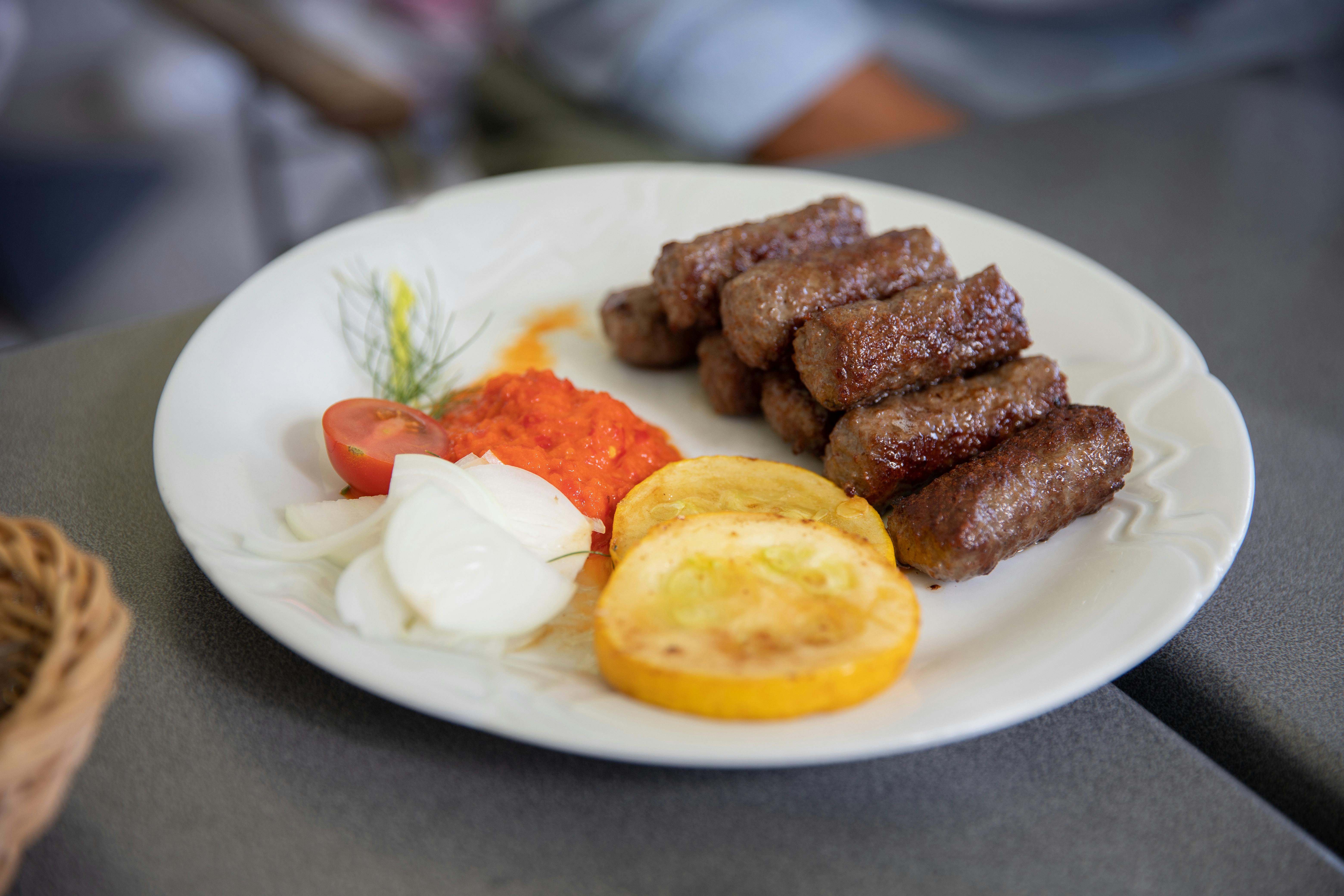
Photo: Media Lens King / Pexels
The diets react (see scores below)
Common Ingredients
- ground beef
- ground pork
- garlic
- paprika
- salt
- black pepper
- baking soda
- onion
Specific recipes may vary.
Incompatible with 5 of 11 diets
Diet Ratings
Cevapi consists almost entirely of ground beef and pork seasoned with garlic, paprika, salt, black pepper, and a small amount of baking soda — all of which are either zero-carb or negligible in carbs. The onion and garlic contribute trace net carbs across a typical serving. The dish is naturally high in fat and protein from the fatty ground meat blend, with virtually no net carbohydrates. There are no grains, sugars, or starchy fillers in this traditional preparation. Note that cevapi is traditionally served with lepinja (flatbread) and ajvar — these accompaniments should be avoided or replaced on keto, but the meat itself is fully compatible.
Cevapi is a traditional Balkan/Serbian grilled meat dish made primarily from ground beef and ground pork — both direct animal flesh products. This is unambiguously incompatible with a vegan diet. The remaining ingredients (garlic, paprika, salt, black pepper, baking soda, onion) are all plant-based, but the core protein components are entirely animal-derived. There is no vegan version of traditional cevapi; a plant-based adaptation would require complete replacement of the meat components and would no longer be cevapi in any traditional sense.
Cevapi is a grilled minced meat dish that is largely paleo-compatible in its protein base — ground beef and pork are both approved paleo foods, and garlic, paprika, black pepper, and onion are all acceptable paleo seasonings. However, two ingredients disqualify the dish: salt (added salt is excluded from strict paleo) and baking soda (a processed leavening agent not available to Paleolithic humans and used here as a food additive to alter texture). Salt is explicitly on the avoid list, and baking soda is a processed chemical additive that falls outside paleo guidelines. These are not incidental trace additives — salt is a core seasoning in the recipe and baking soda is a deliberate functional ingredient. Without these, the dish would score much higher.
Cevapi is a grilled minced meat dish made primarily from ground beef and ground pork — two red meats that the Mediterranean diet explicitly limits to a few times per month. The combination of both beef and pork together compounds the concern around saturated fat intake. While the spices (garlic, paprika, black pepper, onion) are Mediterranean-friendly, they cannot offset the fundamental issue: this dish is essentially a red meat protein with no plant-based emphasis, no olive oil, no vegetables, no legumes, and no whole grains. It directly contradicts the Mediterranean diet's core principle of minimizing red meat consumption. Served as a snack or main, it represents the type of meat-heavy eating pattern the Mediterranean diet is designed to move away from.
Cevapi consists primarily of ground beef and pork — both solid carnivore-approved animal proteins. However, the recipe includes several plant-derived ingredients: garlic, paprika, black pepper, and onion are all excluded under strict carnivore rules. Salt and baking soda (sodium bicarbonate, a mineral leavening agent) are generally accepted. The spice blend and onion push this firmly into 'caution' territory. Most relaxed carnivore practitioners tolerate spices in small amounts, but strict adherents would avoid garlic, onion, paprika, and black pepper entirely. The meat base is excellent; the plant-derived seasonings are the issue.
Strict carnivore practitioners following Dr. Shawn Baker's or Mikhaila Peterson's Lion Diet protocols would avoid Cevapi entirely due to the garlic, onion, paprika, and black pepper — all plant compounds with potential inflammatory properties. Purists argue that even trace plant seasonings undermine the elimination purpose of the carnivore diet.
Cevapi made with ground beef, ground pork, garlic, paprika, salt, black pepper, baking soda, and onion contains only Whole30-compliant ingredients. All components — meats, spices, aromatics, and salt — are explicitly allowed on the program. Baking soda is a mineral leavening agent with no excluded ingredients. Traditionally cevapi are served in flatbread (lepinja), but the dish as described here contains no bread or other excluded ingredients. As long as it is eaten without the bread accompaniment, it is fully compliant.
Cevapi contains two high-FODMAP ingredients that make it unsuitable during the elimination phase: garlic and onion. Both are significant sources of fructans and are among the highest-FODMAP foods tested by Monash University. Even small amounts of garlic (as little as half a clove) exceed FODMAP thresholds, and onion is high-FODMAP at any culinary serving. These are structural ingredients in cevapi, not optional garnishes — they are mixed directly into the meat blend and cannot be removed after cooking. Ground beef and ground pork are themselves low-FODMAP, as are paprika, salt, black pepper, and baking soda. However, the mandatory inclusion of garlic and onion in the recipe makes this dish unavoidable for elimination phase non-compliance. A modified version using garlic-infused oil and omitting onion (or using green onion tops only) could be made low-FODMAP.
Cevapi is a grilled minced meat dish combining ground beef and ground pork, which immediately raises multiple DASH diet concerns. Red meat (beef) is explicitly limited on the DASH diet, and pork can be high in saturated fat depending on the cut used. The combination of two red/fatty meats means the saturated fat content is likely to be significant. Salt is a direct ingredient, and when seasoned for traditional flavor, the sodium content per serving is typically high. Baking soda also contributes additional sodium. DASH guidelines explicitly recommend limiting red meat, high-sodium foods, and high saturated fat sources. While garlic, onion, and paprika are DASH-friendly seasonings, they cannot offset the core issues of the protein base. This dish does not align with DASH principles of lean protein, low sodium, and low saturated fat.
Cevapi are grilled ground meat sausages made from a blend of beef and pork, which creates a moderate Zone compatibility issue. The mixed meat blend is higher in saturated fat and total fat compared to the lean proteins Dr. Sears favors (skinless chicken breast, fish, egg whites). However, Cevapi are not processed junk food — they are whole-ingredient, grilled meat with favorable spices (garlic, paprika, onion are polyphenol-rich and Zone-friendly). The fat content from the pork-beef blend will be higher than ideal, making it harder to hit the 30% fat target without overshooting it and displacing other macros. As a snack category item, a small portion (2-3 pieces) could be paired with low-glycemic vegetables to create a Zone-balanced mini-meal, but careful portioning is essential. The absence of carbohydrates in the protein itself means it must be paired with appropriate low-GI carb sources. The garlic, paprika, and onion are polyphenol-rich, which aligns well with Sears' anti-inflammatory emphasis in his later writings.
Early Zone writings (Enter the Zone) strictly limited fatty red meat and pork due to saturated fat content, which would push Cevapi toward a lower score. However, Sears' later work acknowledges that whole-food animal proteins with natural fat profiles are preferable to processed alternatives, and that saturated fat in the context of an overall anti-inflammatory diet is less concerning than omega-6-heavy seed oils. Some Zone practitioners would treat a small Cevapi portion as an acceptable 'unfavorable' protein block, particularly since the dish contains no added sugars or high-glycemic carbs.
Cevapi is a Balkan grilled meat dish made primarily from ground beef and ground pork, which places it squarely in the 'limit' category of anti-inflammatory eating. Red meat and pork are both associated with higher saturated fat content and arachidonic acid, which can promote inflammatory signaling at higher intake levels. However, cevapi has meaningful redeeming qualities: the dish is seasoned with garlic (a well-established anti-inflammatory agent containing allicin), onion (quercetin, a polyphenol with anti-inflammatory properties), and paprika and black pepper (which contain capsaicin and piperine respectively — both with documented anti-inflammatory effects). Grilling rather than frying is also a preferable cooking method, though high-heat charring of meat can produce pro-inflammatory advanced glycation end-products (AGEs) and heterocyclic amines (HCAs). The combination of two red/processed-adjacent meats (beef + pork) in one dish is the primary concern, making this a food to consume occasionally rather than regularly. It is not a heavily processed product with additives, which keeps it out of 'avoid' territory, and the spice profile is genuinely beneficial. Occasional consumption as a snack or part of a varied diet is acceptable, but it should not be a staple for those following an anti-inflammatory protocol.
Cevapi are grilled ground meat sausages made from a blend of beef and pork, which delivers a meaningful protein hit (~15-20g per 5-6 pieces) but comes with notable fat concerns. The beef-pork combination results in a moderately high saturated fat content — higher than lean proteins like chicken breast or fish — which can worsen GLP-1 side effects including nausea, bloating, and delayed gastric emptying. The spice profile (garlic, paprika, black pepper) is mild enough that it is unlikely to trigger reflux in most patients. There is no fiber, no meaningful micronutrient density, and no hydration benefit. Baking soda is used as a leavening/tenderizing agent and is nutritionally irrelevant. Traditionally served with flatbread (lepinja) and raw onion — the bread adds refined carbs and the portion can grow quickly, compounding the fat load. As a standalone snack protein source, it is acceptable in small portions (3-4 pieces), but the saturated fat content and absence of fiber or micronutrients make it a suboptimal choice compared to leaner proteins. Grilling (the traditional preparation) is a meaningful positive — it avoids added cooking fat and allows some fat to render off.
Some GLP-1-focused dietitians accept moderate red meat consumption when it is the primary protein source available and prepared without added fat, noting that grilled cevapi avoids the worst fat-loading effects seen with fried or heavily processed meats. Others flag all fatty red meat blends as higher risk for GI side effects given slowed gastric emptying, and recommend patients substitute with leaner ground turkey or chicken versions of the same dish.
*See how scores were generated at our methodology page.
Nutritional profile
Six traits that cut across every diet.
Fiber & Plants
How much whole-plant food and fiber it delivers.
Healthy Fats
The quality of its fats (unsaturated, omega-3).
Whole / Unprocessed
How close it is to its natural, unprocessed form.
Gut Gentle
How easy it is on digestion (low FODMAP, few irritants).
Low Glycemic
How little it spikes your blood sugar.
Protein Density
How much protein it packs per calorie.
Controversy Index
Higher controversy = more disagreement between diets.
Diet-Specific Tips
 Keto — 9/10
View tips
- Ground beef and pork provide high fat and protein — ideal keto macros
- No grains, fillers, or binders in the traditional recipe
- Garlic and onion contribute only trace net carbs in the quantities used
- Paprika and baking soda are negligible carb contributors
- Traditional accompaniments (lepinja bread, ajvar) are not keto-compatible and must be avoided
- Unprocessed whole-food protein source aligned with keto principles
 Carnivore — 5/10
View tips
- Ground beef and ground pork are carnivore-approved animal proteins
- Garlic and onion are plant foods excluded on carnivore
- Paprika and black pepper are plant-derived spices excluded on strict carnivore
- Salt is universally accepted on carnivore
- Baking soda is a non-plant mineral compound, generally tolerated
- Spices are debated — tolerated by many practitioners, excluded by strict purists
- No processed fillers, sugar, or grains in the recipe
 Whole30 — 8/10
View tips
- Ground beef and ground pork are compliant proteins
- Garlic, paprika, black pepper, and onion are all allowed seasonings/aromatics
- Salt is explicitly allowed
- Baking soda (sodium bicarbonate) is a compliant leavening agent with no excluded ingredients
- Traditional serving in flatbread is excluded, but the meat itself as listed is compliant
- No added sugars, grains, legumes, dairy, or other excluded ingredients present
 Zone — 5/10
View tips
- Mixed beef-pork blend increases saturated fat above Zone-ideal lean protein levels
- No carbohydrates in the dish itself — requires pairing with low-GI vegetables or fruits to achieve 40/30/30 balance
- Garlic, paprika, and onion contribute polyphenols aligned with Sears' anti-inflammatory focus
- Grilled preparation method avoids added oils or trans fats — preferable to fried alternatives
- No added sugars, fillers, or high-glycemic binders — whole-ingredient composition is Zone-friendly in principle
- Portion control is critical — 2-3 small pieces can fit a Zone protein block, but larger servings will excess fat allocation
 Anti-Inflammatory — 4/10
View tips
- Ground beef and ground pork are both red/fatty meats classified as 'limit' on anti-inflammatory protocols due to saturated fat and arachidonic acid content
- Garlic and onion provide meaningful anti-inflammatory polyphenols (allicin, quercetin)
- Paprika and black pepper contain capsaicin and piperine, both with anti-inflammatory research support
- Grilled preparation is preferable to fried, though high-heat charring generates AGEs and HCAs
- No processed additives, trans fats, refined sugars, or seed oils — relatively clean ingredient list
- Dual red/fatty meat combination (beef + pork) elevates pro-inflammatory concern compared to single lean protein dishes
 GLP-1 Friendly — 4/10
View tips
- Moderate-to-high saturated fat from beef-pork blend — may worsen nausea and bloating on GLP-1 medications
- Meaningful protein content (~15-20g per serving) is a positive
- Zero dietary fiber — does not support digestion or constipation prevention
- Grilled preparation is favorable — no added cooking fat, some fat renders off during cooking
- Mild spice profile unlikely to worsen reflux in most patients
- Traditional accompaniments (lepinja flatbread) significantly worsen the nutritional profile if included
- Portion-sensitive: 3-4 pieces as a snack is manageable; larger servings increase fat load substantially
- No hydration benefit, no notable micronutrient density