Photo: Mariya Muschard / Pexels
The diets react (see scores below)
Common Ingredients
- phyllo dough
- feta cheese
- cottage cheese
- eggs
- milk
- sunflower oil
- sparkling water
Specific recipes may vary.
Incompatible with 6 of 11 diets
Diet Ratings
Gibanica is fundamentally incompatible with a ketogenic diet due to its phyllo dough base. Phyllo dough is made from refined wheat flour and contributes a very high net carb load — a single serving of Gibanica can easily contain 30–50g of net carbs just from the pastry layers, which alone can exceed the entire daily keto carb budget. The filling ingredients (feta cheese, cottage cheese, eggs, milk) are mostly keto-friendly or borderline acceptable, but they cannot redeem a dish built on a grain-based dough. Milk also adds additional carbs via lactose. There is no practical portion size that makes this dish compatible with ketosis.
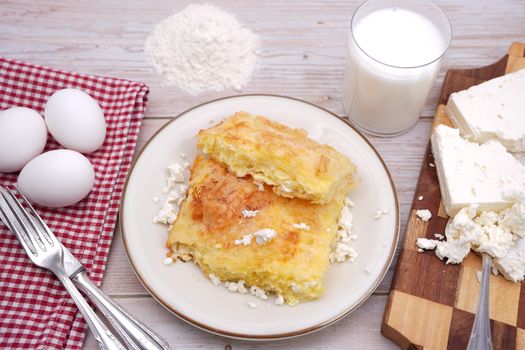
Gibanica is a traditional Serbian cheese and egg pastry that contains multiple animal-derived ingredients. Feta cheese and cottage cheese are dairy products (excluded by all vegan standards), eggs are an animal product (excluded by all vegan standards), and milk is a dairy product. Three distinct categories of animal ingredients are present, making this dish clearly and unambiguously non-vegan. A vegan version would require substituting all dairy with plant-based cheeses and milk alternatives, and replacing eggs with a flax or tofu-based binder.
Gibanica is fundamentally incompatible with the paleo diet. Phyllo dough is made from wheat flour, a grain explicitly excluded from paleo. Feta cheese and cottage cheese are dairy products, also excluded. Milk is dairy. Sunflower oil is a seed oil, one of the most clearly prohibited fats in paleo. While eggs are paleo-approved and sparkling water is neutral, the foundational ingredients — wheat-based dough, multiple dairy products, and a seed oil — place this dish firmly in the avoid category. There is no meaningful paleo adaptation possible without completely deconstructing and rebuilding the dish from scratch.
Gibanica is a Serbian cheese-and-egg pastry that contains several Mediterranean-compatible ingredients (eggs, dairy cheese) but also presents some concerns. Feta cheese is genuinely Mediterranean and widely used in Greek and Balkan cuisines within the Mediterranean framework. Eggs and dairy (cottage cheese, milk) are acceptable in moderation per Mediterranean guidelines. However, phyllo dough is a refined grain product, and sunflower oil is used instead of the preferred extra virgin olive oil. The dish is relatively high in saturated fat from multiple dairy sources and eggs combined. As an occasional breakfast it falls into the 'caution' zone — acceptable but not a staple, and the refined pastry shell and non-olive oil fat source pull it away from core Mediterranean principles.
Some Mediterranean diet scholars, particularly those focused on Eastern Mediterranean and Balkan traditions (which share culinary overlap with Greek and Turkish cuisines), would note that phyllo-based savory pies with cheese and eggs (like Greek tiropita or spanakopita) are traditional staples in these regions and can be considered part of the broader Mediterranean food culture, especially when prepared with olive oil rather than sunflower oil.
Gibanica is fundamentally incompatible with the carnivore diet. The dish is built on phyllo dough (wheat flour — a grain/plant product), which is a direct disqualifier. Additionally, sunflower oil is a plant-derived oil explicitly excluded from carnivore principles, and sparkling water mixed with plant ingredients adds no redemption. While feta cheese, cottage cheese, eggs, and milk are animal-derived ingredients that some carnivore practitioners include (with varying debate around dairy), the foundational structure of this dish — phyllo dough — makes it a plant-based pastry dish. No amount of animal-derived fillings rescues a dish whose primary vehicle is grain-based dough. This is a Serbian savory pastry, not an animal-based meal.
Gibanica contains multiple excluded ingredients that make it incompatible with Whole30. Phyllo dough is a grain-based product (wheat flour), which is explicitly excluded. Milk is dairy, which is excluded. Feta cheese and cottage cheese are also dairy products, excluded under Whole30 rules. Even if those were somehow addressed, phyllo dough alone disqualifies this dish entirely as a grain product. Additionally, gibanica is a savory pastry/pie, which would fall under the spirit-of-the-program rule against recreating baked goods and pastry-style dishes with compliant ingredients.
Gibanica contains multiple high-FODMAP ingredients that collectively make it unsuitable for the elimination phase. Phyllo dough is made from wheat flour, which is high in fructans — a primary FODMAP trigger. Cottage cheese is high in lactose and problematic at standard servings. Milk adds further lactose load. Feta cheese is lower in lactose than most dairy (aged/brined cheeses have reduced lactose), and eggs, sunflower oil, and sparkling water are all low-FODMAP. However, the combination of wheat-based phyllo and lactose-rich cottage cheese and milk creates significant FODMAP burden even at moderate portion sizes. During the strict elimination phase, this dish should be avoided.
Monash University rates feta cheese as low-FODMAP at 40g per serving due to low residual lactose, and some FODMAP practitioners acknowledge that small portions of Gibanica made with lactose-free dairy substitutes and gluten-free phyllo dough could theoretically be tolerated. However, traditional Gibanica as made with standard phyllo and cottage cheese cannot realistically be made low-FODMAP without substantial ingredient substitutions.
Gibanica is a traditional Serbian pastry made primarily of phyllo dough layered with a mixture of feta cheese, cottage cheese, eggs, milk, and sunflower oil. From a DASH perspective, this dish presents a mixed nutritional profile. The primary concern is sodium: feta cheese is notoriously high in sodium (roughly 316mg per ounce), and phyllo dough adds additional sodium. A typical serving of gibanica could easily contain 600-900mg or more of sodium, making it challenging to fit into both the standard DASH limit (<2,300mg/day) and especially the low-sodium DASH target (<1,500mg/day). Feta also contains saturated fat, which DASH limits. On the positive side, eggs and cottage cheese contribute protein and some calcium, sunflower oil is an unsaturated vegetable oil aligned with DASH principles, and milk adds calcium and potassium. The dish is not processed or full of added sugars. However, the high-sodium cheese combination and refined phyllo dough keep this firmly in the 'caution' category. Small portions may be acceptable occasionally, and using reduced-sodium feta or increasing the ratio of cottage cheese to feta would meaningfully improve the DASH compatibility.
NIH DASH guidelines explicitly limit full-sodium feta and refined grain pastries due to sodium and saturated fat concerns. However, some updated DASH-oriented clinicians note that cottage cheese dilutes the sodium load, eggs are now more liberally allowed under current dietary guidelines, and sunflower oil is a preferred fat — arguing that a moderate portion of gibanica within an otherwise compliant DASH day is acceptable, particularly if low-sodium feta is used.
Gibanica is a traditional Serbian cheese-and-egg pastry that has both Zone-friendly and Zone-problematic elements. On the positive side, the protein base is solid: feta cheese, cottage cheese, and eggs together provide substantial protein, with eggs being a lean Zone-favorable source and cottage cheese being commonly used in Zone meal planning. The fat content from cheese and eggs includes some acceptable saturated fat. However, phyllo dough is a refined, high-glycemic carbohydrate that Zone would classify as 'unfavorable' — it spikes insulin and provides little fiber. Sunflower oil is high in omega-6 fatty acids, which conflicts with Zone's anti-inflammatory emphasis on monounsaturated fats (olive oil would be preferred). The overall macro ratio of a typical gibanica skews heavily toward fat and refined carbs with a protein component, making it difficult to hit the 40/30/30 target without significant modification. Portion control is the key tool here — a small slice paired with a large low-GI vegetable side could bring the meal closer to Zone ratios, but the dish as traditionally prepared is not a natural Zone fit. The carb block from phyllo comes with minimal fiber, meaning net carb impact is high.
Some Zone practitioners following Sears' later writings (particularly 'The Mediterranean Zone') might give more latitude here given the egg and cheese protein density. If portion size is kept very small (a thin slice) and the meal is balanced with vegetables, the dish can technically be incorporated into a Zone plan. Additionally, feta and cottage cheese provide protein in blocks that are easy to measure. The issue is really the phyllo-to-filling ratio and the sunflower oil — modifying the recipe with olive oil and reducing phyllo layers would meaningfully improve Zone compatibility.
Gibanica is a traditional Serbian cheese pastry with a mixed anti-inflammatory profile. On the positive side, eggs provide choline and selenium with some anti-inflammatory potential, and fermented dairy like feta offers probiotics that may support gut health and reduce systemic inflammation. Cottage cheese is a moderate protein source without excessive saturated fat. However, the dish has several inflammatory concerns: phyllo dough is a refined carbohydrate with minimal fiber, which can spike blood glucose and promote inflammatory signaling. Feta and cottage cheese together contribute meaningful saturated fat and sodium. Most significantly, sunflower oil is high in omega-6 linoleic acid — anti-inflammatory frameworks consistently flag regular use of sunflower oil as problematic due to its potential to shift the omega-6:omega-3 ratio toward a pro-inflammatory state, especially when heated. The dish is also calorie-dense for breakfast with limited antioxidant or polyphenol content. Occasional consumption is acceptable, but it lacks the fiber, colorful vegetables, omega-3s, or functional spices that characterize anti-inflammatory eating. Substituting extra virgin olive oil for sunflower oil and adding herbs like thyme or rosemary would meaningfully improve its profile.
Mainstream nutrition science (AHA, many dietitians) considers sunflower oil acceptable as part of a balanced diet and views fermented dairy like feta as potentially beneficial for gut microbiome health — from this perspective, Gibanica is a moderate, culturally nutritious breakfast. Anti-inflammatory frameworks such as Dr. Weil's pyramid and IF Rating protocols, however, emphasize minimizing refined grains and high-omega-6 seed oils, making this dish less compatible with strict anti-inflammatory eating.
Gibanica is a traditional Serbian layered cheese pastry made with phyllo dough, feta, cottage cheese, eggs, milk, and sunflower oil. It delivers a reasonable protein contribution from the egg-and-cheese filling, but comes with several GLP-1-relevant drawbacks. The fat load is significant: feta is a high-sodium, moderate-to-high-fat cheese, the dish uses added sunflower oil throughout, and phyllo layers absorb oil during baking. A typical serving can carry 15–25g of fat, which risks worsening GLP-1 side effects such as nausea, bloating, and reflux due to slowed gastric emptying. Sparkling water in the batter introduces minimal carbonation concern in the final baked product, but is not a meaningful issue once baked off. On the positive side, cottage cheese contributes protein and is easy to digest; eggs add protein and micronutrients; and the dish is not fried, spicy, or high in added sugar. Fiber content is negligible (refined phyllo dough). Nutrient density per calorie is moderate at best. Portion size matters considerably — a small slice (60–80g) can fit into a GLP-1 diet as an occasional breakfast item if paired with a high-fiber side, but a standard Serbian serving is substantially larger and would tip the fat and calorie load into problematic territory for GLP-1 patients.
Some GLP-1-focused dietitians may view the egg-and-cottage-cheese base favorably as a culturally appropriate protein source, particularly for patients who struggle with appetite and need calorie-dense foods in small portions; others would flag the combined fat from feta and oil as a reliable nausea trigger and recommend avoiding it entirely during dose escalation phases when GI side effects peak.
*See how scores were generated at our methodology page.
Nutritional profile
Six traits that cut across every diet.
Fiber & Plants
How much whole-plant food and fiber it delivers.
Healthy Fats
The quality of its fats (unsaturated, omega-3).
Whole / Unprocessed
How close it is to its natural, unprocessed form.
Gut Gentle
How easy it is on digestion (low FODMAP, few irritants).
Low Glycemic
How little it spikes your blood sugar.
Protein Density
How much protein it packs per calorie.
Controversy Index
Higher controversy = more disagreement between diets.
Diet-Specific Tips
 Mediterranean — 5/10
View tips
- Feta cheese is a traditional Mediterranean ingredient and a positive factor
- Eggs and dairy are acceptable in moderate amounts per Mediterranean guidelines
- Phyllo dough is a refined grain, not a whole grain — a moderate negative
- Sunflower oil used instead of extra virgin olive oil, which is the preferred fat
- High saturated fat load from combining feta, cottage cheese, eggs, and milk
- No vegetables included, missing plant-forward Mediterranean emphasis
- Savory cheese pastry is more of an occasional treat than a daily staple
 DASH — 4/10
View tips
- High sodium from feta cheese (main concern for DASH compliance)
- Phyllo dough is a refined grain, not a whole grain as DASH prefers
- Saturated fat from feta cheese limits DASH score
- Sunflower oil is a DASH-approved unsaturated vegetable oil
- Cottage cheese and eggs provide protein and some DASH-friendly nutrients
- Milk contributes calcium and potassium aligned with DASH goals
- Portion control is critical — a small serving is more DASH-compatible
- Low-sodium feta substitution would significantly improve DASH score
 Zone — 4/10
View tips
- Phyllo dough is a refined, high-glycemic carbohydrate classified as 'unfavorable' in Zone terminology
- Feta cheese and cottage cheese provide useful protein blocks but also carry saturated fat
- Eggs are a Zone-favorable lean protein source that improves the dish's profile
- Sunflower oil is high in omega-6 fatty acids, conflicting with Zone's anti-inflammatory fat guidance
- Macro ratio skews toward fat and refined carbs rather than the 40/30/30 Zone target
- Small portion with vegetable side could make this workable but requires deliberate balancing
- No low-GI vegetables or favorable carbohydrates present in the dish
 Anti-Inflammatory — 4/10
View tips
- Sunflower oil: high omega-6 content, pro-inflammatory when used regularly or heated
- Phyllo dough: refined carbohydrate, minimal fiber, glycemic concern
- Feta cheese: moderate saturated fat, but fermented with potential probiotic benefit
- Eggs: moderate anti-inflammatory nutrients (choline, selenium), mixed overall profile
- Cottage cheese: lower-fat dairy, more neutral inflammatory profile
- No anti-inflammatory spices, colorful vegetables, or omega-3 sources present
- High sodium content from feta and cottage cheese
 GLP-1 Friendly — 4/10
View tips
- Moderate protein from cottage cheese, feta, and eggs — positive
- High fat per serving from feta, sunflower oil, and phyllo — negative for GI side effects
- Negligible dietary fiber — missed opportunity given GLP-1 constipation risk
- Refined phyllo dough contributes empty carbohydrate calories with low nutrient density
- Not fried or spicy — mitigates some concern
- Portion-sensitive: small slice may be tolerable, standard serving likely problematic
- Sparkling water in batter is baked off and not a functional concern in the final dish