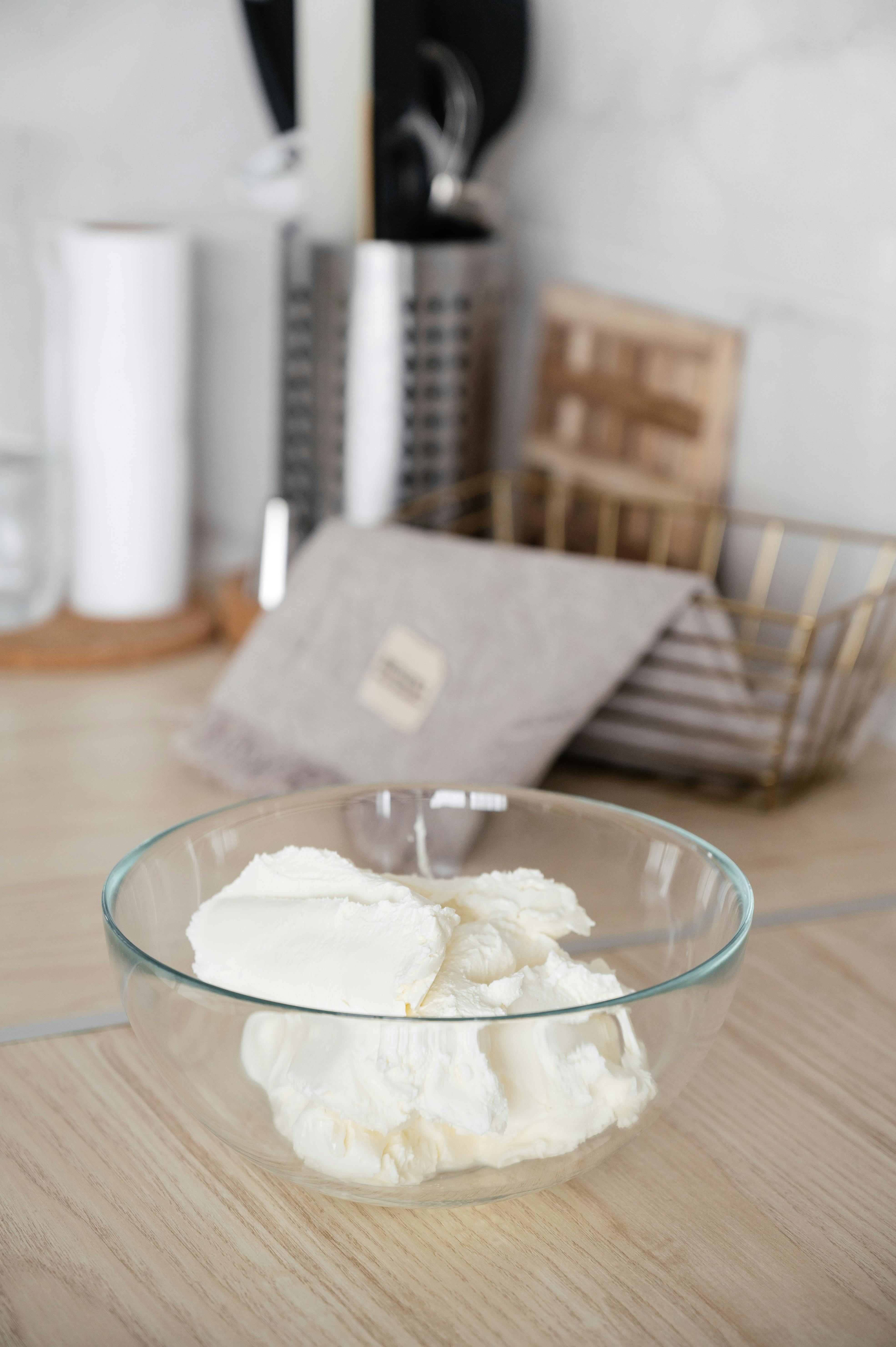
Photo: SHVETS production / Pexels
The diets react (see scores below)
Common Ingredients
- unpasteurized milk
- cream
- salt
- butterfat
- water
Specific recipes may vary.
Incompatible with 7 of 11 diets
Diet Ratings
Kajmak is a traditional Serbian clotted cream/dairy spread made primarily from unpasteurized milk fat, cream, salt, and butterfat. It is essentially a high-fat dairy product similar to clotted cream or crème fraîche, with minimal net carbs (typically under 1-2g per serving). Its macronutrient profile — very high fat, moderate protein, negligible carbohydrates — fits well within ketogenic diet parameters. As a condiment used in small-to-moderate portions, it poses little risk of disrupting ketosis for most practitioners.
Strict or clinical keto protocols, as well as carnivore-adjacent keto practitioners who monitor insulin response closely, may flag full-fat dairy like kajmak due to its dairy protein content (casein and whey) potentially triggering an insulinogenic response disproportionate to its carb content. Some also raise concerns about the use of unpasteurized milk as a base, which while natural and whole, contains trace lactose that could add up with generous servings.
Kajmak is a traditional Serbian dairy product made by skimming the creamy layer off unpasteurized milk. Its ingredients — unpasteurized milk, cream, butterfat, and water — are entirely animal-derived. Dairy is a core excluded category in veganism, making kajmak unequivocally non-vegan. There is no plant-based version of this product in its traditional form, and no meaningful debate exists within the vegan community about its status.
Kajmak is a traditional Serbian clotted cream/dairy spread made from unpasteurized milk and cream, with added salt. Dairy products are excluded from the Paleolithic diet on the grounds that large-scale animal domestication and milking were post-Paleolithic developments. Unlike ghee — which removes casein and lactose through clarification — kajmak retains the full dairy matrix including milk proteins, lactose, and fat together. Additionally, it contains added salt, which is explicitly excluded under paleo rules. These two factors (whole dairy + added salt) place it firmly in the avoid category with high confidence.
Kajmak is a traditional Serbian clotted cream/dairy spread made from unpasteurized milk and cream with high butterfat content. As a full-fat dairy product, it sits in the 'moderate' category of Mediterranean diet principles — dairy is acceptable but not a cornerstone food. The very high butterfat content (similar to clotted cream or butter) pushes it toward the lower end of the caution range, as Mediterranean dairy is more typically represented by fermented, lower-fat options like yogurt, feta, or aged cheeses rather than high-fat cream concentrates. Used sparingly as a condiment, it can fit within the diet, but its richness and saturated fat load mean it should not be a daily staple.
Some Mediterranean diet scholars note that full-fat traditional dairy products from pasture-raised animals have been part of Balkan and Eastern Mediterranean food culture for centuries, and that the food matrix of whole dairy (including fermented raw milk products) may confer metabolic benefits not captured by saturated fat content alone. Traditional Balkan dietary patterns that include kajmak in small amounts alongside abundant vegetables and legumes are not necessarily at odds with Mediterranean principles.
Kajmak is a traditional Serbian clotted cream/dairy spread made from unpasteurized milk, cream, salt, butterfat, and water — essentially a high-fat, minimally processed raw dairy product. It is entirely animal-derived with no plant-based additives, making it acceptable within the broader carnivore framework. Its high butterfat content and raw/unpasteurized nature are actually favored by many carnivore practitioners who include dairy, as raw dairy retains enzymes and is considered less processed. However, dairy as a category remains the single most contested food in the carnivore community, splitting practitioners significantly.
Strict carnivore adherents following a 'meat-only' or Lion Diet protocol (as championed by Mikhaila Peterson and Sean Baker in his stricter guidance) exclude all dairy, including high-fat options like kajmak, citing potential inflammatory responses, lactose intolerance issues, and the argument that dairy is not essential on a carnivore diet. Conversely, Paul Saladino's 'animal-based' approach and raw dairy advocates would view kajmak's unpasteurized, high-fat profile as an ideal carnivore-friendly food.
Kajmak is a traditional Serbian dairy product made from unpasteurized milk and cream — it is essentially a fresh, unclarified dairy product. Whole30 excludes all dairy except ghee and clarified butter. Kajmak is neither ghee nor clarified butter; it is a fresh cream cheese/clotted cream-style product that retains milk solids, proteins, and lactose. Despite its simple ingredient list (milk, cream, salt, butterfat, water), it falls squarely in the excluded dairy category. No compliant version exists — the product itself is dairy by definition.
Kajmak is a traditional Serbian clotted cream product made primarily from the fat layer of heated unpasteurized milk. Its FODMAP status depends heavily on its fat-to-lactose ratio. Because kajmak is essentially a high-fat, cream-skimmed product, it is naturally low in lactose — lactose resides in the watery whey portion, not the fat. However, kajmak is not pure butterfat like ghee; it retains some water and milk solids, meaning residual lactose is present. Fresh (young) kajmak contains more moisture and thus more lactose, while aged kajmak is drier and lower in lactose. Monash University has not specifically tested kajmak. By analogy, Monash rates regular cream as low-FODMAP at 2 tablespoons (40g) due to low lactose content at that serving. A typical condiment serving of kajmak (1-2 tbsp) is likely low-FODMAP, but larger servings or fresh/young varieties with higher moisture content could contribute meaningful lactose. The unpasteurized nature does not affect FODMAP content. Caution is warranted due to variability in moisture/lactose content between fresh and aged versions and the absence of specific Monash testing.
Monash University has not specifically tested kajmak, so its rating is extrapolated from analogous high-fat dairy products like cream and crème fraîche. Some clinical FODMAP practitioners may advise avoiding any unclarified milk-derived product during strict elimination due to unpredictable residual lactose, particularly with fresh (young) kajmak which retains significantly more moisture than aged versions.
Kajmak is a traditional Serbian clotted cream product made primarily from full-fat unpasteurized milk and cream, resulting in an extremely high butterfat content (typically 60-70% fat, predominantly saturated). This directly conflicts with core DASH diet principles, which explicitly limit saturated fat and specify fat-free or low-fat dairy products. The DASH eating plan is built around reducing cardiovascular risk, and kajmak's saturated fat profile is antithetical to this goal. Additionally, salt is added during preparation, contributing sodium. As a full-fat dairy condiment used as a spread or topping, it occupies the category of foods DASH guidelines specifically advise against, similar to butter, cream, and full-fat cheese. The unpasteurized nature adds a food safety concern as a secondary issue.
Kajmak is a traditional Serbian clotted cream/fresh cheese made from unpasteurized milk and cream, with a very high fat content (primarily saturated butterfat) and minimal protein or carbohydrates. From a Zone Diet perspective, it functions almost exclusively as a fat block, but it's predominantly saturated fat rather than the monounsaturated fats (olive oil, avocado, almonds) that Dr. Sears favors. Early Zone writings strictly limited saturated fat due to its pro-inflammatory potential, though Sears' later anti-inflammatory work (Toxic Fat, The Mediterranean Zone) has nuanced this position somewhat. As a condiment used in small quantities, kajmak can technically fit into a Zone meal's fat block allocation (1 fat block = 1.5g fat for animal-protein meals), but the saturated fat profile and very small protein contribution make it an 'unfavorable' fat choice. It's not categorically excluded — the Zone is ratio-based — but it should replace, not supplement, other fat blocks and be used sparingly. It offers no meaningful protein or carbohydrate blocks, limiting its utility as a Zone building block.
Later Zone writings and the Mediterranean Zone framework take a somewhat softer stance on full-fat dairy and saturated fat, acknowledging that traditional dairy foods consumed in moderation may not be as harmful as once thought. Some Zone practitioners would argue that a small dollop of kajmak as a fat block is acceptable within a well-constructed Zone meal, especially given its traditional, minimally processed nature and the absence of trans fats or industrial seed oils.
Kajmak is a traditional Serbian clotted cream product made by skimming and layering the fat that rises when raw milk is slowly heated and cooled. It is extremely high in saturated fat and butterfat — essentially a full-fat dairy concentrate similar to clotted cream or crème fraîche but richer. Anti-inflammatory guidelines consistently flag full-fat dairy and high saturated fat intake as foods to limit or avoid, as saturated fat can promote pro-inflammatory signaling (upregulating NF-κB pathways, increasing arachidonic acid precursors). Kajmak has virtually no mitigating anti-inflammatory properties — it lacks meaningful omega-3s, polyphenols, fiber, or antioxidants. The use of unpasteurized (raw) milk is a separate food safety consideration but doesn't meaningfully alter the inflammatory profile. As a condiment it would typically be consumed in modest amounts, which slightly tempers the score, but its core nutritional profile places it firmly in the 'limit/avoid' category under anti-inflammatory principles. It is analogous to butter or heavy cream in its inflammatory potential.
Some traditional food and ancestral diet advocates (e.g., Weston A. Price Foundation) argue that raw, full-fat dairy from grass-fed animals contains beneficial fat-soluble vitamins (A, D, K2), conjugated linoleic acid (CLA), and butyrate, which may have anti-inflammatory properties and support gut health — a view not reflected in mainstream anti-inflammatory frameworks like Dr. Weil's pyramid, which emphasizes low-fat dairy and limits full-fat versions.
Kajmak is a traditional Serbian clotted cream condiment made primarily from butterfat and cream skimmed from unpasteurized milk. It is essentially a high-fat dairy spread with very little protein relative to its calorie density, minimal fiber, and a saturated fat content comparable to butter or crème fraîche. A typical 2-tablespoon serving delivers roughly 100–130 calories, 10–13g of fat (mostly saturated), fewer than 2g of protein, and negligible fiber. This profile conflicts directly with GLP-1 dietary priorities on multiple fronts: high saturated fat worsens nausea, bloating, and reflux — the most common GLP-1 side effects — because fat significantly delays gastric emptying further on top of the medication's own effect. Its calorie density per gram of nutritional payoff is poor, making it an empty-calorie risk in a patient population where every bite must be nutritionally justified. The use of unpasteurized milk also introduces a food safety consideration that is generally advised against in immunocompromised or metabolically vulnerable populations. As a condiment it is portion-sensitive, but even small portions contribute meaningful saturated fat with negligible protein or fiber return.
Some GLP-1-focused dietitians who take a permissive, culturally sensitive approach argue that small amounts of traditional high-fat condiments like kajmak can be accommodated if they enhance palatability and support dietary adherence in patients who would otherwise undereat. However, most obesity medicine RDs would flag the high saturated fat and negligible protein-per-calorie ratio as disqualifying for regular use, particularly in the early high-side-effect phase of GLP-1 therapy.
*See how scores were generated at our methodology page.
Nutritional profile
Six traits that cut across every diet.
Fiber & Plants
How much whole-plant food and fiber it delivers.
Healthy Fats
The quality of its fats (unsaturated, omega-3).
Whole / Unprocessed
How close it is to its natural, unprocessed form.
Gut Gentle
How easy it is on digestion (low FODMAP, few irritants).
Low Glycemic
How little it spikes your blood sugar.
Protein Density
How much protein it packs per calorie.
Controversy Index
Higher controversy = more disagreement between diets.
Diet-Specific Tips
 Keto — 8/10
View tips
- Very high fat content from cream and butterfat — aligns with 70-80% fat keto target
- Negligible net carbs per standard serving (under 2g)
- Minimal ingredients — whole, unprocessed, no added sugars or grains
- Dairy protein (casein/whey) may cause insulin response in sensitive individuals
- Unpasteurized base is more natural but contains trace lactose
- Used as a condiment, so portion sizes are typically small, limiting carb exposure
 Mediterranean — 4/10
View tips
- Very high butterfat content — closer to butter/clotted cream than standard dairy
- Not a core Mediterranean food; dairy is peripheral and used in moderation
- Unpasteurized, traditionally made — a whole, minimally processed food
- No added sugars or refined ingredients, which is a positive factor
- Should be used sparingly as a condiment, not as a primary fat source
- Mediterranean diet favors olive oil as the primary fat over high-fat dairy spreads
 Carnivore — 5/10
View tips
- 100% animal-derived ingredients — no plant additives
- High butterfat content aligns with carnivore preference for animal fats
- Unpasteurized/raw dairy is favored by many carnivore dairy advocates
- Dairy is the most debated food category in the carnivore community
- Contains water and trace lactose — minimal concern for most practitioners
- Minimally processed traditional preparation method
 Zone — 4/10
View tips
- Extremely high saturated fat content — not the monounsaturated fat preferred in Zone methodology
- Functions almost entirely as a fat block with negligible protein or carbohydrate contribution
- Small condiment portions could fit within fat block allocation (1.5g fat per block for animal protein meals)
- No omega-3 benefit; saturated fat profile is mildly pro-inflammatory per Sears' framework
- Not processed with seed oils or trans fats — a point in its favor vs. margarine or processed spreads
- Unpasteurized status is a food safety consideration but not a Zone-specific concern