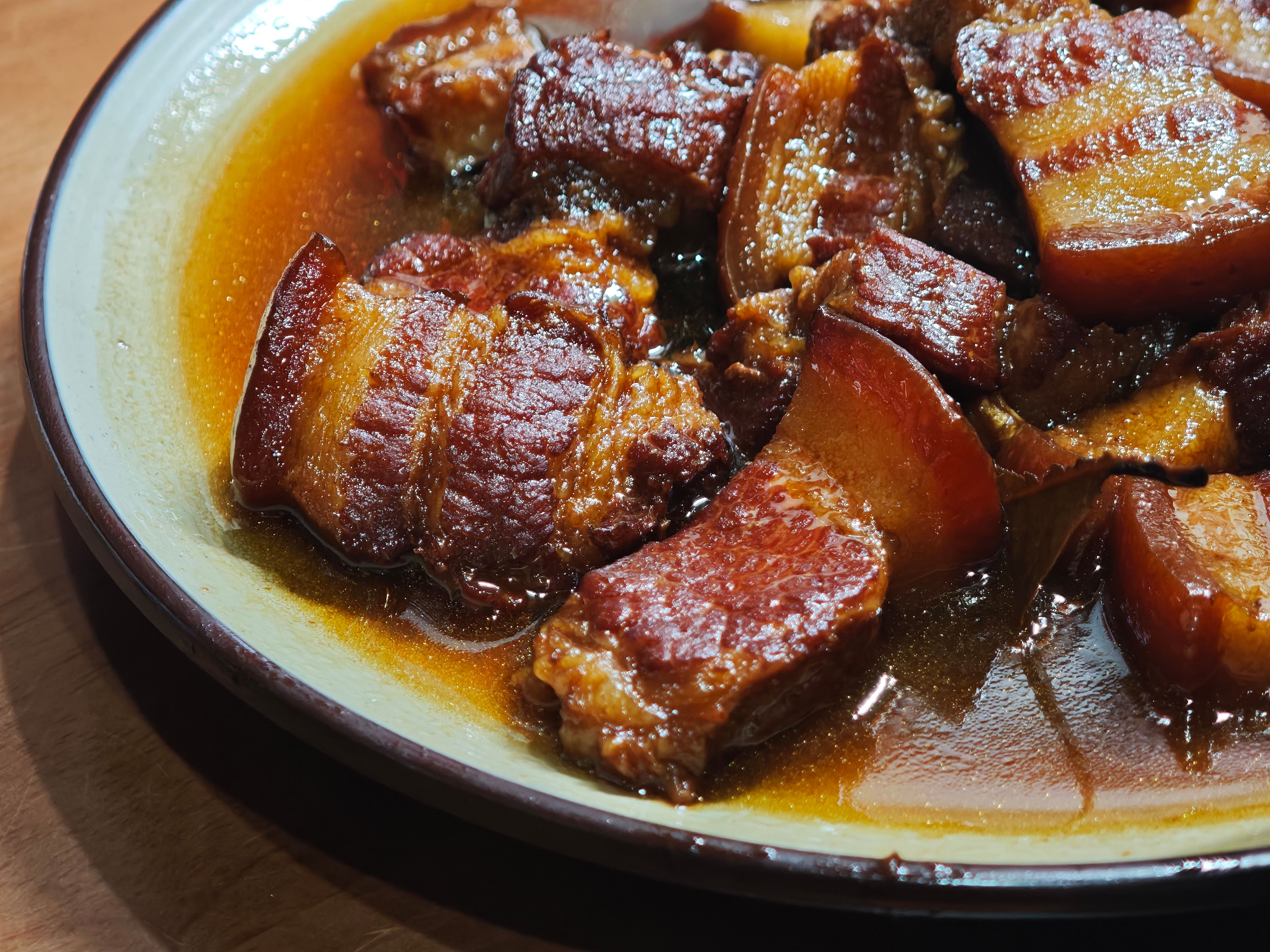
Photo: Vietnam Hidden Light / Pexels
Chinese
Braised Pork Belly with Egg
The diets react (see scores below)
Common Ingredients
- pork belly
- eggs
- soy sauce
- rock sugar
- shaoxing wine
- ginger
- scallions
- star anise
Specific recipes may vary.
Incompatible with 9 of 11 diets
Diet Ratings
Braised Pork Belly with Egg (Hong Shao Rou style) has a keto-friendly protein base — pork belly is high in fat and moderate in protein, and eggs are excellent keto foods. However, the traditional braising liquid is a significant problem: rock sugar is a primary flavoring agent contributing substantial added sugar, and Shaoxing wine adds additional carbohydrates. Soy sauce adds minor carbs. The dish is typically braised for an extended time, meaning the pork and eggs absorb considerable sugar from the sauce. A standard restaurant serving could easily contain 15-25g of net carbs from sugar alone, putting ketosis at risk depending on portion size and cook's ratios. The dish is not inherently incompatible — the base ingredients are keto-friendly — but the traditional preparation method makes it a cautious choice requiring significant recipe modification (eliminating rock sugar, substituting or omitting Shaoxing wine) to be truly keto-safe.
Braised Pork Belly with Egg contains two direct animal products — pork belly (meat) and eggs — both of which are categorically excluded from a vegan diet. There is no ambiguity here: this dish is fundamentally built around animal flesh and animal reproductive products. The remaining ingredients (soy sauce, rock sugar, Shaoxing wine, ginger, scallions, star anise) are plant-based, but they cannot offset the presence of core animal ingredients.
This classic Chinese braised pork dish contains multiple non-paleo ingredients that disqualify it. Soy sauce is a fermented soy and wheat product — both legumes and grains are strictly excluded from the paleo diet. Rock sugar is a refined/processed sugar, also excluded. Shaoxing wine is a grain-based rice wine, placing it firmly in the grain-derived category. While pork belly, eggs, ginger, scallions, and star anise are all paleo-approved, the foundational braising liquid is built on soy sauce and rock sugar, which are core to the dish's character and cannot be considered incidental. The dish cannot be meaningfully evaluated without these ingredients, making it a clear avoid.
Braised Pork Belly with Egg is highly incompatible with Mediterranean diet principles. Pork belly is one of the fattiest cuts of red meat, high in saturated fat, and red meat is restricted to only a few times per month in the Mediterranean diet. The dish is also braised with rock sugar (added sugar) and soy sauce (high sodium, processed condiment), both of which conflict with Mediterranean guidelines. There is no olive oil, no vegetables emphasized, no legumes or whole grains, and the overall dish structure is centered on fatty red meat and sugar — the opposite of a plant-forward, whole-food Mediterranean approach. Eggs do provide some nutritional value and are acceptable in moderation, but they cannot redeem the dish's core issues.
While the dish contains carnivore-approved base ingredients (pork belly and eggs), it is heavily laden with plant-derived and non-carnivore ingredients that disqualify it entirely. Soy sauce is a fermented soybean product — a legume — and is strictly excluded. Rock sugar is pure plant-derived sugar, completely off the carnivore list. Shaoxing wine is a grain-based alcohol with added sugar, also excluded. Ginger, scallions, and star anise are all plant foods (root, allium, and spice respectively), none of which are permitted on a carnivore diet. This dish is fundamentally a plant-seasoned, sugar-braised preparation that happens to contain meat — it cannot be adapted to carnivore without being an entirely different dish.
This dish contains three excluded ingredients: (1) soy sauce, which is made from soy (a legume) and often wheat (a grain), both of which are explicitly excluded on Whole30; (2) rock sugar, which is an added sugar and therefore excluded; and (3) Shaoxing wine, which is an alcoholic beverage and therefore excluded. Coconut aminos could substitute for soy sauce, but rock sugar and Shaoxing wine have no compliant direct substitutes in this traditional recipe. As commonly prepared, this dish is firmly non-compliant.
Braised Pork Belly with Egg contains several high-FODMAP ingredients that make it problematic during the elimination phase. Scallions (green onions) are high in fructans in their white bulb portions, which are commonly used in Chinese braising. Star anise is high in FODMAPs and should be avoided. Shaoxing wine is fermented and contains FODMAPs in typical cooking quantities. Rock sugar itself is sucrose and low-FODMAP, but the combination of problematic aromatics makes this dish difficult to rate as safe. The core proteins — pork belly and eggs — are naturally low-FODMAP, and soy sauce in small amounts (1 tablespoon) is generally low-FODMAP. Ginger in typical cooking quantities is low-FODMAP. However, the scallion bulbs and star anise are the critical problem ingredients in a traditional recipe. If the dish were modified to use only scallion green tops, omit star anise, and limit Shaoxing wine, it could potentially be made low-FODMAP — but as traditionally prepared, it should be avoided during elimination.
Monash University rates scallion green tops as low-FODMAP (the white bulb portion is high in fructans), and some clinical FODMAP practitioners suggest that if only green tops are used and star anise is omitted, this dish could be consumed cautiously. However, most practitioners advise avoiding traditional braised preparations during elimination due to the difficulty of controlling which parts of aromatics are used and how much FODMAP content leaches into the braising liquid.
Braised Pork Belly with Egg is fundamentally incompatible with DASH diet principles across multiple dimensions. Pork belly is one of the fattiest cuts of meat available, extremely high in saturated fat and total fat — directly contradicting DASH's explicit guidance to limit saturated fat and avoid fatty red/processed meats. Soy sauce, a central ingredient used in significant quantity in this dish, is extremely high in sodium (roughly 900-1,000mg per tablespoon), making it nearly impossible to keep this dish within DASH's 1,500–2,300mg daily sodium limit in a realistic serving. Rock sugar adds significant refined sugar, which DASH advises limiting. Shaoxing wine contributes additional sodium and alcohol. The combination of high saturated fat from pork belly plus high sodium from soy sauce represents a dual violation of the two most critical DASH restrictions. While ginger, scallions, and star anise are DASH-friendly aromatics, they cannot offset the core nutritional profile of this dish.
Braised Pork Belly with Egg is a challenging dish for the Zone Diet on multiple fronts. Pork belly is one of the fattiest cuts of pork available, with a roughly 50/50 split of fat to protein by calories, and that fat is predominantly saturated — the opposite of the monounsaturated fats Sears recommends. A typical 3-4 oz serving of pork belly can deliver 35-45g of fat, far exceeding the Zone's 10-15g per meal target and completely distorting the 30/30/40 macro ratio. Rock sugar adds a glycemic load with no nutritional benefit, further pushing the dish toward Zone-unfavorable territory. The braising liquid (soy sauce, rock sugar, Shaoxing wine) is relatively high in sodium and simple carbohydrates. The eggs are a positive element — they provide moderate-quality protein with some fat — but they cannot offset the macro imbalance created by the pork belly. The aromatics (ginger, scallions, star anise) are favorable Zone ingredients. Technically, a very small portion of pork belly could be incorporated into a Zone meal, but the dish as traditionally prepared makes Zone-compliant portioning extremely difficult and would require substantial accompaniment with lean protein and low-GI vegetables to approximate balance.
Some Zone practitioners and later Sears anti-inflammatory writings take a slightly more relaxed view of saturated fat, noting that in the context of an overall low-insulin diet, moderate saturated fat is less harmful than previously thought. Under this interpretation, a small portion of pork belly alongside a large serving of low-GI vegetables could be viewed as a 'caution' rather than near-avoid. However, the rock sugar and the sheer fat density of pork belly make this a difficult case even under the more lenient reading.
Braised Pork Belly with Egg is dominated by pork belly, one of the highest-fat cuts of red meat available, with exceptionally high levels of saturated fat. Anti-inflammatory dietary guidelines consistently place fatty red meat and full-fat pork products in the 'limit' to 'avoid' category due to their association with elevated inflammatory markers (CRP, IL-6) and arachidonic acid content. The braising method renders additional fat into the dish rather than allowing it to drain away, concentrating the saturated fat load. Rock sugar adds significant refined sugar, which independently promotes inflammation. Soy sauce contributes high sodium. On the positive side, the dish includes genuinely beneficial anti-inflammatory aromatics — ginger, scallions, star anise, and Shaoxing wine — which contain antioxidants and polyphenols. Eggs are a moderate-tier protein with mixed inflammatory signaling. However, these beneficial components are far outweighed by the dominant ingredient: a large quantity of high-saturated-fat pork belly. This dish is not a borderline case; pork belly as a primary protein with added sugar places it firmly in the 'avoid' tier for anti-inflammatory eating.
Braised Pork Belly with Egg is a poor choice for GLP-1 patients. Pork belly is one of the fattiest cuts of meat available, with a typical serving (3-4 oz) delivering 35-45g of fat, the majority of which is saturated. This directly worsens GLP-1 side effects including nausea, bloating, and reflux due to slowed gastric emptying — high-fat foods sit in the stomach far longer and significantly amplify GI distress. Rock sugar adds empty calories and contributes to glycemic load with minimal nutritional return. The Shaoxing wine adds alcohol calories. While the braised eggs contribute modest protein, and soy sauce, ginger, star anise, and scallions are benign or mildly beneficial, they cannot offset the core problem: this dish is built around pork belly, a protein source so high in fat that it is essentially counterproductive for GLP-1 patients on every relevant dimension — fat content, digestibility, saturated fat load, and caloric density per gram of protein delivered.
*See how scores were generated at our methodology page.
Nutritional profile
Six traits that cut across every diet.
Fiber & Plants
How much whole-plant food and fiber it delivers.
Healthy Fats
The quality of its fats (unsaturated, omega-3).
Whole / Unprocessed
How close it is to its natural, unprocessed form.
Gut Gentle
How easy it is on digestion (low FODMAP, few irritants).
Low Glycemic
How little it spikes your blood sugar.
Protein Density
How much protein it packs per calorie.
Controversy Index
Higher controversy = more disagreement between diets.
Diet-Specific Tips
 Keto — 4/10
View tips
- Pork belly is high-fat and ideal for keto macros
- Eggs are a perfect keto food
- Rock sugar is a core ingredient adding significant net carbs
- Shaoxing wine contributes additional carbohydrates
- Braising concentrates and infuses sugar into the meat and eggs
- Standard serving likely exceeds or significantly impacts daily carb budget
- Recipe modification (removing sugar) could shift this toward approve territory
 Zone — 5/10
View tips
- Pork belly is extremely high in saturated fat, far exceeding Zone fat block targets
- Rock sugar adds glycemic load with no nutritional value — an unfavorable Zone carbohydrate
- Macro ratio is severely skewed toward fat, undermining the 40/30/30 balance
- Eggs are a positive Zone-compatible protein component
- Aromatics (ginger, scallions, star anise) are Zone-favorable anti-inflammatory ingredients
- Shaoxing wine and soy sauce add minimal carbs/sodium but are manageable in small quantities
- Portion control would need to be extreme to approach Zone compliance, making this dish impractical