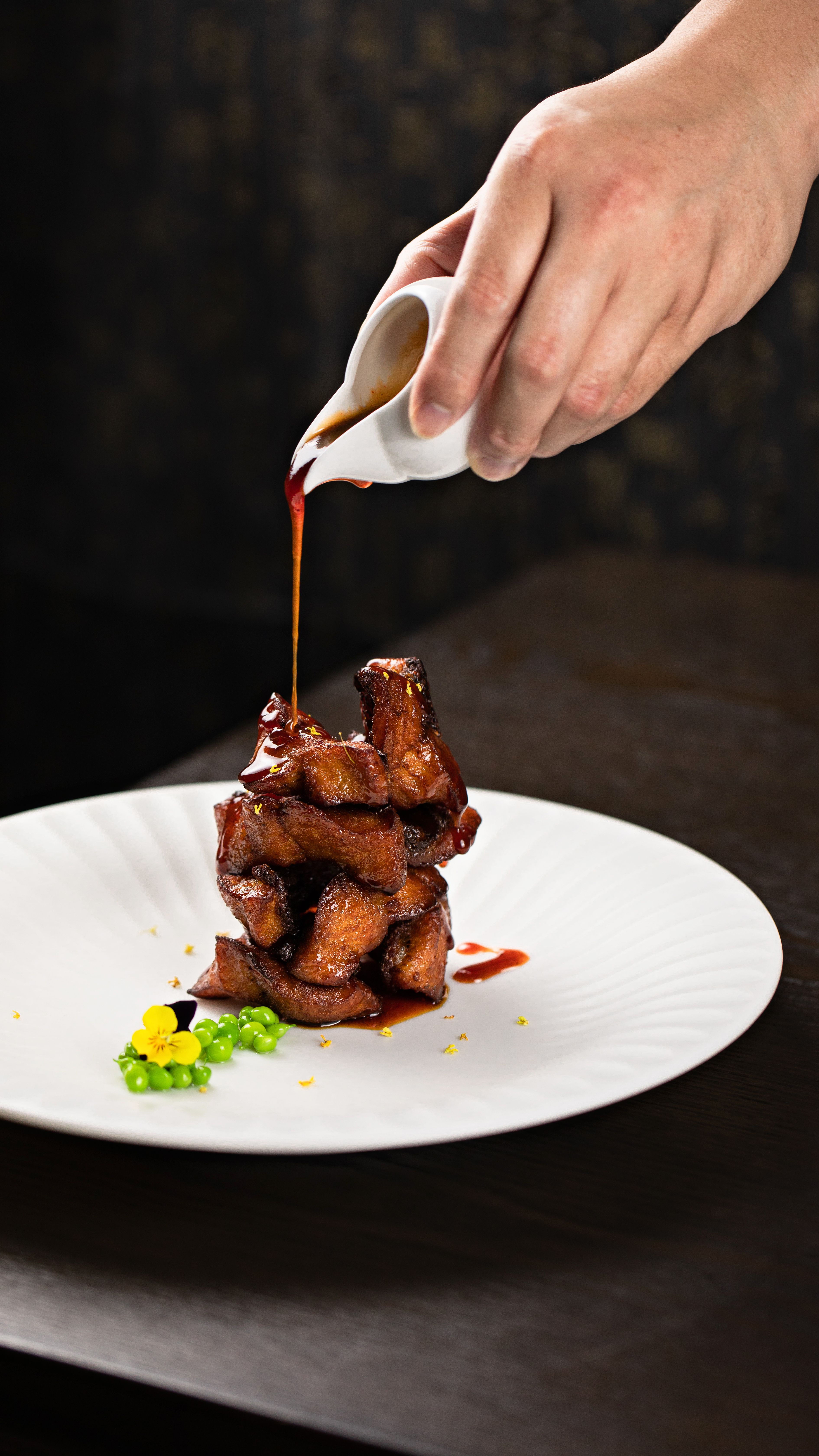
Photo: Change C.C / Pexels
Chinese
Hong Shao Rou
The diets react (see scores below)
Common Ingredients
- pork belly
- soy sauce
- rock sugar
- shaoxing wine
- ginger
- scallions
- star anise
- cinnamon
Specific recipes may vary.
Incompatible with 11 of 11 diets
Diet Ratings
Hong Shao Rou (Red Braised Pork Belly) is fundamentally incompatible with a ketogenic diet in its traditional form. While pork belly itself is an excellent keto protein and fat source, the dish relies heavily on rock sugar as a core braising ingredient, which is pure sucrose and directly raises blood glucose, breaking ketosis. Shaoxing wine also contributes additional sugars and carbohydrates to the braising liquid. Soy sauce adds minor carbs but is not the primary concern. The combination of rock sugar and Shaoxing wine in a reduced braising sauce concentrates these sugars significantly, making a standard serving likely to contain 15–25g or more of net carbs — easily pushing a single dish over or near the daily keto limit. The spices (ginger, scallions, star anise, cinnamon) and pork belly itself are keto-friendly, but the dish cannot be considered keto-compatible as traditionally prepared.
Hong Shao Rou (Red-Braised Pork Belly) is a classic Chinese dish built around pork belly as its central ingredient. Pork is an animal flesh product, making this dish entirely incompatible with a vegan diet. There is no ambiguity here — no vegan framework or organization permits the consumption of pork or any other animal flesh.
Hong Shao Rou (Red-Braised Pork Belly) contains multiple non-paleo ingredients that make it incompatible with the diet. Soy sauce is a fermented soy product — a legume derivative — and is excluded from paleo. Rock sugar is a refined sugar, also excluded. Shaoxing wine is a grain-based alcohol (fermented rice), compounding the issue. The pork belly itself and the aromatics (ginger, scallions, star anise, cinnamon) are paleo-approved, but the dish's defining sauce and sweetener are clear paleo violations. This is not a gray area: soy and refined sugar are unambiguously excluded by all mainstream paleo frameworks.
Hong Shao Rou (Red-Braised Pork Belly) is fundamentally at odds with Mediterranean diet principles. Pork belly is one of the fattiest cuts of red meat, extremely high in saturated fat, and red meat is limited to just a few times per month in the Mediterranean diet. The dish is also heavily sweetened with rock sugar, adding significant refined/added sugars. There is no olive oil, no vegetables of substance, no legumes, and no whole grains involved. The flavor base of soy sauce and shaoxing wine, while not unhealthy per se, is far outside the Mediterranean culinary tradition. The combination of high saturated fat from pork belly and added sugar makes this a dish that directly contradicts the core tenets of the Mediterranean dietary pattern.
Hong Shao Rou (Red-Braised Pork Belly) is heavily incompatible with the carnivore diet despite its animal protein base. While pork belly itself is an excellent carnivore food — a fatty, nutrient-dense cut — the traditional recipe is loaded with plant-derived and processed ingredients that are entirely excluded from the carnivore framework. Rock sugar (plant-derived sweetener), soy sauce (fermented soy/wheat), Shaoxing wine (fermented grain alcohol), ginger (root vegetable), scallions (plant), star anise (spice), and cinnamon (spice) all violate the core carnivore principle of eating exclusively animal products. The sugar and soy sauce alone make this a clear avoid, as they represent processed plant foods and sweeteners. This is not a borderline case — the dish is fundamentally defined by its plant-based braising sauce.
Hong Shao Rou (Red-Braised Pork Belly) contains multiple excluded ingredients. Soy sauce is a soy product and is explicitly excluded from Whole30 (coconut aminos can substitute but soy sauce itself is not allowed). Rock sugar is an added sugar, which is explicitly excluded. Shaoxing wine is an alcoholic beverage (rice wine), which is also excluded. Three core ingredients violate Whole30 rules, making this dish clearly non-compliant in its traditional form.
Hong Shao Rou (Red-Braised Pork Belly) contains multiple high-FODMAP ingredients that make it unsuitable during the elimination phase. Scallions (green onions) are a significant concern — the white bulb portions are high in fructans and are typically used in this dish; even the green tops should be limited. Shaoxing rice wine can contain FODMAPs depending on fermentation residues. More critically, star anise is high-FODMAP at culinary doses used in braising (Monash rates it as high-FODMAP at amounts commonly used in cooking). Soy sauce in small amounts is generally low-FODMAP, rock sugar and ginger are acceptable at standard doses, and pork belly itself is FODMAP-free. However, the combination of scallion bulbs, star anise at braising quantities, and the concentrated braising sauce (which accumulates FODMAPs from multiple ingredients during long cooking) makes this dish high-risk during strict elimination. Cinnamon is low-FODMAP at typical culinary doses.
Monash University rates star anise as high-FODMAP at amounts used in cooking (e.g., 1–2 whole pods), but some clinical FODMAP practitioners debate how much FODMAP actually leaches into the final dish versus stays bound to the spice solids — however, the conservative elimination-phase approach would treat the braising liquid as high-FODMAP. If scallion greens only (no white bulb) are used and star anise is omitted, a modified version could potentially reach 'caution' territory.
Hong Shao Rou (Red-Braised Pork Belly) is fundamentally incompatible with DASH diet principles on multiple counts. Pork belly is one of the fattiest cuts of pork, extremely high in saturated fat and total fat — both of which DASH explicitly limits. Soy sauce is a major sodium contributor, with even modest amounts delivering several hundred milligrams of sodium, easily pushing a single serving toward or past the DASH daily sodium ceiling of 1,500–2,300mg. Rock sugar adds significant amounts of added sugar, another category DASH restricts. The combination of high saturated fat (from pork belly), high sodium (from soy sauce), and added sugar (from rock sugar) simultaneously violates three core DASH restrictions. Red meat in general is limited on DASH, and pork belly specifically represents the most unfavorable fat profile within that already-limited category. The aromatics (ginger, scallions, star anise, cinnamon) are DASH-neutral or mildly positive, but they do not meaningfully offset the primary nutritional concerns of this dish.
Hong Shao Rou (Red-Braised Pork Belly) is fundamentally incompatible with Zone Diet principles for several compounding reasons. Pork belly is one of the fattiest cuts of meat available, with an extremely high ratio of saturated fat — the opposite of the lean protein the Zone requires. A typical serving derives the majority of its calories from fat, making the 30/30/40 macro balance nearly impossible to achieve. Rock sugar is the second major problem: it is a high-glycemic refined sugar used in significant quantity to create the dish's characteristic glaze, contributing empty glycemic load with no fiber offset. The braising liquid — soy sauce, Shaoxing wine, rock sugar — further adds glycemic carbohydrates with negligible nutritional value. The fat profile is dominated by saturated fat from pork belly rather than the monounsaturated fats the Zone prioritizes (olive oil, avocado, almonds). While Zone is ratio-based and not purely exclusionary, this dish combines the two worst offending macro categories simultaneously (high saturated fat + high-glycemic refined sugar) in a way that cannot be corrected by simple portioning without reducing the serving to a garnish-level amount that provides no meaningful protein. The aromatics (ginger, scallions, star anise, cinnamon) are Zone-positive for their anti-inflammatory and polyphenol content, but they are minor components that cannot offset the dish's fundamental macro problems.
Hong Shao Rou (Red-Braised Pork Belly) presents a strongly pro-inflammatory profile driven by its primary ingredient: pork belly. Pork belly is one of the fattiest cuts of meat available, with very high levels of saturated fat — a lipid class consistently linked to elevated inflammatory markers including CRP and IL-6. The anti-inflammatory framework explicitly limits red meat and full-fat animal products, placing fatty pork cuts near the bottom of the pyramid. The rock sugar added to the braise introduces significant added sugar, which drives inflammatory signaling through advanced glycation end-products (AGEs) and insulin response. Shaoxing wine, while used in small quantities, contributes alcohol, which is categorized as something to limit or avoid (only moderate red wine is tolerated in some anti-inflammatory frameworks). On the positive side, the dish does contain genuine anti-inflammatory spices — ginger, cinnamon, star anise, and scallions all carry meaningful anti-inflammatory phytochemicals. Soy sauce provides some beneficial compounds but also high sodium. However, these spice benefits are overwhelmed by the dominant pro-inflammatory drivers: a large portion of high-saturated-fat pork belly plus added sugar. The cooking method (braising in sugar-soy liquid) also promotes AGE formation. This dish is a clear 'avoid' for anyone following anti-inflammatory dietary principles.
Hong Shao Rou (red-braised pork belly) is one of the least GLP-1-compatible dishes in Chinese cuisine. Pork belly is extremely high in saturated fat — typically 40-50% fat by weight — with a poor protein-to-fat ratio. The braising process renders some fat but the meat remains very rich and greasy, which directly worsens the core GLP-1 side effects: nausea, bloating, delayed gastric emptying, and reflux. Rock sugar adds significant simple carbohydrates with no nutritional value, contributing empty calories. The dish is inherently portion-sensitive but even small servings deliver a high fat load. The aromatics (ginger, star anise, cinnamon, scallions) and soy sauce are nutritionally harmless, but they cannot offset the primary protein source. Shaoxing wine adds minimal alcohol per serving but is not a meaningful concern. The fundamental problem is the protein vehicle: pork belly is the opposite of the lean, high-protein-density foods GLP-1 patients require. A patient seeking pork-based Chinese dishes should substitute pork tenderloin or lean pork loin prepared with similar aromatics.
*See how scores were generated at our methodology page.
Nutritional profile
Six traits that cut across every diet.
Fiber & Plants
How much whole-plant food and fiber it delivers.
Healthy Fats
The quality of its fats (unsaturated, omega-3).
Whole / Unprocessed
How close it is to its natural, unprocessed form.
Gut Gentle
How easy it is on digestion (low FODMAP, few irritants).
Low Glycemic
How little it spikes your blood sugar.
Protein Density
How much protein it packs per calorie.
Controversy Index
Higher controversy = more disagreement between diets.