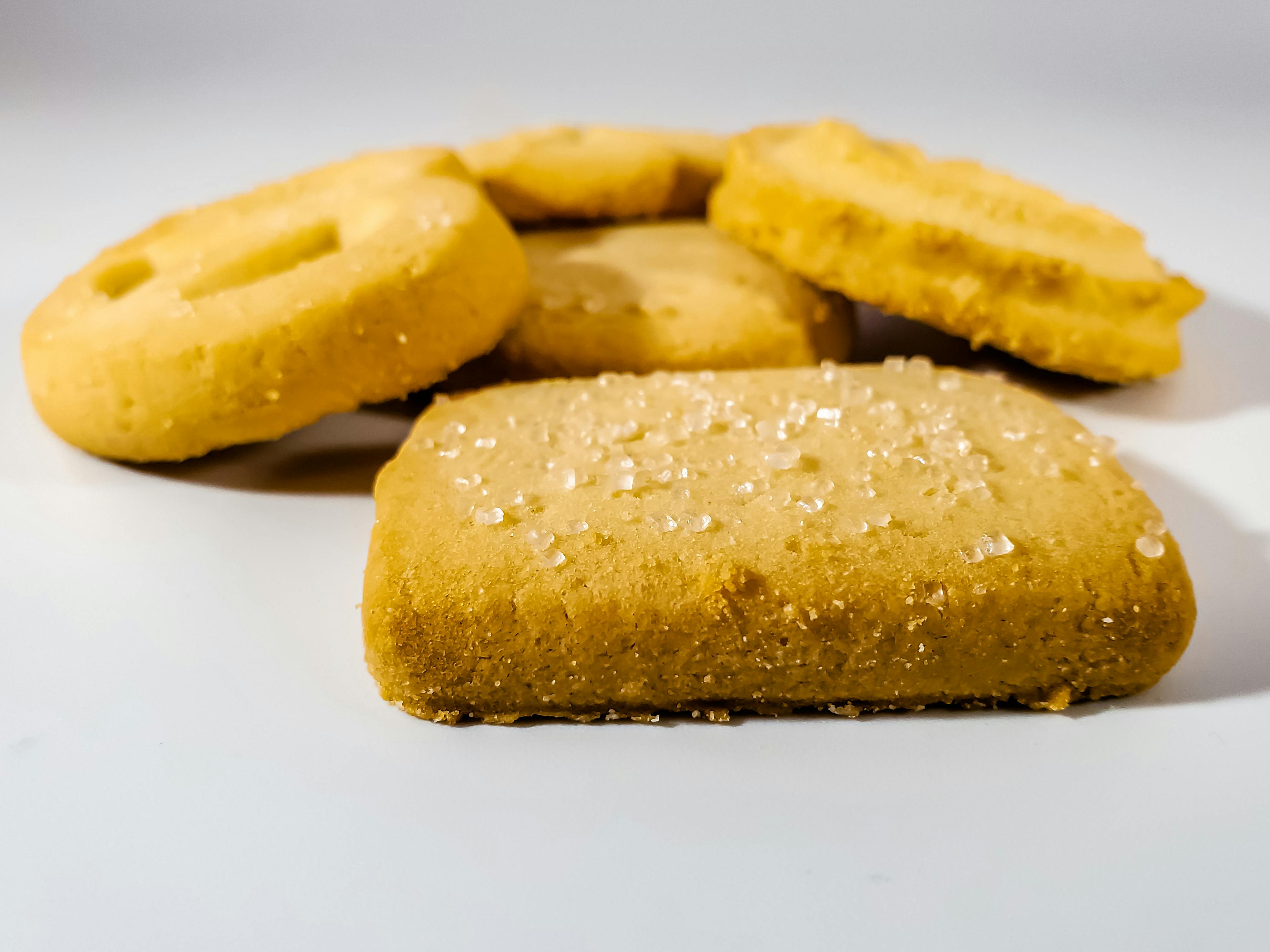
Photo: Terrance Barksdale / Pexels
Scottish
Shortbread
The diets react (see scores below)
Common Ingredients
- butter
- sugar
- flour
- salt
Specific recipes may vary.
Incompatible with 11 of 11 diets
Diet Ratings
Traditional Scottish shortbread is made primarily from wheat flour and sugar, both of which are strictly incompatible with a ketogenic diet. A single standard shortbread biscuit (~20g) contains roughly 12-14g of net carbs, meaning just two or three pieces could consume an entire day's carb allowance. While butter is a keto-friendly fat, it cannot offset the damage done by the flour and sugar. This is a grain-based, sugar-laden baked good with no realistic way to consume it in standard form on keto.
Traditional shortbread contains butter as its primary and defining ingredient, making it incompatible with a vegan diet. Butter is a dairy product derived from cow's milk and is explicitly excluded under all mainstream vegan standards. The remaining ingredients (sugar, flour, salt) are plant-based, but the butter alone disqualifies the dish. Vegan versions of shortbread do exist using plant-based butter substitutes (e.g., coconut oil, vegan margarine), but the traditional Scottish recipe as listed here is not vegan.
Shortbread is fundamentally incompatible with the paleo diet. Every single one of its four core ingredients violates paleo principles: flour is a grain product (wheat), sugar is refined and excluded, butter is a dairy product, and salt is an excluded additive. This is a highly processed baked good with zero paleo-compliant ingredients. There is no meaningful version of shortbread that could be considered paleo without replacing every ingredient entirely, at which point it would no longer be shortbread.
Shortbread is fundamentally incompatible with Mediterranean diet principles. It is composed almost entirely of butter (saturated animal fat, not olive oil), refined white flour (refined grain), and added sugar — three ingredients that the Mediterranean diet specifically discourages. There is no redeeming plant-based, whole grain, or health-promoting component. It is a calorie-dense, nutrient-poor treat with no traditional place in Mediterranean eating patterns.
Shortbread is almost entirely plant-derived and processed. Flour is a grain product, sugar is a refined carbohydrate, and while butter is an animal product, it constitutes only a minority of the dish by weight. The combination of flour and sugar makes this completely incompatible with the carnivore diet at any tier — including the most lenient 'animal-based' approaches. There is no meaningful animal protein, and the dish is defined by its carbohydrate base.
Shortbread contains multiple excluded ingredients and violates the Whole30 program on several fronts. Butter is excluded dairy (only ghee/clarified butter is permitted). Sugar is an excluded added sweetener. Flour (wheat) is an excluded grain. Even if compliant substitutes were used for each ingredient, shortbread is explicitly listed as a baked good that violates the spirit of the Whole30 program — it falls squarely into the 'no recreating baked goods' rule, which specifically prohibits cookies, biscuits, and similar items regardless of ingredient compliance.
Traditional shortbread is made primarily with wheat flour, which is high in fructans — a key FODMAP group that must be restricted during the elimination phase. Even a standard small serving of shortbread (2-3 biscuits, ~40-50g) contains enough wheat flour to deliver a significant fructan load. Butter and sugar are low-FODMAP, and salt is neutral, but the wheat flour is the dominant ingredient by weight after butter, making the dish high-FODMAP at any reasonable portion. Gluten-free shortbread made with rice flour or other GF alternatives would be a different assessment, but standard Scottish shortbread using plain wheat flour is not suitable during elimination.
Shortbread is primarily composed of butter, sugar, and refined white flour — three ingredients that DASH guidelines explicitly limit or discourage. Butter is high in saturated fat, which DASH restricts to reduce cardiovascular risk. Refined flour lacks the fiber and nutrients of whole grains, which DASH emphasizes. Added sugar contributes empty calories with no beneficial micronutrients. The combination results in a snack that is high in saturated fat, high in added sugar, low in fiber, and devoid of the potassium, calcium, magnesium, or protein that DASH prioritizes. There are no redeeming DASH-compatible elements in traditional shortbread.
Shortbread is a classic Scottish butter biscuit made almost entirely of three problematic Zone ingredients: refined white flour (high-glycemic carbohydrate), sugar (pure high-glycemic carbohydrate), and butter (saturated fat). There is no protein component whatsoever, making it essentially impossible to construct a Zone-balanced block ratio from this food alone or even alongside it without radical portion distortion. The carbohydrate load is high-glycemic (white flour + sugar spikes insulin rapidly), the fat is saturated rather than monounsaturated, and there is zero lean protein. In Zone terminology, both the flour and sugar are 'unfavorable' carbohydrate sources that Dr. Sears explicitly discourages. The saturated fat from butter, while not catastrophic in small amounts per Sears' later writings, is the least problematic ingredient here — but it does nothing to redeem the overall profile. A single traditional shortbread finger (~20g) delivers roughly 10g refined carbs, 5g saturated fat, and less than 1g protein — essentially the opposite of a Zone-favorable snack. While the Zone is ratio-based rather than exclusionary, this food offers no favorable macronutrient to anchor a block, making it one of the rare genuine 'avoid' cases.
Shortbread is composed almost entirely of pro-inflammatory ingredients from an anti-inflammatory diet perspective. Butter is high in saturated fat, which in excess is associated with elevated inflammatory markers. Refined white flour (a refined carbohydrate) causes rapid blood glucose spikes that promote inflammatory signaling. Added sugar similarly drives insulin response and is directly associated with increased CRP and IL-6. There are no redeeming anti-inflammatory components — no omega-3s, no antioxidants, no polyphenols, no fiber, no beneficial phytonutrients. The combination of saturated fat, refined carbohydrates, and added sugar makes shortbread a textbook example of what anti-inflammatory dietary frameworks advise against. Occasional consumption as a treat is unlikely to cause significant harm, but it offers nothing anti-inflammatory and concentrates multiple pro-inflammatory factors in a single food.
Shortbread is essentially pure butter, sugar, and refined flour — three ingredients that offer almost nothing beneficial for GLP-1 patients. It is high in saturated fat, high in refined sugar, and made from refined white flour with negligible fiber and zero protein. It delivers empty calories at a time when every calorie needs to count nutritionally. The high butter content can worsen GLP-1 side effects including nausea, reflux, and bloating due to slowed gastric emptying. The refined sugar causes blood sugar spikes without any counterbalancing fiber or protein. There is no redeeming nutritional feature for a GLP-1 patient context.
*See how scores were generated at our methodology page.
Nutritional profile
Six traits that cut across every diet.
Fiber & Plants
How much whole-plant food and fiber it delivers.
Healthy Fats
The quality of its fats (unsaturated, omega-3).
Whole / Unprocessed
How close it is to its natural, unprocessed form.
Gut Gentle
How easy it is on digestion (low FODMAP, few irritants).
Low Glycemic
How little it spikes your blood sugar.
Protein Density
How much protein it packs per calorie.
Controversy Index
Higher controversy = more disagreement between diets.