Photo: AMANDA LIM / Pexels
Chinese
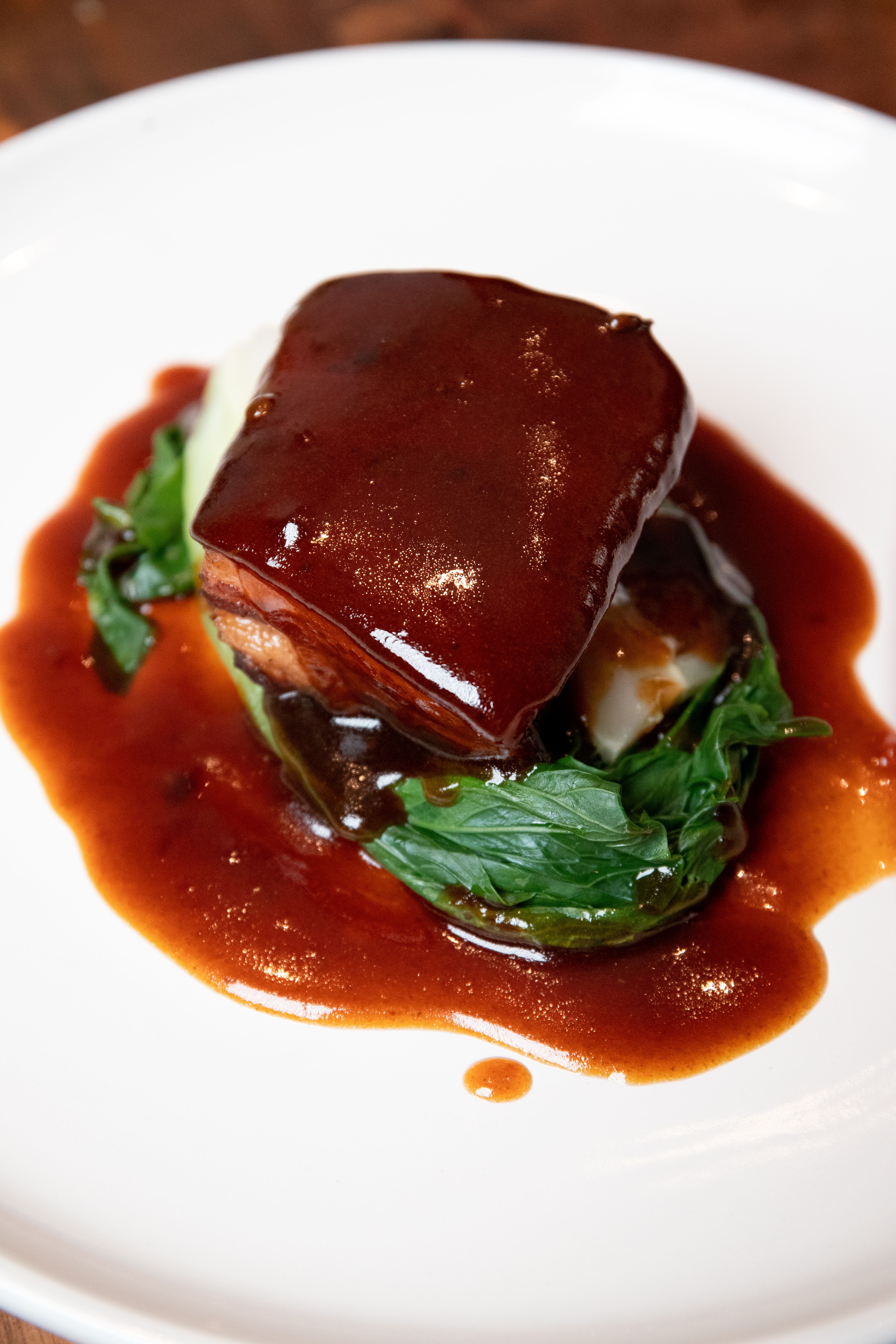
Dong Po Rou
The diets react (see scores below)
Common Ingredients
- pork belly
- soy sauce
- shaoxing wine
- rock sugar
- ginger
- scallions
- star anise
- cinnamon
Specific recipes may vary.
Incompatible with 11 of 11 diets
Diet Ratings
Dong Po Rou is fundamentally incompatible with keto despite featuring pork belly as its base. The braising liquid is built around rock sugar (a concentrated sucrose source added in significant quantities — typically 50-100g per recipe), Shaoxing rice wine (which contains residual sugars and carbohydrates), and soy sauce (which adds further carbs). The prolonged braising process infuses the pork belly with the sugary, wine-based sauce, meaning the fat and protein of the pork are thoroughly saturated with high-carb ingredients. A standard serving could easily deliver 15-30g of net carbs from the sauce alone, and the dish cannot be meaningfully modified without fundamentally changing its character. The rock sugar and Shaoxing wine are not optional garnishes — they are structural to the dish's flavor profile and cooking chemistry.
Dong Po Rou is a classic Chinese braised pork belly dish. Pork belly is the primary and dominant ingredient, making this dish unambiguously non-vegan. All remaining ingredients (soy sauce, Shaoxing wine, rock sugar, ginger, scallions, star anise, cinnamon) are plant-based, but the presence of pork — a mammalian meat — renders the dish entirely incompatible with a vegan diet under any interpretation of vegan principles.
Dong Po Rou is a classic Chinese braised pork belly dish that contains multiple non-paleo ingredients. Soy sauce is a fermented soy-based condiment — a legume derivative — and is strictly excluded from the paleo diet. Shaoxing wine is a processed grain-based rice wine, placing it firmly in the grain/processed category. Rock sugar is refined sugar, also prohibited. While the pork belly itself, ginger, scallions, star anise, and cinnamon are all paleo-approved, the foundational braising liquids that define this dish are non-compliant. The dish cannot be considered paleo in its traditional form, as removing soy sauce and Shaoxing wine would fundamentally alter the recipe into a completely different dish.
Dong Po Rou is a braised pork belly dish that fundamentally conflicts with Mediterranean diet principles on multiple levels. Pork belly is an extremely fatty cut of red meat, high in saturated fat, which the Mediterranean diet restricts to only a few times per month. The dish is also loaded with added sugar (rock sugar), soy sauce (high sodium, processed condiment), and Shaoxing wine — none of which are Mediterranean staples. There are no vegetables, legumes, whole grains, or olive oil present. The cooking method (long braising in sugar and soy sauce) produces a rich, fat-saturated, sugar-glazed result that is essentially the opposite of Mediterranean dietary philosophy.
Dong Po Rou is a heavily braised pork belly dish that, while built on an excellent carnivore-friendly protein (fatty pork belly), is disqualified by multiple plant-based and processed ingredients. Soy sauce is a fermented legume product, Shaoxing wine is a grain-based alcohol, rock sugar is a refined plant sugar, and ginger, scallions, star anise, and cinnamon are all plant-derived aromatics and spices. Every one of these additional ingredients violates carnivore principles. The dish as traditionally prepared cannot be considered carnivore-compatible in any tier of the diet.
Dong Po Rou contains multiple excluded ingredients. Soy sauce contains soy (a prohibited legume) and typically wheat (a prohibited grain). Shaoxing wine is an alcohol, which is excluded on Whole30. Rock sugar is an added sugar, which is explicitly prohibited. Even if coconut aminos were substituted for soy sauce, the shaoxing wine and rock sugar would still disqualify this dish. The braising technique itself is built around these three excluded components, making compliant adaptation essentially impossible while maintaining the dish's identity.
Dong Po Rou contains multiple high-FODMAP ingredients that make it unsuitable during the elimination phase. Scallions (green onion bulbs/white parts) are high in fructans and are a significant FODMAP concern — only the green tops are low-FODMAP. Shaoxing rice wine contains fructans and is generally considered high-FODMAP in the quantities used in braising. Rock sugar (sucrose-based) is generally low-FODMAP in small amounts, but the cumulative FODMAP load from scallion bulbs and Shaoxing wine is problematic. Soy sauce is technically low-FODMAP at 2 tablespoons but is used in large quantities in this dish. Ginger is low-FODMAP. Star anise and cinnamon are used in small spice quantities and are low-FODMAP at typical culinary doses. The core issue is the scallion white parts and Shaoxing wine used extensively in the braising liquid, making this dish high-FODMAP as traditionally prepared.
Monash University rates the green tops of scallions as low-FODMAP, and some FODMAP practitioners suggest the dish could be modified using only green scallion tops and substituting Shaoxing wine with a low-FODMAP alternative (e.g., dry sherry in small amounts or rice vinegar), which could make the dish borderline acceptable. However, as traditionally prepared, the dish is not suitable for the elimination phase.
Dong Po Rou is fundamentally incompatible with the DASH diet. The dish centers on pork belly, one of the fattiest cuts of pork, extremely high in saturated fat and total fat — directly contrary to DASH guidelines that limit saturated fat and red meat. Soy sauce contributes very high sodium (typically 900–1,200mg per tablespoon, with multiple tablespoons used in braising), pushing sodium content well above DASH thresholds in a single serving. Rock sugar adds significant refined sugar. The combination of high saturated fat from pork belly, high sodium from soy sauce, and added sugar from rock sugar hits three major DASH 'limit' categories simultaneously. This dish is the antithesis of DASH core principles.
Dong Po Rou is a classic Hangzhou braised pork belly dish that is fundamentally incompatible with Zone Diet principles on multiple levels. Pork belly is one of the fattiest cuts of meat available, with a fat-to-protein ratio that is the inverse of what the Zone requires — it is dominated by saturated fat rather than lean protein. A typical serving delivers very high saturated fat content and insufficient lean protein to fill a Zone protein block without simultaneously overwhelming the fat allocation for an entire day. The rock sugar used in braising adds significant high-glycemic simple carbohydrates (sugar), which is one of the few carb sources the Zone explicitly discourages. The soy sauce contributes sodium but negligible macronutrient value. The aromatic ingredients (ginger, scallions, star anise, cinnamon) are Zone-friendly, but they cannot redeem the core macronutrient profile. The resulting dish is high in saturated fat, contains added sugar, and provides poor-quality protein per calorie — failing on at least two of the Zone's three macronutrient pillars simultaneously. Even with very small portions, it is nearly impossible to incorporate this dish into a balanced Zone meal without severely distorting the 40/30/30 ratio, particularly given that the fat content would consume multiple fat blocks before achieving even one protein block.
Dong Po Rou is a classic Hangzhou braised pork belly dish that presents multiple red flags from an anti-inflammatory perspective. Pork belly is one of the fattiest cuts available, extremely high in saturated fat — a primary driver of inflammatory markers like CRP and IL-6. The recipe also calls for rock sugar, which contributes significant added sugar to the braising liquid, further promoting an inflammatory response. Soy sauce adds a high sodium load, and while not directly pro-inflammatory, it contributes to overall dietary burden. The cooking method — long braising until the fat is gelatinous and richly saturated — maximizes the fat content absorbed into the meat. On the positive side, the dish does include genuinely anti-inflammatory spices: ginger, star anise, cinnamon, and scallions all carry meaningful anti-inflammatory compounds. Shaoxing wine is a moderate addition. However, these beneficial spices are used in small quantities relative to the dominant pro-inflammatory ingredients — high-fat pork belly and added sugar. The overall dish profile is substantially pro-inflammatory and falls squarely in the 'limit' to 'avoid' category of anti-inflammatory dietary guidance, consistent with red meat/full-fat pork being a food to limit and added sugars being avoided.
Dong Po Rou is a classic Hangzhou braised pork belly dish built around one of the fattiest cuts of pork available. A standard serving (roughly 150-200g) delivers 40-60g of fat, the majority of which is saturated, with relatively modest protein yield per calorie due to the high fat-to-muscle ratio of pork belly. The slow-braising method renders fat throughout the meat rather than removing it, and the rock sugar glaze adds meaningful sugar content with zero nutritional value. High saturated fat content directly conflicts with GLP-1 dietary priorities: it slows gastric emptying further on top of the medication's own effect, significantly worsening nausea, bloating, and reflux. The rich, heavy sauce amplifies GI side effect risk. While soy sauce, ginger, and aromatic spices are benign or mildly beneficial, they cannot offset the core problem. The dish scores a 2 rather than 1 only because the braising liquid contains some protein and the aromatics carry minor digestive benefits (ginger has anti-nausea properties).
*See how scores were generated at our methodology page.
Nutritional profile
Six traits that cut across every diet.
Fiber & Plants
How much whole-plant food and fiber it delivers.
Healthy Fats
The quality of its fats (unsaturated, omega-3).
Whole / Unprocessed
How close it is to its natural, unprocessed form.
Gut Gentle
How easy it is on digestion (low FODMAP, few irritants).
Low Glycemic
How little it spikes your blood sugar.
Protein Density
How much protein it packs per calorie.
Controversy Index
Higher controversy = more disagreement between diets.