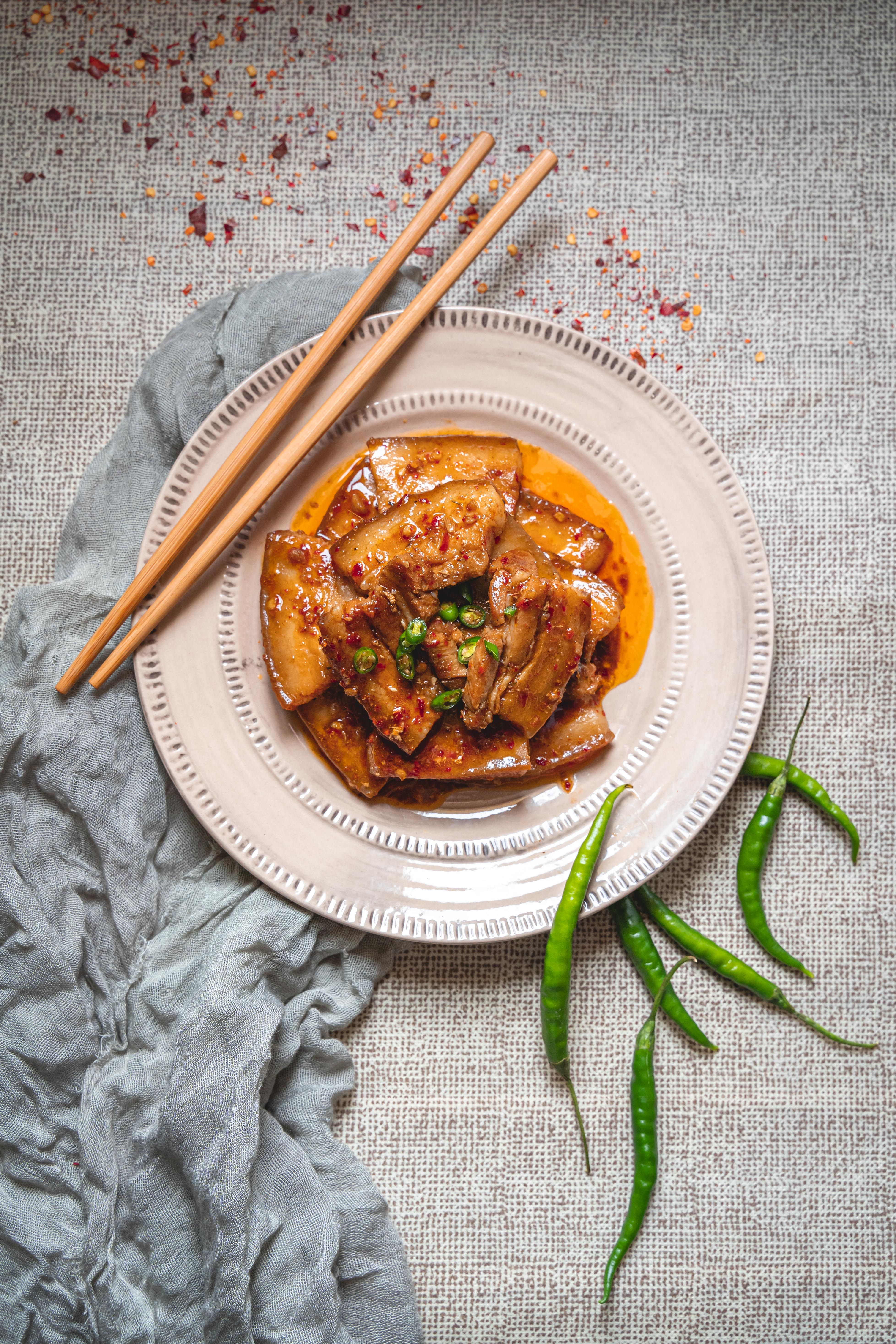
Photo: Eiliv Aceron / Pexels
The diets react (see scores below)
Common Ingredients
- pork belly
- leeks
- chili bean paste
- fermented black beans
- sweet bean sauce
- garlic
- ginger
- sichuan peppercorns
- soy sauce
Specific recipes may vary.
Incompatible with 9 of 11 diets
Diet Ratings
Hui Guo Rou (twice-cooked pork) features pork belly as its base, which is an ideal keto protein and fat source. However, the sauce profile is the primary concern: sweet bean sauce (甜面酱) contains significant added sugars and wheat-based carbs, chili bean paste (doubanjiang) adds moderate carbs, and fermented black beans contribute small additional carbs. Leeks also carry more net carbs than typical keto-friendly vegetables. Combined, the sauce ingredients can push a standard serving into a carb range that challenges ketosis. A strict keto adaptation would require eliminating or minimizing the sweet bean sauce specifically and reducing portion size of the leeks. As served in a traditional restaurant context, this dish is likely incompatible with strict ketosis due to sugar-laden sauces, but a home-cooked low-sugar version could be made keto-friendly.
Some lazy keto or flexible keto practitioners argue that the pork belly's extremely high fat content and the relatively small volume of sauces per serving mean the net carb impact is manageable within a 50g daily limit, especially if this is the only carb source in the meal. Strict keto adherents counter that sweet bean sauce contains wheat flour and added sugars that categorically disqualify the dish without significant modification.
Hui Guo Rou (twice-cooked pork) is a classic Sichuan dish built around pork belly as its primary protein. Pork is an animal flesh product and is unambiguously excluded from a vegan diet. There are no edge cases or contextual nuances here — the dish is fundamentally defined by its pork content, making it entirely incompatible with veganism.
Hui Guo Rou (twice-cooked pork) contains multiple non-paleo ingredients that disqualify it outright. Fermented black beans and chili bean paste are legume-based products, soy sauce is a fermented soy (legume) and wheat product, and sweet bean sauce is grain- and legume-derived. These are not edge cases — legumes, soy, and wheat are among the most clearly excluded food categories in paleo. While pork belly, leeks, garlic, ginger, and Sichuan peppercorns are paleo-compliant, the dish's core flavoring components are fundamentally incompatible with the diet. The dish cannot be considered paleo in its traditional form.
Hui Guo Rou (twice-cooked pork belly) is fundamentally incompatible with Mediterranean diet principles. Pork belly is an exceptionally fatty red meat, high in saturated fat, and the Mediterranean diet restricts red meat to a few times per month. The dish also relies on multiple high-sodium, heavily processed condiments (chili bean paste, fermented black beans, sweet bean sauce, soy sauce) rather than whole, minimally processed ingredients. There is no olive oil, and the overall fat profile is dominated by animal saturated fat. While leeks, garlic, and ginger are positive plant-based elements, they are minor components that do not offset the core issues. This dish contradicts nearly every primary tenet of the Mediterranean dietary pattern.
Hui Guo Rou is fundamentally incompatible with the carnivore diet. While pork belly itself is an excellent carnivore food (fatty, animal-derived, high score on its own), this dish is defined by its plant-based sauce components and aromatics. Chili bean paste, fermented black beans, sweet bean sauce, soy sauce, garlic, ginger, Sichuan peppercorns, and leeks are all plant-derived ingredients that violate core carnivore principles. The sauces also typically contain sugar, wheat, and other processed plant additives. The dish cannot be separated from these ingredients — they are structural to the recipe, not optional garnishes. Even the most liberal carnivore practitioners who tolerate coffee or occasional spices would not sanction a dish where plant-based fermented sauces and vegetables form the primary flavor and volume components.
Hui Guo Rou (Twice-Cooked Pork) contains multiple excluded ingredients that make it clearly non-compliant with Whole30. Soy sauce contains soy (a legume) and typically wheat (a grain), both of which are explicitly excluded. Fermented black beans are legumes and therefore excluded. Sweet bean sauce also contains soy/wheat and added sugar. Chili bean paste (doubanjiang) similarly contains fermented soybeans and often added sugar. These are not minor trace ingredients but core flavor components of the dish that cannot be removed without fundamentally changing the recipe. Even if coconut aminos were substituted for soy sauce, the fermented black beans and bean-based sauces remain disqualifying on their own.
Hui Guo Rou (twice-cooked pork) contains multiple high-FODMAP ingredients that make it unsuitable during the elimination phase. Garlic is one of the highest-FODMAP foods tested by Monash University, containing significant fructans even in small amounts. Leeks are high-FODMAP at typical serving sizes (low-FODMAP only at 54g of the green tops only, but the white/light green portions are high-FODMAP and are often used in this dish). Fermented black beans contain GOS and fructans. Chili bean paste (doubanjiang) typically contains garlic and onion as primary ingredients, adding further fructans. Sweet bean sauce (tianmianjiang) is wheat-based, adding fructan load. Together, these ingredients create a cumulative FODMAP burden that would almost certainly trigger symptoms in FODMAP-sensitive individuals, regardless of portion size. Pork belly, ginger, Sichuan peppercorns, and soy sauce are individually low-FODMAP, but they cannot offset the multiple high-FODMAP components in this dish.
Hui Guo Rou (twice-cooked pork) is fundamentally incompatible with DASH diet principles across multiple dimensions. Pork belly is an extremely high-fat cut — approximately 50% fat by weight — with substantial saturated fat content, directly violating DASH's core directive to limit saturated fat and red meat. The dish's sauce profile compounds this problem severely: chili bean paste (doubanjiang), fermented black beans, sweet bean sauce, and soy sauce are all high-sodium fermented or processed condiments. A typical serving of Hui Guo Rou can deliver 1,200–1,800mg of sodium, representing more than half to nearly the entire DASH daily sodium allowance in a single dish. Red meat is explicitly limited under DASH guidelines, and pork belly represents one of the least DASH-compatible protein sources available. The cooking method (twice-cooked — first boiled, then stir-fried) does not meaningfully reduce the saturated fat load. While garlic, ginger, leeks, and Sichuan peppercorns offer some DASH-positive micronutrients and antioxidants, they cannot compensate for the dominant nutritional negatives.
Hui Guo Rou (twice-cooked pork) presents several Zone Diet challenges. The primary protein — pork belly — is a high-fat, high-saturated-fat cut far removed from the lean proteins Dr. Sears advocates. A typical serving delivers significant saturated fat that disrupts the Zone's 30% fat target with the wrong type of fat. The condiment base (chili bean paste, sweet bean sauce, fermented black beans, soy sauce) adds meaningful sodium and some sugar, particularly from the sweet bean sauce, which nudges glycemic load upward. On the positive side, leeks are a favorable low-glycemic Zone carbohydrate, and the aromatics (garlic, ginger, Sichuan peppercorns) are anti-inflammatory polyphenol contributors that Sears would applaud. The dish is not a Zone-friendly main as traditionally prepared, but it is also not categorically impossible — reducing portion size significantly, trimming visible fat, and pairing with abundant low-glycemic vegetables could allow a small amount to fit within a Zone meal framework. The saturated fat load is the principal obstacle, not the glycemic index of the carbohydrate components.
Some Zone practitioners note that Sears' later writings (Toxic Fat, The Mediterranean Zone) took a more nuanced view of saturated fat, particularly in the context of a predominantly anti-inflammatory diet rich in omega-3s and polyphenols. The garlic, ginger, fermented black beans, and Sichuan peppercorns in this dish are genuinely high-polyphenol ingredients that align with Sears' later anti-inflammatory emphasis, which could slightly rehabilitate this dish's standing for practitioners following his post-2000 framework rather than the strict original Zone block system.
Hui Guo Rou (twice-cooked pork belly) is a traditional Sichuan dish with a challenging anti-inflammatory profile. The primary protein is pork belly, one of the fattiest cuts of pork, extremely high in saturated fat — a well-documented pro-inflammatory nutrient that elevates inflammatory markers when consumed regularly. The dish is prepared by boiling then stir-frying the pork belly, which concentrates the fat rather than reducing it. On the positive side, several ingredients carry genuine anti-inflammatory value: garlic and ginger are well-researched anti-inflammatory spices, leeks provide prebiotic fiber and flavonoids, Sichuan peppercorns contain anti-inflammatory hydroxyl-alpha-sanshool, and fermented black beans and chili bean paste contribute some polyphenols and probiotic-adjacent compounds from fermentation. However, these benefits are substantially outweighed by the dish's core profile. The fermented pastes (chili bean paste, sweet bean sauce, soy sauce) also contribute significant sodium, which at high levels can promote endothelial inflammation. The overall dish is calorie-dense, saturated-fat-heavy, and sodium-laden — a combination consistently associated with elevated CRP and IL-6 in research. The anti-inflammatory herbs cannot compensate for a dish built around a fatty red meat cut. Occasional consumption as a cultural food is different from regular intake, but as a dietary pattern assessment this dish falls in the avoid category.
Hui Guo Rou (twice-cooked pork belly) is a poor fit for GLP-1 patients. Pork belly is one of the highest-fat cuts of meat available, with roughly 35-45g of fat per 100g serving, predominantly saturated fat. The dish is first boiled then stir-fried, meaning the pork retains most of its fat content and is then cooked in additional oil at high heat. This combination of high saturated fat and greasy preparation directly worsens the most common GLP-1 side effects: nausea, bloating, reflux, and prolonged gastric discomfort due to slowed gastric emptying. The sauce profile — chili bean paste, fermented black beans, sweet bean sauce — adds significant sodium, moderate sugar, and spice (Sichuan peppercorns, chili), all of which can further aggravate GI sensitivity. Protein density per calorie is poor given the fat load. The leeks provide modest fiber and some nutritional value, but not enough to offset the core problem. This dish is fundamentally incompatible with GLP-1 dietary priorities across nearly every dimension: fat content, digestibility, spice level, and nutrient density per calorie.
*See how scores were generated at our methodology page.
Nutritional profile
Six traits that cut across every diet.
Fiber & Plants
How much whole-plant food and fiber it delivers.
Healthy Fats
The quality of its fats (unsaturated, omega-3).
Whole / Unprocessed
How close it is to its natural, unprocessed form.
Gut Gentle
How easy it is on digestion (low FODMAP, few irritants).
Low Glycemic
How little it spikes your blood sugar.
Protein Density
How much protein it packs per calorie.
Controversy Index
Higher controversy = more disagreement between diets.
Diet-Specific Tips
 Keto — 4/10
View tips
- Pork belly is high in fat and protein — excellent keto base
- Sweet bean sauce contains added sugar and wheat, a significant carb source
- Chili bean paste and fermented black beans add moderate additional carbs
- Leeks are higher in net carbs than most keto-approved vegetables
- Sichuan peppercorns, garlic, ginger, and soy sauce contribute negligibly to carbs
- Traditional restaurant preparation likely exceeds safe keto carb threshold per serving
- Home modification (omitting sweet bean sauce) could make this dish keto-viable
 Zone — 4/10
View tips
- Pork belly is very high in saturated fat — the antithesis of the lean protein Zone recommends
- Saturated fat content makes hitting the 30% fat target with the right fat type extremely difficult
- Sweet bean sauce adds sugar, raising glycemic load of the condiment base
- Leeks are a favorable Zone carbohydrate (low-glycemic, fibrous)
- Garlic, ginger, and Sichuan peppercorns are anti-inflammatory polyphenol sources aligned with Sears' later focus
- Fermented black beans provide some favorable protein and polyphenols
- Dish could be partially redeemed by using pork tenderloin instead of belly and reducing sauce volume
- High sodium content from multiple fermented/salty condiments is a secondary concern