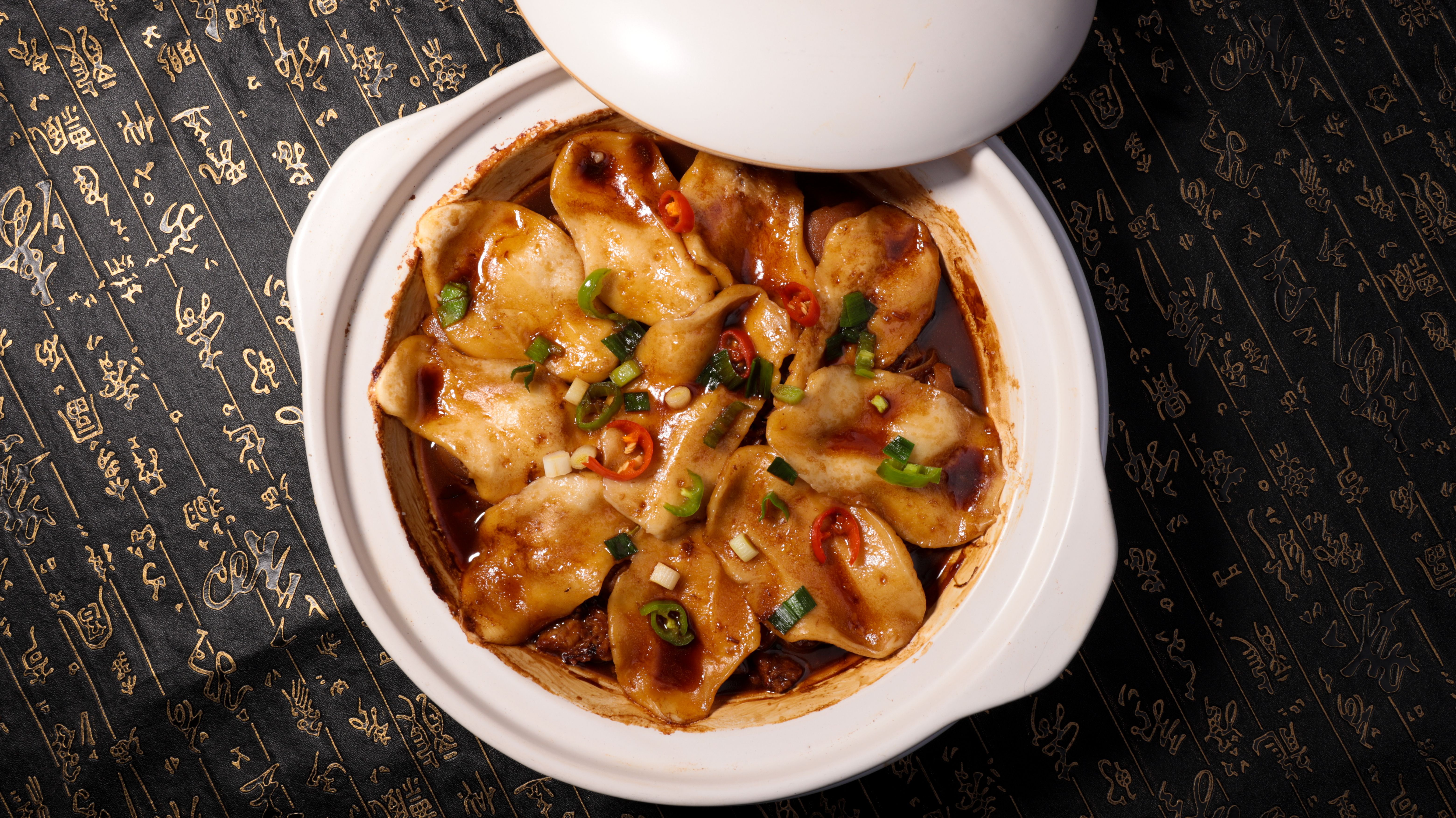
Photo: Change C.C / Pexels
Chinese
Zhong Shui Jiao
The diets react (see scores below)
Common Ingredients
- pork
- wonton wrappers
- chili oil
- sweet soy sauce
- garlic
- sichuan peppercorns
- ginger
- scallions
Specific recipes may vary.
Incompatible with 9 of 11 diets
Diet Ratings
Zhong Shui Jiao (Chengdu-style red oil dumplings) are fundamentally incompatible with ketogenic diets. The wonton wrappers are made from wheat flour, a grain-based product that is high in net carbohydrates — a standard serving of 6-8 dumplings can contain 30-40g of net carbs from the wrappers alone, easily exceeding or consuming the entire daily keto carb budget. The sweet soy sauce adds additional sugars on top of that. While the pork filling, chili oil, garlic, ginger, and Sichuan peppercorns are all keto-friendly, the wrapper and sweet sauce are non-negotiable structural components of the dish that make it incompatible with ketosis. There is no meaningful way to consume a standard portion of this dish within keto macros.
Zhong Shui Jiao (Zhong's dumplings) is a Sichuan specialty featuring pork-filled dumplings in a spiced chili oil and sweet soy sauce dressing. The primary protein is pork, an animal product, which is a clear and direct violation of vegan dietary rules. There is no ambiguity here — pork is animal flesh and is categorically excluded from a vegan diet. The remaining ingredients (wonton wrappers, chili oil, sweet soy sauce, garlic, Sichuan peppercorns, ginger, scallions) are plant-based, but the dish cannot be considered vegan in its listed form due to the pork filling.
Zhong Shui Jiao (Sichuan red oil dumplings) is fundamentally incompatible with the paleo diet. The wonton wrappers are made from wheat flour, a grain explicitly excluded from paleo. Sweet soy sauce contains both soy (a legume) and refined sugar, adding two more major paleo violations. Chili oil is typically made with seed oils (often sesame or vegetable oil), which are also excluded. The remaining ingredients — pork, garlic, ginger, scallions, and Sichuan peppercorns — are paleo-approved, but the core structural and flavoring components of this dish are deeply non-paleo. This dish cannot be adapted without fundamentally changing what it is.
Zhong Shui Jiao (Sichuan red oil dumplings) conflicts with Mediterranean diet principles on multiple fronts. The primary protein is pork (red meat), which is limited to a few times per month in the Mediterranean diet. The wonton wrappers are made from refined white flour, a refined grain discouraged under Mediterranean principles. Sweet soy sauce adds significant refined sugar. Chili oil is typically made from non-olive vegetable oils rather than extra virgin olive oil. The dish is not plant-forward, contains no whole grains, legumes, or vegetables as primary components, and is not part of any Mediterranean culinary tradition. While garlic, ginger, and scallions are positive aromatic ingredients, they do not offset the structural incompatibilities of this dish.
Zhong Shui Jiao (Sichuan red oil dumplings) is fundamentally incompatible with the carnivore diet. While the pork filling itself is carnivore-appropriate, virtually every other component violates carnivore principles. The wonton wrappers are made from wheat flour — a grain and therefore a plant food — forming the structural base of the dish. The sauce is a multi-violation combination: chili oil is plant-derived (peppers + plant oil), sweet soy sauce contains soybeans (legume) and sugar, garlic and ginger are plant foods, Sichuan peppercorns are a plant spice, and scallions are vegetables. This dish is essentially a plant-forward preparation that uses pork only as a minor filling ingredient. No modification short of complete reconstruction would make this carnivore-compatible.
Zhong Shui Jiao (Chengdu-style boiled dumplings in chili oil) contains multiple Whole30-excluded ingredients. Wonton wrappers are made from wheat flour, a grain that is explicitly excluded from the Whole30 program. Sweet soy sauce contains both soy (a legume, excluded) and added sugar (excluded). These are not minor or debatable inclusions — they are foundational to the dish and cannot be removed without fundamentally changing it. Additionally, commercial chili oil often contains soy or other excluded additives, though compliant versions could theoretically exist. The dish as traditionally prepared is firmly non-compliant.
Zhong Shui Jiao (Chengdu-style dumplings in chili oil sauce) contains multiple high-FODMAP ingredients that make it unsuitable during the elimination phase. The wonton wrappers are made from wheat flour, which is high in fructans — a primary FODMAP concern. Garlic is one of the highest-FODMAP foods tested by Monash University and is a core ingredient in both the filling seasoning and the sauce. Scallions (green onion bulb/white parts) are also high-FODMAP, though the green tops alone are low-FODMAP — in practice, both parts are typically used. Sweet soy sauce commonly contains wheat and may contain added sugars that compound fructan load. The combination of wheat wrappers and garlic alone is sufficient to classify this dish as high-FODMAP at any standard serving size. Pork itself, ginger, Sichuan peppercorns, and chili oil (if garlic-free) are all low-FODMAP, but these safe ingredients are outweighed by the problematic ones.
Zhong Shui Jiao (Chengdu red oil dumplings) is fundamentally incompatible with DASH dietary principles. The dish centers on several high-concern components: chili oil contributes significant saturated fat; sweet soy sauce is high in sodium and added sugar; pork (as commonly used — fatty ground pork) is a red meat DASH recommends limiting; and wonton wrappers are refined white flour with negligible fiber. The combination of high sodium from soy sauce, saturated fat from chili oil and fatty pork, and added sugars from sweet soy sauce creates a multi-factor conflict with DASH goals. Sodium content in a typical serving can easily exceed 600–900mg from the sauce alone. While garlic, ginger, scallions, and Sichuan peppercorns are DASH-positive aromatics, they are minor contributors that cannot offset the dish's overall nutritional profile.
Zhong Shui Jiao (Chengdu-style dumplings in red oil) presents a mixed Zone Diet profile. The pork filling provides protein but is not lean (pork belly or fatty minced pork is typical), and the wonton wrappers are refined wheat flour — a high-glycemic, unfavorable carb in Zone terminology. The chili oil adds fat but is likely a seed oil (sesame or vegetable oil) which is omega-6 heavy, contrary to Zone's preference for monounsaturated fats. Sweet soy sauce adds sugar, pushing the glycemic load higher. On the positive side, garlic, ginger, scallions, and Sichuan peppercorns are polyphenol-rich and anti-inflammatory — exactly what Sears champions. The dish can technically be block-portioned (a small serving of 3-4 dumplings provides roughly 1 protein block and 1-2 carb blocks), but the fat quality, refined carb wrappers, and added sugar in the sauce make it an 'unfavorable' Zone choice requiring significant portion discipline. The macro ratio will skew toward carbs and poor-quality fat rather than the ideal 40/30/30.
Some Zone practitioners argue that dumplings, consumed in small controlled portions as a snack (3-4 pieces), can fit within a 1-block snack framework, especially if paired with a lean protein side to correct the ratio imbalance. Sears' later writings on polyphenols would also highlight the anti-inflammatory value of ginger, garlic, and Sichuan peppercorns as meaningful positives worth considering.
Zhong Shui Jiao (Sichuan red oil wontons) is a mixed dish from an anti-inflammatory perspective. On the positive side, it contains several genuinely anti-inflammatory ingredients: garlic, ginger, scallions, Sichuan peppercorns (which contain hydroxy-alpha-sanshool and other bioactive compounds with anti-inflammatory potential), and chili oil (capsaicin has documented anti-inflammatory properties). These spices and aromatics are well-supported in anti-inflammatory nutrition. However, the dish also has meaningful concerns. Pork falls into the 'limit' category as a red meat with saturated fat content, though it is less problematic than beef in moderate amounts. Wonton wrappers are refined carbohydrates with little fiber or nutritional value, contributing a pro-inflammatory element. Chili oil is typically made with a seed oil base (often soybean or rapeseed oil), which is debated in anti-inflammatory contexts due to omega-6 content and refining processes. Sweet soy sauce adds refined sugar and sodium. The dish is not a regular anti-inflammatory staple but is not aggressively harmful either — the spice profile is a genuine asset. Consumed occasionally in moderate portions, it lands in the caution zone.
Some anti-inflammatory practitioners, particularly those aligned with Dr. Weil's approach, would view the chili oil, garlic, ginger, and Sichuan peppercorns as meaningfully beneficial, potentially pushing the dish closer to acceptable. Conversely, stricter anti-inflammatory protocols (such as AIP or those emphasizing omega-6 minimization) would flag the seed oil base of the chili oil and the refined wonton wrappers more severely, along with pork's saturated fat and arachidonic acid content.
Zhong Shui Jiao (Chengdu-style wontons in chili oil) presents multiple significant concerns for GLP-1 patients. The dish is defined by its sauce: chili oil is high in fat and a known GI irritant that worsens nausea and reflux — both already common GLP-1 side effects. Sweet soy sauce adds meaningful sugar with little nutritional return. Sichuan peppercorns, while not as acutely spicy as chili peppers, contribute to a highly stimulating, oily sauce that is difficult for a slowed GI tract to tolerate. The pork filling provides some protein, but wontons are typically small and the protein-per-serving ratio is modest relative to the fat and refined carbohydrate load from the wonton wrappers. The wrappers themselves are refined flour with minimal fiber. The overall dish is fatty, spicy, low-fiber, and built around a sauce that is nearly categorically problematic for GLP-1 patients. Even in a small portion, the chili oil and spice profile make this a poor choice.
Some GLP-1-informed RDs would note that a very small portion (3-4 wontons) could provide meaningful protein and that spice tolerance varies widely among patients — those without reflux or nausea symptoms may tolerate mild versions better than the rating implies. The primary point of disagreement is whether individual GI tolerance should shift this from avoid to caution for asymptomatic patients.
*See how scores were generated at our methodology page.
Nutritional profile
Six traits that cut across every diet.
Fiber & Plants
How much whole-plant food and fiber it delivers.
Healthy Fats
The quality of its fats (unsaturated, omega-3).
Whole / Unprocessed
How close it is to its natural, unprocessed form.
Gut Gentle
How easy it is on digestion (low FODMAP, few irritants).
Low Glycemic
How little it spikes your blood sugar.
Protein Density
How much protein it packs per calorie.
Controversy Index
Higher controversy = more disagreement between diets.
Diet-Specific Tips
 Zone — 4/10
View tips
- Wonton wrappers are refined wheat flour — high-glycemic, unfavorable Zone carb
- Pork filling is typically fatty, not lean — elevated saturated fat
- Sweet soy sauce adds sugar, worsening glycemic load
- Chili oil is likely seed-oil based — omega-6 heavy, counter to Zone fat guidelines
- Garlic, ginger, scallions, Sichuan peppercorns are polyphenol-rich and anti-inflammatory
- Small portion (3-4 dumplings) can approximate a 1-block snack but macro ratios will not align well
- Overall dish skews carb-heavy and fat-quality is poor for Zone standards
 Anti-Inflammatory — 5/10
View tips
- Pork is a red meat — moderate saturated fat and arachidonic acid content place it in the 'limit' category
- Wonton wrappers are refined carbohydrates with minimal fiber — mildly pro-inflammatory
- Garlic, ginger, scallions, and Sichuan peppercorns are anti-inflammatory spices with documented bioactive compounds
- Chili oil provides capsaicin (anti-inflammatory) but is typically seed-oil-based (omega-6 concern)
- Sweet soy sauce adds refined sugar and high sodium — both pro-inflammatory in excess
- Dish is a snack/appetizer portion — moderate quantity limits overall inflammatory load
- Overall spice profile is a genuine anti-inflammatory asset in an otherwise mixed dish