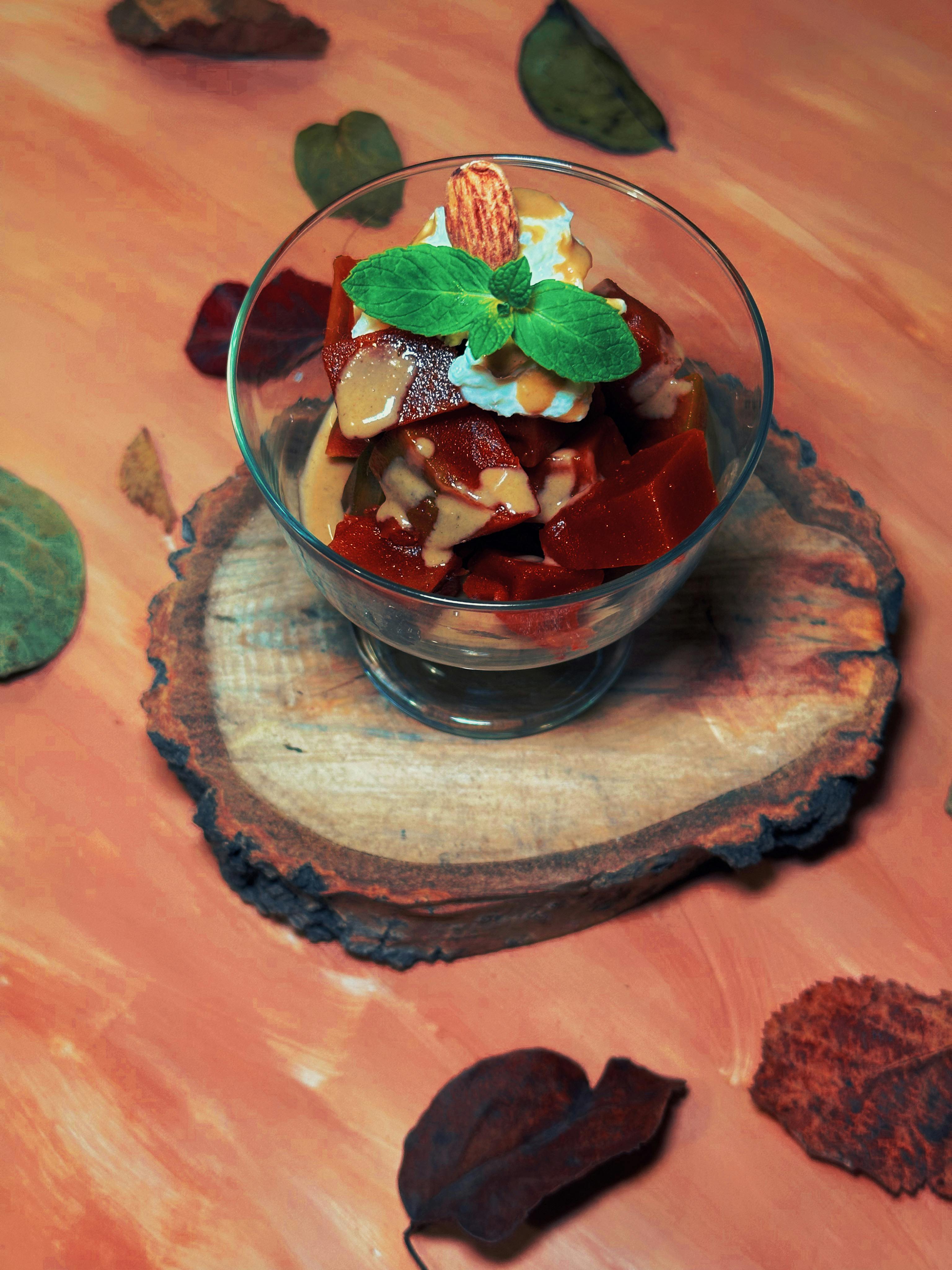
Photo: Gülsüm Bozdemir / Pexels
The diets react (see scores below)
Common Ingredients
- cornstarch
- sugar
- ghee
- cardamom
- nutmeg
- peanuts
- water
Specific recipes may vary.
Incompatible with 10 of 11 diets
Diet Ratings
Halwo (Somali halva) is fundamentally incompatible with a ketogenic diet. Its two primary ingredients are cornstarch and sugar, both of which are extremely high in net carbs and will immediately disrupt ketosis. Cornstarch is a pure refined starch with virtually no fiber, and sugar is 100% fast-acting carbohydrate. A typical small serving of halwo can easily contain 40-60g of net carbs or more, far exceeding the entire daily keto limit. While ghee and peanuts are more keto-friendly ingredients, they are minor components in this preparation and cannot offset the massive carbohydrate load from the starch and sugar base.
Somali halwo (also spelled halwa or xalwo) is a traditional confection made primarily with cornstarch, sugar, cardamom, nutmeg, peanuts, and water — all plant-based — but the defining and essential ingredient is ghee, which is clarified butter derived from cow's milk. Ghee is an animal-derived dairy product and is firmly excluded under vegan dietary rules. Without ghee, the dish would be fully plant-based and could score highly; however, as traditionally prepared and as listed in this recipe, it is not vegan-compliant. A vegan version could be made by substituting ghee with coconut oil or another plant-based fat, but the dish as presented must be rated avoid.
Some whole-food plant-based advocates who are lenient about trace animal fats in traditional cultural dishes might argue that small amounts of ghee in a ceremonial or occasional food are acceptable, but mainstream vegan organizations (Vegan Society, PETA) clearly categorize all dairy derivatives including ghee as non-vegan with no cultural exception.
Halwo contains multiple ingredients that are clearly non-paleo. Cornstarch is a highly processed grain derivative and is excluded. Refined sugar is explicitly prohibited on the paleo diet. Peanuts are legumes, not nuts, and are excluded by all mainstream paleo authorities. Ghee is the only ingredient with any paleo-adjacent standing, and even that is debated. The spices (cardamom, nutmeg) and water are paleo-compliant, but the core structural ingredients of this dish — cornstarch, sugar, and peanuts — are all on the avoid list. This dish is fundamentally incompatible with paleo principles.
Halwo (Somali halva) is a confection built primarily on sugar, cornstarch, and ghee — three ingredients that conflict with Mediterranean diet principles. Sugar is a direct added sugar, cornstarch is a refined grain with minimal nutritional value, and ghee (clarified butter) is a saturated animal fat rather than the preferred extra virgin olive oil. The combination produces a high-sugar, high-saturated-fat snack with very little fiber, vitamins, or phytonutrients. The peanuts and spices (cardamom, nutmeg) are the only redemptive elements, but they are minor contributors in this recipe. As a processed sweet confection, it falls squarely in the 'minimize' category alongside pastries, candies, and refined-grain desserts.
Halwo (Somali halva) is almost entirely plant-based and processed, with zero compatibility with the carnivore diet. The primary ingredients — cornstarch, sugar, cardamom, nutmeg, and peanuts — are all plant-derived and explicitly excluded from any tier of carnivore eating. Cornstarch is a refined grain derivative, sugar is a processed plant carbohydrate, peanuts are legumes, and cardamom and nutmeg are plant spices. The only animal-derived ingredient is ghee, which is a minor component and itself a debated dairy derivative. This dish has no animal protein and is essentially a confection built on carbohydrates and plant fats. It is incompatible with the carnivore diet at every level.
Halwo (Somali halva) contains multiple excluded ingredients that make it clearly non-compliant with Whole30. First, cornstarch is explicitly excluded per Whole30 rules. Second, sugar (added sugar) is excluded. Third, peanuts are legumes, which are explicitly excluded. Any single one of these three ingredients would be enough to disqualify this dish; together they make this a clear avoid with high confidence.
Halwo (Somali halva) is made from cornstarch, sugar, ghee, cardamom, nutmeg, peanuts, and water. Most ingredients are individually low-FODMAP: cornstarch is low-FODMAP, ghee (clarified butter, lactose-free) is low-FODMAP, cardamom and nutmeg in culinary amounts are low-FODMAP, and water is fine. Plain sugar (sucrose) is low-FODMAP. The main concern is peanuts — Monash rates peanuts as low-FODMAP at a 28g (small handful) serving, but they contain GOS which becomes problematic in larger quantities. Halwo is a dense, rich sweet that is typically consumed in moderate portions, but the peanut content per serving could push GOS levels into moderate territory depending on how generously the dish is prepared and served. The dish is generally lower risk than many other snacks, but portion size is the key variable.
Monash University rates peanuts as low-FODMAP at 28g per serve, which is achievable in a modest portion of halwo. However, clinical FODMAP practitioners may advise caution because halwo is a rich confection often eaten in multiple pieces, and cumulative peanut intake across a sitting could exceed the safe GOS threshold. The sugar load, while not a FODMAP concern per se, may also cause digestive symptoms in sensitive individuals.
Halwo (Somali halwa) is a confection made primarily from sugar, ghee, and cornstarch — essentially a high-sugar, high-saturated-fat dessert/snack. Sugar is the dominant ingredient, making this a high-added-sugar food that DASH explicitly limits. Ghee is clarified butter and is very high in saturated fat, which DASH diet guidelines clearly restrict. Cornstarch is a refined carbohydrate with no meaningful fiber, potassium, calcium, or magnesium. The peanuts provide some beneficial unsaturated fat and protein, but in the context of this dish they are a minor component surrounded by DASH-unfriendly ingredients. The spices (cardamom, nutmeg) are negligible nutritionally. This dish is categorically the type of sweet, high-saturated-fat confection that DASH guidelines advise against. Even as an occasional treat, the combination of high added sugar and high saturated fat from ghee places it firmly in the 'avoid' category.
Halwo (Somali halva) is a confection built almost entirely from cornstarch, sugar, and ghee — three ingredients that collectively represent the worst-case scenario for Zone Diet compliance. Sugar is a high-glycemic refined carbohydrate that spikes insulin sharply, which is precisely what the Zone Diet seeks to avoid. Cornstarch is one of the highest-glycemic carbohydrate sources available, with virtually no fiber to moderate its glycemic impact. Ghee is predominantly saturated fat, conflicting with the Zone's emphasis on monounsaturated fats. The dish carries no meaningful lean protein (categorized as 'none'), making it impossible to construct a Zone-balanced block without completely rebuilding the meal around it. Peanuts contribute some protein and monounsaturated fat, but their quantity in this dish is insufficient to offset the dominant sugar-starch-ghee base. Cardamom and nutmeg are polyphenol-containing spices that Sears would approve of, but they are nutritionally negligible in macro terms. As a snack, halwo provides essentially pure glycemic load with saturated fat and no lean protein — the opposite of a Zone-favorable snack, which would pair low-glycemic carbs with lean protein and monounsaturated fat. This dish cannot be meaningfully 'portioned into Zone compliance' because even a small serving delivers a disproportionate carbohydrate and saturated fat hit with no protein anchor.
Somali Halwo (also spelled halva) is a dense, gelatinous confection whose core ingredients are cornstarch and sugar — both major red flags in anti-inflammatory nutrition. Cornstarch is a refined carbohydrate with a very high glycemic index, and the large quantity of added sugar directly promotes inflammatory pathways by spiking blood glucose and insulin, elevating CRP and IL-6 markers in research. Ghee, while not trans fat, is high in saturated fat and is flagged as a 'limit' ingredient under anti-inflammatory principles, and in a dessert like halwo it appears in substantial quantities. The anti-inflammatory positives are minimal: cardamom and nutmeg offer trace anti-inflammatory polyphenols and antioxidants at typical culinary doses, and peanuts provide some protein and modest amounts of resveratrol — but these contributions are negligible against the heavy pro-inflammatory load of refined starch and sugar that define this dish structurally. This is essentially a high-glycemic confection with saturated fat, which is the opposite of what an anti-inflammatory dietary pattern prioritizes. Occasional consumption as a cultural treat is understandable, but from a dietary assessment standpoint, this dish is firmly in the 'avoid' category.
Halwo (Somali halva) is a dense confection made primarily from cornstarch, sugar, and ghee — a combination that is almost entirely refined carbohydrates and saturated fat with negligible protein and fiber. It is a high-calorie, nutrient-poor food that fails nearly every GLP-1 dietary criterion. The sugar load risks blood sugar spikes, the high ghee content (saturated fat) worsens GLP-1 side effects such as nausea, bloating, and reflux, and the extremely low protein and fiber content offer no satiety or muscle-preservation value. Peanuts contribute a small amount of protein and unsaturated fat, but their quantity in a standard serving of halwo is too small to meaningfully offset the overall nutritional profile. Cornstarch is a refined carbohydrate with no fiber benefit. This is a textbook empty-calorie food — exactly what GLP-1 patients should avoid when every bite must count nutritionally.
*See how scores were generated at our methodology page.
Nutritional profile
Six traits that cut across every diet.
Fiber & Plants
How much whole-plant food and fiber it delivers.
Healthy Fats
The quality of its fats (unsaturated, omega-3).
Whole / Unprocessed
How close it is to its natural, unprocessed form.
Gut Gentle
How easy it is on digestion (low FODMAP, few irritants).
Low Glycemic
How little it spikes your blood sugar.
Protein Density
How much protein it packs per calorie.
Controversy Index
Higher controversy = more disagreement between diets.
Diet-Specific Tips
 Low-FODMAP — 5/10
View tips
- Cornstarch is low-FODMAP and safe as a starch base
- Ghee is lactose-free and low-FODMAP
- Plain sugar (sucrose) is low-FODMAP
- Cardamom and nutmeg in culinary amounts are low-FODMAP
- Peanuts are low-FODMAP at ≤28g but contain GOS that can accumulate with larger portions
- Portion size of halwo is the critical factor — small servings likely safe, larger servings risky
- No high-FODMAP ingredients like garlic, onion, wheat, or high-fructose components