Photo: Jeff Siepman / Pexels
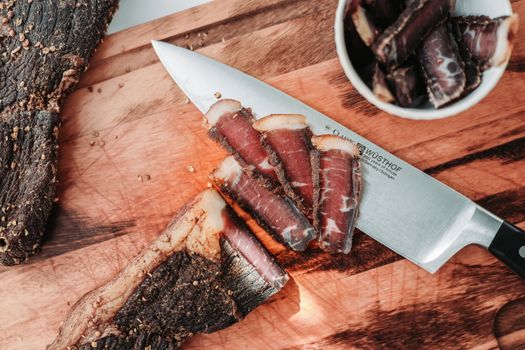
South-African
Biltong
The diets react (see scores below)
Common Ingredients
- beef
- vinegar
- coriander
- salt
- black pepper
- brown sugar
Specific recipes may vary.
Incompatible with 4 of 11 diets
Diet Ratings
Biltong is predominantly beef with spices, making it a protein-rich, low-carb snack that fits keto in principle. However, the inclusion of brown sugar in the curing process is a concern. Traditional biltong uses only small amounts of sugar (typically 1-5g per 100g serving after drying), which is far less than jerky, and most of it is consumed in the brine rather than absorbed into the meat. Net carbs in a standard 30g serving are usually around 1-3g, which is manageable. The main keto concern is the presence of added sugar at all, and the exact carb content varies significantly by recipe and producer. Moderate portions are generally compatible with ketosis, but strict keto practitioners should verify the sugar content of the specific recipe or brand.
Strict keto and carnivore-aligned practitioners argue that any added sugar — even in trace amounts — is unacceptable and that the insulin response risk means biltong should be avoided unless made without sugar. Conversely, lazy or flexible keto practitioners often freely approve biltong as a near-zero-carb snack, noting real-world net carb impact is negligible.
Biltong is a South African dried and cured meat snack made primarily from beef. Beef is an animal product and is categorically excluded from a vegan diet. There is no ambiguity here — the primary and defining ingredient is animal flesh, making this entirely incompatible with veganism regardless of the plant-based spices (vinegar, coriander, salt, black pepper, brown sugar) that accompany it.
Biltong is a traditional South African cured/dried meat that uses mostly paleo-friendly ingredients. Beef, vinegar, coriander, and black pepper are all paleo-approved. However, the recipe includes two problematic ingredients: added salt and brown sugar. Salt is explicitly excluded from strict paleo guidelines as an 'added salt' product, and brown sugar is a refined sugar — both are on the avoid list. That said, the quantities used in biltong are relatively small (primarily for curing/preservation), and the base product is unprocessed beef. Many practical paleo followers accept biltong as a convenient whole-food snack, acknowledging the trace amounts of these curing agents, which is why this lands in caution territory rather than a full avoid.
Some paleo practitioners, particularly those following a strict Cordain-school approach, would avoid biltong entirely due to the added salt and refined sugar, even in small curing quantities. Conversely, many real-food and ancestral health advocates (e.g., Chris Kresser) consider traditionally cured meats like biltong acceptable and far preferable to processed deli meats, given the minimal processing and whole-food base.
Biltong is a dried, cured beef product — red meat is the primary ingredient, which the Mediterranean diet limits to only a few times per month. While the curing process uses relatively wholesome spices (coriander, black pepper, vinegar), the product is still a processed red meat snack with added salt and sugar. High sodium content from curing, the use of red meat as the base protein, and its processed/preserved nature all conflict with core Mediterranean principles. It is not a traditional Mediterranean food, has no olive oil or plant-forward elements, and is far outside the dietary pattern's emphasis on fish, legumes, and vegetables as protein and snack sources.
Some Mediterranean diet interpreters allow small, occasional amounts of lean red meat (a few times per month), and biltong's minimal ingredient list — no artificial preservatives, no refined grain fillers — makes it marginally preferable to ultra-processed meat snacks. A very small portion consumed rarely could technically fit within the 'few times per month' red meat allowance, though this remains a stretch of the framework.
Biltong is a beef-based dried meat product, which forms an acceptable base for the carnivore diet. However, this recipe contains several problematic ingredients: coriander and black pepper are plant-derived spices excluded on a strict carnivore diet, vinegar (typically derived from plant fermentation) is debated, and brown sugar is a clear non-carnivore additive. The beef itself is carnivore-approved, but the combination of plant spices, sugar, and vinegar makes traditional biltong a 'caution' item. Some carnivore practitioners tolerate small amounts of spices and vinegar used in cured/dried meats, but the brown sugar is particularly problematic as a direct sugar addition. A carnivore-adapted biltong using only beef, salt, and possibly a small amount of vinegar would rate much higher.
Strict carnivore adherents (particularly Lion Diet followers and purists like Shawn Baker in his strictest recommendations) would avoid biltong entirely due to the plant-derived spices, vinegar, and especially the brown sugar — arguing that even trace plant compounds and sugar have no place on the diet. On the other end, more flexible 'animal-based' practitioners might accept biltong as a practical high-protein beef snack where the additive amounts are minimal.
Biltong as listed contains brown sugar, which is an added sugar explicitly excluded on the Whole30 program. Regardless of how small the quantity used in curing, added sugar in any form is a disqualifying ingredient. The other components — beef, vinegar, coriander, salt, and black pepper — are all Whole30-compliant, so the dish is otherwise well-suited to the program. A compliant version of biltong can be made by omitting the sugar entirely, as many traditional recipes do.
Biltong is a dried, cured beef snack with a straightforward low-FODMAP ingredient profile. Beef is inherently free of FODMAPs. Vinegar (typically apple cider or brown vinegar) is low-FODMAP at standard culinary amounts. Coriander seed, salt, and black pepper are low-FODMAP spices. Brown sugar is used in small amounts during curing and most of it is rinsed or dries off — the residual quantity in a standard serving (30–40g) is well within low-FODMAP thresholds. Crucially, biltong contains no garlic, no onion, no wheat, and no high-FODMAP additives, distinguishing it from many commercial jerky products. A standard snack serving poses minimal FODMAP risk.
Commercial biltong products sometimes include garlic powder or onion powder as flavoring agents, which are high-FODMAP fructan sources — Monash University and clinical practitioners both advise checking ingredient labels carefully, as the base recipe described here may differ from packaged versions.
Biltong is a cured, dried beef product that is high in sodium due to the salting process used in preservation. As a cured red meat snack, it conflicts with multiple DASH diet principles: it is a red meat product (DASH limits red meat to small portions infrequently), and the curing/drying process concentrates sodium significantly — typical biltong contains 1,000–2,000mg of sodium per 100g serving, which can represent a large proportion or even exceed the entire daily DASH sodium limit in a single snack. DASH guidelines explicitly limit high-sodium processed and cured meats. While biltong is less processed than many jerky products and contains beneficial spices like coriander, the fundamental issues of high sodium content and red meat category make it incompatible with DASH principles.
Biltong is a protein-rich dried beef snack that fits reasonably well into Zone methodology as a portable protein source. The primary ingredient — beef — provides lean protein, though the fat content varies significantly depending on the cut used (silverside vs. fattier cuts). Biltong is generally leaner than jerky and the fat profile skews toward saturated fat rather than the monounsaturated fats Zone prefers. The small amount of brown sugar used in the cure contributes minimal carbohydrates per serving (typically 1-3g per 30g serving), which is not a significant glycemic concern at realistic snack portions. Salt content is high, which is a minor nutritional flag but not a Zone-specific concern. Coriander and vinegar are Zone-neutral and may even contribute modest polyphenol value. As a snack, biltong lacks the carbohydrate and fat blocks needed to form a complete Zone mini-meal, so it must be paired with a low-GI carb (e.g., an apple or vegetables) and a monounsaturated fat source (e.g., a few almonds) to achieve the 40/30/30 ratio. In that context, it functions well as the protein anchor of a Zone snack. The main cautions are saturated fat content (cut-dependent) and sodium.
Some Zone practitioners treat biltong as a near-ideal Zone snack protein — similar to how Dr. Sears recommends low-fat deli meats or jerky-style proteins for on-the-go eating. If made from a lean cut like silverside or topside, the saturated fat concern diminishes substantially, and the negligible sugar from the cure is a non-issue. In that interpretation, biltong could score as high as 7-8 as an approve. The score depends heavily on the specific beef cut and how lean the finished product is.
Biltong presents a mixed anti-inflammatory profile. On the positive side, it contains coriander and black pepper — both spices with meaningful anti-inflammatory properties (coriander contains quercetin and linalool; black pepper contains piperine, which enhances curcumin absorption and has its own anti-inflammatory effects). Vinegar (typically apple cider or malt) is generally neutral to mildly beneficial. However, the primary ingredient is beef — a red meat that is categorized as 'limit' in anti-inflammatory frameworks due to saturated fat content and arachidonic acid, which can serve as a precursor to pro-inflammatory eicosanoids. Additionally, biltong is high in sodium from the curing salt, and elevated sodium intake is associated with increased inflammatory markers. The small amount of brown sugar adds refined sugar, another ingredient to minimize. Unlike jerky, biltong is not fried or smoked heavily and avoids trans fats, artificial preservatives, and nitrates found in many processed meats — a meaningful distinction. As a nutrient-dense, minimally processed, protein-rich snack compared to chips or conventional processed meat snacks, it occupies a middle ground. Occasional consumption in moderate portions is acceptable within an anti-inflammatory framework, but red meat and high sodium content prevent approval.
Some paleo and ancestral diet advocates (e.g., Paul Saladino, Weston A. Price Foundation) argue that minimally processed ruminant meat like biltong is anti-inflammatory due to its conjugated linoleic acid (CLA) content and absence of industrial additives, particularly when sourced from grass-fed cattle. Mainstream anti-inflammatory guidance (Dr. Weil, IF Rating system) consistently places red meat in the 'limit' category regardless of processing method, citing saturated fat and arachidonic acid.
Biltong is a dried, cured beef snack with genuinely strong protein density — typically 30-35g protein per 100g serving, making it an excellent protein-per-calorie food. Unlike jerky, it is not fried or cooked in oil, and the preparation (air-dried with vinegar, spices, and a small amount of brown sugar) keeps it relatively lean if made from lean cuts. However, the fat content varies meaningfully depending on the cut used: lean biltong (silverside, topside) is a solid GLP-1-compatible snack, while fattier cuts (like beef belly biltong) carry enough saturated fat to risk worsening nausea or reflux. Sodium content is also high due to the curing process, which can be a concern for hydration and blood pressure, particularly relevant since GLP-1 patients already have reduced thirst sensation. The small brown sugar quantity in the cure is nutritionally negligible at standard serving sizes. Overall, lean biltong in a small portion (20-40g) is a practical, shelf-stable protein snack for GLP-1 patients, but the cut-dependent fat variability and high sodium prevent a full approval.
Some GLP-1-focused dietitians view lean biltong favorably as a whole-food, minimally processed protein source superior to most protein bars, and would score it higher. Others flag the high sodium content as a consistent concern for GLP-1 patients who may already be experiencing dehydration, and note that beef's saturated fat profile — even in leaner cuts — gives pause compared to poultry or fish-based snacks.
*See how scores were generated at our methodology page.
Nutritional profile
Six traits that cut across every diet.
Fiber & Plants
How much whole-plant food and fiber it delivers.
Healthy Fats
The quality of its fats (unsaturated, omega-3).
Whole / Unprocessed
How close it is to its natural, unprocessed form.
Gut Gentle
How easy it is on digestion (low FODMAP, few irritants).
Low Glycemic
How little it spikes your blood sugar.
Protein Density
How much protein it packs per calorie.
Controversy Index
Higher controversy = more disagreement between diets.
Diet-Specific Tips
 Keto — 6/10
View tips
- Brown sugar is a listed ingredient, introducing added sugar
- Sugar quantity is typically small in traditional biltong after curing/drying process
- Net carbs per standard serving (~30g) are usually 1-3g — manageable for most keto dieters
- High-quality protein from beef aligns with keto macro goals
- Carb content varies widely by recipe and commercial producer — label checking is essential
- Vinegar and spices (coriander, salt, pepper) are keto-friendly
 Paleo — 5/10
View tips
- Beef is fully paleo-approved as primary ingredient
- Vinegar, coriander, and black pepper are paleo-compliant
- Added salt is excluded under strict paleo rules
- Brown sugar is a refined sugar — explicitly on the avoid list
- Small curing quantities of salt and sugar are debated in practice
- Traditional preservation method aligns with ancestral food philosophy
- Far less processed than commercial jerky or deli meats
 Carnivore — 4/10
View tips
- Beef is the primary ingredient and carnivore-approved
- Brown sugar is a direct sugar addition — not carnivore-compliant
- Coriander and black pepper are plant-derived spices excluded on strict carnivore
- Vinegar is plant-fermented and debated within the community
- Salt is acceptable on carnivore
- Traditional preparation process involves drying, making it a processed meat product
- Widely consumed by carnivore practitioners as a convenient beef snack despite non-compliant additives
 Low-FODMAP — 5/10
View tips
- Beef is FODMAP-free
- No garlic or onion in the listed ingredients
- Vinegar is low-FODMAP at culinary amounts
- Brown sugar residual in dried product is minimal per standard serving
- Coriander seed, salt, black pepper are all low-FODMAP
- Commercial variants may add garlic/onion powder — label checking advised
 Zone — 6/10
View tips
- High protein density makes it a useful Zone protein block for snacking
- Saturated fat content varies by cut — lean cuts (silverside, topside) are more Zone-compatible
- Brown sugar in cure adds minimal carbohydrates at typical serving sizes — not a significant glycemic concern
- High sodium content is a nutritional flag, though not a Zone-specific disqualifier
- Must be paired with low-GI carbs and monounsaturated fat to form a complete Zone mini-meal
- Leaner than many processed meat snacks; no trans fats or seed oils
- No vegetables, fiber, or polyphenols inherently present — incomplete as a standalone Zone snack
 Anti-Inflammatory — 4/10
View tips
- Red beef as primary protein — categorized as 'limit' in anti-inflammatory frameworks
- High sodium from curing salt — associated with elevated inflammatory markers
- Coriander and black pepper — anti-inflammatory spice contributors
- Minimal processing compared to conventional processed meats — no nitrates, trans fats, or artificial additives
- Small amount of brown sugar — adds refined sugar, though quantity is low
- High protein density — satiating and lower in refined carbohydrates than most snacks
- Grass-fed sourcing (not specified) could improve omega-3/omega-6 ratio and CLA content
 GLP-1 Friendly — 5/10
View tips
- High protein density (~30-35g per 100g) — strong advantage for GLP-1 patients
- Fat content is highly cut-dependent: lean cuts acceptable, fatty cuts should be avoided
- Not fried or heavily processed — air-dried preparation is GLP-1 friendly
- High sodium from curing process — concern given reduced thirst sensation on GLP-1s
- Brown sugar in cure is negligible at typical serving sizes
- Small, portion-friendly format suits reduced appetite on GLP-1 medications
- Low fiber — does not contribute to the 25-30g daily fiber target
- Beef is a source of saturated fat — less preferred than poultry or fish proteins