Photo: Denys Gromov / Pexels
South-African
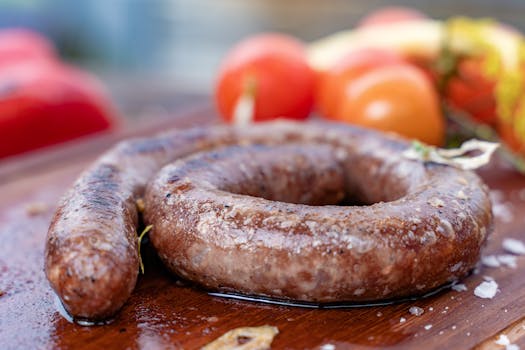
Boerewors
The diets react (see scores below)
Common Ingredients
- beef
- pork
- coriander
- cloves
- nutmeg
- vinegar
- salt
- black pepper
Specific recipes may vary.
Incompatible with 6 of 11 diets
Diet Ratings
Boerewors is a traditional South African sausage made primarily from beef and pork with spices, making it naturally high in fat and protein with minimal carbohydrates. The spices (coriander, cloves, nutmeg, black pepper) and vinegar contribute negligible net carbs per serving. The high fat content from beef and pork aligns well with ketogenic macros. The main consideration is that commercial boerewors may include fillers, breadcrumbs, or added sugars not listed here — homemade or butcher-made versions using only these listed ingredients are clearly keto-friendly.
Some strict keto practitioners flag processed and cured sausages as a caution category due to the risk of hidden fillers, starches, or sugars in commercial preparations, and the vinegar in some recipes may indicate added preservatives or sugar. They recommend verifying the ingredient label of store-bought versions before consumption.
Boerewors is a traditional South African sausage made primarily from beef and pork — both are animal flesh and entirely incompatible with a vegan diet. There is no ambiguity here: the primary ingredients are animal products, and no plant-based substitutes are present in this formulation. The spices (coriander, cloves, nutmeg, black pepper) and vinegar are vegan-friendly, but they are minor components that do not alter the fundamental non-vegan nature of the dish.
Boerewors is a traditional South African sausage that, while based on unprocessed meats (beef and pork) and paleo-friendly spices (coriander, cloves, nutmeg, black pepper), contains two clear paleo violations: added salt and vinegar (a fermented, processed product). More critically, boerewors is by definition a sausage — a processed meat product — which contradicts the paleo philosophy regardless of ingredient quality. Commercial boerewors also typically contains sausage casings and may include fillers or preservatives. The salt addition alone disqualifies it under strict paleo rules, and the processed/sausage format pushes it firmly into avoid territory. The spices themselves (coriander, cloves, nutmeg, black pepper) are paleo-approved, but they cannot redeem the dish's fundamental incompatibilities.
Boerewors is a traditional South African sausage made primarily from beef and pork, both of which are red meats. The Mediterranean diet strictly limits red meat to a few times per month, and processed meats such as sausages are among the foods most discouraged due to their high saturated fat content, added salt, and processing. Even though the spices used (coriander, cloves, nutmeg, black pepper) are wholesome, the core protein base — a blend of two red meats in sausage form — directly contradicts Mediterranean dietary principles. Processed red meat sausages fall into the category of foods associated with increased cardiovascular risk, which the Mediterranean diet is specifically designed to mitigate.
Boerewors is a traditional South African sausage made primarily from beef and pork — both animal-derived proteins fully compatible with carnivore in principle. However, it contains several plant-derived spices (coriander, cloves, nutmeg, black pepper) and vinegar, which push it into caution territory. The spice blend is integral to boerewors and cannot be omitted without fundamentally changing the dish. Most carnivore practitioners tolerate spices in small amounts and would likely consume boerewors without concern, but strict carnivore purists exclude all plant-derived ingredients including spices. Vinegar (typically derived from plant fermentation) is another minor point of contention. The meat base itself is solid — beef-dominant with a good fat ratio — so this is not an avoid, but the spice load is heavier than a simple seasoned sausage.
Strict carnivore adherents following the Lion Diet or a pure meat-only protocol would exclude boerewors entirely due to its multiple plant-derived spices and vinegar. Some practitioners also caution that coriander and other spices contain plant compounds (antinutrients, oxalates) that contradict the core rationale of the carnivore diet.
Boerewors, the traditional South African sausage, is made from beef, pork, and a blend of spices (coriander, cloves, nutmeg, black pepper) with vinegar and salt — all of which are Whole30-compatible ingredients. Vinegar is explicitly allowed on Whole30, and the spices used are natural and permitted. The core recipe as listed contains no excluded ingredients. However, commercial boerewors often includes fillers, binders, added sugars, or other non-compliant additives, so label-reading is essential when purchasing pre-made versions. Homemade boerewors using this ingredient list would be fully compliant.
While this ingredient list is technically Whole30-compliant, boerewors is a sausage product, and Melissa Urban's official guidance discourages over-reliance on processed meats as Whole30 staples. The community debates whether sausages — even compliant ones — honor the program's spirit of moving away from heavily processed food formats, though the official rules do not exclude compliant sausages.
Boerewors is a South African sausage made primarily from beef and pork with spices. The core ingredients — beef, pork, coriander seed, cloves, nutmeg, vinegar, salt, and black pepper — are all individually low-FODMAP. Ground spices like coriander, cloves, and nutmeg are used in small culinary quantities that do not contribute meaningful FODMAP load. Vinegar is low-FODMAP. The main concern with sausages on a low-FODMAP diet is undisclosed fillers or additives such as onion powder, garlic powder, wheat-based rusk, or breadcrumbs, which are common in commercial boerewors recipes to bind the mixture. Traditional boerewors recipes typically do not include onion or garlic, but commercial versions frequently do. The listed ingredients here contain none of these high-FODMAP additives, making this recipe low-FODMAP as described.
Commercial boerewors almost universally contains wheat-based rusk (beskuit) as a filler, which introduces fructans and makes the product high-FODMAP — clinical FODMAP practitioners would caution patients to verify the full ingredient list of any store-bought boerewors before consuming it during the elimination phase. Even homemade versions sometimes include onion, which would push it into the avoid category.
Boerewors is a traditional South African sausage made from beef and pork with significant amounts of added salt, making it high in sodium — a primary concern for DASH diet compliance. It also contains pork fat and a mix of beef and pork, contributing to elevated saturated fat content. DASH guidelines explicitly limit red meat, processed meats, and high-sodium foods. As a cured/seasoned sausage, boerewors falls squarely in the category of processed red meat that DASH recommends avoiding. The spices themselves (coriander, cloves, nutmeg, black pepper) are DASH-friendly, but they do not offset the fundamental issues of high sodium and saturated fat from the meat base.
Boerewors is a traditional South African sausage made primarily from beef and pork, heavily spiced with coriander, cloves, and nutmeg. From a Zone perspective, the protein content is workable — beef and pork can supply lean protein blocks — but boerewors is typically made with a significant fat content (often 30% fat by weight is legally required in South Africa), and much of that fat is saturated rather than the monounsaturated fats the Zone favors. The fat-to-protein ratio is unfavorable for Zone balance, meaning a portion sized for adequate protein (~25g) will likely deliver excess saturated fat well beyond the Zone's 10–15g monounsaturated target. The spice blend (coriander, cloves, nutmeg, vinegar) is Zone-neutral and even mildly anti-inflammatory. There are no carbohydrates of concern in the ingredients list, meaning boerewors functions purely as a protein-fat source and would need to be carefully paired with abundant low-glycemic vegetables and limited additional fat to approach a 40/30/30 block structure. It is not a Zone-favorable protein like skinless chicken or fish, but it is usable in moderation with portion control.
Some later Zone practitioners, influenced by Sears' evolving anti-inflammatory framework, argue that minimally processed, traditionally made red meat sausages with natural spices are preferable to processed foods high in omega-6 seed oils. In this view, a small portion of boerewors paired with polyphenol-rich vegetables could be acceptable. However, Dr. Sears' core Zone writings consistently classify fatty red meat and high-saturated-fat proteins as 'unfavorable,' making this a food that requires meaningful portioning discipline rather than routine inclusion.
Boerewors is a traditional South African sausage made primarily from beef and pork, which places it in the 'limit' or 'avoid' category under anti-inflammatory principles. Red meat (beef) is a known source of arachidonic acid and saturated fat, both associated with pro-inflammatory pathways and elevated inflammatory markers (CRP, IL-6) when consumed regularly. The pork component adds additional saturated fat. As a sausage, boerewors is a processed meat product, which is generally discouraged in anti-inflammatory frameworks due to potential additives, preservatives, and higher sodium content — though the traditional recipe listed here uses relatively clean ingredients without artificial additives. On the positive side, the spice blend is genuinely beneficial: coriander and black pepper have antioxidant and mild anti-inflammatory properties, and cloves contain eugenol, a well-documented anti-inflammatory compound. Nutmeg and vinegar are essentially neutral. The spice profile elevates this above the worst processed meat options, but it cannot offset the core pro-inflammatory protein sources. Occasional consumption as part of an otherwise anti-inflammatory diet is tolerable, but it should not be a regular feature.
Some functional nutrition practitioners note that traditionally made boerewors from grass-fed beef may contain a more favorable omega-6:omega-3 ratio than conventionally raised beef, making it less pro-inflammatory in practice — this view is supported by research distinguishing grass-fed from grain-fed red meat. However, mainstream anti-inflammatory frameworks including Dr. Weil's pyramid consistently place processed red meat sausages in the 'limit' category regardless of sourcing, and most updated guidelines recommend minimizing all processed meats.
Boerewors is a traditional South African sausage made from a blend of beef and pork, and by legal definition must contain at least 90% meat with a fat content that typically runs 20–30% of total weight. This high saturated fat load is a significant problem for GLP-1 patients: fat slows gastric emptying further on top of the medication's own effect, substantially increasing the risk of nausea, bloating, reflux, and upper GI discomfort. The pork component adds additional saturated fat beyond what a lean beef cut would contribute. While boerewors does deliver meaningful protein, the fat-to-protein ratio is unfavorable — a typical 100g serving provides roughly 13–15g protein alongside 20–25g fat, making it a poor vehicle for meeting protein targets efficiently. The spice profile (coriander, cloves, nutmeg, black pepper, vinegar) is relatively mild and unlikely to cause significant GI irritation on its own, but the fat content dominates the risk profile. As a processed fatty meat product it falls into the same category as sausage, bacon, and fatty red meat — all flagged for avoidance or strict limitation in GLP-1 dietary guidance.
Some GLP-1-aware dietitians note that if boerewors is grilled and excess fat is rendered off, protein delivery improves and fat content drops modestly, making occasional small-portion inclusion acceptable for patients with good GI tolerance. Others argue that any high-fat sausage product, regardless of preparation, consistently worsens satiety-related side effects and should remain off the plate during active weight loss on GLP-1 therapy.
*See how scores were generated at our methodology page.
Nutritional profile
Six traits that cut across every diet.
Fiber & Plants
How much whole-plant food and fiber it delivers.
Healthy Fats
The quality of its fats (unsaturated, omega-3).
Whole / Unprocessed
How close it is to its natural, unprocessed form.
Gut Gentle
How easy it is on digestion (low FODMAP, few irritants).
Low Glycemic
How little it spikes your blood sugar.
Protein Density
How much protein it packs per calorie.
Controversy Index
Higher controversy = more disagreement between diets.
Diet-Specific Tips
 Keto — 8/10
View tips
- High fat content from beef and pork aligns with 70-80% fat macro target
- Minimal net carbs from spices — negligible contribution to daily carb limit
- No grains, sugars, or starchy fillers in the listed ingredients
- Commercial versions may contain breadcrumbs or added sugars — label verification recommended
- Protein content is moderate to high, fitting the 20-25% protein range
- Whole-food ingredients with no artificial additives listed
 Carnivore — 5/10
View tips
- Beef and pork base is carnivore-compatible
- Coriander, cloves, nutmeg, and black pepper are plant-derived spices excluded by strict carnivore
- Vinegar is plant-fermented and debated
- Spice quantities in boerewors are significant — not trace seasoning
- No sugar, fillers, or grains listed — cleaner than many commercial sausages
- Most carnivore practitioners would tolerate this; purists would not
 Whole30 — 6/10
View tips
- All listed spices (coriander, cloves, nutmeg, black pepper) are Whole30-approved
- Vinegar is explicitly allowed on Whole30
- No excluded ingredients (no grains, dairy, legumes, added sugar, or soy) in the base recipe
- Commercial boerewors may contain fillers, binders, or added sugar — label-reading required
- Sausage format may be questioned in spirit, though not explicitly excluded by official rules
 Zone — 4/10
View tips
- High saturated fat content typical of sausage formulations (often 30%+ fat by weight) conflicts with Zone's monounsaturated fat preference
- Combined beef and pork base provides adequate protein blocks but at the cost of unfavorable fat profile
- No high-glycemic carbohydrates in the ingredient list — the dish is carb-neutral and must be paired with Zone-friendly carb sources
- Traditional spice blend (coriander, cloves, nutmeg) is Zone-neutral to mildly anti-inflammatory
- Portion control is critical — a Zone-appropriate protein serving will deliver disproportionate saturated fat
- Classified as 'unfavorable' protein in Zone terminology due to high fat and saturated fat content
 Anti-Inflammatory — 5/10
View tips
- Red meat (beef) as primary protein — associated with saturated fat and arachidonic acid, pro-inflammatory
- Pork adds additional saturated fat load
- Processed sausage format — elevated sodium, potential for higher inflammatory impact than whole cuts
- No omega-3 sources or anti-inflammatory vegetables present
- Coriander, cloves, black pepper, and nutmeg provide mild antioxidant and anti-inflammatory benefits
- Relatively clean ingredient list — no artificial additives, trans fats, or refined sugars
- Acceptable occasionally; not suitable as a regular anti-inflammatory meal anchor