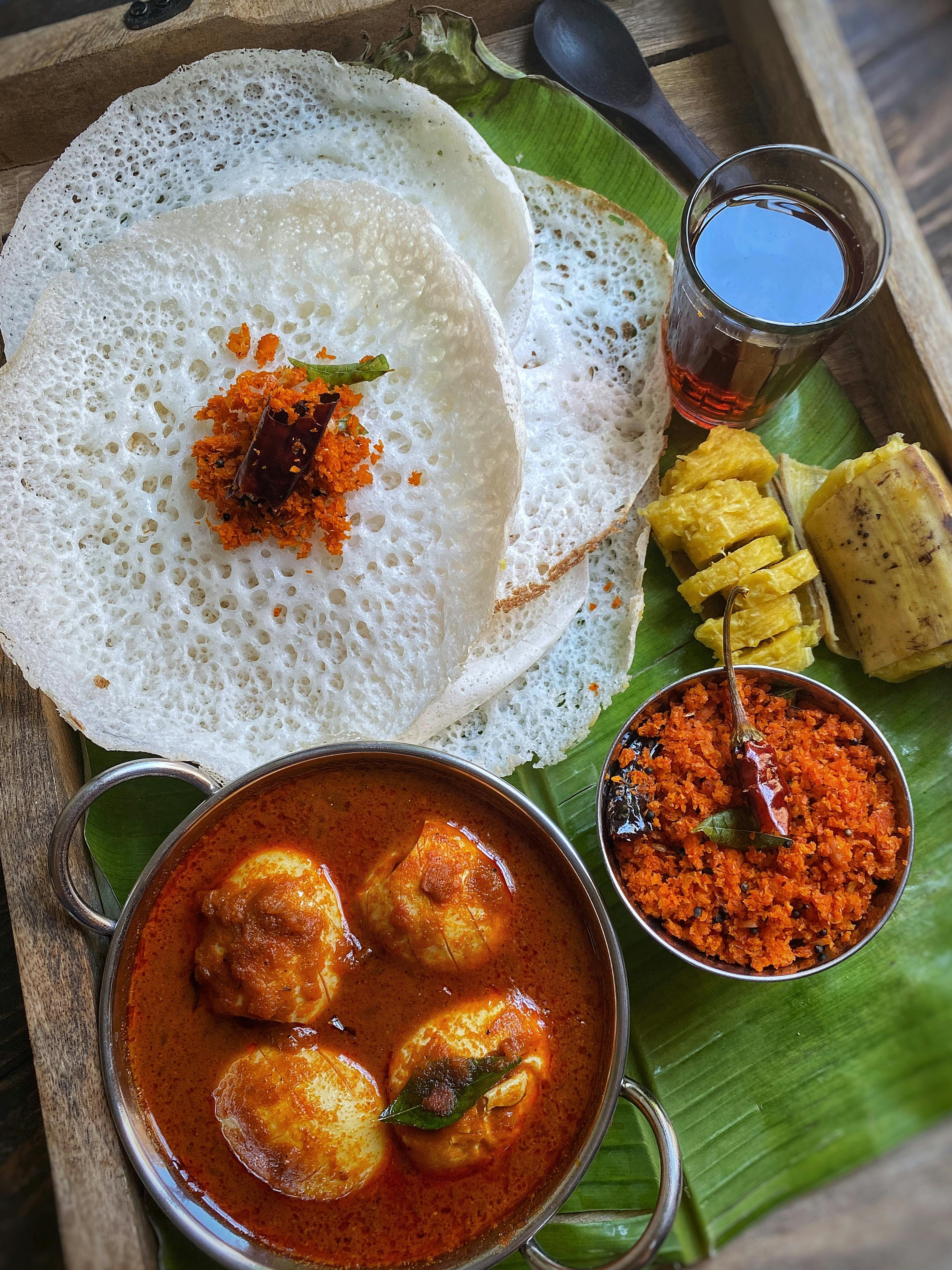
Photo: Saveurs Secretes / Pexels
The diets react (see scores below)
Common Ingredients
- rice
- coconut milk
- yeast
- sugar
- salt
- coconut
Specific recipes may vary.
Incompatible with 4 of 11 diets
Diet Ratings
Appam is a traditional South Indian fermented rice crepe that is fundamentally incompatible with a ketogenic diet. Rice is a high-glycemic grain with very high net carbs (a single appam contains approximately 20-25g net carbs), and added sugar is used in the fermentation batter. Together, even one or two appams can easily exceed the entire daily net carb allowance for ketosis. While coconut milk and coconut are keto-friendly ingredients, they are present in insufficient quantities to offset the dominant rice base. The yeast fermentation does reduce some carbohydrates slightly, but not nearly enough to make this dish keto-compatible. This is a grain-based food with added sugar — two absolute disqualifiers under ketogenic diet rules.
Appam is a traditional South Indian fermented rice pancake made entirely from plant-based ingredients. Rice, coconut milk, yeast, sugar, salt, and coconut are all fully vegan. The dish is naturally dairy-free and egg-free, unlike some other pancake or crepe traditions that rely on eggs or butter. Coconut milk serves as the plant-based fat and liquid base, making this a wholesome, minimally processed whole-food vegan breakfast. Fermentation via yeast is also entirely plant-compatible.
Appam is a traditional South Indian fermented rice pancake that is fundamentally incompatible with the paleo diet. Rice is a grain and is explicitly excluded from paleo eating. Additionally, the recipe includes added sugar and salt, both of which are non-paleo. While coconut and coconut milk are paleo-approved ingredients, they cannot redeem a dish built on a grain foundation. Yeast itself is a gray area in paleo, but is irrelevant here given the primary disqualifying ingredient is rice.
Appam is a fermented rice and coconut milk pancake. It uses white rice (a refined grain), which Mediterranean guidelines de-emphasize in favor of whole grains, but the fermentation process (via yeast) improves digestibility and has parallels in traditional Mediterranean fermented breads. Coconut milk and coconut are plant-based fats but are high in saturated fat, which is not aligned with the Mediterranean emphasis on olive oil as the primary fat source. However, coconut is a natural, minimally processed plant food, and some modern Mediterranean interpretations allow plant-based saturated fats in moderation. The small amount of added sugar is a minor concern. Overall, Appam is not a Mediterranean staple but is a whole, minimally processed, plant-based dish that can be consumed occasionally without significantly contradicting the diet's principles.
Traditional Mediterranean cuisine does not include coconut products, and strict clinical interpretations (e.g., PREDIMED guidelines) would flag the saturated fat from coconut milk as incompatible with the diet's cardiovascular goals. However, broader whole-food plant-based interpretations of the Mediterranean diet may accept coconut-based dishes occasionally, especially when the dish is naturally fermented and free of ultra-processed ingredients.
Appam is a fermented rice crepe made entirely from plant-based ingredients: rice (a grain), coconut milk, coconut, yeast, and sugar. It contains zero animal products and violates every tier of the carnivore diet. Rice is a grain explicitly excluded from carnivore, coconut and coconut milk are plant-derived, sugar is a processed plant product, and yeast-fermented foods with plant bases have no place in this dietary framework. This dish is fundamentally incompatible with carnivore principles at every level.
Appam is a traditional South Indian/Sri Lankan fermented rice pancake/crepe. It contains multiple excluded ingredients and violates the spirit of the program on two levels. First, rice is an excluded grain on Whole30, making this dish non-compliant regardless of other considerations. Second, added sugar is listed as an ingredient and is explicitly excluded. Third, even if those ingredients were swapped, Appam is a pancake/crepe-style dish, which falls squarely into the 'no recreating baked goods or junk food' rule — Whole30 explicitly lists crepes and pancakes as prohibited food forms even when made with compliant ingredients.
Appam is a South Indian fermented rice crepe made primarily from rice batter with coconut milk. The main ingredients are generally low-FODMAP: rice (low-FODMAP, gluten-free grain), small amounts of sugar and salt (low-FODMAP), and yeast (low-FODMAP in small quantities used for fermentation). The key concern is coconut milk, which is low-FODMAP at 1/2 cup (125ml) per Monash but becomes high-FODMAP at larger amounts due to polyols (sorbitol). Shredded/desiccated coconut is low-FODMAP at 1/4 cup but moderate-high at larger serves. A single appam typically uses a moderate amount of coconut milk in the batter, and when served traditionally with additional coconut milk on the side (stew or sweetened coconut milk), the cumulative coconut milk intake can exceed safe thresholds. Fermentation of the rice batter may slightly reduce FODMAP content. At 1-2 appams with controlled coconut milk quantity, this dish is likely low-FODMAP, but traditional serving styles often involve generous coconut milk, pushing it into caution territory.
Monash University rates coconut milk as low-FODMAP at ≤1/2 cup (125ml), but clinical FODMAP practitioners often advise caution with coconut milk-heavy dishes because the cumulative amount across batter and accompaniments frequently exceeds the safe threshold. The fermentation process may reduce some FODMAPs in the rice batter, but this benefit is not well-documented specifically for appam in Monash testing.
Appam is a South Indian fermented rice and coconut milk pancake. While it is made from a fermented base (which aids digestibility) and is naturally low in sodium when made at home, several DASH concerns arise: (1) Coconut milk and shredded coconut are high in saturated fat from tropical oils, which DASH explicitly limits. (2) White rice is a refined grain rather than the whole grain DASH emphasizes. (3) Added sugar, though small in quantity, contributes to the limit on sweets. On the positive side, appam is typically low in sodium, contains no red meat or trans fats, and is moderate in calories per piece. The primary concern is the saturated fat content from coconut milk and coconut, which places it in a 'caution' category — acceptable occasionally in small portions but not a DASH staple. If prepared with reduced coconut milk or light coconut milk, the score improves slightly.
NIH DASH guidelines explicitly restrict tropical oils including coconut due to high saturated fat content, placing coconut-heavy dishes in the caution or avoid zone. However, some updated clinical interpretations note that the medium-chain triglycerides (MCTs) in coconut may behave differently metabolically than long-chain saturated fats, and that traditional appam consumed in modest portions represents a culturally appropriate, low-sodium, minimally processed breakfast option that some DASH-oriented dietitians may allow in moderation.
Appam is a South Indian fermented rice pancake made primarily from white rice and coconut milk. From a Zone Diet perspective, it presents several challenges. White rice is a high-glycemic, 'unfavorable' carbohydrate in Zone terminology — Dr. Sears explicitly identifies refined grains as foods that spike insulin and disrupt the Zone hormonal balance. The fermentation process (yeast) does modestly lower the glycemic impact compared to plain white rice, which is a mitigating factor, but not enough to make appam a favorable Zone carb. Coconut milk and coconut contribute saturated fat (lauric acid), which Sears' earlier Zone writings cautioned against, though his later anti-inflammatory work is somewhat more permissive on certain saturated fats. Critically, appam contains no meaningful lean protein source, making it impossible to build a Zone-balanced meal from appam alone — it would need to be paired with substantial lean protein (egg whites, grilled fish, chicken) to approach the 40/30/30 ratio. The dish is predominantly a high-glycemic carbohydrate load with saturated fat, and virtually no protein. While a small portion of appam could technically be counted as a carb block in a larger Zone meal, its macro profile is poorly suited to Zone principles. It scores toward the lower end of 'caution' rather than 'avoid' only because fermentation slightly lowers GI and small portions are theoretically usable as a carb block.
Some Zone practitioners note that fermented foods have modestly lower glycemic responses than their unfermented counterparts, and that coconut's medium-chain triglycerides (MCTs) have a different metabolic profile than long-chain saturated fats. Dr. Sears' later writings on polyphenols and gut health also view fermented foods more favorably. In this framing, a single small appam paired with egg whites and vegetables could fit into a Zone breakfast — making it a workable 'unfavorable' carb block rather than a near-avoid food.
Appam is a traditional South Indian fermented rice and coconut milk crepe with a mixed anti-inflammatory profile. On the positive side, coconut milk and fresh coconut contain medium-chain triglycerides (MCTs) and lauric acid, which some research associates with anti-inflammatory and antimicrobial properties. The fermentation process (via yeast) improves digestibility and bioavailability of nutrients, and may enhance the gut microbiome — a meaningful anti-inflammatory benefit. On the negative side, the base is white rice, a refined carbohydrate with a moderate-to-high glycemic index that lacks the fiber and antioxidants of whole grains. White rice is associated with blood sugar spikes, which can trigger low-grade inflammatory responses. Added sugar, while small in quantity, is a minor pro-inflammatory flag. The dish is also relatively low in omega-3s, polyphenols, and other key anti-inflammatory compounds. Overall, Appam is a moderate, culturally traditional food — not strongly pro-inflammatory, but not a strong anti-inflammatory choice either. It is best consumed in moderation and paired with anti-inflammatory sides (e.g., vegetable-based curries with turmeric and legumes).
Coconut products are a point of contention: Dr. Weil's framework and mainstream nutrition research express caution over coconut milk's high saturated fat content (primarily lauric acid), viewing it as potentially pro-inflammatory in excess. However, proponents of ancestral and traditional diet approaches (e.g., Paleo, AIP communities) consider coconut's MCTs to be metabolically neutral or beneficial, and fermented rice preparations are valued in functional nutrition for their prebiotic effects.
Appam is a traditional South Indian fermented rice and coconut milk crepe/pancake. It is low in protein (primary protein listed as none), moderate in fat from coconut milk and coconut, and made primarily from refined/fermented rice — offering limited fiber and low nutrient density per calorie. The fermentation process does improve digestibility slightly, which is a minor positive for GLP-1 patients dealing with slowed gastric emptying. However, it falls short on the two top GLP-1 dietary priorities: it contributes negligible protein and minimal fiber. The coconut milk adds saturated fat, which can worsen GLP-1 GI side effects like nausea and bloating if consumed in larger portions. Sugar is added in the batter, contributing empty calories. On the positive side, appam is soft, light, and easy to digest, and individual portions are small. It is not fried and is not heavily processed. It could be acceptable in a small serving if paired with a high-protein accompaniment (e.g., egg curry, lentil stew) to meet protein goals, but on its own it is a poor choice for GLP-1 patients who must maximize nutritional value from limited caloric intake.
Some GLP-1-focused dietitians may be more permissive with fermented rice preparations due to improved glycemic response from fermentation and easier digestibility, particularly for patients struggling with GI side effects who need gentle, tolerable foods. Others would flag the saturated fat from coconut milk and the low protein-per-calorie ratio as disqualifying for a primary breakfast item, recommending it only as a small side if paired with significant protein.
*See how scores were generated at our methodology page.
Nutritional profile
Six traits that cut across every diet.
Fiber & Plants
How much whole-plant food and fiber it delivers.
Healthy Fats
The quality of its fats (unsaturated, omega-3).
Whole / Unprocessed
How close it is to its natural, unprocessed form.
Gut Gentle
How easy it is on digestion (low FODMAP, few irritants).
Low Glycemic
How little it spikes your blood sugar.
Protein Density
How much protein it packs per calorie.
Controversy Index
Higher controversy = more disagreement between diets.
Diet-Specific Tips
 Vegan — 9/10
View tips
- Rice is fully plant-based
- Coconut milk is a plant-derived dairy alternative
- Yeast is a plant-compatible leavening agent
- No eggs, dairy, or animal-derived ingredients present
- Fermented whole-food preparation aligns well with whole-food plant-based principles
- Traditional recipe requires no vegan substitutions — it is vegan by default
 Mediterranean — 5/10
View tips
- White rice rather than whole grain is a moderate concern
- Coconut milk and coconut are high in saturated fat, not aligned with olive oil-centric Mediterranean fat profile
- Fermentation via yeast is a positive, paralleling traditional Mediterranean fermented breads
- No animal protein, minimally processed, plant-based overall
- Small amount of added sugar is a minor negative
- Not a traditional Mediterranean dish, but not inherently harmful in moderation
 Low-FODMAP — 5/10
View tips
- Rice is low-FODMAP and gluten-free — safe base ingredient
- Coconut milk is low-FODMAP at ≤125ml but high-FODMAP at larger amounts (polyols/sorbitol)
- Fermentation of rice batter may reduce FODMAP load slightly
- Coconut (shredded) is low-FODMAP at 1/4 cup but moderate at larger serves
- Cumulative coconut milk from batter plus traditional accompaniments may exceed safe threshold
- Sugar, salt, and yeast in typical quantities are low-FODMAP
 DASH — 4/10
View tips
- High saturated fat from coconut milk and coconut — tropical oils limited by DASH
- Refined white rice rather than whole grain — DASH prefers whole grains
- Low sodium when traditionally prepared — a DASH positive
- No lean protein, limiting nutrient density per DASH recommendations
- Small amount of added sugar — DASH limits sweets
- Fermented preparation may improve digestibility but does not change macronutrient concerns
- Light or reduced-fat coconut milk substitution would improve DASH compatibility
 Zone — 5/10
View tips
- White rice base is a high-glycemic 'unfavorable' carbohydrate in Zone terminology — raises insulin significantly
- No lean protein present — appam cannot independently meet Zone's 30% protein requirement
- Coconut milk and coconut contribute saturated fat, which early Zone writings limited
- Fermentation (yeast) modestly lowers glycemic index compared to plain rice, a partial mitigating factor
- Added sugar further increases glycemic load
- Would require substantial lean protein pairing (fish, egg whites) to approach Zone balance
- Predominantly a carbohydrate-and-fat dish with no protein block contribution
 Anti-Inflammatory — 5/10
View tips
- White rice base is a refined carbohydrate with moderate-to-high glycemic index — mild pro-inflammatory concern
- Fermentation via yeast improves digestibility and supports gut microbiome health — anti-inflammatory benefit
- Coconut milk and fresh coconut provide MCTs and lauric acid — debated between beneficial and pro-inflammatory (saturated fat content)
- Small amount of added sugar — minor pro-inflammatory flag
- No omega-3 fatty acids, minimal polyphenols or antioxidants in the dish itself
- Neutral overall; context of the full meal (e.g., paired with vegetable/legume-based sides) strongly affects net inflammatory impact
 GLP-1 Friendly — 4/10
View tips
- Very low protein — does not contribute to the 15-30g per meal protein target
- Minimal dietary fiber — does not support the 25-30g daily fiber goal
- Coconut milk and coconut add saturated fat, which may worsen nausea and bloating on GLP-1s
- Added sugar contributes empty calories in a low-calorie eating context
- Fermentation slightly improves digestibility — a mild positive for GLP-1 patients
- Soft texture and small portion size are GLP-1-friendly
- Acceptable only if paired with a high-protein accompaniment; poor standalone breakfast choice