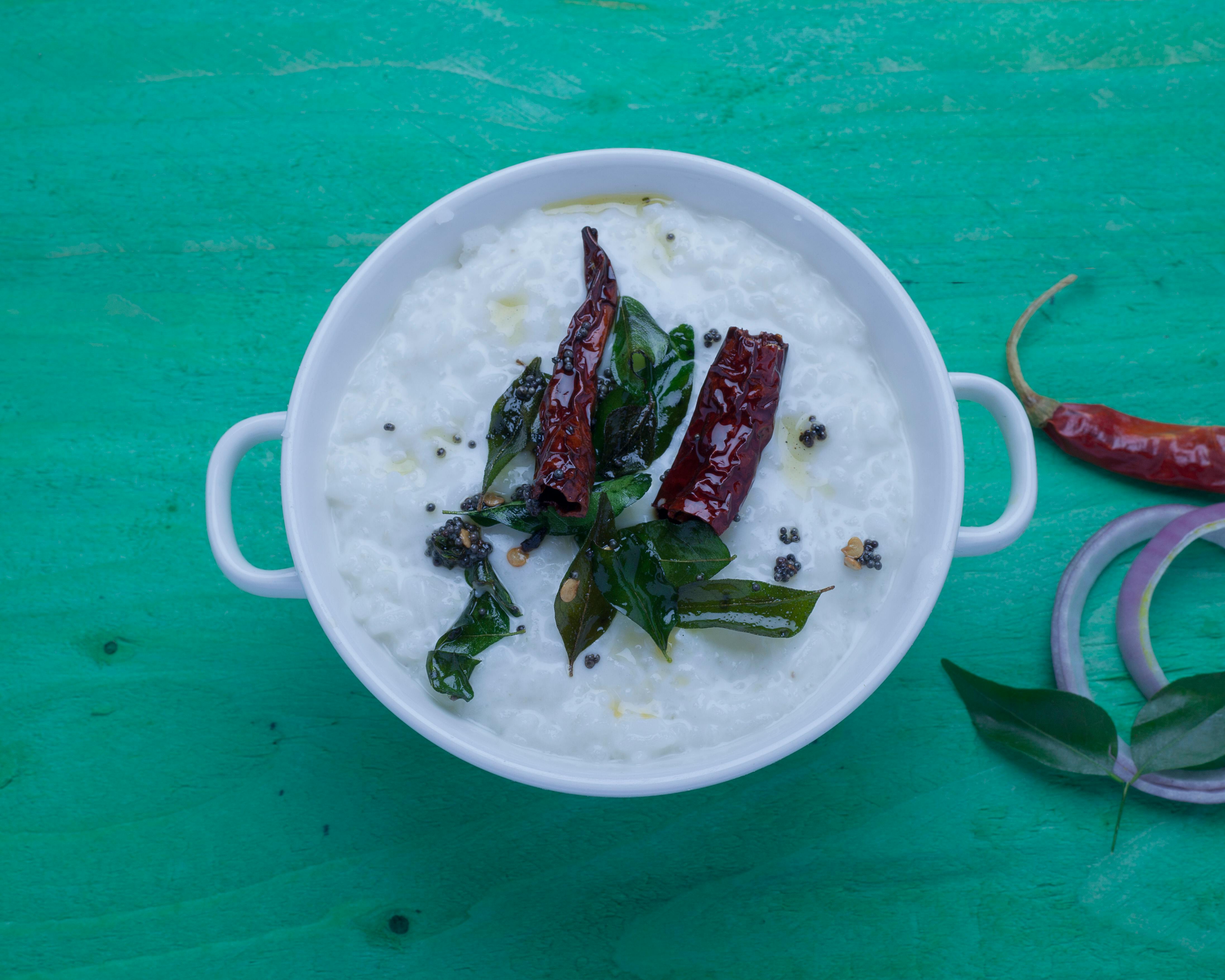
Photo: Milton Das / Pexels
The diets react (see scores below)
Common Ingredients
- rice
- yogurt
- mustard seeds
- curry leaves
- green chiles
- ginger
- cashews
- cilantro
Specific recipes may vary.
Incompatible with 5 of 11 diets
Diet Ratings
Curd Rice is fundamentally incompatible with a ketogenic diet. The primary ingredient, rice, is a high-glycemic grain with approximately 45g of net carbs per cooked cup — a single standard serving would likely exceed the entire daily net carb allowance for keto. There is no viable way to consume this dish in meaningful portions while maintaining ketosis. The yogurt adds additional carbs from lactose, and cashews, while often used in small amounts, contribute further net carbs. The aromatics (mustard seeds, curry leaves, green chiles, ginger, cilantro) are keto-friendly in the quantities used, but they cannot offset the massive carbohydrate load from rice, which is the dish's foundational ingredient.
Curd Rice contains yogurt, which is a dairy product made from cow's or buffalo's milk. Dairy is an animal-derived ingredient and is unambiguously excluded from a vegan diet. All other ingredients — rice, mustard seeds, curry leaves, green chiles, ginger, cashews, and cilantro — are fully plant-based, but the yogurt disqualifies the dish entirely. A vegan version could be made by substituting dairy yogurt with plant-based yogurt (coconut, cashew, or soy-based), which is a common adaptation in vegan Indian cooking.
Curd Rice contains two major non-paleo ingredients that are clear violations: rice (a grain, explicitly excluded from the paleo diet) and yogurt (a dairy product, excluded under standard paleo rules). These are not minor or debated ingredients — both represent foundational exclusions in paleo philosophy. Rice is a grain with anti-nutrients and was not a staple of Paleolithic diets, and yogurt is a processed dairy product. The remaining ingredients — mustard seeds, curry leaves, green chiles, ginger, cashews, and cilantro — are individually paleo-friendly, but they cannot redeem a dish whose two primary components are off-limits. This dish is fundamentally incompatible with the paleo diet.
Curd Rice is a traditional South Indian dish combining cooked white rice with yogurt (curd), tempered with mustard seeds, curry leaves, green chiles, ginger, cashews, and cilantro. From a Mediterranean diet perspective, the dish has both positive and problematic elements. The yogurt is a fermented dairy product consistent with moderate Mediterranean dairy consumption, and the aromatics (ginger, curry leaves, green chiles, cilantro) and cashews align well with plant-forward principles. However, the base is white rice — a refined grain — rather than a whole grain, which conflicts with Mediterranean guidelines favoring whole grains like barley, farro, or brown rice. The dish lacks olive oil (using no added fat beyond the tempering, which may use neutral oil or ghee), and it is nutritionally limited as a protein source. Overall, it is acceptable in moderation but not a Mediterranean staple.
Some Mediterranean diet interpreters note that white rice is traditional in parts of southern Europe (e.g., Spain, Greece, Italy) and is acceptable in moderation within the dietary pattern. Under this view, the yogurt base and plant-based aromatics could push the score slightly higher. However, modern clinical Mediterranean diet guidelines (e.g., PREDIMED protocol) consistently favor whole grains over refined white rice.
Curd Rice is fundamentally incompatible with the carnivore diet. The primary ingredient is rice, a grain that is strictly excluded from all tiers of the carnivore diet. While yogurt is an animal-derived dairy product, it is outnumbered by a host of plant-based ingredients: mustard seeds, curry leaves, green chiles, ginger, cashews, and cilantro — all of which are explicitly excluded from carnivore. Even the most lenient 'animal-based' practitioners who include dairy and some plant foods would not consider this dish carnivore-compatible given that rice forms its base and plant ingredients dominate throughout.
Curd Rice contains two excluded ingredients: rice (a grain, explicitly excluded on Whole30) and yogurt (dairy, explicitly excluded on Whole30). These are foundational components of the dish, not optional add-ons, making the dish incompatible with the Whole30 program. The remaining ingredients — mustard seeds, curry leaves, green chiles, ginger, cashews, cilantro — are all compliant, but the dish cannot be made without its two defining ingredients without becoming an entirely different dish.
Curd Rice contains several low-FODMAP ingredients (white rice, mustard seeds, curry leaves, ginger, cilantro, green chiles) but is anchored by yogurt, which is the primary FODMAP concern. Yogurt contains lactose, making it high-FODMAP at standard servings (>2/3 cup per Monash). A typical serving of curd rice uses a substantial amount of yogurt — often 1/2 to 1 cup per portion — which is likely to exceed the Monash low-FODMAP threshold of approximately 2/3 cup (170g). Additionally, cashews are low-FODMAP only at a small serving of 10 nuts (about 15g); larger handfuls commonly used in tempering can push into moderate-to-high GOS territory. White rice itself is safely low-FODMAP. The dish as traditionally prepared is borderline: technically achievable within low-FODMAP limits if lactose-free yogurt is substituted and cashews are strictly portioned, but standard preparation is likely to be problematic due to lactose load.
Monash University rates yogurt as low-FODMAP at up to 2/3 cup (170g), but many clinical FODMAP practitioners advise avoiding regular yogurt entirely during strict elimination due to practical portion creep and the fact that curd rice is yogurt-forward by design. Substituting lactose-free yogurt resolves the core issue, but the dish as traditionally made remains a caution. Cashews at >10 nuts also add meaningful GOS that strict practitioners would flag.
Curd Rice is a South Indian dish combining cooked rice with yogurt and aromatic tempering. From a DASH perspective, it has several positive attributes: yogurt provides calcium and probiotics, and the aromatics (mustard seeds, curry leaves, ginger, green chiles, cilantro) add nutrients with minimal sodium. However, traditional curd rice typically uses full-fat yogurt, which DASH explicitly limits in favor of low-fat or fat-free dairy. The rice used is generally white rice rather than a DASH-preferred whole grain. Cashews add healthy unsaturated fats but also calories and should be portion-controlled. Sodium content depends heavily on preparation — if salt is added generously (common in traditional recipes), it can push the dish toward a cautious rating. Made with low-fat yogurt, brown rice, and minimal salt, this dish could edge toward approval. As commonly prepared with white rice and full-fat yogurt, it lands in the caution zone — acceptable in moderation but not optimized for DASH.
NIH DASH guidelines specify low-fat dairy, which would flag the full-fat yogurt commonly used in curd rice. However, updated clinical interpretations note emerging evidence that full-fat fermented dairy (like yogurt) may not negatively impact cardiovascular outcomes and may even confer benefits via probiotics — some DASH-oriented dietitians now permit full-fat yogurt in moderation, which would raise this dish's score closer to 6-7.
Curd Rice is a South Indian comfort dish where rice and yogurt are the dominant macronutrients, creating significant Zone challenges. White rice is a high-glycemic carbohydrate that Sears classifies as 'unfavorable' — it raises blood sugar rapidly and is dense in carb blocks (roughly 45g net carbs per cup cooked), making it easy to blow the 40% carb ceiling while providing little fiber or polyphenol benefit. Yogurt contributes some protein and fat, but full-fat yogurt also adds saturated fat, and the protein content is modest relative to the carb load from rice. The dish as traditionally prepared would be heavily carb-dominant, likely 60-70% carbs by calories, far outside Zone ratios. However, Zone is ratio-based, not exclusion-based: a small portion of curd rice (perhaps 1/3 cup) alongside lean protein and non-starchy vegetables could theoretically be incorporated into a Zone meal as the carbohydrate block component. The aromatics — mustard seeds, curry leaves, green chiles, ginger, cilantro — are Zone-positive polyphenol contributors. Cashews add monounsaturated fat but also carbs. The dish has no lean protein source listed, and the yogurt protein alone is insufficient for a Zone meal. As a side dish (not a full meal), it can function as a carb block substitute if portioned tightly, but the high-GI rice and carb-heavy profile make it a caution rather than an approve.
Some Zone practitioners and Sears' later writings (The OmegaRx Zone, Toxic Fat) emphasize anti-inflammatory eating over strict GI rankings, noting that yogurt's fermented nature, protein, and calcium are beneficial. If made with brown rice instead of white, the GI drops significantly and the dish becomes more Zone-compatible. Additionally, a small portion paired with fish or chicken could serve as the carbohydrate block in a balanced Zone meal, making some coaches treat it as acceptable rather than cautionary.
Curd Rice is a mixed profile dish from an anti-inflammatory standpoint. On the positive side, it contains several anti-inflammatory ingredients: yogurt provides probiotics that support gut health and may reduce systemic inflammation; mustard seeds contain omega-3 ALA and antioxidant glucosinolates; curry leaves are rich in antioxidants and have shown anti-inflammatory properties in research; ginger is a well-established anti-inflammatory spice; green chiles contribute capsaicin, which has anti-inflammatory effects; and cilantro adds modest polyphenol content. Cashews provide some healthy fats and minerals, though they are higher in omega-6 than ideal. The primary concern is white rice, which is a refined carbohydrate with a high glycemic index that can promote insulin spikes and mild inflammatory responses. The yogurt component is low-fat dairy, which falls in the 'moderate' category. If made with whole grain or brown rice, the dish would score meaningfully higher. As a side dish in a broader meal, the refined rice concern is somewhat mitigated. The spice profile — especially ginger, green chiles, mustard seeds, and curry leaves — is genuinely impressive and pulls the dish toward neutral-to-positive territory, preventing a lower score.
Some anti-inflammatory practitioners, particularly those following Dr. Weil's guidance, would view the probiotic-rich yogurt and the exceptional spice blend as strong positives that largely offset the white rice concern, potentially rating this dish higher. Conversely, practitioners following low-glycemic anti-inflammatory protocols or those addressing gut dysbiosis may flag both the refined rice and dairy components more heavily, rating this lower.
Curd rice is a traditional South Indian dish combining cooked rice with yogurt, tempered with mustard seeds, curry leaves, green chiles, ginger, cashews, and cilantro. It is easy to digest, cooling, and gentle on the stomach — qualities that can be genuinely helpful for GLP-1 patients experiencing nausea or GI distress. The yogurt contributes some protein and probiotics, and the dish is low in fat overall (cashews add modest fat). However, the primary caloric base is white rice — a refined grain with low fiber, low protein density, and high glycemic load. For GLP-1 patients eating significantly fewer calories, a dish where the majority of volume comes from refined carbohydrates offers poor nutritional return per bite. Protein content is low (roughly 5-8g per serving from yogurt alone), well below the 15-30g per meal target. Fiber is minimal. The green chiles may cause mild GI irritation in sensitive patients. As a side dish in a small portion paired with a high-protein main, it is more acceptable, but as a standalone meal or large portion, it underdelivers on the two top priorities for GLP-1 patients.
Some GLP-1-focused dietitians may recommend curd rice specifically on high-nausea days or post-injection days due to its exceptional digestibility and soothing texture, accepting the low protein density as a temporary trade-off. Others would suggest swapping white rice for brown rice or cauliflower rice and increasing the yogurt ratio to meaningfully improve protein and fiber content without losing the dish's palatability.
*See how scores were generated at our methodology page.
Nutritional profile
Six traits that cut across every diet.
Fiber & Plants
How much whole-plant food and fiber it delivers.
Healthy Fats
The quality of its fats (unsaturated, omega-3).
Whole / Unprocessed
How close it is to its natural, unprocessed form.
Gut Gentle
How easy it is on digestion (low FODMAP, few irritants).
Low Glycemic
How little it spikes your blood sugar.
Protein Density
How much protein it packs per calorie.
Controversy Index
Higher controversy = more disagreement between diets.
Diet-Specific Tips
 Mediterranean — 5/10
View tips
- White rice is a refined grain, not aligned with whole-grain Mediterranean preference
- Yogurt is an accepted dairy component in moderate Mediterranean consumption
- Cashews, mustard seeds, curry leaves, ginger, and cilantro are plant-forward and beneficial
- No olive oil used; traditional tempering fat may be ghee or neutral oil, not Mediterranean
- Dish is low in fiber and protein relative to Mediterranean meal ideals
- Fermented dairy (yogurt) provides probiotic benefit consistent with Mediterranean principles
 Low-FODMAP — 5/10
View tips
- Yogurt (lactose) is the primary FODMAP risk — high lactose load at standard curd rice portions exceeds Monash threshold
- Lactose-free yogurt substitution would significantly improve FODMAP safety
- Cashews are low-FODMAP only at ≤10 nuts (~15g); typical tempering quantities may exceed this
- White rice is safely low-FODMAP at any reasonable serving
- Curry leaves, mustard seeds, green chiles, ginger, and cilantro are all low-FODMAP
- Traditional preparation is unlikely to be elimination-phase safe without ingredient modifications
 DASH — 5/10
View tips
- Full-fat yogurt is standard in traditional preparation, conflicting with DASH low-fat dairy guidance
- White rice is less preferred than whole grains under DASH principles
- Low natural sodium from ingredients, but added salt in preparation is common
- Beneficial aromatics (mustard seeds, curry leaves, ginger) align with DASH anti-inflammatory emphasis
- Cashews contribute healthy fats but add caloric density requiring portion control
- Substituting low-fat yogurt and brown rice would significantly improve DASH compatibility
 Zone — 4/10
View tips
- White rice is a high-glycemic 'unfavorable' carbohydrate per Sears — raises insulin significantly
- Dish is heavily carb-dominant (60-70%+ calories from carbs), outside the 40% Zone ceiling
- No lean protein source — yogurt provides some protein but insufficient for a Zone protein block
- Yogurt contributes saturated fat; full-fat versions further complicate Zone fat ratios
- Cashews add monounsaturated fat (Zone-positive) but also additional carbohydrate load
- Polyphenol-rich aromatics (ginger, curry leaves, chiles, cilantro) are anti-inflammatory positives
- Tight portion control (small side serving) could fit as a carb block in a balanced Zone meal
- Substituting brown rice would improve glycemic profile and Zone compatibility
 Anti-Inflammatory — 5/10
View tips
- White rice is a refined carbohydrate with high glycemic index — primary inflammatory concern
- Yogurt provides beneficial probiotics supporting gut health and reducing systemic inflammation
- Ginger is a well-documented anti-inflammatory spice (inhibits COX-2 and NF-κB pathways)
- Mustard seeds contain ALA omega-3 fatty acids and antioxidant glucosinolates
- Curry leaves are rich in carbazole alkaloids with demonstrated antioxidant and anti-inflammatory activity
- Green chiles contribute capsaicin, which reduces inflammatory cytokines
- Cashews are modest in anti-inflammatory value — healthy fats but relatively higher omega-6 ratio
- Dish scores better as part of a varied anti-inflammatory meal than as a standalone dish
 GLP-1 Friendly — 4/10
View tips
- Low protein density — yogurt provides some protein but white rice contributes negligible protein, well below the 15-30g per meal target
- Low fiber — white rice is a refined grain with minimal fiber, missing the 25-30g daily target
- High glycemic carbohydrate base — white rice offers poor nutrient density per calorie for GLP-1 patients with reduced appetite
- Digestibility is a genuine strength — one of the easiest dishes on the GI tract, beneficial for nausea or post-injection days
- Yogurt provides probiotics and modest protein — a positive factor, though insufficient alone
- Cashews add unsaturated fat in small amounts — acceptable but marginally increases caloric density without proportional nutritional benefit
- Green chiles may worsen reflux or nausea in sensitive GLP-1 patients
- Portion-sensitive — more acceptable in small amounts as a side alongside a high-protein main dish