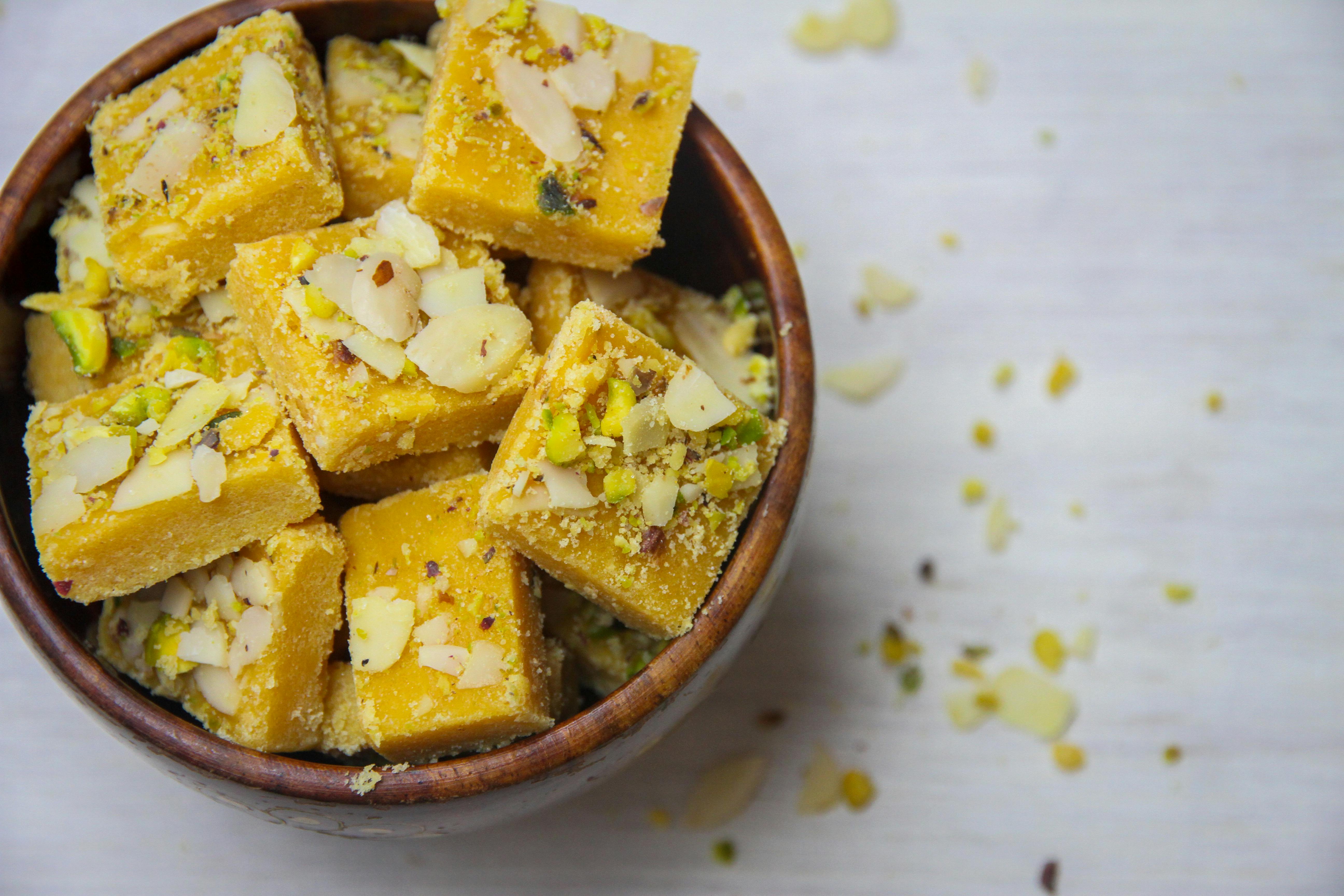
Photo: Pure Punjabi / Pexels
The diets react (see scores below)
Common Ingredients
- gram flour
- ghee
- sugar
- water
- cardamom
Specific recipes may vary.
Incompatible with 11 of 11 diets
Diet Ratings
Mysore Pak is a traditional Indian sweet made primarily from gram flour (chickpea flour), large quantities of sugar, and ghee. While ghee is keto-friendly, the dominant ingredients — sugar and gram flour — make this dish entirely incompatible with ketosis. Sugar is pure sucrose providing massive net carbs with zero fiber benefit, and gram flour (besan) carries approximately 50-60g of net carbs per 100g. A single piece of Mysore Pak typically contains 20-30g of net carbs, which alone can exceed or completely consume an entire day's keto carb allowance. There is no realistic portion size that makes this food compatible with ketogenic diet principles.
Mysore Pak contains ghee, which is clarified butter — a dairy product derived from cow's milk and therefore a clear animal product. This makes the dish incompatible with a vegan diet. The remaining ingredients (gram flour, sugar, water, cardamom) are all plant-based, but ghee is a defining and essential ingredient in authentic Mysore Pak, typically used in generous quantities. There is no ambiguity here: ghee is firmly excluded under all mainstream vegan definitions.
Mysore Pak is fundamentally incompatible with the Paleo diet. The dish's two primary structural ingredients — gram flour (made from chickpeas, a legume) and sugar (refined) — are both firmly on the Paleo exclusion list. Gram flour is a legume-derived product, prohibited due to its anti-nutrient content (lectins, phytates). Refined sugar is excluded as a processed food with no Paleolithic precedent. Ghee occupies a gray area in Paleo, and cardamom is fine, but these two compliant-leaning ingredients cannot redeem a dish whose foundation is built on non-Paleo foods. This is not a close call.
Mysore Pak is a traditional Indian sweet made primarily from gram flour, ghee, and sugar — a combination that directly contradicts Mediterranean diet principles. While gram flour (chickpea flour) is a legume-based ingredient that would otherwise be acceptable, it is used here in the context of a high-sugar, high-saturated-fat confection. Ghee (clarified butter) is high in saturated fat and is not a recognized fat source in the Mediterranean diet, where extra virgin olive oil is the canonical primary fat. The large quantity of added sugar makes this a high-glycemic, nutrient-poor food from a Mediterranean diet perspective. The dish falls squarely into the 'minimal added sugars and processed/refined foods' category that the Mediterranean diet actively discourages. It offers no meaningful fiber, healthy fats, or micronutrient density in the form it is consumed.
Mysore Pak is an Indian sweet confection made entirely from plant-based and processed ingredients: gram flour (a legume-based flour), sugar, water, and cardamom (a plant spice). While ghee is an animal-derived fat, it is merely one component in a dish that is otherwise completely incompatible with the carnivore diet. Gram flour is a legume product, sugar is a processed carbohydrate, and cardamom is a plant spice — all explicitly excluded from the carnivore diet. This dish has no animal protein, is high in carbohydrates, and represents the opposite of carnivore principles.
Mysore Pak contains two excluded ingredients: gram flour (chickpea/besan flour, which is a legume-based flour and therefore excluded on Whole30) and sugar (added sugar, explicitly excluded). Additionally, even if those ingredients were replaced, Mysore Pak is a traditional Indian confection — a sweet, dense fudge-like candy — which falls squarely into the 'no recreating junk food/sweets' prohibition. There is no compliant version of this dish possible given its fundamental nature as a sugar-based confection made from legume flour.
Mysore Pak is primarily made from gram flour (besan/chickpea flour), which is high in GOS (galacto-oligosaccharides) — a major FODMAP category derived from legumes. Gram flour is high-FODMAP even at relatively small serving sizes (Monash rates chickpea/besan flour as high-FODMAP at just 2/3 tablespoon per serve). A standard portion of Mysore Pak would contain a significant quantity of gram flour, making it unsuitable during the elimination phase. The remaining ingredients — ghee, sugar, water, and cardamom — are low-FODMAP and not a concern. However, the foundational ingredient (gram flour) makes this sweet clearly high-FODMAP at any standard serving.
Mysore Pak is a traditional Indian confection made primarily from gram flour, ghee, and sugar — a combination that directly conflicts with core DASH diet principles. Ghee is clarified butter, an animal fat extremely high in saturated fat (approximately 60-65% saturated fat by composition). DASH explicitly limits saturated fat and full-fat dairy-derived fats. The dish is also very high in added sugar and total calories, with minimal fiber relative to the gram flour content due to the cooking process and ratio of ingredients. While gram flour (chickpea flour) itself is a legume-based ingredient with some DASH-friendly properties (fiber, protein, magnesium), it is used in small proportion relative to the ghee and sugar. The overall nutritional profile — high saturated fat, high added sugar, calorie-dense, negligible potassium or beneficial micronutrients per serving — places this firmly in the 'avoid' category. DASH guidelines explicitly limit sweets and foods high in saturated fat, both of which characterize this dessert snack.
Mysore Pak is a traditional Indian sweet made almost entirely of sugar, ghee, and gram flour — a combination that makes it extremely difficult to incorporate into any Zone-balanced meal. Sugar is a high-glycemic carbohydrate that spikes insulin rapidly and offers no fiber or nutritional value beyond empty calories, directly opposing Zone principles. Ghee (clarified butter) is a saturated fat source with no monounsaturated fat benefit, which conflicts with the Zone's preference for olive oil, avocado, and almonds. Gram flour (besan) does provide some protein and is lower-glycemic than refined flour, but in this preparation it is overwhelmed by the sugar and ghee content. The dish has no lean protein component, no low-glycemic vegetables, and no monounsaturated fat — meaning all three Zone macronutrient pillars are violated simultaneously. There is no realistic portioning strategy that would allow Mysore Pak to fit into a Zone block framework without creating a severe carbohydrate and saturated fat surplus. It is essentially a confection, placing it firmly in 'avoid' territory alongside candy and pure sugar sources.
Mysore Pak is a traditional South Indian sweet made almost entirely of pro-inflammatory ingredients. Ghee is a saturated fat that the anti-inflammatory framework places in the 'limit' category, and in Mysore Pak it is used in very large quantities — often at a near 1:1 ratio with gram flour by weight, making it the dominant macronutrient. Sugar is the second major ingredient and a primary driver of inflammation through glycation, elevated blood glucose, and suppression of immune function. The combination of high saturated fat and high refined sugar in a single dense confection is precisely the nutritional profile that anti-inflammatory protocols flag as problematic. Gram flour (chickpea flour) is the one redeeming ingredient — it provides plant protein and fiber, and chickpeas are generally anti-inflammatory — but it is structurally overwhelmed here by ghee and sugar. Cardamom is a mildly anti-inflammatory spice but contributes negligibly at culinary doses. There is no meaningful omega-3 content, no significant antioxidant load, and no fiber advantage given the sugar and fat context. This is an occasional treat food even within traditional dietary frameworks, and it clearly falls in the avoid category for anyone following anti-inflammatory principles regularly.
Mysore Pak is a traditional South Indian sweet made primarily from gram flour (besan), large quantities of ghee, and sugar — a combination that makes it a poor fit for GLP-1 patients on nearly every criterion. It is calorie-dense with almost no protein contribution per serving despite containing gram flour (the ghee and sugar dominate the macronutrient profile). The very high saturated fat content from ghee directly worsens the GLP-1 side effect profile — nausea, bloating, and reflux are all exacerbated by high-fat foods due to slowed gastric emptying. The high sugar content spikes blood glucose and provides empty calories, directly counterproductive when patients are eating far less and need every calorie to be nutritionally meaningful. It has negligible fiber. The dense, rich texture is difficult to digest and small portions offer no meaningful nutritional return. Cardamom is the only ingredient with no drawbacks, but it cannot offset the profile of the rest of the dish.
*See how scores were generated at our methodology page.
Nutritional profile
Six traits that cut across every diet.
Fiber & Plants
How much whole-plant food and fiber it delivers.
Healthy Fats
The quality of its fats (unsaturated, omega-3).
Whole / Unprocessed
How close it is to its natural, unprocessed form.
Gut Gentle
How easy it is on digestion (low FODMAP, few irritants).
Low Glycemic
How little it spikes your blood sugar.
Protein Density
How much protein it packs per calorie.
Controversy Index
Higher controversy = more disagreement between diets.