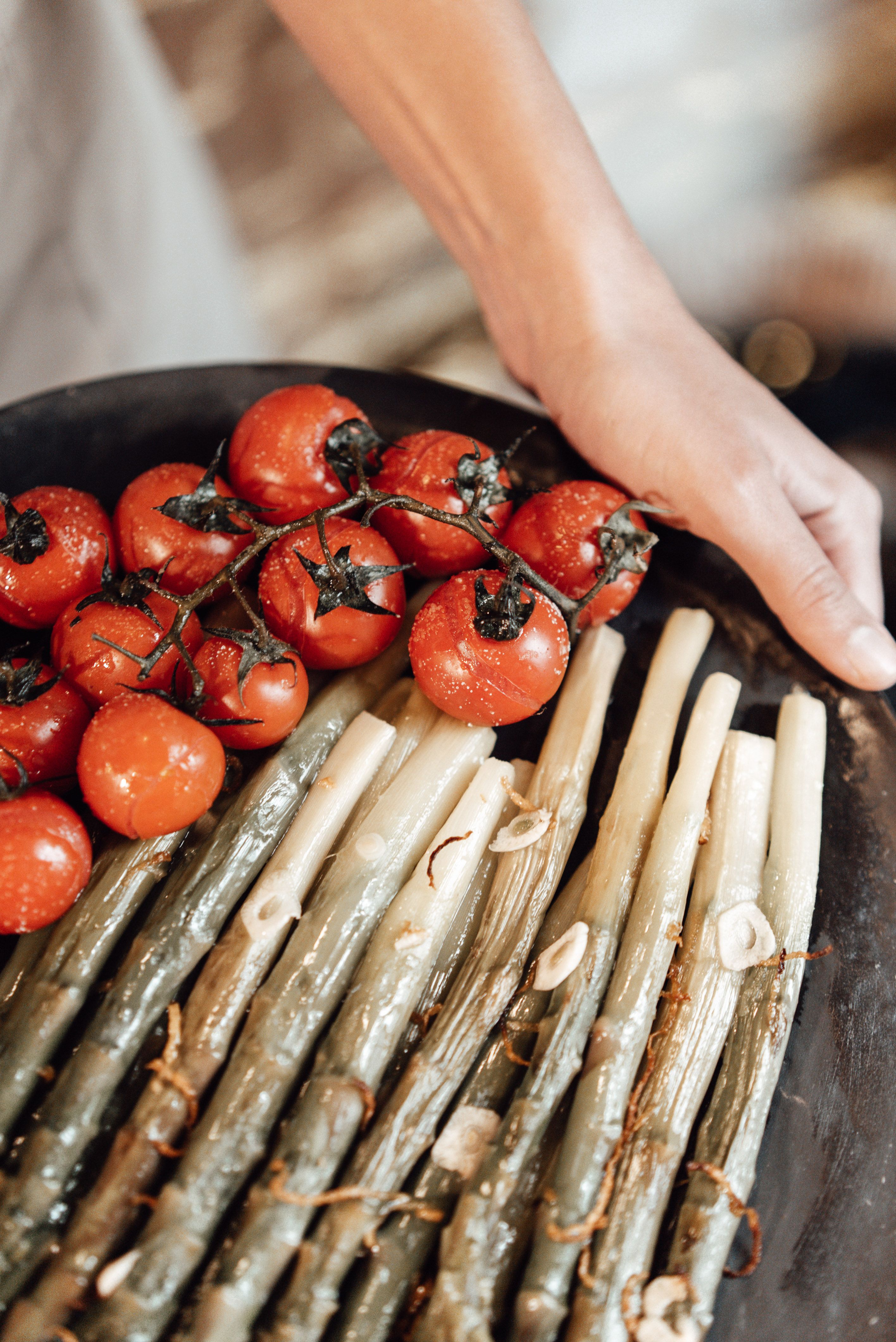
Photo: furkanfdemir / Pexels
Spanish
Calcots con Romesco
The diets react (see scores below)
Common Ingredients
- calcots
- tomatoes
- red peppers
- almonds
- hazelnuts
- garlic
- olive oil
- sherry vinegar
Specific recipes may vary.
Incompatible with 3 of 11 diets
Diet Ratings
Calcots con Romesco presents a mixed keto profile. The romesco sauce itself is relatively keto-friendly — almonds, hazelnuts, olive oil, garlic, red peppers, and tomatoes contribute healthy fats and moderate carbs manageable in small portions. However, the primary ingredient, calcots (a type of green onion/spring onion from Catalonia), are the main concern. Calcots are sweeter and starchier than regular scallions, with a notably higher carbohydrate content, especially when served in traditional quantities (typically 10-20 per person). A standard serving of 10 calcots could contribute 15-25g net carbs from the calcots alone, before accounting for the tomatoes and red peppers in the romesco. In small, controlled portions (3-5 calcots with romesco), the dish could fit within a daily keto budget, but traditional serving sizes make it risky for maintaining ketosis.
Some lazy keto or flexible keto practitioners argue that calcots, being allium vegetables, are acceptable given their fiber content and the nutrient density of the dish overall, especially when total daily carbs are tracked carefully. Strict keto adherents, however, would flag both the calcots' sugar content and the tomato/red pepper base of romesco as too carb-heavy for regular inclusion.
Calcots con Romesco is an entirely plant-based dish. Calcots are a type of green onion/spring onion native to Catalonia, traditionally grilled over an open flame. The romesco sauce is made from tomatoes, red peppers, almonds, hazelnuts, garlic, olive oil, and sherry vinegar — all whole plant foods. Every ingredient in this dish is derived from plants, with no animal products or animal-derived ingredients present. The dish is also predominantly whole food in nature, with minimally processed components, which earns it a high score within the approve range.
Calcots con Romesco is largely paleo-friendly, built on whole vegetables, nuts, and olive oil. Calcots (a type of green onion/scallion), tomatoes, red peppers, almonds, hazelnuts, and garlic are all unprocessed plant foods clearly available to hunter-gatherers. Olive oil is a preferred paleo fat. The primary concern is sherry vinegar: vinegar is a fermented, processed product and while not explicitly a grain, legume, or dairy, strict paleo interpretations exclude it as a processed additive. Most mainstream paleo practitioners and resources (Mark Sisson, Whole30) do permit small amounts of vinegar — including apple cider and wine-based vinegars — as a flavoring agent, placing this ingredient in a gray zone rather than a hard exclusion. The dish as a whole is minimally processed and nutrient-dense, keeping it in solid caution-to-approve territory, but the sherry vinegar just prevents a clean approve.
Strict Cordain-school paleo excludes all fermented/processed condiments including vinegar, as it is not a food a Paleolithic human would have had access to in refined form. Under this interpretation, the romesco sauce would need the vinegar omitted entirely to qualify.
Calcots con Romesco is an exemplary Mediterranean dish from Catalonia. Calcots are a type of spring onion — a classic plant-based vegetable. The romesco sauce is built on tomatoes, red peppers, almonds, hazelnuts, garlic, and extra virgin olive oil, with sherry vinegar for acidity. Every single ingredient aligns perfectly with Mediterranean diet principles: vegetables, nuts, and olive oil are core staples encouraged daily. There are no processed ingredients, refined grains, added sugars, or animal products. This dish is wholly plant-based, nutrient-dense, and deeply rooted in the traditional Mediterranean (specifically Catalan) culinary tradition.
Calcots con Romesco is entirely plant-based with zero animal products. Calcots are a type of green onion (vegetable), and the romesco sauce is made from tomatoes, red peppers, almonds, hazelnuts, garlic, olive oil, and sherry vinegar — all strictly plant-derived ingredients. Every single component of this dish violates carnivore diet principles. There is no animal protein, no animal fat, and no animal-derived ingredient whatsoever. This dish is a complete non-starter on any tier of the carnivore diet.
Calcots con Romesco is fully Whole30 compliant. Calcots (a type of green onion/scallion native to Catalonia) are vegetables and explicitly allowed. The romesco sauce is made from tomatoes, red peppers, almonds, hazelnuts, garlic, and olive oil — all whole, unprocessed foods that are approved on Whole30. Sherry vinegar is explicitly permitted under the Whole30 vinegar exception (sherry vinegar is a wine-based vinegar and is listed as compliant). Every ingredient in this dish is either a vegetable, a nut, a natural fat, or a compliant vinegar, with no excluded ingredients present.
This dish has two major high-FODMAP problems that make it unsuitable during the elimination phase. First, calcots are a type of green onion/spring onion (Allium) that are high in fructans — they are essentially the star ingredient of this dish and are consumed in large quantities (traditionally dozens per person). Even small amounts of onion-family vegetables are high-FODMAP due to fructans. Second, garlic is definitively high-FODMAP at any culinary dose, also due to fructans, and it is a core ingredient in romesco sauce. The romesco sauce otherwise contains mostly low-FODMAP ingredients: tomatoes are low-FODMAP at standard servings (up to 65g per Monash), red peppers are low-FODMAP (up to 52g), almonds are low-FODMAP at small servings (10 almonds/12g), hazelnuts are low-FODMAP at small servings (10 nuts/15g), olive oil is low-FODMAP, and sherry vinegar is low-FODMAP. However, the calcots and garlic make this dish unavoidable high-FODMAP as traditionally prepared. There is no realistic way to portion-control calcots in this dish — they are the main ingredient and are eaten in abundance.
Calcots con Romesco is a dish centered on vegetables (calcots are a type of green onion/scallion, tomatoes, red peppers) with heart-healthy nuts (almonds, hazelnuts), garlic, and olive oil — all ingredients strongly aligned with DASH principles. The dish is naturally low in sodium, rich in potassium, magnesium, fiber, and healthy unsaturated fats. Olive oil and nuts are DASH-endorsed fat sources. Sherry vinegar adds flavor without sodium. The main consideration is caloric density from nuts and olive oil, which requires portion awareness, but neither is a DASH concern at moderate quantities.
NIH DASH guidelines emphasize limiting total fat intake and recommend specific portion control for nuts (4-5 servings/week) and oils (2-3 servings/day); some conservative DASH clinicians may flag romesco sauce as calorie-dense if consumed in large quantities, though updated clinical interpretations increasingly support the cardiovascular benefits of the Mediterranean-style fat profile present here (olive oil, tree nuts).
Calcots con Romesco is a strong Zone-friendly side dish. Calcots (a type of green onion/scallion) are low-glycemic vegetables — exactly the kind Zone favors. The romesco sauce is built on tomatoes and red peppers (favorable, low-GI Zone carbs), almonds and hazelnuts (excellent monounsaturated fat sources), olive oil (the gold standard Zone fat), garlic (polyphenol-rich), and sherry vinegar (essentially calorie-neutral and anti-inflammatory). The fat profile is predominantly monounsaturated, which aligns perfectly with Zone's fat priorities. The dish is naturally lower in carbs and higher in healthy fats, making it easy to balance with a lean protein (e.g., grilled chicken or fish) and a small additional carb serving to hit 40/30/30. The main Zone consideration is portion control of the nut-heavy romesco, which is calorie-dense — a generous pour could push fat blocks high. As a side with no protein component, it needs a lean protein pairing to complete a Zone meal. Polyphenol density (tomatoes, peppers, almonds, vinegar) earns extra credit under Sears' anti-inflammatory framework.
Some Zone practitioners might flag the hazelnut and almond density in romesco as pushing fat blocks into excess at typical serving sizes, requiring careful portioning. Additionally, as a fat-and-carb-dominant dish with no protein, it functions as a side only and must be deliberately paired — some stricter Zone adherents prefer dishes that more easily hit all three macro blocks in one plate.
Calcots con Romesco is an outstanding anti-inflammatory dish. Calcots (green onions/scallions) contain quercetin and organosulfur compounds with documented anti-inflammatory effects. The romesco sauce is built on tomatoes and red peppers — rich in lycopene, vitamin C, and carotenoids — all well-established antioxidants that reduce inflammatory markers. Almonds and hazelnuts contribute vitamin E, healthy monounsaturated fats, and polyphenols. Garlic is one of the most potent anti-inflammatory alliums, containing allicin and organosulfur compounds that suppress NF-κB signaling. Extra virgin olive oil is a cornerstone of anti-inflammatory eating, providing oleocanthal (an ibuprofen-like COX inhibitor) and oleic acid. Sherry vinegar adds negligible amounts of acetic acid with no inflammatory concern. The dish has no refined carbohydrates, added sugars, seed oils, or processed ingredients. It aligns almost perfectly with Dr. Weil's Anti-Inflammatory Food Pyramid, emphasizing colorful vegetables, nuts, EVOO, garlic, and herbs. The only reason to hold back from a perfect 10 is the nightshade debate around tomatoes and red peppers.
Tomatoes and red peppers are nightshades, which mainstream anti-inflammatory nutrition (including Dr. Weil) considers beneficial due to lycopene and carotenoid content. However, the Autoimmune Protocol (AIP) and practitioners like Dr. Tom O'Bryan argue that solanine and lectins in nightshades may trigger inflammation in individuals with autoimmune conditions or gut permeability issues — those populations may want to modify or avoid this dish.
Calcots con Romesco is a nutrient-dense, whole-food dish built on vegetables (calcots, tomatoes, red peppers), nuts (almonds, hazelnuts), garlic, olive oil, and sherry vinegar. On the positive side, it delivers meaningful fiber from the vegetables and nuts, micronutrients from the peppers and tomatoes, and heart-healthy unsaturated fats from olive oil and the mixed nuts. The dish is easy to digest, lightly prepared, and contains no added sugars, refined grains, or fried components. However, it carries notable drawbacks for GLP-1 patients: there is virtually no protein (nuts contribute a small amount but not enough to matter at a side-dish serving), and the fat content from almonds, hazelnuts, and olive oil combined can be substantial — potentially triggering nausea, reflux, or bloating given slowed gastric emptying. The romesco sauce is typically served in a generous portion relative to the greens, concentrating the fat load. As a side dish paired with a lean protein main, it works reasonably well. Eaten alone or in large quantities, it is nutritionally incomplete for GLP-1 patients and may cause GI discomfort.
Some GLP-1-focused dietitians would rate this higher, viewing the healthy fat profile and fiber-rich vegetables as ideal nutrient-dense accompaniments that support satiety without empty calories. Others caution that any high-fat condiment or sauce — even one made from whole-food ingredients — is problematic during the early adaptation phase when GI side effects are most pronounced, and would recommend limiting romesco sauce specifically.
*See how scores were generated at our methodology page.
Nutritional profile
Six traits that cut across every diet.
Fiber & Plants
How much whole-plant food and fiber it delivers.
Healthy Fats
The quality of its fats (unsaturated, omega-3).
Whole / Unprocessed
How close it is to its natural, unprocessed form.
Gut Gentle
How easy it is on digestion (low FODMAP, few irritants).
Low Glycemic
How little it spikes your blood sugar.
Protein Density
How much protein it packs per calorie.
Controversy Index
Higher controversy = more disagreement between diets.
Diet-Specific Tips
 Keto — 4/10
View tips
- Calcots are sweeter and higher in carbs than regular scallions — traditional servings are large
- Romesco sauce contributes healthy fats from almonds, hazelnuts, and olive oil
- Tomatoes and red peppers in romesco add moderate carbs but are manageable in sauce quantities
- Sherry vinegar is negligible carb-wise in sauce amounts
- Traditional portion sizes (10-20 calcots) are incompatible with keto limits
- Small portions (3-5 calcots) with generous romesco sauce could fit within daily carb budget
 Vegan — 9/10
View tips
- Calcots are plant-based (a variety of green onion/scallion)
- Romesco sauce is made entirely from whole plant ingredients: tomatoes, peppers, nuts, garlic, olive oil, and vinegar
- No animal products, dairy, eggs, or animal-derived additives present
- Whole-food, minimally processed ingredients throughout
- Traditional Catalan dish that happens to be naturally vegan
 Paleo — 6/10
View tips
- Calcots (green onions) are whole vegetables — clearly paleo approved
- Tomatoes, red peppers, and garlic are unprocessed paleo-approved vegetables
- Almonds and hazelnuts are paleo-approved whole nuts
- Olive oil is a preferred paleo fat
- Sherry vinegar is a fermented, processed condiment — debated in paleo; most modern practitioners permit vinegar in small amounts as a flavoring
- No grains, legumes, dairy, seed oils, or refined sugars present
- Overall dish is minimally processed and whole-food based
 Mediterranean — 9/10
View tips
- All ingredients are whole, unprocessed plant foods
- Extra virgin olive oil is the primary fat source — a core Mediterranean staple
- Almonds and hazelnuts provide heart-healthy fats and are encouraged regularly
- Calcots are a traditional Catalan vegetable, deeply rooted in Mediterranean food culture
- Tomatoes and red peppers contribute antioxidants (lycopene, carotenoids)
- Sherry vinegar is a traditional Mediterranean acidulant with negligible sugar
- No red meat, dairy, refined grains, or processed ingredients
- Dish is entirely plant-forward with no animal protein
 DASH — 8/10
View tips
- Calcots and roasted vegetables provide potassium, fiber, and key DASH micronutrients
- Almonds and hazelnuts are DASH-approved nuts — rich in magnesium and healthy fats
- Olive oil is the preferred DASH-friendly fat source
- No added sodium or high-sodium ingredients
- Naturally low in saturated fat and free of trans fat
- Sherry vinegar enhances flavor without sodium contribution
- Portion size of romesco sauce matters due to caloric density from nuts and oil
- No red meat, processed ingredients, or added sugars
 Zone — 7/10
View tips
- Calcots are low-glycemic vegetables — a favorable Zone carbohydrate source
- Almonds and hazelnuts provide monounsaturated fats, the Zone's preferred fat type
- Olive oil is the ideal Zone fat
- Tomatoes and red peppers are low-GI, polyphenol-rich Zone carbs
- No protein component — must be paired with lean protein to complete a Zone meal
- Romesco is calorie-dense; portion control needed to avoid excess fat blocks
- High polyphenol and omega-3 content aligns with Sears' anti-inflammatory emphasis
- No high-glycemic, processed, or trans fat ingredients present
 Anti-Inflammatory — 9/10
View tips
- Calcots (green onions) — quercetin and organosulfur anti-inflammatory compounds
- Tomatoes and red peppers — lycopene, carotenoids, vitamin C (nightshade caveat for autoimmune populations)
- Almonds and hazelnuts — vitamin E, monounsaturated fats, polyphenols
- Garlic — allicin and organosulfur compounds, suppresses NF-κB inflammatory pathway
- Extra virgin olive oil — oleocanthal (COX inhibitor), oleic acid, anti-inflammatory cornerstone
- No refined carbohydrates, added sugars, trans fats, or seed oils
- Whole, minimally processed ingredients throughout
 GLP-1 Friendly — 5/10
View tips
- No meaningful protein — fails the #1 GLP-1 dietary priority
- High combined fat from almonds, hazelnuts, and olive oil may worsen nausea or reflux
- Good fiber contribution from calcots, tomatoes, and red peppers
- All whole-food, minimally processed ingredients with strong nutrient density
- No added sugar, no refined grains, no fried components
- Works best as a small side portion alongside a high-protein main
- Fat load from romesco sauce is portion-sensitive — a large serving becomes problematic