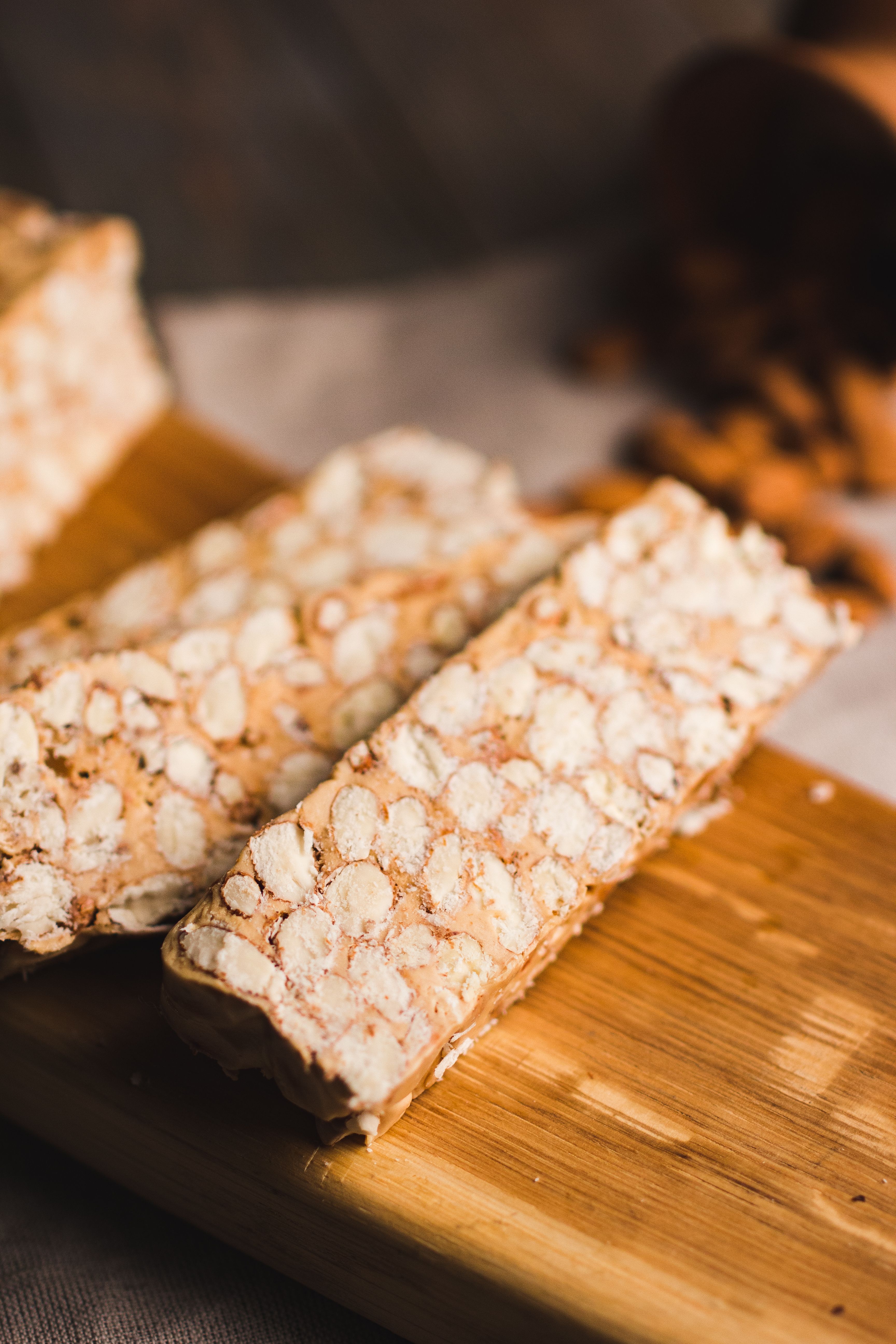
Photo: Vladimir Gladkov / Pexels
The diets react (see scores below)
Common Ingredients
- almonds
- honey
- sugar
- egg whites
- wafer paper
Specific recipes may vary.
Incompatible with 8 of 11 diets
Diet Ratings
Turron is a traditional Spanish confection that is fundamentally incompatible with a ketogenic diet. Its primary sweetening agents are honey and sugar — both are high-glycemic carbohydrates that immediately spike blood glucose and disrupt ketosis. A standard 30-40g serving of turron can contain 20-25g of net carbs almost entirely from these sugars, which alone can exceed or max out the entire daily keto carb budget. While almonds are keto-friendly on their own, they are overshadowed by the dominant sugar content. Wafer paper adds additional refined carbs. There is no meaningful way to consume turron in a portion that preserves ketosis.
Traditional Spanish turrón contains two clear animal-derived ingredients: honey (an insect-derived product excluded by virtually all major vegan organizations including the Vegan Society and PETA) and egg whites (a direct animal product). Both are unambiguous non-vegan ingredients, making this dish firmly off-limits for vegans. The almonds, sugar, and wafer paper are plant-based, but the presence of honey and egg whites overrides any partial compliance. Vegan versions of turrón can be made using agave or maple syrup in place of honey and aquafaba or other egg replacers instead of egg whites, but the traditional recipe as listed is not vegan-compatible.
Turron contains multiple paleo-incompatible ingredients. Refined sugar is explicitly excluded from the paleo diet as a processed, non-ancestral sweetener. Wafer paper is made from rice starch or potato starch — processed grain/starch-based ingredients that fall outside paleo guidelines. While almonds, honey, and egg whites are individually paleo-compatible, the dish as a whole is disqualified by the refined sugar and wafer paper. Even setting aside the wafer paper, the high refined sugar content alone would push this firmly into avoid territory. The dish is a heavily processed confection that contradicts both the ingredient rules and the philosophy of unprocessed, ancestral eating.
Turron is a traditional Spanish confection with deep Mediterranean roots, particularly in regions like Alicante and Jijona. Its almond base is a genuine Mediterranean strength—nuts are encouraged daily. However, the high sugar and honey content pushes it firmly into the 'added sugars' category that the Mediterranean diet advises minimizing. While honey is a more natural sweetener with some traditional Mediterranean use, the combination of honey plus added sugar makes this a high-sugar treat. The egg whites are a minor, acceptable ingredient. Turron is best understood as an occasional traditional treat rather than a regular snack, placing it in caution territory rather than outright avoidance due to its wholesome almond base and cultural authenticity.
Some Mediterranean diet practitioners note that traditional turron—especially the harder Alicante variety with minimal processing—has been part of Spanish Mediterranean culture for centuries, and its almond-dominant composition with natural honey could be seen as more acceptable than modern candy alternatives. However, stricter clinical interpretations of the Mediterranean diet would flag the added sugar content and recommend very infrequent consumption.
Turron is a Spanish confection made almost entirely of plant-derived and processed ingredients. Almonds are nuts (excluded from carnivore), honey and sugar are sweeteners (sugar is strictly excluded; honey is debated but moot here), wafer paper is a plant-based starch product, and the only animal-derived ingredient — egg whites — is a minor binder in a heavily plant-based, sugar-laden product. This dish has no meaningful animal protein, is dominated by nuts and refined sugar, and is incompatible with carnivore diet principles at any tier.
Turron contains added sugar, which is explicitly excluded on the Whole30. Honey is also considered an added sugar under Whole30 rules and is likewise excluded. Both of these ingredients are clear violations of the program's core rules. Even if sugar and honey were set aside, wafer paper is typically made from rice or wheat starch, which would introduce a grain-based ingredient. This dish fails on multiple counts and cannot be made compliant without fundamentally changing its nature.
Turron's primary FODMAP concern is honey, which is high in excess fructose and is a well-established high-FODMAP ingredient with no safe serving size during the elimination phase. Honey is listed by Monash University as high-FODMAP even in small amounts (1 teaspoon/7g is already rated red). Almonds are low-FODMAP at 10 nuts (12g) per Monash, but exceed safe thresholds at larger portions; in turron, almonds are typically consumed in significant quantities. Sugar (sucrose) is low-FODMAP, egg whites are low-FODMAP, and wafer paper (rice-based) is generally low-FODMAP. However, the honey content alone makes traditional turron incompatible with the elimination phase of the low-FODMAP diet regardless of portion size.
Monash University clearly rates honey as high-FODMAP, making this a relatively clear avoid. However, some clinical FODMAP practitioners note that certain commercial turron products may substitute honey with glucose syrup or invert sugar, which would change the FODMAP profile significantly — product-specific ingredient checking would be required. Additionally, the almond quantity per serving varies widely; small portions of turron might keep almond FODMAPs within safe limits, but the honey issue remains primary.
Turron is a Spanish confection made primarily from almonds, honey, sugar, and egg whites. The almonds are a DASH-friendly ingredient — nuts are explicitly encouraged in the DASH eating plan for their heart-healthy fats, magnesium, and potassium. However, turron is fundamentally a sweet candy: honey and sugar are the binding agents, making it high in added sugars. DASH guidelines limit sweets and added sugars to 5 or fewer servings per week (with small portion sizes), and turron would count as a sweets serving. It is low in sodium, which is a positive attribute. It contains no saturated fat or trans fat of concern. The net profile is a nut-based sweet — acceptable very occasionally in small portions within the DASH sweets allowance, but not a food to emphasize or consume freely.
NIH DASH guidelines clearly limit added sugars and sweets, placing turron firmly in the occasional-treat category. However, some DASH-oriented clinicians note that when almonds are the primary ingredient and the sugar content is moderate per serving, turron compares favorably to other candies — a small portion (1–2 pieces) could be considered a combined nuts-plus-sweets serving rather than pure empty calories, making it marginally more acceptable than sweets with no nutritional redeeming value.
Turron is a Spanish confection made primarily from almonds, honey, sugar, and egg whites. While almonds are a Zone-favorable monounsaturated fat source, the dominant macronutrient profile of turron is high-glycemic sugar and honey — pure simple carbohydrates with no fiber buffer and a very high glycemic load. There is no meaningful protein (egg whites are a trace component), and the fat from almonds is overwhelmed by the sugar content. This is fundamentally a candy/confection, making it nearly impossible to incorporate into a Zone-balanced meal without massive macro distortion. The 40/30/30 ratio cannot be approximated: carbs are excessive and high-glycemic, protein is negligible, and fat (while monounsaturated) is insufficient to counterbalance. Zone methodology explicitly flags foods high in sugar and honey as unfavorable due to their insulin-spiking potential and anti-inflammatory disruption. This is analogous to candy — one of the few categories Zone practitioners should genuinely avoid rather than merely portion-control.
Turrón is a traditional Spanish confection made primarily from almonds, honey, sugar, and egg whites. The almonds are a genuine anti-inflammatory asset — rich in vitamin E, monounsaturated fats, magnesium, and fiber, with a favorable omega-3/omega-6 profile compared to many nuts. Honey in small amounts has some antioxidant and antimicrobial properties, particularly in minimally processed forms. However, turrón as a whole is a high-sugar confection: the combination of honey and added sugar means this is primarily a sweet treat with significant glycemic load. Excess sugar drives inflammation through multiple pathways, including AGE (advanced glycation end-product) formation, elevated blood glucose, and increased CRP. The wafer paper (rice paper) is a neutral refined carbohydrate with no meaningful nutritional contribution. The egg whites are a lean protein source with minimal inflammatory impact. In summary, turrón is a borderline food: the almond base provides real anti-inflammatory value, but the dominant sugar content offsets this substantially. It is acceptable as an occasional treat but not a food to emphasize in an anti-inflammatory pattern.
Turrón is a traditional Spanish confection made primarily from almonds, honey, and sugar — making it essentially a high-sugar, calorie-dense candy with minimal nutritional value for GLP-1 patients. The dominant macronutrient profile is sugar and fat (from almonds), with negligible protein and no meaningful fiber relative to the caloric load. While almonds do contain some healthy unsaturated fats, in this format they are embedded in a high-sugar matrix that drives blood glucose spikes, provides empty calories, and offers none of the protein or fiber density that GLP-1 patients critically need. The high sugar content directly conflicts with Rule 8 (avoid high-sugar foods) and Rule 6 (nutrient density per calorie). The concentrated sweetness and fat combination may also worsen nausea and digestive discomfort given slowed gastric emptying on GLP-1 medications. With reduced appetite, every calorie consumed must deliver meaningful nutrition — turrón fails this standard almost entirely.
*See how scores were generated at our methodology page.
Nutritional profile
Six traits that cut across every diet.
Fiber & Plants
How much whole-plant food and fiber it delivers.
Healthy Fats
The quality of its fats (unsaturated, omega-3).
Whole / Unprocessed
How close it is to its natural, unprocessed form.
Gut Gentle
How easy it is on digestion (low FODMAP, few irritants).
Low Glycemic
How little it spikes your blood sugar.
Protein Density
How much protein it packs per calorie.
Controversy Index
Higher controversy = more disagreement between diets.
Diet-Specific Tips
 Mediterranean — 4/10
View tips
- High almond content supports Mediterranean nut intake
- Significant added sugar (both honey and refined sugar) contradicts Mediterranean principles
- Traditional Spanish Mediterranean food with cultural legitimacy
- Egg whites are a minor, acceptable ingredient
- Refined wafer paper is a minimally concerning processed element
- Best consumed as an occasional seasonal treat, not a daily snack
 DASH — 4/10
View tips
- Almonds are a DASH-approved nut source providing healthy fats, magnesium, and potassium
- High added sugar content from honey and sugar conflicts with DASH sweets limitation
- No sodium of concern — positive attribute for DASH compliance
- No saturated fat or tropical oils present
- Must be counted against the DASH sweets allowance (≤5 servings/week)
- Portion control is essential — small serving size mitigates sugar burden
 Anti-Inflammatory — 4/10
View tips
- Almonds are anti-inflammatory: rich in vitamin E, monounsaturated fat, fiber, and magnesium
- High added sugar content (honey + refined sugar) is pro-inflammatory and raises glycemic load
- Excess sugar promotes AGE formation and elevates CRP
- Honey has minor antioxidant value but acts largely as a sugar source in this context
- Wafer paper is a neutral refined starch with no anti-inflammatory benefit
- Overall profile is dominated by sugar, making this a 'caution' treat rather than a beneficial snack